Thomas Wolfe, page 1
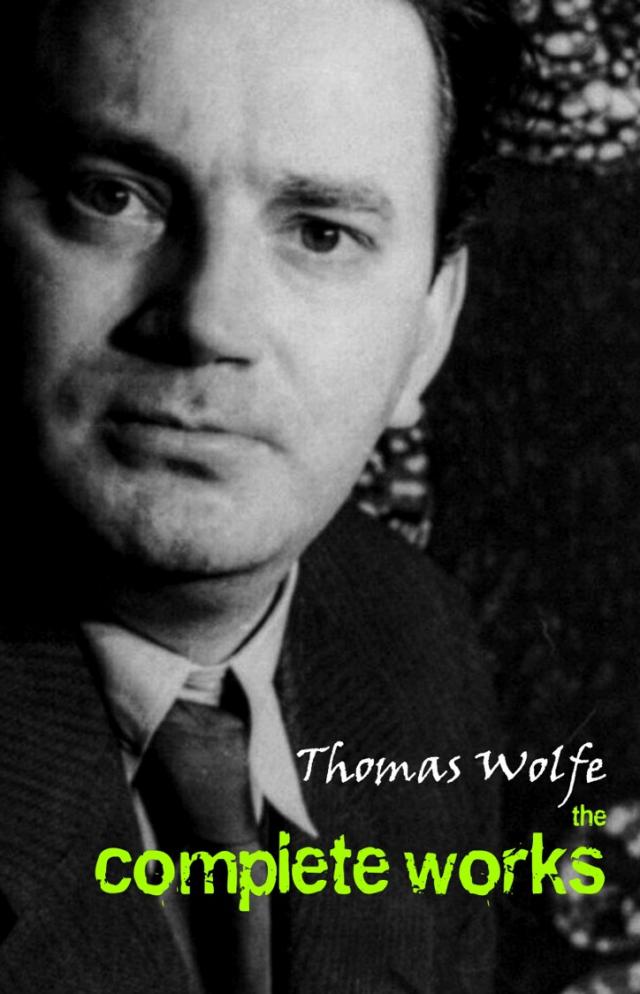


THE
COMPLETE
WORKS
OF
THOMAS
WOLFE
THOMAS WOLFE
NOVELS
Look Homeward, Angel (1929)
Of Time and the River (1935)
The Web and the Rock (1939)
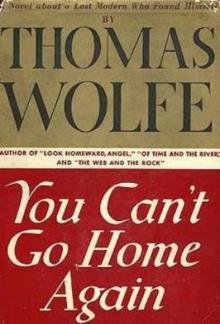
You Can’t Go Home Again (1940)
The Hills Beyond (1941, unfinished)
The Good Child’s River (1991, unfinished)
The Party at Jack’s (1995, unfinished)
STORIES
An Angel on the Porch (1929)
A Portrait of Bascom Hawke (1931)
The Web of Earth (1932)
The Train and the City (1932)
Death the Proud Brother (1933)
No Door (1933)
The Four Lost Men (1934)
Boom Town (1934)
The Sun and the Rain (1934)
The House of the Far and Lost (1934)
Dark in the Forest, Strange as Time (1934)
The Names of the Nation (1934)
For Professional Appearance (1935)
One of the Girls in Our Party (1935)
Circus at Dawn (1935)
His Father’s Earth (1935)
Old Catawba (1935, a.k.a. The Men of Old Catawba)
Arnold Pentland (1935, a.k.a. A Kinsman of his Blood)
The Face of the War (1935)
Gulliver (1935)
In the Park (1935)
Only the Dead Know Brooklyn (1935)
Polyphemus (1935)
The Far and the Near (1935, a.k.a. Cottage by the Tracks)
The Bums at Sunset (1935)
The Bell Remembered (1936)
Fame and the Poet (1936)
I Have a Thing to Tell You (1937)
Return (1937)
Mr. Malone (1937)
Oktoberfest (1937)
’E, A Recollection (1937)
April, Late April (1937)
The Child by Tiger (1937)
Katamoto (1937)
The Lost Boy (1937)
Chickamauga (1938)
The Company (1938)
A Prologue to America (1938)
Portrait of a Literary Critic (1939)
The Party at Jack’s (1939)
The Birthday (1939)
A Note on Experts: Dexter Vespasian Joyner (1939)
Three O’Clock (1939)
The Winter of Our Discontent (1939)
The Dark Messiah (1940)
The Hollyhock Sowers (1940)
Nebraska Crane (1940)
So This Is Man (1940)
The Promise of America (1940)
The Hollow Men (1940)
The Anatomy of Loneliness (1941, a.k.a. God's Lonely Man)
The Lion at Morning (1941)
The Plumed Knight (1941)
The Newspaper (1941, a.k.a. Gentlemen of the Press)
No Cure for It (1941)
On Leprechauns (1941)
The Return of the Prodigal (1941)
Old Man Rivers (1947)
Justice Is Blind (1953)
No More Rivers (1983)
The Spanish Letter (1987)
PLAYS
The Mountains (1970)
Mannerhouse (1985)
COLLEGE WRITINGS
A Field in Flanders (1917)
To France (1917)
The Challenge (1918)
A Cullenden of Virginia (1918)
To Rupert Brooke (1918)
The Drammer (1919)
An Appreciation (1919)
The Creative Movement in Writing (1919)
Deferred Payment (1919)
Russian Folk Song (1919)
The Streets of Durham (1919)
The Crisis in Industry (1919)
Concerning Honest Bob (1920)
1920 Says a Few Words to Carolina (1920)
The Return of Buck Gavin (1924)
The Third Night (1938)
A Previously Unpublished Statement by Thomas Wolfe (1960)
The Man Who Lives with His Idea (1943)
Attributions:
Tar Heels Despite Defeat of Last Week Await Virginians (1919)
Ye Who Have Been There Only Know (1919)
Useful Advice to Candidates (1920)
The Bibiograph (1920)
OTHER TEXTS
The Story of a Novel (1935)
A Western Journey (1939)
Something of My Life (1948)
NOVELS
thomas wolfe
LOOK HOMEWARD, ANGEL
A Story of the Buried Life
Charles Scribner’s Sons, 1929
[The text follows the 1957 Charles Scribner’s Sons edition.]
LOOK HOMEWARD, ANGEL
[¬]
To the Reader
PART ONE
1 · 2 · 3 · 4 · 5 · 6 · 7 · 8 · 9 · 10 · 11 · 12 · 13
PART TWO
14 · 15 · 16 · 17 · 18 · 19 · 20 · 21 · 22 · 23 · 24 · 25 · 26 · 27
PART THREE
28 · 29 · 30 · 31 · 32 · 33 · 34 · 35 · 36 · 37 · 38 · 39 · 40
TO A. B.
“Then, as all my soules bee,
Emparadis’d in you, (in whom alone
I understand, and grow and see,)
The rafters of my body, bone
Being still with you, the Muscle, Sinew, and Veine,
Which tile this house, will come againe.”
[¬]
TO THE READER
This is a first book, and in it the author has written of experience which is now far and lost, but which was once part of the fabric of his life. If any reader, therefore, should say that the book is “autobiographical” the writer has no answer for him: it seems to him that all serious work in fiction is autobiographical—that, for instance, a more autobiographical work than “Gulliver’s Travels” cannot easily be imagined.
This note, however, is addressed principally to those persons whom the writer may have known in the period covered by these pages. To these persons, he would say what he believes they understand already: that this book was written in innocence and nakedness of spirit, and that the writer’s main concern was to give fulness, life, and intensity to the actions and people in the book he was creating. Now that it is to be published, he would insist that this book is a fiction, and that he meditated no man’s portrait here.
But we are the sum of all the moments of our lives—all that is ours is in them: we cannot escape or conceal it. If the writer has used the clay of life to make his book, he has only used what all men must, what none can keep from using. Fiction is not fact, but fiction is fact selected and understood, fiction is fact arranged and charged with purpose. Dr. Johnson remarked that a man would turn over half a library to make a single book: in the same way, a novelist may turn over half the people in a town to make a single figure in his novel. This is not the whole method but the writer believes it illustrates the whole method in a book that is written from a middle distance and is without rancour or bitter intention.
[¬]
PART ONE
. . . a stone, a leaf, an unfound door; of a stone, a leaf, a door. And of all the forgotten faces.
Naked and alone we came into exile. In her dark womb we did not know our mother’s face; from the prison of her flesh have we come into the unspeakable and incommunicable prison of this earth.
Which of us has known his brother? Which of us has looked into his father’s heart? Which of us has not remained forever prison-pent? Which of us is not forever a stranger and alone?
O waste of loss, in the hot mazes, lost, among bright stars on this most weary unbright cinder, lost! Remembering speechlessly we seek the great forgotten language, the lost lane-end into heaven, a stone, a leaf, an unfound door. Where? When?
O lost, and by the wind grieved, ghost, come back again.
[¬]
1
A destiny that leads the English to the Dutch is strange enough; but one that leads from Epsom into Pennsylvania, and thence into the hills that shut in Altamont over the proud coral cry of the cock, and the soft stone smile of an angel, is touched by that dark miracle of chance which makes new magic in a dusty world.
Each of us is all the sums he has not counted: subtract us into nakedness and night again, and you shall see begin in Crete four thousand years ago the love that ended yesterday in Texas.
The seed of our destruction will blossom in the desert, the alexin of our cure grows by a mountain rock, and our lives are haunted by a Georgia slattern, because a London cutpurse went unhung. Each moment is the fruit of forty thousand years. The minute-winning days, like flies, buzz home to death, and every moment is a window on all time.
This is a moment:
An Englishman named Gilbert Gaunt, which he later changed to Gant (a concession probably to Yankee phonetics), having come to Baltimore from Bristol in 1837 on a sailing vessel, soon let the profits of a public house which he had purchased roll down his improvident gullet. He wandered westward into Pennsylvania, eking out a dangerous living by matching fighting cocks against the champions of country barnyards, and often escaping after a night spent in a village jail, with his champion dead on the field of battle, without the clink of a coin in his pocket, and sometimes with the print of a farmer’s big knuckles on his reckless face. But he always escaped, and coming at length among the Dutch at harvest time he was so touched by the plenty of their land that he cast out his anchors there. Within a year he married a rugged young widow with a tidy farm who like all the other Dutch had been charmed by his air of travel, and his grandiose speech, particularly when he did Hamlet in the manner of the great Edmund Kean. Every one said he should have been an actor.
The Englishman begot children—a daughter and four sons—lived easily and carelessly, and bore patiently the weight of his wife’s harsh but honest tongue. The years passed, his bright somewhat staring eyes grew dull and bagged, the tall Englishman walked with a gouty shuffle: one morning when she came to nag him out of sleep she found him dead of an apoplexy. He left five children, a mortgage and—in his strange darks eyes which now stared bright and open—something that had not died: a passionate and obscure hunger for voyages.
So, with this legacy, we leave this Englishman and are concerned hereafter with the heir to whom he bequeathed it, his second son, a boy named Oliver. How this boy stood by the roadside near his mother’s farm, and saw the dusty Rebels march past on their way to Gettysburg, how his cold eyes darkened when he heard the great name of Virginia, and how the year the war had ended, when he was still fifteen, he had walked along a street in Baltimore, and seen within a little shop smooth granite slabs of death, carved lambs and cherubim, and an angel poised upon cold phthisic feet, with a smile of soft stone idiocy—this is a longer tale. But I know that his cold and shallow eyes had darkened with the obscure and passionate hunger that had lived in a dead man’s eyes, and that had led from Fenchurch Street past Philadelphia. As the boy looked at the big angel with the carved stipe of lilystalk, a cold and nameless excitement possessed him. The long fingers of his big hands closed. He felt that he wanted, more than anything in the world, to carve delicately with a chisel. He wanted to wreak something dark and unspeakable in him into cold stone. He wanted to carve an angel’s head.
Oliver entered the shop and asked a big bearded man with a wooden mallet for a job. He became the stone cutter’s apprentice. He worked in that dusty yard five years. He became a stone cutter. When his apprenticeship was over he had become a man.
He never found it. He never learned to carve an angel’s head. The dove, the lamb, the smooth joined marble hands of death, and letters fair and fine—but not the angel. And of all the years of waste and loss—the riotous years in Baltimore, of work and savage drunkenness, and the theatre of Booth and Salvini, which had a disastrous effect upon the stone cutter, who memorized each accent of the noble rant, and strode muttering through the streets, with rapid gestures of the enormous talking hands—these are blind steps and gropings of our exile, the painting of our hunger as, remembering speechlessly, we seek the great forgotten language, the lost lane-end into heaven, a stone, a leaf, a door. Where? When?
He never found it, and he reeled down across the continent into the Reconstruction South—a strange wild form of six feet four with cold uneasy eyes, a great blade of nose, and a rolling tide of rhetoric, a preposterous and comic invective, as formalized as classical epithet, which he used seriously, but with a faint uneasy grin around the corners of his thin wailing mouth.
He set up business in Sydney, the little capital city of one of the middle Southern states, lived soberly and industriously under the attentive eye of a folk still raw with defeat and hostility, and finally, his good name founded and admission won, he married a gaunt tubercular spinstress, ten years his elder, but with a nest egg and an unshakable will to matrimony. Within eighteen months he was a howling maniac again, his little business went smash while his foot stayed on the polished rail, and Cynthia, his wife—whose life, the natives said, he had not helped to prolong—died suddenly one night after a hemorrhage.
So, all was gone again—Cynthia, the shop, the hard-bought praise of soberness, the angel’s head—he walked through the streets at dark, yelling his pentameter curse at Rebel ways, and all their indolence; but sick with fear and loss and penitence, he wilted under the town’s reproving stare, becoming convinced, as the flesh wasted on his own gaunt frame, that Cynthia’s scourge was doing vengeance now on him.
He was only past thirty, but he looked much older. His face was yellow and sunken; the waxen blade of his nose looked like a beak. He had long brown mustaches that hung straight down mournfully.
His tremendous bouts of drinking had wrecked his health. He was thin as a rail and had a cough. He thought of Cynthia now, in the lonely and hostile town, and he became afraid. He thought he had tuberculosis and that he was going to die.
So, alone and lost again, having found neither order nor establishment in the world, and with the earth cut away from his feet, Oliver resumed his aimless drift along the continent. He turned westward toward the great fortress of the hills, knowing that behind them his evil fame would not be known, and hoping that he might find in them isolation, a new life, and recovered health.
The eyes of the gaunt spectre darkened again, as they had in his youth.
All day, under a wet gray sky of October, Oliver rode westward across the mighty state. As he stared mournfully out the window at the great raw land so sparsely tilled by the futile and occasional little farms, which seemed to have made only little grubbing patches in the wilderness, his heart went cold and leaden in him. He thought of the great barns of Pennsylvania, the ripe bending of golden grain, the plenty, the order, the clean thrift of the people. And he thought of how he had set out to get order and position for himself, and of the rioting confusion of his life, the blot and blur of years, and the red waste of his youth.
By God! he thought. I’m getting old! Why here?
The grisly parade of the spectre years trooped through his brain. Suddenly, he saw that his life had been channelled by a series of accidents: a mad Rebel singing of Armageddon, the sound of a bugle on the road, the mule-hoofs of the army, the silly white face of an angel in a dusty shop, a slut’s pert wiggle of her hams as she passed by. He had reeled out of warmth and plenty into this barren land: as he stared out the window and saw the fallow unworked earth, the great raw lift of the Piedmont, the muddy red clay roads, and the slattern people gaping at the stations—a lean farmer gangling above his reins, a dawdling negro, a gap-toothed yokel, a hard sallow woman with a grimy baby—the strangeness of destiny stabbed him with fear. How came he here from the clean Dutch thrift of his youth into this vast lost earth of rickets?
The train rattled on over the reeking earth. Rain fell steadily. A brake-man came draftily into the dirty plush coach and emptied a scuttle of coal into the big stove at the end. High empty laughter shook a group of yokels sprawled on two turned seats. The bell tolled mournfully above the clacking wheels. There was a droning interminable wait at a junction-town near the foot-hills. Then the train moved on again across the vast rolling earth.
Dusk came. The huge bulk of the hills was foggily emergent. Small smoky lights went up in the hillside shacks. The train crawled dizzily across high trestles spanning ghostly hawsers of water. Far up, far down, plumed with wisps of smoke, toy cabins stuck to bank and gulch and hillside. The train toiled sinuously up among gouged red cuts with slow labor. As darkness came, Oliver descended at the little town of Old Stockade where the rails ended. The last great wall of the hills lay stark above him. As he left the dreary little station and stared into the greasy lamplight of a country store, Oliver felt that he was crawling, like a great beast, into the circle of those enormous hills to die.
The next morning he resumed his journey by coach. His destination was the little town of Altamont, twenty-four miles away beyond the rim of the great outer wall of the hills. As the horses strained slowly up the mountain road Oliver’s spirit lifted a little. It was a gray-golden day in late October, bright and windy. There was a sharp bite and sparkle in the mountain air: the range soared above him, close, immense, clean, and barren. The trees rose gaunt and stark: they were almost leafless. The sky was full of windy white rags of cloud; a thick blade of mist washed slowly around the rampart of a mountain.
Below him a mountain stream foamed down its rocky bed, and he could see little dots of men laying the track that would coil across the hill toward Altamont. Then the sweating team lipped the gulch of the mountain, and, among soaring and lordly ranges that melted away in purple mist, they began the slow descent toward the high plateau on which the town of Altamont was built.
In the haunting eternity of these mountains, rimmed in their enormous cup, he found sprawled out on its hundred hills and hollows a town of four thousand people.