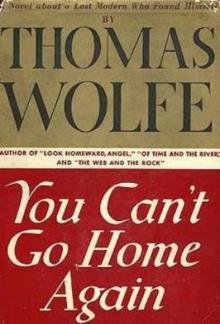
Thomas Wolfe, page 148



Sometimes it was just a word, the intonation of a phrase—the way they would say “very” or “American,” which chilled and withered all the ardours of the heart, or the way they would say “Thank you!” when you paid for something, crisply, courteously, yet with a quick, cautious, and obdurate finality, as if some one had swiftly and firmly closed a door lest you should try to enter it. Eugene could listen to them talk and hear all the words, the moods and tones of life and humor that he had known all his life, until it seemed that he could foresee the very stories they were going to tell, the very situations they were going to describe—and then in an instant all the familiar pattern of their speech would vanish, and their words could not have been stranger to him had they spoken in a foreign tongue.
Thus, as Eugene looked at the young college fellows playing in the fields below the house, their shouts and cries, the boyish roughness of their play, their strong scurfed knees, and panting breath, evoked the image of a life so familiar to him that he felt all he had to do to enter it again was to walk across the velvet width of lawn that separated him from it. But if he passed these same people two hours later in the High Street, their lives, their words were stranger than a dream, or they seemed to have an incredible fictitious quality that made everything they did or said seem false, mannered, and affected, so that when he listened to them he had a feeling of resentment and contempt for them, as if they spoke and moved with the palpable falseness of actors.
Eugene would see two young fellows before a college gate, and one, fragile of structure, with a small lean head, a sheaf of straight blonde hair and thin, sensitive features which were yet sharply and strongly marked, would be talking to another youth, his hands thrust jauntily into the pockets of his baggy gray trousers as he talked and the worn elegance of his baggy coat falling across his hands in folds of jaunty well-worn smartness.
“I say!” the youth would be saying in his crisp, rapid, sharply blurred inflections that seemed to come out of lips that barely moved. “Where were you last night? We missed you at the party in old Lambert’s rooms, you know. Every one wondered why you didn’t turn up.”
“Oh,” the other said (but the way he said this word sounded almost like “Ow” to Eugene). “Did they? I’m frightfully sorry to have missed it, but I simply couldn’t get thöh. Had dinner with a chap I know at Magdalen. His sister’s down for a day or so, and later on I simply couldn’t break away.—How was the party?”
“Ow!” the other cried, casting his head back with a strong quick movement and an exultant little laugh. “Ripping! Simply ripping! What a shame you had to miss it! Old Fenton got quite squiffed along towards ten o’clock,” he went on affectionately and with his exultant little laugh, “and really it was priceless! He insisted on doing an imitation of Queen Victoria sitting down to read The Times upon her w. c. just after modern plumbing was installed—Ow!” he cried exultantly again, casting his head up with a sharp strong movement, “the whole thing was convulsing!—To see old Fenton settle down!” he cried, “to see him look around suspiciously,” he whispered, still maintaining the perfect dramatic sharpness of his inflection as he looked around with a descriptive gesture, “to see him wait uneasily to see what’s going to happen—finally to see the look of blissful satisfaction and contentment gradually stealing over his face,” he whispered rapturously, “as he settles back to read The Times in peace—ow!” he cried again, as he cast back his small lean head with an exultant laugh, “—the whole thing was really too superb!—it really was, you know! Old Lambert was quite convulsed! We had to lift him up and stretch him out upon the bed before he got his breath again.”
In conversations such as these, in the choice and accent of the words, the sharp crisp and yet blurred inflections of the speech, even in the jaunty nonchalance of hands in pockets, the hang and fold of the coat, in the exultant little laugh and the sharp strong upward movement of the small lean head, there was something alien, suave, and old. To Eugene it seemed to be the style of a life that was far older, more suavely knowing and mature, than any he had ever known, so that at such a time as this, these young boys who on the playing fields had almost the appearance of tousled overgrown urchins, now seemed far more assured and sophisticated than he could ever be.
At the same time, the sound and inflection of their words—their assured exercise of a style of language that knew exactly where to use and how to inflect such words as “very,” “quite,” “superb,” “priceless,” “terribly,” “marvellous,” and so on—this style and use seemed to Eugene almost false, fictional, affected, and theatrical.
He felt this way chiefly because he had read about such people all his life in books and for the most part had heard them speak in this manner only in smart plays upon the stage. He was always connecting these young Englishmen with actors in the theatre, and for a moment his mind would resentfully accuse them of being nothing but cheap and affected actors themselves and, bitterly, of “trying to talk with an English accent”—a phrase which obviously had no meaning, since they were only speaking their own language in the way they had been taught to speak it.
But then, at tea-time, Eugene would see these youths again in Buol’s, flirting, with the clumsy naïveté of a grubby schoolboy, with a leering rawboned hag of a waitress, and obviously getting the thrill of their lives from the spurious grins which this dilapidated strumpet flashed at them through her artificial teeth. Or, as he went up the road towards his house at night, he would pass them standing in the dark shadows of the stormy trees, with their arms clumsily clasped around the buttocks of a servant girl, and their lives seemed unbelievably young, naked, and innocent again.
Around Eugene was the whole structure of an enchanted life—a life hauntingly familiar and just the way he had always known it would be—and now that he was there, he had no way of getting into it. The inn itself was ancient, legendary, beautiful, elfin, like all the inns he had ever read about, and yet all of the cheer, the warmth, the joy and comfort he had dreamed of finding in an inn was lacking.
Upstairs the halls went crazily up and down at different levels, one mounted steps, went down again, got lost and turned around in the bewildering design of the ancient added-on-to structure—and this was the way he had always known it would be. But the rooms were small, cold, dark, and dreary, the lights were dim and dismal, you stayed out of your room as much as possible and when you went to bed at night you crawled in trembling between clammy sheets, and huddled there until the bed was warm. When you got up in the morning there was a small jug of warm water at your door with which to shave, but the jug was too small, you poured it out into the bowl and shaved yourself and added cold water from the pitcher then in order to get enough to wash your face and hands. Then you got out of the room and went downstairs as quickly as you could.
Downstairs it would be fine. There would be a brisk fire crackling in the hearth, the old smoke-gold of morning and the smell of fog, the crisp cheerful voices of the people and their ruddy competent morning look, and the cheerful smells of breakfast, which was always liberal and good, the best meal that they had: kidneys and ham and eggs and sausages and toast and marmalade and tea.
But at night there would come the huge boiled-flannel splendor of the dinner, the magnificent and prayerful service of the waiter, who served you with such reverent grace from heavy silver platters that you felt the food must be as good as everything looked. But it never was.
Eugene ate at a large table, in the centre of the dining-room, provided by a thoughtful management for such isolated waifs and strays as himself. The food looked very good, and was, according to the genius of the nation, tasteless. How they ever did it he could never tell: everything was of the highest quality and you chewed upon it mournfully, wearily, swallowing it with the dreary patience of a man who has been condemned forever to an exclusive diet of boiled unseasoned spinach. There was a kind of evil sorcery, a desolate and fathomless mystery in the way they could take the choicest meats and vegetables and extract all the succulence and native flavor from them, and then serve them up to you magnificently with every atom of their former life reduced to the general character of stewed hay or well-boiled flannel.
There would be a thick heavy soup of dark mahogany, a piece of boiled fish covered with a nameless, tasteless sauce of glutinous white, roast beef that had been done to death in dish-water, and solid, perfect, lovely brussels sprouts for whose taste there was no name whatever. It might have been the taste of boiled wet ashes, or the taste of stewed green leaves, with all the bitterness left out, pressed almost dry of moisture, or simply the taste of boiled clouds and rain and fog. For dessert, there would be a pudding of some quivery yellow substance, beautifully moulded, which was surrounded by a thin sweetish fluid of a sticky pink. And at the end there would be a cup of black, bitter, liquid mud.
Eugene felt as if these dreary ghosts of food would also come to life at any moment, if he could only do some single simple thing—make the gesture of an incantation, or say a prayer, or speak a magic word, a word he almost had, but couldn’t quite remember.
The food plagued his soul with misery, bitter disappointment, and bewilderment. For Eugene liked to eat, and they had written about food better than any one on earth. Since his childhood, there had burned in his mind a memory of the food they wrote about. It was a memory drawn from a thousand books (of which Quentin Durward, curiously, was one), but most of all it came from that tremendous scene in Tom Brown at Rugby, which described the boy’s ride with his father through the frosty darkness, in an English stage-coach, the pause for breakfast at an inn, and the appearance of the host, jolly, red-faced, hospitable, who had rushed out to welcome them.
Eugene could remember with a gluttonous delight the breakfast which that hungry boy had devoured. It was a memory so touched with the magic relish of frost and darkness, smoking horses, the thrill, the ecstasy of the journey and a great adventure, the cheer, the warmth, the bustle of the inn, and the delicious abundance of the food they gave the boy, that the whole thing was evoked with blazing vividness, and now it would almost drive Eugene mad with hunger when he thought of it.
Now it seemed to him that these people had written so magnificently about good food not because they always had it, but because they had it rarely and therefore made great dreams and fantasies about it, and it seemed to him that this same quality—the quality of lack rather than of possession, of desire rather than fulfilment—had got into everything they did, and made them dream great dreams, and do heroic acts, and had enriched their lives immeasurably.
They had been the greatest poets in the world because the love and substance of great poetry were so rare among them. Their poems were so full of the essential quality of sunlight because their lives had known sunlight briefly, and so shot through with the massy substance of essential gold (a matchless triumph of light and color and material, in which they have beaten the whole world by every standard of comparison) because their lives had known so much fog and rain, so little gold. And they had spoken best of April because April was so brief with them.
Thus from the grim gray of their skies they had alchemied gold, and from their hunger, glorious food, and from the raw bleakness of their lives and weathers they had drawn magic. And what was good among them had been won sternly, sparely, bitterly, from all that was ugly, dull, and painful in their lives, and, when it came, was more rare and beautiful than anything on earth.
But that also was theirs: it was another door Eugene could not enter.
[¬]
LXIX
Later, Eugene could remember everything except the way he found the house and came to live there. But a man named Morison, who was staying at the Mitre when Eugene got there, found the house and gave him the address. He was a man of twenty-eight or thirty years, but he constantly seemed younger, much younger, no older than the average college youth, an illusion that was never permanent, however, and never for a moment convincing, because one felt constantly that everything about the man was spurious.
He had been, he said, a lieutenant in the flying corps, and had just the month before resigned his commission. And he said he had resigned his commission because he had received an appointment from the government in the African colonial service, and had been sent up to the university to take a special six months’ course in Colonial Administration, after which he would be “sent out” to assume his new duties in the Colonies. Finally, he was, he said, by birth, an Edinburgh Scotchman, although his family were by blood more English than Scotch, and he had lived most of his life in England. His references to his family were casual, easy, and indefinite, but carried with them, somehow, the connotations of aristocratic distinction.
He referred to his father often, but always in this casual and easy manner, as “the governor,” and to his mother as “the mater,” flinging in parenthetically with his easy nonchalance such a statement as “of course, my whole crowd came from Devonshire”—a statement which was unadorned and meaningless enough but that somehow—God knows how—carried with it a wonderful evocation of an ancestral seat, an ancient and distinguished name, the quiet but impregnable position of one of the “old county families.”
And yet, God knows how he did it: the man said nothing about his people that might not be said of any modest little family, and probably everything he said was true. He made no open pretenses to great name or wealth or ancient lineage, but in these swift, casual, half-blurted-out references to “the governor,” “the mater,” and so on, he projected perfectly a legend of prestige and family that was most engaging in its sense of style and dash and recklessness.
The design of this legend was perfectly familiar to every one: Eugene had read it a thousand times in the pages of books, but he had never known any one who could evoke it so perfectly, so tellingly, and with such a non-committal economy of means, as Morison. In this casual, charming, almost nakedly simple picture of his life which he could suggest in a blurted-out phrase without giving a shred of real information about himself, or making a single admission of fact, the characters were few in number, their lineaments broadly and forcibly outlined, and their setting a familiar one.
In this setting, Morison himself played the part of the dashing young aristocrat, wild, reckless, and impetuous, always ready for fun, fight, or frolic, a bottle of Scotch, or a pretty woman, a roaring drunk, or a hot seduction—a mad hare-brained sort of fellow who plunged impetuously forward into everything, but who was somehow always saved from the odium that attaches itself to a baser sort of drunkard, brawler, or seducer, because he had in him those mysterious qualities of blood and character that made of him “a gentleman,” and therefore gave his acts a faultless style, a whole immunity.
And the figure that he stroked in of his father was also a pleasant one. For “the governor,” although he existed chiefly for the purpose of admonishment and reproof, as a curb upon the wild spirits of his son, was neither a sour Puritan, nor a grim-visaged household tyrant, but really a very good and understanding sort of fellow, and, within reasonable limits, as tolerant as any one could ask. The old boy, in fact, had been “a bit of a buck himself” in his younger days, and had seen his share of the flesh and the devil, and was quite willing to make allowances for the wilder escapades of youth, so long as a reasonable decorum and moderation were observed.
But there, alas, was the rub—as Morison himself would ruefully admit. He was himself such a mad, scape-grace sort of fellow that his acts sometimes passed all the bounds of decorum and propriety, and for that reason “the governor” was always “having him in upon the carpet.”
There, in fact, was the whole setting. The governor existed for the sole purpose of “having him in upon the carpet”—one never saw them in any other way, but when Morison spoke about it one saw them in this way with blazing vividness. And this picture—the picture of Morison going in “upon the carpet”—was a very splendid one.
First, one saw Morison pacing nervously up and down in a noble and ancient hall, puffing distractedly on a cigarette and pausing from time to time in an apprehensive manner before the grim, closed barrier of an enormous seventeenth-century door which was tall and wide enough for a knight in armor to ride through without difficulty, and before whose gloomy and overwhelming front Morison looked very small and full of guilt. Then, one saw him take a last puff at his cigarette, brace his shoulders in a determined manner, knock on the panels of the mighty door, and in answer to a low growl within, open the door and advance desperately into the shadowed depths of a room so immense and magnificent that Morison looked like a single little sinner walking forlornly down the nave of a cathedral.
At the end of this terrific room, across an enormous space of carpet, sat “the governor.” He was sitting behind a magnificent flat desk of ancient carved mahogany, in the vast shadowed depths behind him storied rows of old bound volumes climbed dizzily up into the upper darkness and were lost. And men in armor were standing grimly all around, and the portraits of the ancestors shone faintly in the gloom, and the old worn mellow colors of the tempered light came softly through the colored glass of narrow Gothic windows which were set far away in recessed depths of the impregnable mortared walls.
Meanwhile, “the governor” was waiting in grim silence as Morison advanced across the carpet. The governor was a man with beetling bushy eyebrows, silver hair, the lean, bitten and incisive face, the cropped mustache of a man who has seen service in old wars, and commanded garrisons in India, and after clearing his throat with a low menacing growl, he would peer fiercely out at Morison beneath his bushy brows, and say: “Well, young man?”—to which Morison would be able to make no answer, but would just stand there in a state of guilty dejection.
And the talk that then passed between the outraged father and the prodigal son was, from Morison’s own account, astonishing. It was a talk that was no talk, a talk that was almost incoherent but that each understood perfectly, another language, not merely an economy of words so spare that one word was made to do the work of a hundred, but a series of grunts, blurts, oaths and ejaculations, in which almost nothing was said that was recognizable as ordered thought, but in which the meaning of everything was perfectly conveyed.