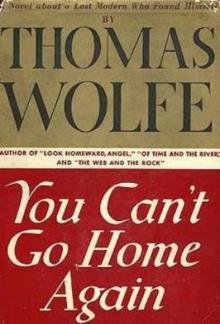
Thomas Wolfe, page 511



“And—you mean you’ll be satisfied?”
“Huh? Satisfied?” Nebraska turned to him with a puzzled look. “How do you mean?”
“I mean after all you’ve seen and done, Bras—the big cities and the crowds, and all the people shouting—and the newspapers, and the headlines, and the World Series—and—and—the first of March, and St. Petersburg, and meeting all the fellows again, and spring training—”
Nebraska groaned.
“Why, what’s the matter?”
“Spring trainin’.”
“You mean you don’t like it?”
“Like it! Them first three weeks is just plain hell. It ain’t bad when you’re a kid. You don’t put on much weight durin’ the winter, an’ when you come down in the spring, it only takes a few days to loosen up an’ git the kinks out. In two weeks you’re loose as ashes. But wait till you been aroun’ as long as I have!” He laughed loudly and shook his head. “Boy! The first time you go after a grounder, you can hear your joints creak. After a while you begin to limber up—you work into it an’ git the soreness out of your muscles. By the time the season starts, along in April, you feel pretty good. By May you’re goin’ like a house a-fire, an’ you tell yourself you’re as good as you ever was. You’re still goin’ strong along in June. An’ then you hit July, an’ you git them double-headers in St. Looie! Boy, oh boy!” Again he shook his head and laughed, baring big square teeth. “Monkus,” he said quietly, turning to his companion, and now his face was serious, and he had his black Indian look—“you ever been in St. Looie in July?”
“No.”
“All right, then,” he said very softly and scornfully. “An’ you ain’t played ball there in July. You come up to bat with sweat bustin’ from your ears. You step up an’ look out to where the pitcher ought to be, an’ you see four of him. The crowd in the bleachers is out there roastin’ in their shirt-sleeves, an’ when the pitcher throws the ball, it just comes from nowheres—it comes right out of all them shirt-sleeves in the bleachers. It’s on top of you before you know it. Well, anyway, you dig in an’ git a toe-hold, take your cut, an’ maybe you connect. You straighten out a fast one. It’s good fer two bases if you hustle. In the old days you could’ve made it standin’ up. But now—boy!” He shook his head slowly. “You cain’t tell me nothin’ about that ball park in St. Looie in July! They got it all growed out in grass in April, but after July first”—he gave a short laugh—“hell! it’s paved with concrete! An’ when you git to first, them dogs is sayin’, ‘Boy, let’s stay here!’ But you gotta keep on goin’—you know the manager is watchin’ you—you’re gonna ketch hell if you don’t take that extra base, it may mean the game. An’ the boys up in the press box, they got their eyes glued on you, too—they’ve begun to say old Crane is playin’ on a dime—an’ you’re thinkin’ about next year an’ maybe gittin’ another Series—an’ hope to God you don’t git traded to St. Looie. So you take it on the lam, you slide into second like the Twentieth Century comin’ into the Chicago yards—an’ when you git up an’ feel yourself all over to see if any of your parts is missin’, you gotta listen to one of the second baseman’s wisecracks: ‘What’s the hurry, Bras? Afraid you’ll be late fer the Veterans’ Reunion?’”
“I begin to see what you mean, all right,” said George.
“See what I mean? Why, say! One day this season I ast one of the boys what month it was, an’ when he told me it was just the middle of July, I says to him: ‘July, hell! If it ain’t September, I’ll eat your hat!’ ‘Go ahead, then,’ he says, ‘an’ eat it, because it ain’t September, Bras—it’s July.’ ‘Well,’ I says, ‘they must be havin’ sixty days a month this year—it’s the longest damn July I ever felt!’ An’ lemme tell you, I didn’t miss it fer, either—I’ll be dogged if I did! When you git old in this business, it may be only July, but you think it’s September.” He was silent for a moment. “But they’ll keep you in there, gener’ly, as long as you can hit. If you can smack that ole apple, they’ll send you out there if they’ve got to use glue to keep you from failin’ apart. So maybe I’ll git in another year or two if I’m lucky. So long’s I can hit ’em, maybe they’ll keep sendin’ me out there till all the other players has to grunt every time ole Bras goes after a ground ball!” He laughed. “I ain’t that bad yet, but soon’s I am, I’m through.”
“You won’t mind it, then, when you have to quit?”
He didn’t answer at once. He sat there looking out the window. Then he laughed a little wearily:
“Boy, this may be a ride on the train to you, but to me—say!—I covered this stretch so often that I can tell you what telephone post we’re passin’ without even lookin’ out the window. Why, hell yes!”—he laughed loudly now, in the old infectious way—“I used to have ’em numbered—now I got ’em named!”
“And you think you can get used to spending all your time out on the farm in Zebulon?
“Git used to it?” In Nebraska’s voice there was now the same note of scornful protest that it had when he was a boy, and for a moment he turned and looked at his friend with an expression of astonished disgust. “Why, what are you talking about? That’s the greatest life in the world!”
“And your father? How is he, Bras?”
The player grinned and shook his head: “Oh, the Ole Man’s happy as a possum. He’s doin’ what he wanted to do all his life.”
“And is he well?”
“If he felt any better, he’d have to go to bed. Strong as a bull,” said Nebraska proudly. “He could wrastle a bear right now an’ bite his nose off! Why, hell yes!” the player went on with an air of conviction—“he could take any two men I know today an’ throw them over his shoulder!”
“Bras, do you remember when you and I were kids and your father was on the police force, how he used to wrestle all those professionals that came to town? There were some good ones, too!”
“You’re damn right there was!” said the player, nodding his head. “Tom Anderson, who used to be South Atlantic champion, an’ that fellah Petersen—do you remember him?”
“Sure. And that big fellow they called the Strangler Turk—”
“Yeah, an’ he was good, too! Only he wasn’t no Turk—he only called hisself one. The Ole Man told me he was some kind of Polack from the steel mills, an’ that’s how he got so strong.”
“And Bull Dakota—and Texas Jim Ryan—and the Masked Marvel?”
“Yeah—only there was a whole lot of them—guys cruisin’ all over the country callin’ theirselves the Masked Marvel. The Ole Man wrastled two of ’em. Only the real Masked Marvel never came to town. The Ole Man told me there was a real Masked Marvel, but he was too damn good, I guess, to come to Libya Hill.”
“Do you remember the night, Bras, when your father was wrestling one of these Masked Marvels, and we were there in the front row rooting for him, and he got a stranglehold on this fellow with the mask, and the mask came off—and the fellow wasn’t the Masked Marvel at all, but only that Greek who used to work all night at the Bijou Cafe for Ladies and Gents down by the depot?”
“Yeah—haw-haw!” Nebraska threw back his head and laughed loudly. “I’d clean fergot that damn Greek, but that’s who it was! The whole crowd hollered frame-up an’ tried to git their money back—I’ll swear, Monk! I’m glad to see you!” He put his big hand on his companion’s knee. “It don’t seem no time, does it? It all comes back!”
“Yes, Bras—” for a moment George looked out at the flashing landscape with a feeling of sadness and wonder in his heart—“it all comes back.”
[¬]
SO THIS IS MAN
[Town and Country, August 1940]
In the infinite variety of common, accidental, oft-unheeded things one can see the web of life as it is spun. Whether we wake at morning in the city, or lie at night in darkness in the country towns, or walk the streets of furious noon in all the dusty, homely, and enduring lights of present time, the universe around us is the same. Evil lives forever—so does good. Man alone has knowledge of these two, and he is such a little thing.
For what is man?
First, a child, soft-boned, unable to support itself on its rubbery legs, that howls and laughs by turns, cries for the moon but hushes when it gets its mother’s breast; a sleeper, eater, guzzler, howler, laugher, idiot, and a chewer of its toe; a little tender thing all blubbered with its spit, a reacher into fires, a beloved fool.
After that, a boy, hoarse and loud before his companions, but afraid of the dark; will beat the weaker and avoid the stronger; worships strength and savagery, loves tales of war and murder, and violence done to others; joins gangs and hates to be alone; makes heroes out of soldiers, sailors, prize fighters, football players, cowboys, gunmen, and detectives; would rather die than not out-try and out-dare his companions, wants to beat them and always to win, shows his muscle and demands that it be felt, boasts of his victories and will never own defeat.
Then the youth: goes after girls, is foul behind their backs among the drugstore boys, hints at a hundred seductions, but gets pimples on his face; begins to think about his clothes, becomes a fop, greases his hair, smokes cigarettes with a dissipated air, reads novels and writes poetry on the sly. He knows hate, love, and jealousy; he is cowardly and foolish; he cannot endure to be alone; he lives in a crowd, thinks with the crowd, is afraid to be marked off from his fellows by any eccentricity. He joins clubs and is afraid of ridicule; he is bored and unhappy and wretched most of the time. There is a great cavity in him; he is dull.
Then the man: he is busy, he is full of plans and reasons, he has work. He gets children, buys and sells small packets of everlasting earth, intrigues against his rivals, is exultant when he cheats them. He wastes his little three score years and ten in spendthrift and inglorious living; from his cradle to his grave he scarcely sees the sun or moon or stars; he is unconscious of the immortal sea and earth; he talks of the future, and he wastes it as it comes. If he is lucky, he saves money. At the end his fat purse buys him flunkies to carry him where his shanks no longer can; he consumes rich food and golden wine that his wretched stomach has no hunger for; his weary and lifeless eyes look out upon the scenery of strange lands for which in youth his heart was panting. Then the slow death, prolonged by costly doctors, and finally the graduate undertakers, the perfumed carrion, the suave ushers with palms outspread to leftwards, the fast motor hearses, and the earth again.
This is man: a writer of books, a putter-down of words, a painter of pictures, a maker of ten thousand philosophies. He grows passionate over ideas, he hurls mockery and scorn at another’s work, he finds the one way, the true way, for himself, and calls all others false—yet in the billion books upon the shelves there is not one that can tell him how to draw a single fleeting breath in peace and comfort. He makes histories of the universe, he directs the destiny of nations, but he does not know his own history, and he cannot direct his own destiny with dignity or wisdom for ten consecutive minutes.
Here, then, is man, this moth of time, this dupe of brevity and numbered hours, this travesty of waste and sterile breath. Yet if the gods could come here to a desolate, deserted earth where only the ruin of man’s cities remained, where only a few marks and carvings of his hand were legible upon his broken tablets, where only a wheel lay rusting in the desert sand, a cry would burst out of their hearts, and they would say: “He lived, and he was here!”
Behold his works:
He needed speech to ask for bread—and he had Christ! He needed songs to sing in battle—and he had Homer! He needed words to curse his enemies—and he had Dante, he had Voltaire, he had Swift! He needed cloth to cover up his hairless, puny flesh against the seasons—and he wove the robes of Solomon, he made the garments of great kings, he made the samite for the young knights! He needed walls and a roof to shelter him—and he made Blois! He needed a temple to propitiate his God—and he made Chartres and Fountains Abbey! He was born to creep upon the earth—and he made great wheels, he sent great engines thundering down the rails, he launched great wings into the air, he put great ships upon the angry sea!
Plagues wasted him and cruel wars destroyed his strongest sons, but fire, flood, and famine could not quench him. No, nor the inexorable grave—his sons leaped shouting from his dying loins. The shaggy bison with his thews of thunder died upon the plains; the fabled mammoths of the unrecorded ages are vast scaffoldings of dry, insensate loam; the panthers have learned caution and move carefully among tall grasses to the water hole; and man lives on amid the senseless nihilism of the universe.
For there is one belief, one faith, that is man’s glory, his triumph, his immortality—and that is his belief in life. Man loves life, and, loving life, hates death, and because of this he is great, he is glorious, he is beautiful, and his beauty is everlasting. He lives below the senseless stars and writes his meanings in them. He lives in fear, in toil, in agony, and in unending tumult, but if the blood foamed bubbling from his wounded lungs at every breath he drew, he would still love life more dearly than an end of breathing. Dying, his eyes burn beautifully, and the old hunger shines more fiercely in them—he has endured all the hard and purposeless suffering, and still he wants to live.
Thus it is impossible to scorn this creature. For out of his strong belief in life, this puny man made love. At his best, he is love. Without him there can be no love, no hunger, no desire.
So this is man—the worst and best of him—this frail and petty thing who lives his day and dies like all the other animals, and is forgotten. And yet, he is immortal, too, for both the good and evil that he does live after him.
The desire for fame is rooted in the hearts of men. It is one of the most powerful of human desires, and perhaps for that very reason, and because it is so deep and secret, it is the desire that men are most unwilling to admit, particularly those who feel most sharply its keen and piercing spur.
The politician, for example, would never have us think that it is love of office, the desire for the notorious elevation of public place, that drives him on. No, the thing that governs him is his pure devotion to the common weal, his selfless and high-minded statesmanship, his burning idealism to turn out the rascal who usurps the office and betrays the public trust which he himself, he assures us, would so gloriously and devotedly maintain.
So, too, the soldier. It is never love of glory that inspires him to his profession. It is never love of battle, love of war, love of all the resounding titles and the proud emoluments of the heroic conqueror. Oh, no. It is devotion to duty that makes him a soldier. He is inspired simply by the endless ardor of his patriotic abnegation. He regrets that he has but one life to give for his country.
So it goes through every walk of life. Even the businessman will not admit a selfish motive in his money-getting. On the contrary, he is the developer of the nation’s resources. He is the benevolent employer of thousands of working men who would be lost and on the dole without the organizing genius of his great intelligence. He is the defender of the American ideal of rugged individualism, the shining exemplar to youth of what a poor country boy may achieve in this nation through a devotion to the national virtues of thrift, industry, obedience to duty, and business integrity. He is, he assures us, the backbone of the country, the man who makes the wheels go round, the leading citizen, Public Friend No. 1.
All these people lie, of course. They know they lie, and everyone who hears them also knows they lie. The lie, however, has become a part of the convention of American life. People listen to it patiently, and if they smile at it, the smile is weary, touched with resignation and the indifferent dismissals of fatigue.
Curiously enough, the lie has also invaded the world of creation—the one place where it has no right at all to exist. There was a time when the poet, the painter, the musician, the artist of whatever sort was not ashamed to confess that the desire for fame was one of the driving forces of his life and labor. But what a transformation from that time to this! Nowadays one will travel far and come back fruitless if he hopes to find an artist who will admit that he is devoted to anything except the service of some ideal—political, social, economic, religious, or esthetic—which is outside himself, and to which his own humble fame-forsaking person is reverently and selflessly consigned.
Deluded man! Poor vassal of corrupted time! We have freed ourselves from all degrading vanities, choked off the ravening desire for individual immortality, and now, having risen out of the ashes of our father’s earth into the untainted ethers of collective consecration, we are clear at last of all that vexed, corrupted earth—clear of the sweat and blood and sorrow, clear of the grief and joy, clear of the hope and fear and human agony of which our father’s flesh and that of every other man alive before us was ever wrought.
And yet: Made of our father’s earth, blood of his blood, bone of his bone, flesh of his flesh—born like our father, here to live and strive, here to win through or be defeated—here, like all the other men who went before us, not too nice or dainty for the uses of this earth—here to live, to suffer, and to die—O brothers, like our fathers in their time, we are burning, burning, burning in the night.
[¬]
THE PROMISE OF AMERICA
[Coronet, September 1940]
Go, seeker, if you will, throughout the land and you will find us burning in the night.
There where the hackles of the Rocky Mountains blaze in the blank and naked radiance of the moon, go make your resting stool upon the highest peak. Can you not see us now? The continental wall juts sheer and flat, its huge black shadow on the plain, and the plain sweeps out against the East, two thousand miles away. The great snake that you see there is the Mississippi River.