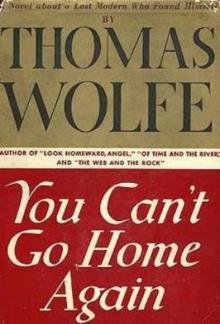
Thomas Wolfe, page 360


Something blurred and passed across the eyes of the boy, and suddenly all of the gold and singing had gone out of the day. He got up and walked out of the study, and down the hallway, holding the book open in his hand. When he got to the sitting room he saw his mother there. She glanced up placidly, then looked at him quickly, startled, and got up, putting her sewing things down upon the table as she rose.
“What is it? What’s the matter with you?”
He walked over to her, very steadily, but on legs which felt as light and hollow as a cork.
“This book,” he mumbled and held the page up to her, pointing at the place—“this book—read what it says here.”
She took it quickly, and read. In a moment she handed it back to him, and her fingers shook a little, but she spoke calmly:
“Well?”
“What the books says—is that father?”
“Yes,” she said.
“Then,” he said, staring slowly at her and swallowing hard, “does that mean that father——”
And suddenly, he saw that she was crying; she put her arms around his shoulders, as she answered:
“My dear child, your father is so proud, and in some ways a child himself. He wouldn’t tell you. He could not bear to have his son think that his father was a cripple.”
And all at once the boy remembered what his father had once said to him; and knew what he had meant.
A cripple!
Fifty years and more have passed since then, but every time the memory returned to Robert Joyner’s son, the vision blurred, and something tightened in the throat, and the gold and singing passed out of the sun as it did on that lost day in spring, long, long ago.
A cripple—he, a cripple!
He could see the bald head and red face, the stocky figure limping heavily away to court . . . and hear the fast, hard ringing of the bell . . . and remember Looky Thar, the courthouse loafers, and the people passing . . . the trials, the lawyers, and the men accused . . . the soldiers coming to the house . . . the things they talked of and the magic that they brought . . . and his war-young heart boy-drunk with dreams of war and glory . . . the splendid Generals, and his father so unwarlike, as he thought . . . and the unworthiness of his romantic unbelief . . . to see that burly and prosaic figure as it limped away toward court . . . and tried to vision him with Gordon in the Wilderness . . . or charging through the shot-torn fields and woods at Gettysburg . . . or wounded, sinking to his knees at Spotsylvania . . . and failing miserably to see him so; and, boylike, failing to envision how much of madness or of magic even brick-red faces and bald heads may be familiar with . . . down the Valley of Virginia more than seventy years ago.
But a cripple?—No! no cripple. One of the strongest, straightest, plainest, most uncrippled men his son would ever know.
Half a century has gone since then, but when Robert Joyner’s son would think of that lost day, it would all come back . . . the memory of each blade, each leaf, each flower . . . the rustling of each leaf and every light and shade that came and went against the sun . . . the dusty Square, the hitching posts, the mules, the ox-teams, and the horses, the hay-sweet bedding of the country wagons . . . the courthouse loafers . . . and Old Looky Thar . . . and Webber’s mule teams trotting across the Square . . . each door that opened . . . and each gate that slammed . . . and everything that passed throughout the town that day . . . the women sitting on the latticed porches of their brothels at the edge of “Niggertown” . . . the whores respiring in warm afternoon, and certain only of one thing—that night would come! . . . and all things known, as well as things unseen, a part of his whole consciousness . . . a little mountain town down South one afternoon in May some fifty years ago . . . and time passing like the humming of a bee . . . time passing like the thrumming in a wood . . . time passing as cloud shadows pass above the hill-flanks of the mountain meadows, or like the hard, fast pounding of the courthouse bell. . . .
And now, his father dead, and long since buried, who limped his way to court and who had been to Gettysburg . . . another man since dead and buried with the gorilla arm-length of an ape. . . .
And time still passing . . . passing like a leaf . . . time passing, fading like a flower . . . time passing like a river flowing . . . time passing . . . and remembered suddenly, like the forgotten hoof and wheel. . . .
Time passing as men pass who never will come back again . . . and leaving us, Great God, with only this . . . knowing that this earth, this time, this life, are stranger than a dream.
[¬]
thomas wolfe
THE GOOD CHILD’S RIVER
The University of North Carolina Press, Suzanne Stutman, ed., 1991
By night on my bed I sought him whom my soul loveth:
I sought him, but I found him not.
[The text follows the first edition.]
THE GOOD CHILD’S RIVER
[¬]
I · The Time That Is Lovely
II · [My Cousin Robert]
III · [My Father on Tour]
IV · [A Baby Is Born]
V · My Father’s Youth
VI · The Three Sisters
VII · Esther
VIII · White Fokes
I
THE TIME THAT IS LOVELY
“Long, long into the night I lay—”
(One!)
“Long, long into the night I lay awake—”
(Two!)
“Long, long into the night I lay awake, thinking how I should tell my story!”
(One, two, three, four! One, two, three, four!)
Time!
O, there are bells and that is time:
What time is that?
That was the half hour that the bells were striking,
And that was time, time, time.
And that was time, dark time. Yes, that was time, time that dark hangs above our heads in lovely bells.
Time. You hang time upon great bells in a tower, you keep time ticking in a delicate pulse upon your wrist, you imprison time within the small coiled wafer of a watch, and each man has his own, a separate, time.
One!
Now in the dark I hear the boats there in the river.
Two!
Now I can hear the great horns blowing in the river. Great horns are baying in the harbor’s mouth, great horns are lowing in the gulf of night, great ships are putting out to sea.
They call! Ships call! The great ships call!
Hark, then: Hear you now! O hark!
The river is a tide of moving waters; by night it floods the pockets of the Earth. By night it drinks strange time, dark time; by night the river drinks proud potent tides of strange dark time. By night the river draws the tides, proud potent tides of time’s dark waters that with champ and lift of teeth, with lapse and reluctivity of their breath, fill with a kissing glut the sockets of the land. Sired by the horses of the sea, maned with the dark: they come.
They come! The great night horsemen come! And the horses of sleep are galloping over the land.
Great whistles blow there. Can you not hear great whistles blow there?
(O now I hear the whistles blowing on the river:)
And there are ships there. Do you not hear the ships there?
(O now great ships are going down the river! O now great ships are putting out to sea!)
A harness of light ships is on the water. A thunder of faint hooves is on the land!
And there is time there! Do you not hear dark time there?
(O now I hear dark time there! Strange time, dark tragic time there! O now I hear dark time, strange time, the dark, the moving tide of time as it flows down the river! And in the night time, in the dark there, in all the sleeping silence of the Earth, I hear the river, the rich immortal river, full of its strange dark time. Full with the pulse of time it flows there, full with the pulse of all men living, sleeping, dying, waking, it will flow there, full with the dark and secret moments of our lives it flows there, in the day time, in the dark, drinking with ceaseless glut the land, mining into its tides the earth as it mines the hours and moments of our life into its tides, moving against the sides of ships, foaming about piled crustings of old wharves, sliding like time and silence by vast cliffs of cities, girdling the isle of life with moving waters—thick with the wastes of earth, dark with our stains, and heavied with our dumpings: rich, rank, beautiful, and unending as all life, all living, as it flows by us, by us, by us, to the sea!)
—
There, tell me; tell me, there. Where is lost time now? Where are lost ships, lost faces, and lost love? Where is the lost child now? Did no one see her as the tangled shipping? Did no one see her by light waters? By proud cleavages of forgotten ships at Counties Slip, by forgotten fume-flows of light smoke above Manhattan? Lost? Did no one speak to her? Ah, please! Can no one find her, hold her, keep her—bring her back to me? Gone? Just for a moment, I beseech you, just for a moment out of measured, meted, and unmindful time.
Gone? Then is she lost? Can no one bring me back a child? Why should a dog, a horse, a rat bare lips—at “them”—You’ll build great engines yet and taller towers, our dust will tremble to far greater wheels; have you no engines then to bring back sixty seconds of lost time?
Then she is lost.
—
And once upon a time there was a tiny little girl, and she was a might pretty sweet little girl, too, and she was awfully smart, she learned to write before she was six years old, and she used to write her dear uncles John and Fred letters and they were great fat fellows, God! how those fellows could eat! the very best of everything was just about good enough for them, and they simply adored her, and she used to call them her Dere Uncle Honeys: We have a Dog called Roy and he is swete but Bella says he is also messy Sister is lerning to talk and she can now say everything and I am taking french lessons and the tetcher says I can now talk it good I am awfuely smart and good and I think of my dere Uncle Honeys all the time wel that is all Sister sends luv and we know our dere Uncle Honeys will not forget us and will bring something luvly yore darling litel Esther.
—
O, but that must have been much later after we came back; yes, I think it must have been a year or two later because all I can remember before is a big boat that went up and down and Mama got awfully sick, God, she was white, I got so frightened and began to cry, and Daddy was so lovely: he brought her champagne, I heard him say, “Here, drink this, you’ll feel better,” and she said, “O, I can’t, I can’t!” But she did, everyone always did what he wanted them to do; and I had a nurse called Miss Crampton—isn’t that a funny name to have?—and at first we lived behind the museum in Gower Street, then later we were in Tavistock Square, and the milkman had a little cart that he pushed before him and he made a funny noise in his throat, and every morning when he came by they let me go out and sit upon the curb and wait for him, and the sun was like old gold and murky looking, and I gave the man some money, two or three pennies and he said in a loud voice, “There you are, Miss, fresh as a dyesy,” and he gave me a tiny little bottle of cream and I drank it all right there before him, and gave him back the bottle—God! I was proud, I think I was about three or four years old; and then when I asked Daddy why cream cost so much more than milk he said “Because it’s so hard for the cow to sit down on those little bottles,” and O! I thought that was so wonderful I couldn’t stop thinking about it, and Mama told him he ought to be ashamed of himself talking to a child like that, but there was something so wonderful about him, I believed everything he said.
Then later Daddy was away on a tour with [Richard] Mansfield and Mama went with him and they left me with Auntie May: she had a house in Portman Square, God! what a lovely house that was! She was a writer, she wrote under the name of Hugh Trench, isn’t that a queer name for a woman writer to have? She wrote a book called The Heart of Mile-End Mary, it was all about a kid who grew up in the east end of London, it was damned good: the whole thing was done with the most enormous skill, it was trash, but it was awfully good trash, it’s ten times better than that stuff Cousin Rupert writes now, he makes me tired that fellow! He thinks he’s hell. We were both about the same age and we had the same governess, we never could get along, we were always fighting; he’s just the same as he always was, I don’t think people change that way. Auntie May was awfully nice: she always let us have tea with her, I used to love that, all sorts of people came to see her, she knew a great many people; and one day when I came down to tea there was an old man there with a long white beard and I was wearing my little apron, I must have been awfully sweet; and Auntie said “Come here, my dear,” and she took me and stood me between her knees, and turned my face toward the old man and God! I was frightened, there was something so strange about it! And Auntie said “I want you to look at this gentleman and remember his name for some day you will know more about him and remember meeting him.” Then Auntie said that the old man’s name was Mister Wilkie Collins and that he was a writer and I thought that was an awfully funny name for anyone to have and I wondered what an old man like that could write. Then Rupert laughed at me and teased me because I was afraid of Mister Collins. O! he was dreadful! I used to hate him! and I began to cry and Mister Collins got me to come and sit on his knee, and he was really an awfully nice old man, I think he died a year or so after that. He began to tell me some stories and they were simply fascinating but I’ve forgotten what they were. But God! I used to love his books—O! he wrote some wonderful books: did you ever read The Woman in White and the Moonstone? Well, they’re pretty swell. So then I guess we must have been away two years in all, Daddy was on this tour with Mansfield, and when we got back we all went to live with Bella, I think that was the only time she and Mama were separated, they simply adored each other—well, no, maybe we did not live with Bella at first, Mama still had some of those houses left down on Eleventh Street, so maybe we went there at first, I don’t know, sometimes it seems such a long time ago, we moved around so much and sometimes now it all gets confused.
—
That was a good time then, for then the sun came out one day and the Bridge made music through the shining air, it was like a song: it soared like flight above the harbor, and there were men with derby hats upon it. It was like something you remember for the first time, it was like seeing something clearly for the first time in your life and down below it was the river: I think it is like that when you are a kid, I am sure it must be just like that, you remember things but they are all confused and broken up and darkness is in them; and then one day you know what day it is, and you know what time it is, and you remember everything you see; and it was just like that; I could see all the masts of the sailing ships tied up below, and they were like a forest of young trees, they were delicate and spare and close together and they had no leaves upon them and I thought of Spring. And a ship was coming up the river, and there was a white excursion boat all jammed with people and a band was playing, and I could see and hear it all. And I saw all the faces of the people on the Bridge, and they were coming toward me and there was something strange and sad about it, and yet it was the most magnificent thing I had ever seen: the air was clean and sparkling like sapphires and out beyond this was the harbor and I knew that the sea was there. And I heard the hoofs of all the horses, and the bells of the street cars, and all those heavy trembling sounds as if the Bridge was all alive: it was like time, it was like the red brick houses that they have in Brooklyn, it was like being a kid in the early nineties, and I guess that was when it was.
The Bridge made music and a kind of magic in me, it bound the earth together like a cry; and all of the earth seemed young and tender, I saw the people moving in two streams back and forth across the Bridge, and it was just as if we all had just been born. God! I was so happy I could hardly speak, but when I asked Daddy where we were going he kept singing in a kind of chant, “To see the man who built the Bridge, who built the Bridge, who built the Bridge, to see the man who built the Bridge, my fair La-dee.” “O Daddy, we are not?” I said; he was so wild and wonderful, he told so many stories I never knew when to believe him. We sat up front on one of those open cars behind the motorman: the man kept clanging on his bell with his foot, Daddy was so happy and excited, when he got that way he had a wild crazy look in his eye. God! he was handsome! He was all dressed up in a rich dark coat with light grey trousers, he had a pearl in his necktie and a grey derby tilted sideways on his head, it was all so rich and perfect; his hair was like bright sand, it was thick and shiny. I was so proud of him, everyone stared after him wherever he went, the women were simply mad about him.
So when we got over there we got off and walked down a street and went up the steps of this wonderful old house, and an old nigger man came to the door and let us in: he had a white coat on and he was all white and black and clean looking, and he made you think of good things to eat and drinks in tall thin glasses, something with mint and frost and lots of ice in it. And we went back through the house behind the nigger and it was one of those wonderful old houses that are so dark and cool and grand with walnut stair rails a foot thick and mirrors up to the ceiling. Then this old nigger took us into a room in the back of the house and it was one of the most magnificent rooms you ever saw: it was noble and high, and the air from the sea was in it, it had three great windows all open and a balcony outside and beyond that you could see all of the harbor and there was the Bridge where we had come from. It was like a dream: the Bridge soared through the air and seemed to be so near the window and yet it was so far away. And down below us was the river, and the sparkle of the water, and all the ships; and boats were coming in and boats were going out to sea; and there were delicate plumes of smoke above the boats.