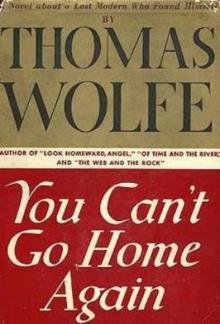
Thomas Wolfe, page 400



Even the weary jaded old man, Jake Abramson, who had been regarding her fixedly with a vulpine smile during the whole course of her animated monologue, now smiled a little more warmly as he turned away to speak to other friends. He had really paid no attention to what she was saying, but Mrs. Jack’s way of telling a story was so pleasant, her rosy face and twinkling eyes were so full of life and eagerness, she spoke with such excitement, with such gusto, with such ready humor, that everything she said was interesting. And, in a tired and jaded world, people could just look at her animated little face and figure, her eager and excited voice for hours at a time, without growing tired.
The two women—Miss Heilprinn and Mrs. Jack who were now left standing together in the centre of the big room, offered a remarkable and instructive comparison in the capacities of their sex. Miss Heilprinn was in appearance as in face a very distinguished woman. The thing that one noticed about her immediately was her bland and smiling pallor. She suggested oil—smooth oil, oil of tremendous driving power and generating force. And although no one would ever have called her a beautiful woman, no discerning eye could fail to see instantly that she was a very handsome one.
She was a woman perhaps of middling height, perhaps a little under it: at any rate she was a little taller than Mrs. Jack. Her smooth and smiling face, her plump figure, hips and ankles, were inclined to heaviness and corpulence. Her face was almost impossibly bland. It was a blandness without unction, a blandness without hypocrisy. On first sight the smooth, plump, smiling features had a look of almost Buddhistic quality and the fruity tones, the infectious chuckle, the eyes that narrowed into jolly slits whenever the lady laughed or even smiled, contributed to a first impression of imperturbable and unquenchable good nature.
But let the ingenuous spirit be not too easily deceived: a closer examination of this lady would have revealed a pair of twinkling eyes that missed nothing and that were as hard as agate. Her distinguished looking grey hair was combed back in a pompadour and she was splendidly gowned with a suavity that was perfectly adapted to the bland and imperturbable assurance of her worldliness. She would, and could, if occasion or necessity had demanded it, have taken the gold fillings out of her best friend’s teeth and never for a moment lost the oily blandness of her smiling face, the infectious chuckle of her throaty voice, as she did so.
To say merely that she was “as hard as nails” would be to put an unfair strain upon the durability of common iron. In the theatrical profession, and along Broadway, where she had reigned for years as the governing brain and directive force behind a celebrated art theatre she was known familiarly as “the Duchess.” And the business acuity which had wrung this homage from the hard lips of that milling street was fully deserving of all the tributes, all the oaths, that had been heaped upon it.
As the two ladies, both of whom were warm old friends, stood looking at each other affectionately in the act of greeting, a very instructive performance in worldly shrewdness was being quietly unfolded between them for the enlightenment or amusement of one privileged to see. Each woman was perfectly cast in her own role. Each had found the perfect adaptive means by which she could utilize her full talents with the least waste and friction and with the greatest smooth persuasiveness.
Miss Heilprinn’s role in life had been essentially a practical and not a romantic one. It had been her function to promote, to direct, to govern, and in the tenuous and uncertain speculations of the theatre to take care not to be fleeced by the wolves of Broadway. The brilliance of her success, the power of her will, and the superior quality of her mettle, was written plain upon her. It took no very experienced observer to see instantly that in the unequal contest between the Duchess and the wolves of Broadway it had been the wolves who had been fleeced. Lucky, indeed, was the wolf who could escape an encounter with the Duchess with a portion of his native hide intact.
And in that savage unremitting warfare, when bitter passions had been aroused, when undying hatreds had been awakened, when eyes had been jaundiced and when lips had been so bitterly twisted that they had never regained their rosy pristine innocence and now lay written on haggard faces like a yellowed scar, had the face of the Duchess grown hard and bitter? Had her mouth contracted to a grim and bitter line? Had her jaw out-jutted like a granite crag? Were the marks of the wars visible anywhere upon her? By no means.
The more murderous the fight, the blander her face. The more treacherous and guileful the strategy in its snaky intrigues, the more cheerful and good-natured the fruity lilt of her good-humored chuckle. She had actually thriven on it. She seemed to blossom like a flower beneath the dead and barren glare of Broadway lights. And she never seemed to be so happily and unconsciously herself as when playing about ingenuously in a nest of rattlesnakes.
The other lady presented a tactical problem of quite another sort. Mrs. Jack’s career had been romantic rather than executive. Yet, in a strange, hard way, each woman was completely worldly, each woman was wholly practical, each woman was fundamentally concerned with her own interests, her own success.
In a curious way, Mrs. Jack’s strategy was more guileful and complex than that of her smooth companion. Mrs. Jack’s strategy was that of the child: she had early learned the advantages of possessing the rosy, jolly little face of flowerlike loveliness. She had early learned the advantages of a manner of slightly bewildered surprise, naive innocence, of smiling doubtfully and inquiringly yet good-naturedly at her laughing friends, as if to say: “Now, I know you’re laughing at me, aren’t you? I don’t know what it is. I don’t know what I’ve done or said now. Of course, I know I’m not clever the way you are—all of you are so frightfully smart—but anyway I have a good time, and I like you all—Hah?”
She had even learned in recent years that deafness itself might have its compensations in furthering this illusion of her happy, somewhat bewildered innocence. She had early learned as well the value of tears in a woman’s life and what an effective weapon tears may be. She had learned the supreme value of romantic emotion as a triumphant answer-all to reasoned thought or to the objections of fair play and a sense of justice. She knew better than most women that if any act of hers was ever called in question, if any act of hers which she was trying to conceal was ever discovered, and she was confronted with it, there was no answer so effective, so annihilating as tempestuous tears—romantic and irrational declaration:
“All right. All right—I’m through!—She’s finished!—She’s no good anymore!—Throw her out—Let her go!—She’s tried to do the best she could but you’ve thrown her out now—You’ve told her she wasn’t any good anymore—All right, then—” Here she would smile a pathetic twisted smile as she squeaked these touching little words, move aimlessly toward the door in a pathetic gesture of departure, smile a pathetic twisted little smile again and wave her hand childishly in farewell as she squeaked pathetically—“All over—Finished—Done for—She’s no good—Goodbye, Goodbye—” After which, of course, there was nothing but embarrassed, half amused, half angry, half disgusted surrender.
She had her faults, no doubt—she was “romantic.” Most people, even those who knew her well considered her affectionately to be a “most romantic person—” “a very romantic woman.” For this reason she had triumphantly escaped censure for many acts that would have brought down upon many another less privileged, less gifted and less favored person a heavy punishment. She was essentially not less shrewd, not less accomplished, not less subtle and not less hardly determined to have her own way, to secure her own ends in the hard world than was the blandly, suavely smiling Roberta Heilprinn—But oh! As her friends said she was “so beautiful,” she was “such a child,” she was so “good”—and everybody loved her!
Not everyone, however, was so easily deceived by Mrs. Jack’s deceptive innocence. The bland lady who now confronted her in greeting was one of these: hence the instructive quality of the moment. Miss Roberta Heilprinn’s hard and merry eye, indeed, missed no artifice of that rosy, innocently surprised, small person. And hence perhaps the twinkle in her eye as she greeted her old friend was a little harder, brighter and more lively than it usually was, the bland, Buddhistic smile, a little smoother in its oily suavity, and the fruity tones, the engaging yolky chuckle, a trifle more infectious, and on all of these accounts, perhaps more full of genuine affection as she bent and kissed the rosy, glowing little cheek.
And she, the blooming object of this affectionate caress, although she never changed the expression of surprised delighted innocence on her rosy face, knew full well all that was going on in the other woman’s mind. For a moment, so quickly imperceptibly, that no one save Olympian Mercury could have followed that swift glance, the eyes of the two women, stripped bare of all concealing artifice, met each other nakedly. And in that moment there was matter for Olympian laughter. But no one of these gifted worldlings saw it.
—
“I mean!—You know!—” At the words, eager, rapid, uttered in a rather hoarse, yet strangely seductive tone of voice, Mrs. Jack smiled and turned: “There’s Amy!”
Then, as she saw the angelic head, with its unbelievable harvest of golden curls, the snub nose and the little freckles, and the lovely face so radiant with an almost boyish quality of eagerness, of animation, of enthusiasm, she thought; “Isn’t she beautiful! And—and—there is something so sweet, so lovely, so—so good about her!”
She did not know why or how this was true. Indeed, as she well knew, from any worldly point of view it would have been hard to prove. If Amy Van Leer was not “a notorious woman” the reason was that she had surpassed the ultimate limit of notoriety, even for New York, years before. She had a reputation that stank even in the more decadent groups of the great capitals on the Continent.
By the time she was nineteen years old she had been married and divorced and had a child. And even at that time her conduct had been so scandalous that her first husband, a member of one of the most powerful of the American plutocracies, had had no difficulty in getting a divorce and in demonstrating her unfitness for the custody of her own child. There had been a sensational case which fairly reeked. Since that time, seven years before, it would have been impossible to define or chronicle her career in any terms measurable to time or to chronology. Although the girl was now only twenty-six years old, her life seemed to go back through aeons of iniquity, through centuries of vice and dissipation, through a Sargassic seadepth of depravity.
Thus, one might remember one of the innumerable scandals connected to her name and that it had happened only three short years before, and then check oneself suddenly with a feeling of stunned disbelief, a feeling that time had suddenly turned phantom, that one had dreamed it all, that it had happened in a kind of outrageous night-mare. “Oh no! It can’t be!—That happened only three short years ago and since then she’s—why she’s—”
And one would turn to stare in stupefaction at that angelic head, that snub nose, that boyish eager face—as one who, in this bewildering guise, might know that he was looking at the dread Medusa, or that, couched here in this pleasant counterfeit of youthful eagerness and naiveté, he was really looking at some ageless creature, some enchantress of Circean cunning whose life was older than the ages and whose heart was old as Hell.
What was the truth of it or what the true image of that sun-headed, golden counterfeit of youth and joy no one could say. It baffled time, it turned reality to phantasmal shapes. One could, and had, as here and now, beheld this golden head, this tilted nose, this freckled, laughing, eager face, here at its very noon of happy innocence. And before ten days had made their round, one had come on it again in the corruptest gatherings of Paris, drugged fathoms deep in opium, foul bodied and filth spattered, cloying to the embraces of a gutter rat, so deeply rooted in the cesspool that it seemed its very life was nothing but a tainted plant, whose roots had grown out of sewage and who had never known any life but that.
And then one would remember the laughing boyish, eager, and hoarse-throated girl with the snub nose, the freckles and the golden head that one had seen four-thousand miles away just seven days before. And time would turn into a dusty ash, the whole substantial structure of the world would reel in witches’ dance, and melt away before one’s eyes like fumes of smoke.
And she?—the cause, or agent of this evil miracle—Medusa, Circe or unhappy child—whatever was the truth—to tell her story!—Oh, it was impossible! That story could be told no more than one could chronicle the wind, put halters on a hurricane, saddle Mercury, or harness with a breded skein of words the mapless raging of tempestuous seas.
Chronology?—Well, for birth, she had the golden spoon; she was a child of Pittsburgh steel, the heiress of enfabled wealth, of parentage half—perhaps the fatal half—of Irish blood; she had been born O’Neill.
And youth? It was the youth and childhood of a dollar princess, kept, costly, cabined, pruned, confined; a daughter of “Society”:—and of a woman, twice divorced and three times married. Her girlhood had been spent in travel and rich schools, in Europe, Newport, New York and Palm Beach. By eighteen she was “out”—a famous beauty; by nineteen she was married. And by twenty her name was tainted and divorced.
And, since then? There were not words to tell the story, and although there were warm apologists who tried to find the reason for it, or to make for it excuse, there was not enough logic in the Universe to find a reason or to shape a plan, to phrase an argument for that maelstrom of a life.
“The facts speak for themselves”? The very facts were unspeakable; could one have spoken them there would not be space enough for a full record, and no one credulous enough for their belief; one could not quote the simple and accepted truths, which were that she had been three times married and that one marriage had been annulled and had lasted only twenty hours; and that a third had ended tragically when her husband, a young French writer of great talent, but a hopeless addict of cocaine, had shot himself.