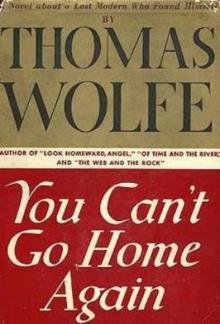
Thomas Wolfe, page 133



A few days later Eugene had gone home with Abe for dinner: he lived with his mother, two brothers, and Jimmy, his sister’s illegitimate child, in a flat which occupied the second floor of an old four-storey red-brick house in Twelfth Street, near Second Avenue, on the East Side. The old woman had prepared a good meal for them: a thick rich soup, chopped chicken livers, chicken, cake, and a strong sweet wine: she served them but would not sit and eat with them: she came in briefly and shook hands shyly and awkwardly, mumbling incoherently, a mangled jargon of Yiddish and English. Suddenly, however, as if she had briefly mastered herself by a strong effort her old and sorrowful face was twisted by a convulsion of powerful and incurable grief, and a long, terrible, savagely wailing cry was torn from her throat: she turned blindly, and with a movement of natural and primitive sorrow, she suddenly seized the edges of her apron in her gnarled and worn hands and flung it up over her head and rushed toward the door at a blind, lunging, reeling step. She was like one demented by sorrow: the old woman began to beat her withered breasts and pull at her wispy gray hair, meanwhile running and stumbling blindly around her kitchen in a horrible and savage dementia and drunkenness of grief. Abe followed her out, and Eugene could hear his voice, low, urgent, and tender, as he spoke to her persuasively in Yiddish, and her long wailing cries subsided and he returned. His face was sad and weary-looking and in a moment he said: “Mama’s breaking up fast. She’s never been able to get over my brother’s death. She thinks about it all the time: she can’t get it off her mind.”
“How long has he been dead, Abe?”
“He died over a year ago,” Abe said. “But that doesn’t matter: I know her—she’ll never forget it now as long as she lives. She’ll always feel the same about it.”
This terrible and savage picture of grief was carved upon Eugene’s memory unforgettably: it became a tremendous and formidable fact, a fact as ancient, timeless, and savage as the earth, a fact which neither the stupefying oblivion of the city’s life, the furious chaos of the streets, the savage glare of ten thousand blind and dusty days could touch. The old woman’s grief was taller than their tallest towers, and more enduring than all their steel and stone: it would last forever when all the city’s bones were dust, and it was like the grief of all the women who had ever beat their breasts and flung their aprons across their heads and run, wailing, with a demented and drunken step: it filled him with horror, anger, a sense of cruelty, disgust, and pity.
She was the fertile and enduring earth from which they sprung, and all of them, transformed so sharply and so curiously by the city’s tone and life, drew in to her with devotion and respect: Abe, with his dreary gray face of the man-swarm cipher, Sylvia with her feverish, electric night-time glitter, all of the brothers and sisters, with all that was new, sharp, alien, flashy, trivial, or material in speech, dress, manner, and belief—all of them returned to her with love, loyalty, and reverence as to some great broodhen of the earth. The old woman’s life was rooted in the soil of two devotions: the synagogue and the home, and all that happened beyond the limits of this devotion was phantom and remote: this soil was ageless, placeless, everlasting.
Abe loved his mother dearly: whenever he spoke of her, even casually, his voice was touched with a hush of respect and affection. But he disliked his father: the few times Eugene heard him mention him he spoke of him in a hard and bitter voice, referring to him as “that guy,” or “that fellow,” as if he were a stranger. Eugene never saw the father: the children all felt bitterly towards him and had sent him away to room alone. Abe told Eugene that the man was a shoemaker, and apparently improvident and thriftless. He had never been able to earn enough to support his family, and in addition, Abe said, he was a petty family tyrant. Abe’s childhood had been scarred by memories of privation, tyranny and poverty—the mother and the children had had a bitter struggle for existence, and Abe had worked since his eighth year at a variety of hard, gray, shabby and joyless employments: he had been a newsboy, a grocer’s delivery boy, an office boy in a broker’s office, a typist in a collection agency endlessly writing out form letters, the office man and secretary for the head-professor of the architectural school, and one of these pallid, swarthy, greasily sweating youths of the fur and garment house districts who ceaselessly propel through swarming and kaleidoscopic streets of trade small wheel-trucks piled high with dresses, garments, furs, and clothes or with the thousand travelling varieties of all that horrible nondescript junk known under the indecisive name of “novelties.” Once, also, he had spent part of a summer in New Jersey unloading freight cars filled with Georgia watermelons, and for a considerable time he had driven a truck for his two oldest brothers, who had a zinc business in the “gas-house district” of the East Side, between Avenue A and the river and North of Fourteenth Street.
Here, once, Eugene had accompanied him at noon of a flashing day in spring, a glitter of light and flashing waters, a sparkle of gold and blue: in a large bare space near factories they had seen a ring of young thugs throwing dice, and near the river were the immense and ugly turrets of the gas tanks, and then the wharves, the great odorous piers, and the flashing waters—the vast exultant play and traffic of the river life, the powerful little tugs, the ships, and the barges laden with their strings of rusty freight cars.
As they walked away through the powerful ugliness and devastation of that district, with its wasteland rusts and rubbish, its slum-like streets of rickety tenement and shabby brick, its vast raw thrust of tank, glazed glass and factory building, and at length its clean, cold, flashing strength and joy of waters—a district scarred by that horror of unutterable desolation and ugliness and at the same time lifted by a powerful rude exultancy of light and sky and sweep and water, such as is found only in America, and for which there is yet no language—as they walked away along a street, the blue wicked shells of empty bottles began to explode on the pavements all around them: when they looked around to see from what quarter this attack was coming, the street was empty save for a young thug who leaned against the rotting edge of a closed door, hands thrust in pockets, and a look of pustulate and evil innocence upon his thin tough Irish face. The street was evil and silent and empty, but when they turned and went on again, the exploding bottles began to drop around them on the pavement in splinters of sinister blue.
Abe grinned toughly: he did not seem at all surprised or perturbed by the murderous stealth and secrecy of the attack, its obscene and cowardly uselessness. He explained that the district had been one of the worst in the city and the headquarters for one of the most criminal gangs: time and again the gangsters had broken into his brother’s zinc shop and robbed it, and Abe and all his brothers, being Jews, had had to fight it out since childhood, foot and fist and tooth and nail, and club and stone, with the young Irish toughs and gangsters who infested the district. Such had been his childhood: he told Eugene many stories of bloody fights waged back and forth across these pavements, of young boys maimed, crippled, or blinded in these savage fights, of one boy who had his eye torn out of his head by his enemy’s gouging thumb in a fight to a finish on one of the piers, and of another whose brains had been smashed out on the pavement below the elevated structure by a rock hurled by an enemy’s hand in a fight of the neighborhood gangs. Thus, in pier and alley, on street and roof, children had learned the arts of murder, the smell of blood, the odor of brains upon the pavement. Abe told how one of his older brothers, Barney—a thickly set powerful-looking man with short thick hands and a tough meaty-looking fighter’s face, gray, square, and good-humored—had to fight it out step by step with the gangsters, who had come to his shop, again and again, with demands for money—money which the merchants of the district paid them meekly and regularly for “protection”—a euphemism for graft and menace, a bribe for being left alone and for the assurance that one’s shop would not be entered and one’s stock smashed or stolen in the night. Barney had met all these menaces with a hard cold eye and two rock-like fists with which time and again he had beaten into a pulp the thugs who came to threaten him: he was a good man and a savage fighter and he had learned the arts of combat in the sternest and most brutal arena on earth—the city streets.
“And—oh-ho-ho-ho!”—softly, painfully, Abe lifted his widely grinning face and laughed, “how that guy loves it! Say! they picked the wrong one when they picked on him! Oh-ho-ho-ho-ho! Can he fight! Does he love it! Say! do you know what I saw him do to two of them one time—oh-ho-ho-ho-ho-ho! Gee! it was rich! They came in there to shake him down and—Oh! Ho-ho!—ho! You shoulda seen it! He picks up a keg of zinc that weighs 200 pounds and he breaks it—oh-ho-ho-ho!—over the first guy’s head.”
“And what became of the second guy?”
“Oh-ho-ho-ho! . . . Gee, it was rich! You shoulda seen that other guy get out of there! Say! He almost tore the door down in his hurry—oh-ho-ho-ho!”
Such were the various members of this family as Eugene came to know about them: each of them in his own way was marked by a decisive individuality and independence of spirit which told of their lives of combat, toil and struggle in the city streets, and yet, although indelibly marked, scarred and hardened by his life, none of them had been brutalized by it. In fact, as Eugene thought of all these people later, an extraordinary quality in them became evident. It was this: here was a family of poor East Side Jews, the children of an immigrant and thriftless shoemaker and an old orthodox Jewish woman. These children had all had to make their own way, to fight and struggle bitterly for a living: now some of them were tough, rugged and unlettered merchants, traders and mechanics, some were successful milliners and designers, and some were talented musicians, students of science, people of extraordinary intelligence and ability. And all of them, even the most unlettered, seemed to have a completely natural unaffected interest and respect for the arts, or for scholarly and intellectual attainment. This circumstance—this remarkable fusion in one poor Jewish family of elements which would have seemed almost incredible in the families of poor laboring or country people Eugene had known before—this combination of the manual, the commercial, the artistic and the scholarly in one poor family—seemed so natural both to him and to them that Eugene never found it strange or wonderful until years later.
[¬]
LVI
June had brought with it a blessed respite from his classes at the university. Now the summer drew on towards its close—the brutal and weary New York summer with its swelter of dead wet heats, its death of hope, its sorrow of a timeless memory. And yet, in the city’s summer nights there was a kind of solemn joy, a hush of peace and light and human resignation that was so different from the wild and nameless joy and pain of spring, the sorrow of autumn, the winter’s grim and stern protraction of the soul. Then—in these nights of waning summer—more than at any other season of the year, the immense and murmurous sound of time was audible. It was above one and around one, it was near and far, it was immense and omnipresent, and it was indefinable. It seemed to hover somewhere in the upper air, above the city’s steep canyons, the giant explosions of her thousand towers, the swarming millions of her tortured and uneasy life forever waging their desperate, ugly and unprofitable strife in all her hot and tangled mazes. And that voice of time, above the ugly clamor of that tormented life, was imperturbable; immense, remote and murmurous, it seemed to have resumed into itself all of the rumors of the earth, and to comprise, out of the bitter briefness of man’s days, the essence of his own eternity, and to be itself eternal, fixed, and everlasting, no matter what men lived or died.
The people of the city heard this sound of time, and on these evenings of the waning summer, their lives were subject to its spell. For the first time in many months one heard the sounds of quiet laughter in the streets at night, the voices of the people as they passed were strangely hushed, the sounds of life were immense, all murmurous as time itself.
This sense of peace, of resignation, of a quiet and tranquil sorrow and joy was everywhere; it may have been some quality of the summer air that imposed on all the violence of the city’s life a kind of muted harmony, but the spirit of this peace seemed to have entered the very flesh and spirit of the city, somehow to have tranquillized the feverish blood and nervous and exacerbated bodies of its people. For the first time in months their eyes were quiet and thoughtful and had lost their look of hatred and suspicion, hostility and mistrust. Their faces had lost their strained, hard, and hurried look, even their tongues had lost some of their strident, rasping, and abusive violence.
That immense and murmurous hush of time and sorrowful acceptance had touched even the life of youth. At night one still saw groups of young men walking through the streets, but even they had somehow been subdued and chastened by this spell of time. And in these bands of youth—these straggling bands of young men who struggle through the city streets at night in groups of six or eight, and who have become so much a part of our familiar experience and the city’s life that they no longer seem curious to us—the change that this great spell of time had wrought was perhaps more evident than anywhere else.
Where were the songs of youth upon those city streets? Where the laughter, the wild spontaneous mirth, the passion, warmth and golden poetry of youth? Where was the great boy Jason looking for brothers in the fellowship of that inspired adventure of man’s youth—the proud, deathless image of what all of us desire when young, where was it? Where were the noble thoughts and ardors of young men, the fierce and bitter desperation and the proud and foolish hopes, the grand dreams and the music of the fleeting and impossible reveries—all that makes youth lovely and desirable, and that keeps man’s faith—where was it among these young men on the city streets?
It was not there. Poor sallow, dark, swarthy creatures that they were, with rasping tongues, loose mouths and ugly jeering eyes, this infamous band of youth was death-in-life itself. It had been brought still-born from its mother’s womb into a world of city streets and corners, into all the waning violence of the tenement, bitterly to try to root its meagre life into the rootless rock, meagrely to struggle in its infamous small phlegm along the pavements, feebly to imitate the feeble objects of its base idolatry—of which the most heroic was a gangster, the most sagacious was a pimp, the most witty was some Broadway clown.
How often have we seen them, heard them, turned away from them with weariness and disgust, as they straggled along at night, a meagre shirt-sleeved band of gangling sizes, each fearful and uneasy in the other’s eye, kicking the ash-cans over as feats of derring-do, trying for approbation with a hoarse call and a pitiable and mirthless striving after repartee, of which the more glittering fragments ran like this:
“Hey-y . . . Eddy! . . . Holy Jeez! . . . Hey-y, youse guys! . . . Cuh-mahn!”
“Ah-h, what’s yer hurry? . . . Hey-y! Youse udah guys! . . . Joe’s in a hurry . . . Who’s goin’ t’ pay duh taxi-ride?”
“Holy Jeez! What’s keepin’ yuh! . . . Youse guys, cuh-mahn!”
“Ah-h, guh-wahn. . . . What’s t’ hurry? Where’s duh fire?”
Now in these nights of waning summer, even these raucous voices, the pitiable sterility of these feeble jests, that meagre and constricted speech consisting almost wholly of a few harsh cries and raucous imprecations that recurred intolerably, incredibly through all the repercussions of an idiot monotony—all of the rootless, fearful, and horrible desolation of these young pavement lives—was somehow caught up in this great and tragic nush and spell of time, transmuted by it, until even their vast unloveliness of youth was given a sorrowful quality of pity and regret.
August came, and with it already a faint and troubling premonition of the autumn—a breath, a fragrance, and an odor—that somehow spoke of summer’s ending, the premonitory thrill and promise of the voyage. What was it? It was one of those very strange and troubling odors known here in America, of which our lives are all compact, which we have lived and breathed and known with our blood, and for which we have no language. It is, somehow—the odor of cities, cities, cities—at the hour of evening, the scorched end of every expiring day—the smell of evening hush and peace and of the sea in harbors. It is the smell of old worn woods, warm, resinous, sultry, getting into our very entrails somehow with its strange and nameless fragrance of sorrow and delight; the smell of the wooden baseball bleachers, of the old worn plankings of an amusement park, passed over by a million feet since morning; and it is the smell of street-cars, car-barns, the faded day-coach plush of trains, the smell of bridges and of old wharves and piers, of hot tarred roofing, and of tar out in the streets, of summer’s fatigue, quietness, and summer’s ending, the quiet and tranquil sorrow of memory as we remember youth, our father’s voice upon the night-time summer porch, the smell of the grape-vines and the ripened grapes, the grinding screech and halt of a street-car on the hill above our father’s house, and the knowledge that all this is lost, our father dead, our childhood gone, another year, our first in the great man-swarm of the city, ended—and this, the knowledge of the bitter briefness of our days, is somehow mixed with the smell of the sea in harbors, the freshening breeze of evening, the call of ships, and, somehow, God knows how, with the intolerable thrill and promise of the unknown voyage.
And with this breath of autumn and the promise of the voyage there came to Eugene the news that Starwick was at that moment in the city—would stop there briefly on his way to Europe. At this time also, Joel Pierce turned up and Eugene renewed an acquaintance that had begun in Cambridge and lapsed during the interim.