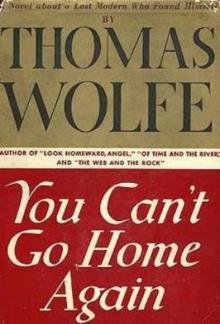
Thomas Wolfe, page 367



Although my cousin Robert was a Jew, he looked forward to Christmas with as much eagerness as any other child: Bella always had a Christmas tree with gifts for everyone and the family would always gather at her house on Christmas day. For this reason Robert was so troubled now by the silence of the house. Also, until that year, he had accepted Christmas as other children do, as a season of gifts and feasting, and he had never questioned its origin or meaning. But, a few days before, when some of the children at school had been talking of the holiday and of what they planned to do, Robert had said he was going to spend the day at his Aunt Bella’s. Then one of the boys, a young tough named Rags Cassidy, began to laugh and sneer at my cousin Robert, and said:
“Why, you ain’t got no right to even talk about it. Jews don’t have Christmas.”
When Robert went home that day he told his mother what the boy had said. My Aunt Mary was a very fine woman, but she was not like Bella or my mother, she did not have much humor; she was a very emotional woman and a fancy talker. So when my cousin Robert told her what this Cassidy had said, my aunt clasped him to her bosom and wept and said, “O my son! My little son! Yes! You are a Jew! Tell him you are a Jew! Tell him you belong to a race that has been persecuted and tortured for three thousand years. Tell him that Christ was a Jew—this Christ that they pretend to worship and in whose name they do such cruel things. Tell them the Twelve Apostles were Jews. Tell him the greatest poets and philosophers who ever lived were Jews, that Spinoza and Disraeli and Heine were all Jews.”
Robert did not think it would do much good to tell the Cassidy boy these things, but he promised he would try, and the next day when the boy started on him again, Robert said:
“Spinosey and Heinie and the Twelve Apostles were all Jews.”
“You’re crazy,” the Cassidy boy said, “Heine is the name of a Dutchman.”
This is what Robert had always thought, too. So he changed the subject.
“Well, Christ was a Jew,” he said.
This made the Cassidy boy very mad and he said if Robert said it again he would smash him one. So Robert didn’t say it, but he said:
“Well, if he wasn’t one, what was he?”
“He wasn’t nothing!” the Cassidy boy shouted. “He was the Loid.”
Robert did not understand what the boy meant, and he did not say anything until he had spoken to my father. He knew that my father understood everything and did not get excited like Aunt Mary: My father was a Christian, but he was very smart, and he could always tell my cousin Robert things to say that the Cassidy boy could not answer. So when Robert went to see him, my father said:
“What did he say he was?”
“He said he was the Loid,” my cousin Robert said.
“He did, did he?” my father said. “Well, if he knows so much, ask him which Loid he means.”
My cousin Robert looked doubtfully at my father.
“There are a lot of Loids,” my father said. “First of all there is the North German Loid. Then there is the British South African Loid. Then there are all the Loids in the insurance business. Then there is Loid and Taylor’s. Then there are all the English Loids: there is Loid Tennyson and Loid Cornwallis and Loid Burgoyne and Loid Halpus. Maybe he means Loid Halpus,” my father said. “Ask him if he doesn’t mean Loid Halpus.”
When Robert told the Cassidy boy what my father had said, the boy got very angry and said that someday he would kill himself a Jew, but he had no answer to make to the things my father had told Robert to say.
Therefore, my cousin Robert now sat there on the top step thinking of these things, and of Christmas, and on the ominous and forbidding quiet which now filled the house.
Wherever my father and my mother and Bella were, there was richness and joy: for days the house had been alive with a delightful activity, he had seen Bella come in from the streets with her arms loaded with packages, for weeks my mother and Else had been together in the kitchen: they had baked dozens of cakes, pies, tarts, cookies, and loaves of bread. That magnificent house was perfumed now with a dozen strange, rich, and delicate odors—of cinnamon and butter, of spiced fruits and brandied peaches, of preserved ginger brought from China in jars of dark green with heads of woven straw, the Christmas wreathes with their thick stiff leaves of dull green and the red bitterness of their berries. Bella loved abundance and joy, the very best of everything was just about good enough for her, and in addition to the finest meats and fruits and poultry, she loved whatever was rich, rare, and subtle—silks and spices from China, the smoky shawls of India, goblets of thin Austrian glass, the oldest, rarest, headiest wines of the Rhine and Burgundy, the heavy silver chains and lockets of the East, the softest warmest furs of the North—she loved all things that were rich and rare and plentiful in man and nature, she gathered the treasures of the earth about her, and then, because she was the bountiful giver, the source of love and abundance, she gave them out again.
Shall we hear the sound of the hoof and the wheel in the street again? Shall we hear the sound of the foot on the step? And was there any music in that sound? If there was music, is there more to say?
How proud, how sharp, how certain some have been! Where are the lost words now? Some had the medicines for all our griefs and could not heal their own. Of some was said: “How fine, how wise, how subtle.” They died, we said that we regretted them, and our memory grew as grey as their own dust. Some used the mockery of limber tongues, some cursed and threatened, and now the mocker and the angry man lie in the earth together. There was no music in their flesh, they brought no joy up to the lintel of a door, and they are lost. They could not help their barrenness, the taste of life was bitter on their lips, and they are lost. They were born without juice or succulence, they grew wise upon the words of others, they knew what they did not know, and they are lost. There was a fashion in disdainfulness, some therefore curled their lips and spoke of nightingales in Jersey City, and they are lost. They could not mock, and so they curled their lips in mockery; they could not weep, and therefore they covered their faces with their hands; they made a skein of words to speak of love, but they had no love, no love, and they are lost. Born without hope or hopelessness, born without love or madness, they breathed the air punctually and moved inglorious flesh about, and they are lost. They hated life and could not die, they could not believe in their own unbelief, they longed to make the semblance of a living man, they had the parts and painted grief or laughter, and they are lost.
But we heard the horses and wheels of Bella’s carriage in the street as children, we heard her slow stride on the steps, the glorious undulations of her dress, and our hearts were lifted to our throats with joy, and the sound of the hoof and the wheel will walk in our brain forever. Therefore, can we say more than this of any man when he is dead? Perhaps there are a thousand memories and reasons, ten thousand affirmations or denials, but at the end, the very end, what can we say of him? At the end, the very end, we might say: “He was not wise or faithful; his tongue was cruel and his brain was mad. He was so wrong and so mistaken, he was drunken, wild and foolish, he laid the treasure of his spirit waste, and he brought us pain because we loved him.” At the end, the very end, we might say all these things if they were true, but we would not say them, we would not remember them, they would be melted from us like a wisp of smoke, if joy and richness dwelt in him. At the end, the very end, we could say no more than this, for there would be no more to say than this: “Our hearts were lifted to our throats with joy whenever we heard his step outside the door.”
There are some people who have this quality of richness and joy in them, they were born with it and it stays with them throughout their life, no matter what they do, no matter what ruin or misfortune falls upon them. Some of these people are rich and some are poor, but it does not matter at all whether they are rich or poor in worldly wealth, such people are really always rich: they have in them a wealth that can never be taken away from them and that makes them richer in poverty than millionaires. My father and my Aunt Bella had this quality more than anyone I have ever known.
At this time Bella was rich. She still had a considerable portion of the property my grandfather had given to his children: this house was part of it. She had also married a doctor who was a wealthy man, and who had a large practice among rich people. She always had plenty of money at this time, and she spent it with the same gesture as a farmer sowing grain: if there was any chink or rift in the comfort of life, any crack or barrenness in the richness of things, Bella stopped it with gold. She could not bear that anyone within sight or touch of her life should want for anything, and her beautiful and opulent hunger soared over the earth and gathered into her house the rarest things: a poor child like my cousin Robert felt, on entering this house, that he had come into magic, that there was nothing within his wish or desire that could not instantly and abundantly be given to him.
Later, when Bella had begun to feel the pinch of money, this was just the same. Whatever she wanted, or whatever anyone else wanted, she got at once. If she wanted a new carriage and horses, and she had no money for them, she would sell a house; if she had no house to sell, she would bite off pearls or emeralds from a necklace, and send a servant out to get money on them from a pawnbroker: once she paid a grocer who had refused her father credit by sending him a diamond bracelet, and if she wanted to wear jewels which she had already pawned, she would retrieve them by sending others in their place.
One might say that it is easy to give to people this sense of joy and richness so long as one has wealth to fling away in this fashion. It is not true. There is no joy in wealth alone: in the hands of meagre and barren people wealth has a dusty color. The real wealth that Bella had burned like a flame inside her, and it never went out. In the last years of her life, when she had lost everything, when she was a ruined and broken old woman, wrecked with drugs, drifting from one cheap lodging house to another, this quality was more triumphant than it had ever been. Wherever she went the people wanted to be near her: the people in these dingy places—the little shop-girls and stenographers, the broken down chorus women, the clerks and book keepers, and those desolate and barren old men and women who carefully eked their meagre candle-end of life out in these houses—were instantly drawn toward her, and they loved her. The story of her ruin, the degradation of the drug, was legible upon her flesh and in her eye, but their vision passed by this at once and they could never see her in this ruined mask again: Bella stood instantly revealed to them as the most beautiful and distinguished woman they had ever known, whatever she touched at once became valuable and beautiful, the dingy little rooms she lived in at once grew glorious when she entered them, and the poor lives of all these little people feasted like starved sparrows on the endless wealth and bounty of her spirit.
When I have spoken of her to people who never met her, I have found that many would not believe me: some laughed at me and said I had a romantic temperament, that exaggeration was natural to me, that my memory had thrown a false glow over her, and that such a person as I described had never lived. Other people would get somewhat annoyed and bitter when I told them about Bella: there were always people who had not had much life of their own because they had nothing to make it with. I have often noticed that such people get angry and sarcastic when told that such a person as Bella has lived upon this earth: Some of them buy their own sterility, they clutch their little delusion of futility because it is all they have, and they feel it gives them a bitter elegance. If it is taken away from them they are deprived of their whole stock-in-trade, they have nothing left: they say that joy and glory have departed from the earth, and when they meet a person like Bella they are finished. They can still speak, but their words sound foolish. Once when I was talking to such people about Bella, a man burst out resentfully:
“Yes, but why? Why? To what end? What was she living for? For what purpose was all this energy and exuberance? What did it all amount to in the end?”
He waited for an answer but I did not answer him because he was a fool and a fancy talker: he really did not want an answer. My words would have had no meaning for him. But I knew the answer.
I knew the answer because I am a Jew and we are born with a knowledge of all the sorrow on the earth. We are so wise because we know at once that we must die. We have been to the wailing wall of love and death for so many centuries, we know so well how to weep and laugh, and we have no time for childish Gentile gabble of futility. We began at the beginning, we have been the master delvers and explorers of living for so long a time that we know! We know! An immense and tragic authority rests upon us. We knew all that at the start, and it was one of us who wrote thousands of years ago: “I gave my heart to know wisdom, and to know madness and folly: I perceived that this also is vexation of spirit.” And the same man wrote that the day of a man’s death is better than the day of his birth, he wrote that the “fool foldeth his hands together and eateth his flesh,” and he wrote that there is nothing better for a man than that he should eat and drink and enjoy good in his labor. He told us to do the work that lay before us with all our might, for there is neither work nor wisdom in the grave, he told us to live with all our heart, and he said that the living know that they shall die, but the dead know nothing. A Jew said this thousands of years ago, he knew the human destiny and what befalls us, and there has never been anything beyond it in courage, in wisdom or in understanding.
Bella knew this. The reason she had so much exultancy and joy in her life was because the sorrow of time and death was in her heart. The reason she lived this life so well was because she knew that she must die. She died a ruined and broken woman but I think she had as great a wisdom in her as any person I have ever known. The wisdom that Bella had was this: that a man can save his life only by saving nothing, that we can hope to live only by giving all the life we have in us to living, that, in the end, whatever is saved is wasted. I know that we must save nothing that we value dearly: our love, our life, our talent, our possessions and our money must be given utterly and fiercely, and I know whoever saves a precious thing is damned and lost. When I think of Bella, I think also of all the people I have known who have lost their lives through saving them: the people who were forever fearful, forever cautious, who never did anything intensely and with all their life and spirit: who always yielded sparingly and by less than half, and who always kept their eye upon half opened doors of safety and retreat. Here were the lovers with strings of compromise and caution on their love, here were half-poets who wrote of their half-lives the flimsy substitutes for passion; here were the quarter-rebels, and the part-adventurers, the bold eye longing for new lands and oceans and the cold withdrawing heart. Here were the frugal cooks, the thrift of crusts and salad leaves, the almost-good economics and the reworked remnants, here were the people who had never done or felt anything with all their spirit, with all their life and energy—here they were, most of the men and women I have known on this earth, these are the really poor and the truly wretched, the halfhearted, the half-willed, the half-minded! Here, finally, were those who were frugal, mean, stingy with money, devoured by what they had hoarded, destroyed by what they had saved: the men who had saved their gold and wasted their lives.
As I thought of all these people I saw clearly that they, and not people like Bella, were the true wasters and wantons of the earth: these people were the enemies of life, the foes to inspired and magnificent living—the cautious, the calculating, the corrupt—and in the end what did they have for all their pains of fear and caution? They had saved, saved, saved, and in the name of God, for what had all this saving been? What had they saved themselves for? For the bitter lips. For the starved eyes and the constricted heart. For ten thousand days of grey awakenings, for the countless repetitions of their weary acts of dressing, feeding, working, for ten thousand nights of lying down to rest, to sleep, to restore their wasted energies for what, for what? For endless turnings of the wheel that ground no grain. For this meagre house of skin and bone that year by year grows dry and yellow with depletion, that unhallowed by love or joy grows old and sick when corrupted to base uses; for this patched up dwelling place, this shabby inn, and for its final thoughts of dusty earth.
No. I know now with an utter certainty that who saves his life shall lose it, and that Bella had been superbly right, triumphant in her ruin, victorious in her death. I heard her say once, with her wild, impatient, fiercely hungry gesture: “God! I’d like to go up all at once in one good blaze—just like a bonfire!” It was the madness of her hunger, but it was right.
When a person has this glorious endowment of energy and joy it is not an exaggeration to say that “nothing else matters.” With such a person the simplest act glows with a vital and exultant power, and the most common and familiar things begin to live with a fresh and living glory. About my first memory of Bella was of her smoking a cigarette: I was sitting on the floor of our back parlor, and it was Spring, and suddenly I looked up and I saw Bella looking at me as she lit a cigarette. I can see her slow rich smile, with the faint shadow of her dimple appearing as she looked at me with the deep and living sparkle of her eyes that was so mocking and so tender, I saw her face dip toward the lighted match, and her mouth pucker, I saw her flick the match away, and then she looked toward mother, who was busy with her sewing, and spoke to her. I do not know what she said, but I know it was something about me, and then she looked at me again for a moment, and her great laugh filled the room. I saw the delicate wires of smoke curl from her nostrils, perhaps I did not know then what tobacco was, but all at once I understood that it was one of the most delicious things in the world, that it was a poignant and glorious weed, and that the cigarette which Bella was smoking at that moment was the finest cigarette that anyone had ever smoked. All at once I discovered the earth. In a second the obscure and broken memory of my infancy was flooded with light: the whole world came to life before me, instantly I saw and knew everything. Bella was sitting in the centre of a universe each part of which was pulsing and glowing with her own joy and energy. I saw the spacious and beautiful room, the high white ceiling with its great central bud of plaster, the back windows that were so proud and tall with their clean sunlit curtains fluttering in the breeze, the squares of living sunlight on the floor, the shelves of books, and the warm comfort of the furniture. I saw the strength and delicacy of everything, the wonderful life that pulsed in all these well used objects, the generous and strong design of the furniture, the carelessness, the ease, the whole living texture of the room charged with its own life and the lives of the people who dwelt here.