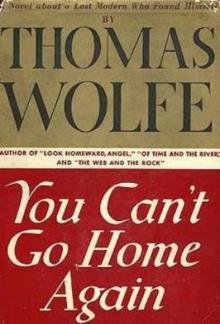
Thomas Wolfe, page 232



“Do you?” he said. “Do you know a lot about it? I suppose you do.”
“Do I know a lot about it!” she cried. “And he asks me if I know a lot about it!” she exclaimed comically, and Jewishly raised her palms to the attendant universe. “Let me at him!” she said with a jolly burlesque of pugnacity. “Just let me at him! Well, young fellow, all I got to say is, if you find anyone who knows more about it than your old Esther, you’re going to have to get up pretty early in the morning. That’s all I’ve got to say about it!” He was somehow delighted by the joy she took in her skill and knowledge; her boastfulness was so gay and good-humored that no one could be displeased with it, and he felt sure now that it was entirely justified.
“Oh, I know the most marvelous things about clothes,” she went on solemnly. “There’s no one who knows the things about clothes that I do. Some day I’ll tell you all about it. . . . You know, I’ve got a job working for a big dressmaking place downtown. I go in two mornings a week and design for them. It is the most wonderful place to work, I wish you could see it. It’s so clean and spacious, they have these big, quiet rooms, and all around you everywhere they have bolts and bolts of beautiful material. There’s something so magnificent about all this cloth, it is noble and beautiful, you can do such wonderful things with it. I love to go back to the work room and watch all the little tailors at work. You know, they’re very fine workmen, some of them get paid two hundred dollars a week. And God!” she exclaimed suddenly, her little face deepening with a rich flush of humor, “how they stink! It’s simply dreadful sometimes, you could cut the stink with a knife. But I love to watch them at their work. They have such delicate hands. When they draw the thread through and make a knot it is like a kind of dance.”
As the woman talked, a feeling of immense joy, peace, and certitude entered his spirit. He got from her a sense of strength, ease, and happiness which he had not felt before, and the doubts and confusion of a moment before had vanished. Suddenly the life of the city seemed opulent, glorious, and full of triumph for him, he felt able to conquer and subdue any obstacle, he forgot his horror and fear of the swarming life of the streets, and the terrible loneliness and impotent desolation of a human atom threading its way among millions, trying to make its life prevail against the horror of gigantic crowds and architectures.
This little creature had found a way of life that seemed to him full of happiness and success: she was strong, small, and competent, she was also full of joy, tenderness, and lively humor, and she was immensely brave and gentle. He saw plainly that she was a product of the city. She had been born in the city, lived in it all her life, and she loved it; and yet she didn’t have the harassed and driven look, the sallow complexion, the strident and metallic quality that many city people have. She was the natural growth of steel, stone, and masonry, yet she was as fresh, juicy, and rosy as if she had come out of the earth.
There are some people who have the quality of richness and joy in them and they communicate it to everything they touch. It is first of all a physical quality; then it is a quality of the spirit. With such people it makes no difference if they are rich or poor: they are really always rich because they have such wealth and vital power within them that they give everything interest, dignity, and a warm color. When one sees such a person in a lunchroom drinking a cup of coffee, one can almost taste and smell the full delicious flavor of the coffee: it is not simply one of a million cups of lunchroom coffee, it is the best cup of coffee that has ever been made, and the person who drinks it seems to possess to the utmost every drop of its essence and flavor. Yet this is done without affected gusto, gourmandising, sighs, or smackings and lickings of the lips. It is a real and vital power this person has for joy and richness, it comes from the texture of his life, it cannot be imitated.
A tramp, a hobo, or a beggar often has this quality. It is a joy to see such a man thrust his hand carelessly into the baggy pocket of a ragged old coat and draw out a loose cigarette, put it in his mouth, light it with twisted lips and a flame cupped in his hard palms, and then draw the first pungent draft of smoke deeply and deliciously into his lungs, exhaling it presently in slow fumings from his nostrils with a naked lift of his teeth.
The men who drive great trucks at night across the country often have this power. They lean against their fenders in the small green glow of lamps, they smoke; their lives are given then to speed and darkness, they enter towns at dawn. The men who rest from labor have this power. The masons coming from their work who sit in trains and smoke strong, cheap cigars—there is something simple and innocent about such men as they look at their cheap cigars, held in their great stiff fingers, with pleased smiles. The sharp fumes drug their tired flesh with deep content.
Those who have this quality are the young policemen sitting in shirt-sleeves in the all-night eating places, taxi drivers with black shirts, prize fighters, baseball players, and racing drivers, brave and gentle people; steel workers sitting astride a giddy spar, locomotive engineers and brakemen, lone hunters, trappers, most shy and secret people who live alone, whether in the wilderness or in a city room; in general, all people who deal with sensuous things, with what has taste, smell, hardness, softness, color, must be wrought or handled—the builders, the movers, the physical and active people, the creators.
The people who do not have this quality are the people who rustle papers, tap keys—the clerks, the stenographers, the college instructors, the people who eat lunch in drug stores, the countless millions who have lived meagerly in pallor and safety.
But when a person has in him the vitality of joy, it is not a meaningless extravagance to say that “nothing else matters.” He is rich. It is probably the richest resource of the spirit; it is better than all formal learning, and it cannot be learned, although it grows in power and richness with living. It is full of wisdom and repose, since the memory and contrast of pain and labor are in it. It comes from competence, and it is touched with sadness, since the knowledge of death is on it. It has learned acceptance and regret, and it is nice because it sees that what is barren must be false.
Mrs. Jack had this vital quality of joy in its highest degree. With her it was not merely a physical and sensuous thing, it was a richly imaginative and delicately intuitive thing; it was full of faith and dignity, and she communicated it to everything she touched. Thus, as she drew his attention to the instruments and materials with which she worked—the drawing table, with its one smooth slab of soft white wood laid flat on trestles, the fat little pots of paint, the crisp squares of drawing paper, nailed with thumb tacks to the table, the neatly sharpened pencils and the delicate brushes, and the T-squares, sliding rules, and triangles—he began to feel the essence and vital beauty of these objects as he had never felt them before. Mrs. Jack loved these things because they were precise and delicate instruments, and because they served honestly and richly the person who knew how to use them.
This warm and lovely talent served her everywhere with an unfaltering directness and certainty. Mrs. Jack wanted what was best and most beautiful in life, she was always on the lookout for it, and she never failed to know and appreciate it when she found it. In everything, she wanted only the best. She would not make a salad of wilted leaves: if the outer parts were not crisp and fresh, she would strip them off and use the heart. If she had possessed only two dollars in the world, and had invited some people to dinner, she would not stingily spread her money out in little dabs of one thing and another. She would have gone to the markets and bought there the best steak she could find for two dollars, she would have brought it home and cooked it herself until it was informed with all the succulence and flavor her own rich character could give it, then she would have served it on a thick, creamy platter on a table adorned only by her big plates and the heavy and simple eighteenth-century knives and forks she had got in England. This would be all, but when her guests had eaten there would not be one of them who did not feel that he had richly banqueted.
People who have this energy of joy and delight draw other people to them as bees are drawn to ripe plums. Most people have little power for living in themselves, they are pallid and uncertain in their thoughts and feelings, and they think they can derive the strength, the richness, and the character they lack from one of these vital and decisive people. For this reason people loved Mrs. Jack and wanted to be near her: she gave them a feeling of confidence, joy, and vitality which they did not have in themselves.
Again, the world is full of people who think they know what they really do not know—other people have had their convictions and beliefs and feelings for them. With Mrs. Jack, it was at once obvious that she knew what she knew. When she spoke of the little tailors sitting cross-legged on their tables, and of the delicate and beautiful movements of their hands, or when she described the beauty and dignity of the great bolts of cloth, or when she spoke with love and reverence of the materials and instruments she worked with, one saw at once that she spoke in this manner because she had used and known all these things, she had worked and wrought with them, and her knowledge was part of her life, her flesh, her love, her marrow, her tissue, and was melted and mixed indissolubly with the conduits of her blood. This is what knowledge really is. It is finding out something for oneself with pain, with joy, with exultancy, with labor, and with all the little ticking, breathing moments of our lives, until it is ours as that only is ours which is rooted in the structure of our lives. Knowledge is a potent and subtle distillation of experience, a rare liquor, and it belongs to the person who has the power to see, think, feel, taste, smell, and observe for himself, and who has hunger for it.
As Mrs. Jack talked about herself and her life, and told in her vivid and glowing manner of her daily little discoveries in the streets, Monk began to get a vision of the city’s life that was as different from the swarming horror of his own Faustine vision as anything could be. He saw that the city, whose immensity drowned him in confusion and impotence, was for her simply what rich woods and meadows might be for a country child. She loved the unending crowds as a child might love a river or tall, blown grass. The city was her garden of delight, her magic island, in which always she could find some new joy, some new rich picture to feed her memory.
She was like time, like the elfin light of time, because she gave the warm and magical color of distance and memory to things she had seen an hour before. In these stories to which her vivid and visual mind reduced experience, and in which her childhood and youth appeared so often, a picture of the old New York, and the old America, was already expanding and being given order and perspective in Monk’s mind.
His own America was the America of the country man of the wilderness. The story of his potent and turbulent blood was a story of hundreds of men and women who had lived in loneliness, and whose bones were buried in the earth. The memory that lived in him was not the memory of men who had lived in paved and numbered streets, it was the memory of solitude and the distance and direction of the hunter and the frontiersman—a memory even now of men who “lived over yonder,” a memory of “a feller I was talkin’ to t’other day over in Zebulon,” a memory of men who lived “jist before you git to the fork of the road where it turns off to go down into that holler—you’ll see a big locust tree thar an’ if you jist foller along that path hit’ll take you right by his place—hit ain’t fer, not more’n a mile, I reckon—you cain’t miss hit.”
Their greeting to strangers had been hearty, and their voices full of a deliberate kindliness, their gestures were slow and courtly, but their eyes were mistrustful and sharp, and flickered rapidly, and the smouldering embers of violence and murder were quickly fanned to fury in them. When they awoke at morning their eyes were fixed upon the calm and immutable earth, they watched the slow processional of the seasons, and fixed in their memory were always a few familiar things—a tree, a rock, a bell. The calm of the eternal earth and its elastic spring below man’s foot had been his inheritance. He had the experience of the country boy who comes to the city—his feet were tired of the endless pavements, his eyes were weary of incessant change and movement, and his brain was sick with the horror of great crowds and buildings.
But now, in Mrs. Jack, he beheld a natural and happy product of the environment that terrified him, and in her warm little stories he began to get a picture of the city America he had not known, but had imagined. It was a world of luxury, comfort, and easy money; of success, fame, and excitement; of theatres, books, artists, writers; of delicate food and wine, good restaurants, beautiful fabrics, and lovely women. It was a world of warm, generous, and urbane living; and it all seemed wonderful, happy, and inspired to him now.
In his countless goings and comings about New York, his rides in the subways, his walks through the streets, each one of which had become a savage struggle with life, sound, movement, and design until he now faced the simplest excursion among a crowd with tightened nerves and a sense of horror and dislike, he had often observed an expression on the faces of middle-aged New Yorkers which repelled and depressed him. The expression was surly, sour, and petulant, the texture of the flesh was grey and sallow, and it sagged in a doughy fashion. Upon these countenances there was legible a common story of mean and ungenerous living, of bad food eaten dully without distaste or enjoyment in cafeterias, of homes in dismal single bedrooms or flats, of employment as night clerks in cheap hotels, ticket sellers in subways, cashiers in lunchrooms, as petty and ill-humored officials in uniform—the kind of men who snarl and bully and answer a civil question with an insolent reply, or who fawn in a whining and revolting manner when told that the stranger they have insulted is a person of importance to their employer:
“Why didn’t yuh tell me yuh was a friend of Mr. Crawford’s? I didn’t know! If I’d known you was a friend of Mr. Crawford’s yuh coulda had anything yuh like. Sure! Yuh can’t blame us. Yuh know how it is,” in a whining and confidential voice, intended to be ingratiating. “We gotta be careful. So many people comes here wantin’ to see Mr. Crawford that ain’t got no business to see him that he wouldn’t have no time at all if we let ’em all in. Then if we let ’em in an’ they ain’t got no business to be let in, we get blamed for it. Yuh know how it is.”
Upon these mean visages he had not been able to find any sign that would indicate any dignity or beauty in their lives. Their lives stretched back through a succession of grey and ugly days into that earlier New York of which he could get no picture except that it was dreary, and barren, and dull. He felt contempt, disgust, and pity for them. They were like small things that whine when threatened or beaten, and they belonged to that vast, drab horde who snarled, fawned, bickered, and whined their ways at length into nameless, numberless, and forgotten graves.
And he hated these people, too, because they gave the lie to all his early country visions of a warm, magnificent, and opulent life in the great city. It seemed impossible that they should have come out of the same time and the same city as Mrs. Jack. In her stories of her childhood and youth, of her wonderful, wild father who was an actor, of her beautiful, wasteful mother who bit diamonds from her necklace when she needed money, of her fat Rabelaisian Christian uncles who were enormously rich and ate the most succulent foods, which they themselves went to market for every day, poking and prodding at the meat and vegetables, of her beautiful and generous Jewish aunt, of her Christian aunt, of her English relatives, her Dutch relatives, of her husband’s German relatives and her visits to them, of Mr. Roosevelt, and of actors, jolly priests, plays, theatres, cafés, and restaurants, of a great number of brilliant and interesting people—bankers, brokers, socialists, nihilists, suffragettes, painters, musicians, servants, Jews, Gentiles, foreigners, and Americans, he began to get fixed in his imagination an opulent and thrilling picture of the city in the Nineties and the early years of the twentieth century.
[¬]
24
“THIS THING IS OURS”
They had been meeting three or four times every week. These hours and moments snatched from work, at noon time or late at night after the performance was over, and spent together on the ride uptown in a taxicab, over the plates at lunch somewhere in Greenwich Village, or over the polished slab, the almost vacant privacy, of a Childs restaurant late at night, were very eager, very precious ones. But, as is usual with most lovers in the city, they were both troubled by the lack of that essential need of love—a meeting place: a meeting place not on the corner, in a cab, before a window, or on the street, shared emptily beneath the naked sky with all blind and brute participations of the million-footed crowd, but a meeting place where they could be alone and which would be their own.
Both felt increasingly a sense of this unhappy lack. To meet her at her house now seemed impossible—not from fear or inexpediency, and assuredly not from any shame, but because both had the sense of their own integrity. What they were, they were, and they felt no concealment, but they also had the sense of their own decency and propriety. And this was also true about their meetings at the theatre: here the sense of all her active life, her work, her association with her friends was still too recent, it still clung to her and hung like a troubling veil of mist above the life of each.
As for the small hotel in which he lived, had meeting there been possible, the stupefactions of that place, the dreary contagion of its shabby lives, would have been too much for him.
She solved the problem in a characteristic way, in a manner typical of the indomitable purpose which, he was to find, that small figure housed. And, rather comically, she found it by a demonstration of one of those processes of a woman’s mind by which she gets the thing that she is looking for by pretending that she is looking for something else. She began to talk about “a place to work.”