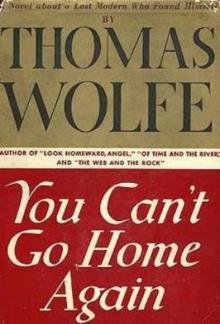
Thomas Wolfe, page 557
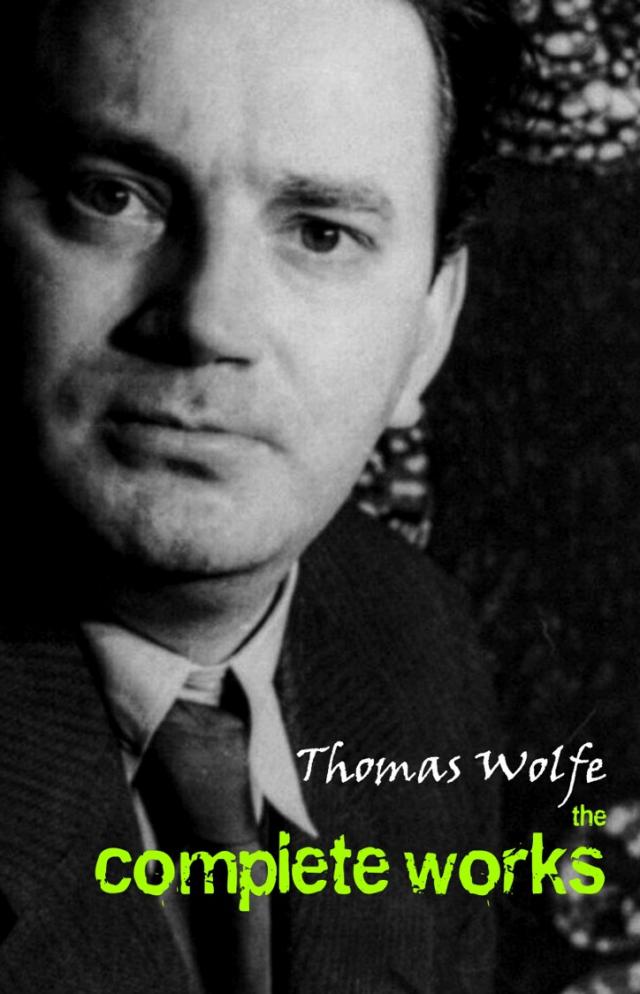


As I began to realize the true nature of the task I had set for myself, the image of the river began to haunt my mind. I actually felt that I had a great river thrusting for release inside of me and that I had to find a channel into which its flood-like power could pour. I knew I had to find it or I would be destroyed in the flood of my own creation, and I am sure that every artist who ever lived has had the same experience.
Meanwhile, I was being baffled by a fixed and impossible idea whose error at the time I did not fully apprehend. I was convinced at that time that this whole gigantic plan had to be realized within the limits of a single book which would be called “The October Fair.” It was not until more than a year had passed, when I realized finally that what I had to deal with was material which covered almost 150 years in history, demanded the action of more than 2,000 characters, and would in its final design include almost every racial type and social class of American life, that I realized that even the pages of a book of 200,000 words were wholly inadequate for the purpose.
How did I finally arrive at this conclusion? I think it is not too much to say that I simply wrote myself into it. During all that year, I was writing furiously, feeling now the full pressure of inexorable time, the necessity to finish something. I wrote like mad; I finished scene after scene, chapter after chapter. The characters began to come to life, to grow and multiply until they were numbered by the hundreds, but so huge was the extent of my design, as I now desperately realized, that I can liken these chapters only to a row of lights which one sometimes sees at night from the windows of a speeding train, strung out across a dark and lonely countryside.
I would work furiously day after day until my creative energies were utterly exhausted, and although at the end of such a period I would have written perhaps as much as 200,000 words, enough in itself to make a very long book, I would realize with a feeling of horrible despair that what I had completed was only one small section of a single book.
During this time I reached that state of naked need and utter isolation which every artist has got to meet and conquer if he is to survive at all. Before this I had been sustained by that delightful illusion of success which we all have when we dream about the books we are going to write instead of actually doing them. Now I was face to face with it, and suddenly I realized that I had committed my life and my integrity so irrevocably to this struggle that I must conquer now or be destroyed. I was alone with my own work, and suddenly I knew that I had to be alone with it, that no one could help me with it now no matter how anyone might wish to help. For the first time I realized another naked fact which every artist must know, and that is that in a man’s work there are contained not only the seeds of life, but the seeds of death, and that that power of creation which sustains us will also destroy us like a leprosy if we let it rot stillborn in our vitals. I had to get it out of me somehow. I saw that now. And now for the first time a terrible doubt began to creep into my mind that I might not live long enough to get it out of me, that I had created a labor so large and so impossible that the energy of a dozen lifetimes would not suffice for its accomplishment.
During this time, however, I was sustained by one piece of inestimable good fortune. I had for a friend a man who is, I believe, not only the greatest editor of his time, but a man of immense and patient wisdom and a gentle but unyielding fortitude. I think that if I was not destroyed at this time by the sense of hopelessness which these gigantic labors had awakened in me, it was largely because of the courage and patience of this man. I did not give in because he would not let me give in, and I think it is also true that at this particular time he had the advantage of being in the position of a skilled observer at a battle. I was myself engaged in that battle, covered by its dust and sweat and exhausted by its struggle, and I understood far less clearly than my friend the nature and the progress of the struggle in which I was engaged. At this time there was little that this man could do except observe, and in one way or another keep me at my task, and in many quiet and marvelous ways he succeeded in doing this.
I was now at the place where I must produce, and even the greatest editor can do little for a writer until he has brought from the secret darkness of his own spirit into the common light of day the completed concrete accomplishment of his imagining. My friend, the editor, has likened his own function at this painful time to that of a man who is trying to hang on to the fin of a plunging whale, but hang on he did, and it is to his tenacity that I owe my final release. Meanwhile, my creative power was functioning at the highest intensity it had ever known. I wrote at times without belief that I would ever finish, with nothing in me but black despair, and yet I wrote and wrote and could not give up writing. And it seemed that despair itself was the very goad that urged me on, that made me write even when I had no belief that I would ever finish. It seemed to me that my life in Brooklyn, although I had been there only two and a half years, went back through centuries of time, through ocean depths of black and bottomless experience which no ordinary scale of hours would ever measure. People have sometimes asked me what happened to my life during these years. They have asked me how I ever found time to know anything that was going on in the world about me when my life was so completely absorbed by this world of writing. Well, it may seem to be an extraordinary fact, but the truth is that never in my whole life have I lived so fully, have I shared so richly in the common life of man as I did during these three years when I was struggling with the giant problem of my own work.
For one thing, my whole sensory and creative equipment, my powers of feeling and reflection—even the sense of hearing, and above all, my powers of memory, had reached the greatest degree of sharpness that they had ever known. At the end of the day of savage labor, my mind was still blazing with its effort, could by no opiate of reading, poetry, music, alcohol, or any other pleasure, be put at rest. I was unable to sleep, unable to subdue the tumult of these creative energies, and as a result of this condition, for three years I prowled the streets, explored the swarming web of the million-footed city and came to know it as I had never done before. It was a black time in the history of the nation, a black time in my own life and, I suppose, it is but natural that my own memory of it now should be a pretty grim and painful one.
Everywhere around me, during these years, I saw the evidence of an incalculable ruin and suffering. And the staggering impact of this black picture of man’s inhumanity to his fellow man, the unending repercussions of these scenes of suffering, violence, oppression, hunger, cold, and filth and poverty going on unheeded in a world in which the rich were still rotten with their wealth left a scar upon my life, a conviction in my soul which I shall never lose.
And from it all, there has come as the final deposit, a burning memory, a certain evidence of the fortitude of man, his ability to suffer and somehow to survive. And it is for this reason now that I think I shall always remember this black period with a kind of joy that I could not at that time have believed possible, for it was during this time that I lived my life through to a first completion, and through the suffering and labor of my own life came to share those qualities in the lives of people all around me. And that is another thing which the making of a book has done for me. It has given my life that kind of growth which I think the fulfilment of each work does give the artist’s life, and insofar as I have known these things, I think that they have added to my stature.
The early winter of 1933 arrived and with it, it seemed to me, the final doom of an abysmal failure. I still wrote and wrote, but blindly, hopelessly, like an old horse who trots around in the unending circle of a treadmill and knows no other end nor purpose for his life than this. If I slept at night, it was to sleep an unceasing nightmare of blazing visions that swept across my fevered and unresting mind. And when I woke, it was to wake exhausted, not knowing anything but work, lashing myself on into a hopeless labor, and so furiously at it through the day and then night again, a frenzied prowling of a thousand streets, and so to bed and sleepless sleep again, the nightmare pageantry to which my consciousness lay chained a spectator.
Such was the state my life had come to in the early winter of 1933, and even at that moment, although I could not see it, the end of my huge labor was in sight. In the middle of December of that year the great editor, of whom I have spoken, and who, during all this tormented period, had kept a quiet watch upon me, called me to his home and calmly informed me that my book was finished. I could only look at him with stunned surprise, and finally I only could tell him out of the depth of my own hopelessness, that he was mistaken, that the book was not finished, that it could never be completed, that I could write no more. He answered with the same quiet finality that the book was finished whether I knew it or not, and then he told me to go to my room and spend the next week in collecting in its proper order the manuscript which had accumulated during the last two years.
I followed his instructions, still without hope and without belief. I worked for six days sitting in the middle of the floor surrounded by mountainous stacks of typed manuscript on every side. At the end of a week I had the first part of it together, and just two days before Christwas, 1933, I delivered to him the manuscript of “The October Fair,” and a few days later, the manuscript of “The Hills Beyond Pentland.” The manuscript of “The Fair” was, at that time, something over 1,000,000 words in length. He had seen most of it in its dismembered fragments during the three preceding years, but now, for the first time, he was seeing them in their sequential order, and once again his marvelous intuition was right; he had told me the truth when he said that I had finished the book.
It was not finished in any way that was publishable or readable. It was really not a book so much as it was the skeleton of a book, but for the first time in four years the skeleton was all there. An enormous labor of revision, weaving together, shaping, and, above all, cutting remained, but I had the book now so that nothing, not even the despair of my own spirit, could take it from me. He told me so, and suddenly I saw that he was right.
I was like a man who is drowning and who suddenly, at the last gasp of his dying effort, feels earth beneath his feet again. My spirit was overwhelmed by the greatest triumph it had ever known, and although my mind was tired, my body exhausted, from that moment on I felt equal to anything on earth.
It was evident that many problems were before us, but now we had the thing, and we welcomed the labor before us with happy confidence. In the first place there was the problem of the book’s gigantic length. Even in this skeletonized form the manuscript of “The October Fair” was over a million words in length, which is about twelve times the length of the average novel or twice the length of “War and Peace.” It was manifest, therefore, that it would not only be utterly impossible to publish such a manuscript in a single volume, but that even if it were published in several volumes, the tremendous length of such a manuscript would practically annihilate its chances of ever finding a public which would read it.
This problem now faced us, and the editor grappled with it immediately. As his examination of the manuscript of “The October Fair” proceeded, he found that the book did describe two complete and separate cycles. The first of these was a movement which described the period of wandering and hunger in a man’s youth. The second cycle described the period of greater certitude, and was dominated by the unity of a single passion. It was obvious, therefore, that what we had in the two cyclic movements of this book was really the material of two completely different chronicles, and although the second of the two was by far the more finished, the first cycle, of course, was the one which logically we ought to complete and publish first, and we decided on this course.
We took the first part. I immediately prepared a minutely thorough synopsis which described not only the course of the book from the first to last, but which also included an analysis of those chapters which had been completed in their entirety, of those which were completed only in part, and of those which had not been written at all, and with this synopsis before us, we set to work immediately to prepare the book for press. This work occupied me throughout the whole of the year 1934. The book was completed at the beginning of 1935, and was published in March of that year under the title of “Of Time and the River.”
In the first place, the manuscript, even in its unfinished form, called for the most radical cutting, and because of the way in which the book had been written, as well as the fatigue which I now felt, I was not well prepared to do by myself the task that lay ahead of us.
Cutting had always been the most difficult and distasteful part of writing to me; my tendency had always been to write rather than to cut. Moreover, whatever critical faculty I may have had concerning my own work had been seriously impaired, for the time being at least, by the frenzied labor of the past four years. When a man’s work has poured from him for almost five years like burning lava from a volcano; when all of it, however superfluous, has been given fire and passion by the white heat of his own creative energy, it is very difficult suddenly to become coldly surgical, ruthlessly detached.
To give a few concrete illustrations of the difficulties that now confronted us: The opening section of the book describes the journey of a train across the State of Virginia at night. Its function in the book is simply to introduce some of the chief characters, to indicate a central situation, to give something of the background from which the book proceeds, and perhaps through the movement of the train across the stillness of the earth to establish a certain beat, evoke a certain emotion which is inherent to the nature of the book. Such a section, therefore, undoubtedly serves an important function, but in proportion to the whole purport of the book, its function is a secondary one and must be related to the whole book in a proportionate way.
Now in the original version, the manuscript which described the journey of the train across Virginia at night was considerably longer than the average novel. What was needed was just an introductory chapter or two, and what I had written was over 100,000 words in length, and this same difficulty, this lack of proportion, was also evident in other parts of the manuscript.
What I had written about the great train was really good. But what I had to face, the very bitter lesson that every one who wants to write has got to learn, was that a thing may in itself be the finest piece of writing one has ever done, and yet have absolutely no place in the manuscript one hopes to publish. This is a hard thing, but it must be faced, and so we faced it.
My spirit quivered at the bloody execution. My soul recoiled before the carnage of so many lovely things cut out upon which my heart was set. But it had to be done, and we did it. And so it went all up and down the line. Chapters 50,000 words long were reduced to ten or fifteen thousand words, and having faced this inevitable necessity, I finally acquired a kind of ruthlessness of my own, and once or twice, myself, did more cutting than my editor was willing to allow.
Such, then, were some of our major difficulties with the manuscript we had in hand, and although since its publication there have been many declarations to the effect that the book would have benefitted by a much more radical cutting, the cutting we did do was much more drastic than I had dreamed was possible.
Meanwhile I was proceeding at full speed with the work of completing my design, finishing the unfinished parts and filling in the transition links which were essential.
This in itself was an enormous job and kept me writing all day long as hard as I could go for a full year. Here again the nature of my chief fault was manifest. I wrote too much again. I not only wrote what was essential, but time and time again my enthusiasm for a good scene, one of those enchanting vistas which can open up so magically to a man in the full flow of his creation would overpower me, and I would write thousands of words upon a scene which contributed nothing of vital importance to a book whose greatest need already was ruthless condensation.
During the course of this year, I must have written well over a half million words of additional manuscript, of which, of course, only a small part was finally used.
The nature of my method, the desire fully to explore my material, had led me into another error. The whole effect of those five years of incessant writing had been to make me feel not only that everything had to be used, but that everything had to be told, that nothing could be implied. Therefore, at the end, there were at least a dozen additional chapters which I felt had to be completed to give the book its final value. A thousand times I debated this question desperately with my editor. I told him that these chapters had to go in simply because I felt the book would not be complete without them, and with every argument he had, he tried to show me that I was wrong. I see now that on the whole he was right about it, but at the time I was so inextricably involved in my work, that I did not have the detachment necessary for a true appraisal.
The end came suddenly—the end of those five years of torment and incessant productivity. In October I took a trip to Chicago, a two weeks’ vacation, my first in over a year. When I returned I found that my editor had quietly and decisively sent the manuscript to the press, the printers were already at work on it, the proof was beginning to come in. I had not foreseen it; I was desperate, bewildered. “You can’t do it,” I told him, “the book is not yet finished. I must have six months more on it.”
To this he answered that the book was not only finished, but that if I took six months more on it, I would then demand another six months and six months more beyond that, and that I might very well become so obsessed with this one work that I would never get it published. He went on to say, and I think with complete justice, that such a course was wrong for me. I was not, he said, a Flaubert kind of writer. I was not a perfectionist. I had twenty, thirty, almost any number of books in me, and the important thing was to get them produced and not to spend the rest of my life in perfecting one book. He agreed that with six months’ additional work upon the book, I might achieve a certain finish and completeness, but he did not think that the benefit would be nearly as great as I thought it would be, and his own deep conviction was that the book should be published at once without further delay, that I should get it out of me, forget about it, turn my life to the final completion of the work which was already prepared and ready, waiting for me. He told me, furthermore, exactly what the nature of the criticism would be, the criticism of its length, its adjectives, its overabundance, but he told me not to despair.