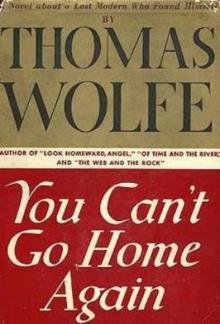
Thomas Wolfe, page 268
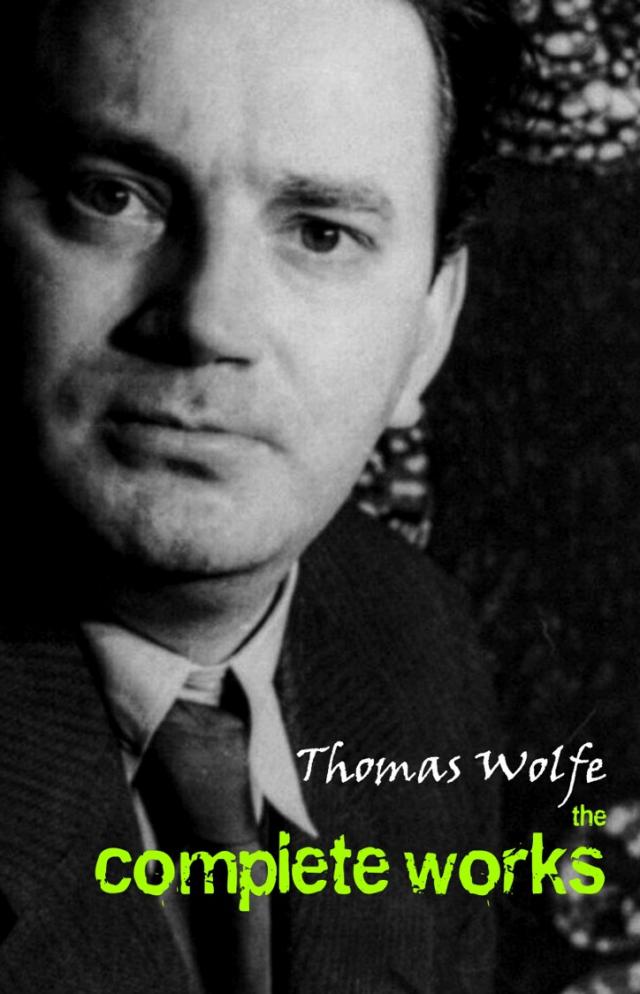


For a moment it seemed that he was so near to her that she could touch him with her hand. Then she remembered that he had left her, that his lost soul was wandering God knows where upon this earth, driven by what mad hunger, what blind fury, and his letter had said that his lost body now lay battered and broken in a foreign land. She felt she knew so well now what he needed, she felt that she could save him now if she could only speak to him.
She saw him as his talent wasted and lay idle, as his brain grew black with madness, as he used his strength to smash himself to pieces against life. She saw how he was being devoured by his own hunger as the power in him turned tooth and claw, like a wild beast, on itself, and on all the people who had loved him, and she felt that she alone knew how to save and feed him. She was the wall he lacked, the imprisoned warmth he searched through all the world to find. Now that she could not speak to him, she wanted to write it all down for him, all the rich deposits of her life, the harvest of all her seasons to October; but her heart was a tongueless eloquence, she had never tried her skill at putting down such words, although their meaning was inside her.
Why are you absent in the night, my love? Where are you when the bells ring in the night? Now, there are bells again, how strange to hear the bells in this vast, sleeping city! Now, in a million little towns, now in the dark and lonely places of this earth, small bells are ringing out the time! O my dark soul, my child, my darling, my beloved, where are you now, and in what place, and in what time? O ring, sweet bells, above him while he sleeps! I send my love to you upon those bells.
Strange time, forever lost, forever flowing like the river! Lost time, lost people, and lost love—forever lost! There’s nothing you can hold there in the river! There’s nothing you can keep there in the river! It takes your love, it takes your life, it takes the great ships going out to sea, and it takes time, dark, delicate time, the little ticking moments of strange time that count us into death. Now in the dark I hear the passing of dark time, and all the sad and secret flowing of my life. All of my thoughts are flowing like the river, all of my life is passing like the river, I dream and talk and feel just like the river, as it flows by me, by me, by me, to the sea.
So she sat there thinking of these things until the clocks were striking twelve. The sound of the clocks was lost and broken in the wind, the leaf kept straining in the wind and would not fall, the dry leaves fled along the path before her.
And a policeman came and said: “It’s time you were in bed, young lady. Where do you live?”
And she said: “I have no home, for home is where the heart is, and the heart has been taken out of me, the heart has gone out of me entirely, and I am left alone to die here in the dark.”
And he asked her if she had been waiting for anyone, and she said yes, and she would wait forever, and he would not come. And he asked her to describe the person she was waiting for, for maybe he had seen him; and she said:
“He has the face of a demented angel, his head is wild and beautiful, and there is madness and darkness and evil in his brain. He is more cruel than death, and more lovely than a flower. His heart was made for love, and it is full of hate and darkness. His soul was made for light and purity, and it is poisoned by evil and vile suspicions. His brain should be a bright and flaming sword, and it is sick and twisted with its nightmares. He flies away from those who love and worship him, he stabs them to the heart and leaves them, he goes away with strangers who will do him harm. He is like a god, all made of light, and he lives alone in chains and darkness.”
Then the policeman said he had not seen anyone who looked like that.
And she said: “No, if you had seen him you would remember him, for there is no one like him. ‘His face is fair as heaven when singing birds unfold—’” and she could not go on, the tears were flowing down her face so fast she could not see, and they were choking her.
The policeman said she had been drinking, and it was true. She had been drinking all day long and she had had no food, and she had put the enemy into her mouth, and it had done no good. (“And this,” she thought, “is what you have brought me to, and we are decent people in my race, and full of pride, and I have been good and faithful all my life.”)
Then the man said if she did not go along he would arrest her and run her in; and she did not care, and said:
“I am ready to go. Take me to some other prison.”
And he was a good man and kept calling her “young lady,” he could not see her grey hair in the dark; and he said he did not want to do that, and he asked her where she lived, and when she said Park Avenue, he thought that she was drunk and joking him. But when she said that it was true and gave him her address, he said, with a suspicious look on his face:
“Is your name in the Social Registeh?”
(“God, aren’t they wonderful!” she thought. “You walk about and meet them every day, and then when you remember what they said to you, you don’t believe they said it, you don’t see how it could be true, it doesn’t seem possible, you think that someone made it up.”)
So then she said:
“No, my name is not in the Social Register, because I am nothing but a little Jew, and little Jews don’t get their names put in. But if there were a Social Register for little Jews, I’d be in that one.”
Then the policeman looked at her in a funny way. He took her by the arm and called her “lady,” and they walked up the path to the corner and got in a taxi.
The city wheeled before her in a drunken dance—a cliff of lights, a craziness of towers, a spoke of streets, the rags and sudden splinters of chaotic brightness. And in the forepart of her mind she could still see that red leaf tugging at the lowest bough, and the wind blew, and all things were lost and drowned there in the wind.
The light shook and trembled stiffly on the ground, there was a skirl of blown papers at the corner, below the light they chased each other about like winged things in a circle, and they never strayed nor stopped. They were the tattered records of yesterday, and already the immense world they spoke of had died and been forgotten.
She sat beside the policeman in the taxi, and he was quiet, and she listened to her own thoughts in the darkness:
We reach for life with all these traps and nets of words, our frenzy mounts up with our impotence, we try to keep and hold some single thing with all this fecund barrenness of print, and the sum of it all is a few blown papers in the wind. The possession of all things, even the air we breathe, is held from us, and the river of life and time flows through the grasp of our hands, and, for all our hunger and desire, we hold nothing except the trembling moments, one by one. Over the trodden and forgotten words, the rot and dusty burials of yesterday, we are born again into a thousand lives and deaths, and we are left forever with only the substance of our weary flesh, and the hauntings of an accidental memory.
There go two lovers blown by the wind. Their faces are turned towards each other, they are proud and smiling, there is no one like them in the world, and what they know no one has ever known before. They pass. Their feet have made no record on the pavements. They leave the corner to the wind, to emptiness, and to October.
The lights burn green, then red, and cliff by cliff the buildings rise along the avenue, appalling in their insolence, their pride, and their cold beauty. Across the street I see my sister’s shop, its eleven slender floors of elegance. The unadorned white flatness of its sides is like the hips of the women it adorns. The building is inspired and perfect, as cold, sensual, and luxurious as the life it feeds upon, for it lives on the insolence of fashion and the death of things. The legend of great wealth and of sterility is written on it, yet there is no sign, no symbol, and no single token in these flat blocks of stone wherein this story is engraved.
Now I see how a snake lies coiled and waiting at the heart of life, and I see how men come to love the adder and the asp. Some of the best and loveliest of us all have been afraid and died, and over all this cruelty of towers is the face of fear.
Oh, I want to cry out to them and tell them they were fools to be afraid! I want to say the things they were afraid to say—that love is rooted in the earth, that love is beautiful and everlasting, and that men must love life and hate the barren waste of death that will not die, and is afraid to die. There is a terrible thing that I have learned and that must be changed in us. These people who have been afraid have hated love. They hate the lover and they mock at love, and their hearts are full of dust and bitterness.
My sister and I were brave and beautiful as children. We were so strong, so faithful, and so full of love. The vexed weave and fabric of our childhood was so rich, but full of pain and joy, and most uncertain. There were my father and my mother, and our lovely Bella. They were so lost and beautiful that it almost seems now we had been the parents of our parents, the mothers of the children that begot us. We were both so young, so clear, so unperplexed, so richly gifted. The gift of structure and of beauty was alive in us, and everything we made was good.
The earth was ours because we loved the earth. We had the touch and gift of nature in us. We saw the life that all things have in them—the life that slowly beats its pulse out of the thickness of an old brick wall, the life that hangs wearily in the set of an old warped door, the life that lives in chairs and tables, and in old knives with worn silver handles, the life of all things that a man has used and dwelt in—a coat, a shoe, the set of your battered hat, my dear one. And then these streets and motored heights at which your soul shrank, these swarms and movements where your heart grew faint!
“The earth!” you said. “Give us the earth again!”
I tell you that the earth is here, and that we knew it. This is the soil, the harvest, and the earth. I tell you there has never been an earth more potent and more living than these streets and pavements. Perhaps, as you have said, there’s something in my rich Jew’s blood that loves a crowd. We swarm with honey, we like laughter, richness, movement, food, and the fullness of a crowd. This was my meadow. I knew it and I loved it, I walked about in it, these faces were my blades of grass. I understood the life that dwelt in it—the tired but happy life of streets when crowds have left them in the evening, the brooding calm of buildings breathing after use and labor, the quiet sounds of the day’s end, the smell of the sea and shipping that comes forever from the harbor, the last, red, earthless light of the sun that falls remotely, without violence or heat, upon the ancient red of old brick buildings. These, and a million other things, I knew and loved.
Therefore I know this is as good earth as the hills and mountains of your childhood land. What horror did you want to flee? Must you forever be a fool without a faith and eat your flesh?
“The horror of eight million faces!”
Remember eight—know one.
“The horror of two million books!”
Write one that has two thousand words of wisdom in it.
“Each window is a light, each light a room, each room a cell, each cell a person!”
All rooms, all windows, and all persons for your hunger? No. Return to one: fill all that room with light and glory, make it shine as no other room ever shone before, and all life living on this earth will share it with you.
Oh, if I could only cry out to you now and give my wisdom to you, and tell you that you must not fear these monsters of piled stone and brightness! There is no wonder and no mystery here you cannot fathom. If they build a Babel of ten thousand floors, or if a city of ten million men should shrink to a crawling wedge of ants, yet will my heart be whole in me, yet will I remember a leaf, and the coming of young green in April. For I have seen these quiet streets thicken with wheel and fume and clamor, I have seen the merry tide of lives and faces grow dense and wide, I have seen the human house melt down below inhuman towers, and I know no mystery in these signs. I told you once how my sister’s shop came from a dress she made for me out of a piece of picked-up bargain cloth: there was a touch of magic in her secret spirit, and out of it this building of proud stone has come. Is not a man, then, taller than a tower? Is not the mystery in an atom of tired flesh greater than all these soaring lights?
And now I think of quiet streets again, and brownstone houses, the old lost city of my childhood, and it seems almost close enough to lay my finger on it. I see the child’s face once more, I see the dozen persons I have been and was and am no longer. I hear old sounds, old songs, old laughter. The tide of memory surges across my heart with all its various freight of great and little things—the faces of the men in derby hats as they came towards me over Brooklyn Bridge, the laughter of lovers in dark streets, the tugging of a leaf upon a bough, a pool of sudden moonlight on the sea’s dark water on the night I met you, a skirl of blown papers on the street, a gnarled tree that hung across a broken wall in Maine, a voice that cried out and was silent long ago, and a song that my mother sang at dusk as she lay dying.
And I think of you! I think of you!
All things, all times out of my marvelous life come in together, and I think of all the beauty I have made and how it vanished. I see the stages of the theatres I have worked in, the end of the run, and the men taking down the scenes, the actors coming in and saying good-bye to one another: the brief glow and glory of my work and its quick death, the oblivion of the storehouse, the curtains lifted on the rows of empty seats.
And I think of you.
And you, I thought one night, were sitting there in darkness as all my heart cried out, “He has come back to me!” And I said: “Who’s there? Who is the man that’s sitting there?” But then I saw, I always see, it is not you. It is not you I see. And the ushers keep on turning up the empty seats.
And now I have come home again, home from the park in old October.
The policeman brought her home, and she hoped no one would be there. Katy let them in, and Esther told her to give the man some money and a drink.
And then she went into the darkness of her room, and stood in darkness listening to all the boats there on the river. She thought of him, and everything went whirling in her brain like blown leaves that scurry in the Park in old October.
She thought of him. Long, long into the night she thought of him.
(One!)
Oh now I hear the boats there on the river.
(Two!)
Oh now great boats are going down the river.
(Three!)
As long, long into the night I lay awake.
Time, please, time! What time is it? It’s time you were in bed, young lady. It’s time that you were dead, young lady. Yes, it’s time your darling died.
Time, please, time! I keep thinking of you all the time. Sometimes I cannot see your face, and then I cover my eyes with my hands and you come back, and it is just as if you are there and I am talking to you.
“With thee conversing I forget all time.” O God! How beautiful that is, and how true it is! I think of all the time that we have spent together, and all the wonder and the glory we have known. Would anyone ever believe it? Was there ever anything like it?
I take the book, the great anthology you gave me, and I read in it sometimes halfway through the night. God, the lovely things that can be found in it! I see that other hearts were heavy before mine, and that the poets in every time have all written of their grief. It is so beautiful, but what glory was ever greater than our own! Who has written about it? Who has put down my agony? Who ever loved as we did? Who ever knew the glory and the grief and all the lovely times that we have known together?
[¬]
50
THE LOOKING GLASS
In his hospital room in Munich, Monk sat on the edge of his bed. Facing him, on the wall, was a mirror above the dresser, and he stared into it.
“Man’s image in a broken looking glass.” What of his broken image in a looking glass unbroken?
Out of the dark pool of the looking glass, the Thing hinged forward at the waist, the trunk foreshortened, the thick neck sunken in the hulking shoulders, the barrel contours of the chest, the big paw clasped around the knee. So was he made, so fashioned.
And what nature had invented, human effort had improved. In the dark pool of the mirror the Thing was more grotesque and simian than it had ever been. Denuded of its shock of hair, the rakishly tonsured skull between the big wings of its ears came close upon the corrugated shortness of the forehead into the bushy ridges of the brow; below this, the small, battered features, the short pug nose, up-tilted, flattened towards the right (it had been broken at the center on the other side), the long upper lip, thick mouth, the general look of startled, quick attentiveness—it was a good job. Not since childhood had he looked so much the part the boys had made for him—the “Monk.”
He looked at it now, and it at him, with a quizzical, detached objectiveness, not as a child looks in a mirror, at the silent eloquence of his pooled self, unspeaking, saying “I,” but outside of it, and opposite, regardant, thinking, “Well, by God, you are a pretty sight!”—and meaning, not Himself, but It.
It looked back at him, breathing thickly through half-parted, swollen lips. (He could smell the odor of stale iodine, the dried, blood-wadded cotton in his nose.) He drew in hoarsely through the battered mouth, and in the looking glass the loosened teeth bared, caked with filaments of blood. Above the mouth, the nose smeared sideways on the face, the blood-injected eyes attentive now; below the eyes, the rainbow purple-green-and-yellow coloration of the face.