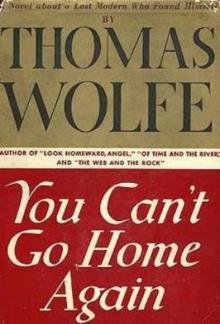
Thomas Wolfe, page 83



The mark of his madness was plain upon him: intuitively men knew he was not a poor man, and the people who had seen him so many times in State Street would nudge one another, saying: “You see that old guy? You’d think he was waitin’ for a handout from the Salvation Army, wouldn’t you? Well, he’s not. He’s got it, brother. Believe me, he’s got it good and plenty: he’s got it salted away where no one ain’t goin’ to touch it. That guy’s got a sock full of dough!”
“Jesus!” another remarks. “What good’s it goin’ to do an old guy like that? He can’t take any of it with him, can he?”
“You said it, brother,” and the conversation would become philosophical.
Bascom Pentland was himself conscious of his parsimony, and although he sometimes asserted that he was “only a poor man” he realized that his exaggerated economies could not be justified to his business associates on account of poverty: they taunted him slyly, saying, “Come on, Pentland, let’s go to lunch. You can get a good meal at the Pahkeh House for a couple of bucks.” Or “Say, Pentland, I know a place where they’re havin’ a sale of winter overcoats: I saw one there that would just suit you—you can get it for sixty dollars.” Or “Do you need a good laundry, Reverend? I know a couple of Chinks who do good work.”
To which Bascom, with the characteristic evasiveness of parsimony, would reply, snuffling derisively down his nose: “No, sir! You won’t catch me in any of their stinking restaurants. You never know what you’re getting: if you could see the dirty, nasty, filthy kitchens where your food is prepared you’d lose your appetite quick enough.” His parsimony had resulted in a compensating food mania: he declared that “in his young days” he “ruined his digestion by eating in restaurants,” he painted the most revolting pictures of the filth of these establishments, laughing scornfully down his nose as he declared: “I suppose you think it tastes better after some dirty, nasty, stinking nigger has wiped his old hands all over it” (phuh-phuh-phuh-phuh-phuh!)—here he would contort his face and snuffle scornfully down his nose; and he was bitter in his denunciation of “rich foods,” declaring they had “destroyed more lives than all the wars and all the armies since the beginning of time.”
As he had grown older he had become more and more convinced of the healthy purity of “raw foods,” and he prepared for himself at home raw revolting messes of chopped-up carrots, onions, turnips, even raw potatoes, which he devoured at table, smacking his lips with an air of keen relish, and declaring to his wife: “You may poison yourself on your old roasts and oysters and turkeys if you please: you wouldn’t catch me eating that stuff. No, sir! Not on your life! I think too much of my stomach!” But his use of the pronoun “you” was here universal rather than particular because if that lady’s longevity had depended on her abstinence from “roasts and oysters and turkeys” there was no reason why she should not have lived forever.
Or again, if it were a matter of clothing, a matter of fencing in his bones and tallows against the frozen nail of Boston winter, he would howl derisively: “An overcoat! Not on your life! I wouldn’t give two cents for all the old overcoats in the world! The only thing they’re good for is to gather up germs and give you colds and pneumonia. I haven’t worn an overcoat in thirty years, and I’ve never had the vestige—no! not the semblance—of a cold during all that time!”—an assertion that was not strictly accurate since he always complained bitterly of at least two or three during the course of a single winter, declaring at those times that no more hateful, treacherous, damnable climate than that of Boston had ever been known.
Similarly, if it were a question of laundries he would scornfully declare that he would not send “his shirts and collars to let some dirty old Chinaman spit and hock upon them—yes!” he would gleefully howl, as some new abomination of nastiness suggested itself to his teeming brain—“yes! and iron it in, too, so you can walk around done up in old Chinaman’s spit!”—(Phuh-phuh-phuh-phuh-phuh!)—here he would grimace, contort his rubbery lip, and laugh down his nose in forced snarls of gratification and triumph.
This was the old man who, even now, as his nephew sped to meet him, stood in his dusty little office clutching his raw and bony hands across his waist.
In spite of the bewildering elaboration of his uncle’s direction, the boy found his offices without much trouble. He went in and a moment later, his hand was being vigorously pumped by his uncle’s great stiff paw, and he heard that instant howling voice of welcome—the voice of a prophet calling from the mountain tops—coming to him without preliminary or introduction, as he had heard it last eight years before.
“Oh, hello, hello, hello. . . . How are you, how are you, how are you . . . say!” his uncle turned abruptly and in a high howling tone addressed several people who were staring at the young man curiously, “I want you all to meet my sister’s youngest son—my nephew, Mr. Eugene Gant . . . and say!” he bawled again, but in remoter tone, in a strangely confiding and insinuating tone—“would you know he was a Pentland by the look of him? . . . Can you see the family resemblance?” He smacked his rubbery lips together with an air of relish, and suddenly threw his great gaunt arms up and let them fall with an air of ecstatic jubilation, squinted his small sharp eyes together, contorted his rubbery lips in their amazing and grotesque grimace, and stamping ecstatically at the floor with one long stringy leg, taking random ecstatic kicks at any object that was within reach, he began to snuffle with his strange forced laughter, and howled deliriously, “Oh, my yes! . . . The thing is evident. . . . He is a Pentland beyond the shadow of a vestige of a doubt! . . . Oh, by all means, by all means, by all means!” and he went on snuffling, stamping, howling, and kicking at random objects in this way until the strange seizure of his mirth had somewhat subsided. Then, more quietly, he introduced his nephew to his associates in the curious business of which he was a partner.
And it was in this way that the boy first met the people in his uncle’s office—an office and people who were, during the years that followed, and in the course of hundreds of visits, to become a part of the fabric of his life—so hauntingly real, so strangely familiar that in the years that followed he could forget none of them, remember everything just as it was.
These offices, which he saw for the first time that day, were composed of two rooms, one in front and one behind, L-shaped, and set in the elbow of the building, so that one might look out at the two projecting wings of the building, and see lighted layers of offices, in which the actors of a dozen enterprises “took” dictation, clattered at typewriters, walked back and forth importantly, talked into telephones or, what they did with amazing frequency, folded their palms behind their skulls, placed their feet restfully on the nearest solid object, and gazed for long periods dreamily and tenderly at the ceilings.
Through the broad and usually very dirty panes of the window in the front office one could catch a glimpse of Faneuil Hall and the magnificent and exultant activity of the markets.
These dingy offices, however, from which a corner of this rich movement might be seen and felt, were merely the unlovely counterpart of millions of others throughout the country and, in the telling phrase of Baedeker, offered “little that need detain the tourist”: a few chairs, two scarred roll-top desks, a typist’s table, a battered safe with a pile of thumb-worn ledgers on top of it, a set of green filing cases, an enormous green, greasy water-jar always half filled with a rusty liquid that no one drank, and two spittoons, put there because Brill was a man who chewed and spat widely in all directions—this, save for placards, each bearing several photographs of houses with their prices written below them—8 rooms, Dorchester, $6500; 5 rooms and garage, Melrose, $4500, etc.—completed the furniture of the room, and the second room, save for the disposition of objects, was similarly adorned.
Such then was the scene in which the old man and his nephew met again after a separation of eight years.
[¬]
X
The youth was drowned in the deepest sea—an atom bombarded, ignorant of all defense in a tumultuous world. The shell of custom, the easy thoughtless life which had sucked pleasure from the world about, these four years past, crumbled like caked mud. He was nothing, nobody—there was no heart or bravery left in him; he was conscious of unfathomable ignorance—the beginning, as Socrates suggested, of wisdom—he was lost.
He had wanted to cut a figure in the world—he had simply never imagined the number of people that were in it. And like most people who hug loneliness to them like a lover, the need of occasional companionship, forever tender and forever true, which might be summoned or dismissed at will, cut through him like a sword.
There was, of course, among the members of the play-writing class an energetic and calculated sociability. The supposed advantages of discussion with one another, the interplay of wit, and so on, above all what was called “the exchange of ideas,” but what most often was merely the exchange of other people’s ideas,—all these were mentioned often; they were held in the highest esteem as one of the chief benefits to be derived from the course.
Manifestly, one could write anywhere. But where else could one write with around one the constant stimulus of other people who also wrote? Where could one learn one’s faults so well as before a critical and serious congress of artists? They were content with it—they got what they wanted. But the lack of warmth, the absence of inner radial heat which, not being fundamental in the structure of their lives, had never been wanted, filled him with horror and impotent fury.
The critical sense had stirred in him hardly at all, the idea of questioning authority and position had not occurred to him.
He was facing one of the oldest—what, for the creative mind, must be one of the most painful—problems of the spirit—the search for a standard of taste. He had, at seventeen, as a sophomore, triumphantly denied God, but he was unable now to deny Robert Browning. It had never occurred to him that there was a single authoritatively beautiful thing in the world that might not be agreed on, by a community of all the enlightened spirits of the universe, as beautiful. Every one, of course, knew that King Lear was one of the greatest plays that had ever been written. Only, he was beginning to find, every one didn’t.
And now for the first time he began to worry about being “modern.” He had the great fear young people have that they will not be a part of the most advanced literary and artistic movements of the time. Several of the young men he knew had contributed stories, poems, and criticisms to little reviews, published by and for small groups of literary adepts. They disposed of most of the established figures with a few well-chosen words of contempt, and they replaced these figures with obscure names of their own who, they assured him, were the important people of the future.
For the first time, he heard the word “Mid-Victorian” applied as a term of opprobrium. What its implications were he had no idea. Stevenson, too, to him hardly more than a writer of books for boys, books that he had read as a child with interest and delight, was a symbol of some vague, but monstrously pernicious influence.
But he discovered at once that to voice any of these questionings was to brand oneself in the esteem of the group; intuitively he saw that their jargon formed a pattern by which they might be placed and recognized; that, to young men most of all, to be placed in a previous discarded pattern was unendurable disgrace. It represented to them the mark of intellectual development, just as in a sophomore’s philosophy, the belief that God is an old man with a long beard brings ridicule and odium upon the believer, but the belief that God is an ocean without limit, or an all-pervasive and inclusive substance, or some other equally naive and extraordinary idea, is regarded as a certain sign of bold enlightenment. Thus, it often happens, when one thinks he has extended the limits of his life, broken the bonds, and liberated himself in the wider ether, he has done no more than to exchange a new superstition for an old one, to forsake a beautiful myth for an ugly one.
The young men in Professor Hatcher’s class were sorry for many things and many people.
“Barrie?” began Mr. Scoville, an elegant and wealthy young dawdler from Philadelphia, who, by his own confession, had spent most of his life in France, “Barrie?” he continued regretfully, in answer to a question. For a moment, he drew deeply on his cigarette, then raised sad, languid eyes. “I’m sorry,” he said gently, with a slight regretful movement of his head—“I can’t read him. I’ve tried it—but it simply can’t be done.” They laughed, greatly pleased.
“But it is a pity, you know, a great pity,” Francis Starwick remarked languidly, using effectively his trick of giving a tired emphasis to certain words which conveyed a kind of sad finality, a weary earnestness to what he said. He turned to go.
“But—but—but—how—how—how very interesting! Why is it, Frank?” Hugh Dodd demanded with his earnest stammering eagerness. He was profoundly respectful of Starwick’s critical ability.
“Why is what?” said Starwick in his curiously mannered voice, his air of languid weariness.
“Why is it a great pity about Barrie?” knitting his bushy brows together, and scowling with an air of intense concentration over his words as he spoke. “Because,” said the appraiser of Values, as he prepared to depart, arranging with feminine luxuriousness the voluptuous folds of his blue silk scarf, “the man really had something one time. He really did. Something strange and haunting—the genius of the Kelt.” Swinging his cane slowly, acutely and painfully conscious that he was being watched, with the agonizing stiffness that was at the bottom of his character, he strolled off across the Yard, stark and lovely with the harsh white snow and wintry branches of bleak winter.
“You know—you know—you know—that’s very interesting,” said Dodd, intent upon his words. “I’d—I’d—I’d never thought of it in just that way.”
“Barrie,” drawled Wood, the maker of epigrams, “is a stick of taffy, floating upon a sea of molasses.”
There was laughter.
He was forever making these epigrams; his face had a somewhat saturnine cast, his lips twisted ironically, his eyes shot splintered promises of satiric wisdom. He looked like a very caustically humorous person; but unhappily he had no humor. But they thought he had. No one with a face like that could be less than keen.
So he had something to say for every occasion. He had discovered that the manner counted for wit. If the talk was of Shaw’s deficiencies as a dramatist, he might say:
“But, after all, if one is going in for all that sort of thing, why not have lantern slides and a course of lectures.”
Thus he was known, not merely as a subtle-souled and elusive psychologist but also as a biting wit.
“Galsworthy wrote something that looked like a play once,” some one remarked. “There were parts of Justice that weren’t bad.”
“Yes. Yes,” said Dodd, peering intently at his language. “Justice—there were some interesting things in that. It’s—it’s—it’s rather a pity about him, isn’t it?” And as he said these words he frowned earnestly and intently. There was genuine pity in his voice, for the man’s spirit had great charity and sweetness in it.
As they dispersed, some one remarked that Shaw might have made a dramatist if he had ever known anything about writing a play.
“But he dates so—how he dates!” Scoville remarked.
“Those earlier plays——”
“Yes, I agree”—thus Wood again. “Almost Mid-Victorian. Shaw:—a prophet with his face turned backwards.” Then they went away in small groups.
[¬]
XI
To reach his own “office,” as Bascom Pentland called the tiny cubicle in which he worked and received his clients, the old man had to traverse the inner room and open a door in a flimsy partition of varnished wood and glazed glass at the other end. This was his office: it was really a very narrow slice cut off from the larger room, and in it there was barely space for one large dirty window, an ancient dilapidated desk and swivel chair, a very small battered safe buried under stacks of yellowed newspapers, and a small bookcase with glass doors and two small shelves on which there were a few worn volumes. An inspection of these books would have revealed four or five tattered and musty law books in their ponderous calf-skin bindings—one on Contracts, one on Real Property, one on Titles—a two-volume edition of the poems of Matthew Arnold, very dog-eared and thumbed over; a copy of Sartor Resartus, also much used; a volume of the essays of Ralph Waldo Emerson; the Iliad in Greek with minute yellowed notations in the margins; a volume of the World Almanac several years old; and a very worn volume of the Holy Bible, greatly used and annotated in Bascom’s small, stiffly laborious, and meticulous hand.
If the old man was a little late, as sometimes happened, he might find his colleagues there before him. Miss Muriel Brill, the typist, and the eldest daughter of Mr. John T. Brill, would be seated in her typist’s chair, her heavy legs crossed as she bent over to undo the metal latches of the thick galoshes she wore during the winter season. It is true there were also other seasons when Miss Brill did not wear galoshes, but so sharply and strongly do our memories connect people with certain gestures which, often for an inscrutable reason, seem characteristic of them, that any frequent visitor to these offices at this time of day would doubtless have remembered Miss Brill as always unfastening her galoshes. But the probable reason is that some people inevitably belong to seasons, and this girl’s season was winter—not blizzards or howling winds, or the blind skirl and sweep of snow, but gray, grim, raw, thick, implacable winter: the endless successions of gray days and gray monotony. There was no spark of color in her, her body was somewhat thick and heavy, her face was white, dull, and thick-featured and instead of tapering downwards, it tapered up: it was small above, and thick and heavy below, and even in her speech, the words she uttered seemed to have been chosen by an automaton, and could only be remembered later by their desolate banality. One always remembered her as saying as one entered: “. . . Hello! . . . You’re becoming quite a strangeh! . . . It’s been some time since you was around, hasn’t it? . . . I was thinkin’ the otheh day it had been some time since you was around. . . . I’d begun to think you had forgotten us. . . . Well, how’ve you been? Lookin’ the same as usual, I see. . . . Me? . . . Oh, can’t complain. . . . Keepin’ busy? I’ll say! I manage to keep goin’. . . . Who you lookin’ for? Father? He’s in there. . .. Why, yeah! Go right on in.”
“Jesus!” another remarks. “What good’s it goin’ to do an old guy like that? He can’t take any of it with him, can he?”
“You said it, brother,” and the conversation would become philosophical.
Bascom Pentland was himself conscious of his parsimony, and although he sometimes asserted that he was “only a poor man” he realized that his exaggerated economies could not be justified to his business associates on account of poverty: they taunted him slyly, saying, “Come on, Pentland, let’s go to lunch. You can get a good meal at the Pahkeh House for a couple of bucks.” Or “Say, Pentland, I know a place where they’re havin’ a sale of winter overcoats: I saw one there that would just suit you—you can get it for sixty dollars.” Or “Do you need a good laundry, Reverend? I know a couple of Chinks who do good work.”
To which Bascom, with the characteristic evasiveness of parsimony, would reply, snuffling derisively down his nose: “No, sir! You won’t catch me in any of their stinking restaurants. You never know what you’re getting: if you could see the dirty, nasty, filthy kitchens where your food is prepared you’d lose your appetite quick enough.” His parsimony had resulted in a compensating food mania: he declared that “in his young days” he “ruined his digestion by eating in restaurants,” he painted the most revolting pictures of the filth of these establishments, laughing scornfully down his nose as he declared: “I suppose you think it tastes better after some dirty, nasty, stinking nigger has wiped his old hands all over it” (phuh-phuh-phuh-phuh-phuh!)—here he would contort his face and snuffle scornfully down his nose; and he was bitter in his denunciation of “rich foods,” declaring they had “destroyed more lives than all the wars and all the armies since the beginning of time.”
As he had grown older he had become more and more convinced of the healthy purity of “raw foods,” and he prepared for himself at home raw revolting messes of chopped-up carrots, onions, turnips, even raw potatoes, which he devoured at table, smacking his lips with an air of keen relish, and declaring to his wife: “You may poison yourself on your old roasts and oysters and turkeys if you please: you wouldn’t catch me eating that stuff. No, sir! Not on your life! I think too much of my stomach!” But his use of the pronoun “you” was here universal rather than particular because if that lady’s longevity had depended on her abstinence from “roasts and oysters and turkeys” there was no reason why she should not have lived forever.
Or again, if it were a matter of clothing, a matter of fencing in his bones and tallows against the frozen nail of Boston winter, he would howl derisively: “An overcoat! Not on your life! I wouldn’t give two cents for all the old overcoats in the world! The only thing they’re good for is to gather up germs and give you colds and pneumonia. I haven’t worn an overcoat in thirty years, and I’ve never had the vestige—no! not the semblance—of a cold during all that time!”—an assertion that was not strictly accurate since he always complained bitterly of at least two or three during the course of a single winter, declaring at those times that no more hateful, treacherous, damnable climate than that of Boston had ever been known.
Similarly, if it were a question of laundries he would scornfully declare that he would not send “his shirts and collars to let some dirty old Chinaman spit and hock upon them—yes!” he would gleefully howl, as some new abomination of nastiness suggested itself to his teeming brain—“yes! and iron it in, too, so you can walk around done up in old Chinaman’s spit!”—(Phuh-phuh-phuh-phuh-phuh!)—here he would grimace, contort his rubbery lip, and laugh down his nose in forced snarls of gratification and triumph.
This was the old man who, even now, as his nephew sped to meet him, stood in his dusty little office clutching his raw and bony hands across his waist.
In spite of the bewildering elaboration of his uncle’s direction, the boy found his offices without much trouble. He went in and a moment later, his hand was being vigorously pumped by his uncle’s great stiff paw, and he heard that instant howling voice of welcome—the voice of a prophet calling from the mountain tops—coming to him without preliminary or introduction, as he had heard it last eight years before.
“Oh, hello, hello, hello. . . . How are you, how are you, how are you . . . say!” his uncle turned abruptly and in a high howling tone addressed several people who were staring at the young man curiously, “I want you all to meet my sister’s youngest son—my nephew, Mr. Eugene Gant . . . and say!” he bawled again, but in remoter tone, in a strangely confiding and insinuating tone—“would you know he was a Pentland by the look of him? . . . Can you see the family resemblance?” He smacked his rubbery lips together with an air of relish, and suddenly threw his great gaunt arms up and let them fall with an air of ecstatic jubilation, squinted his small sharp eyes together, contorted his rubbery lips in their amazing and grotesque grimace, and stamping ecstatically at the floor with one long stringy leg, taking random ecstatic kicks at any object that was within reach, he began to snuffle with his strange forced laughter, and howled deliriously, “Oh, my yes! . . . The thing is evident. . . . He is a Pentland beyond the shadow of a vestige of a doubt! . . . Oh, by all means, by all means, by all means!” and he went on snuffling, stamping, howling, and kicking at random objects in this way until the strange seizure of his mirth had somewhat subsided. Then, more quietly, he introduced his nephew to his associates in the curious business of which he was a partner.
And it was in this way that the boy first met the people in his uncle’s office—an office and people who were, during the years that followed, and in the course of hundreds of visits, to become a part of the fabric of his life—so hauntingly real, so strangely familiar that in the years that followed he could forget none of them, remember everything just as it was.
These offices, which he saw for the first time that day, were composed of two rooms, one in front and one behind, L-shaped, and set in the elbow of the building, so that one might look out at the two projecting wings of the building, and see lighted layers of offices, in which the actors of a dozen enterprises “took” dictation, clattered at typewriters, walked back and forth importantly, talked into telephones or, what they did with amazing frequency, folded their palms behind their skulls, placed their feet restfully on the nearest solid object, and gazed for long periods dreamily and tenderly at the ceilings.
Through the broad and usually very dirty panes of the window in the front office one could catch a glimpse of Faneuil Hall and the magnificent and exultant activity of the markets.
These dingy offices, however, from which a corner of this rich movement might be seen and felt, were merely the unlovely counterpart of millions of others throughout the country and, in the telling phrase of Baedeker, offered “little that need detain the tourist”: a few chairs, two scarred roll-top desks, a typist’s table, a battered safe with a pile of thumb-worn ledgers on top of it, a set of green filing cases, an enormous green, greasy water-jar always half filled with a rusty liquid that no one drank, and two spittoons, put there because Brill was a man who chewed and spat widely in all directions—this, save for placards, each bearing several photographs of houses with their prices written below them—8 rooms, Dorchester, $6500; 5 rooms and garage, Melrose, $4500, etc.—completed the furniture of the room, and the second room, save for the disposition of objects, was similarly adorned.
Such then was the scene in which the old man and his nephew met again after a separation of eight years.
[¬]
X
The youth was drowned in the deepest sea—an atom bombarded, ignorant of all defense in a tumultuous world. The shell of custom, the easy thoughtless life which had sucked pleasure from the world about, these four years past, crumbled like caked mud. He was nothing, nobody—there was no heart or bravery left in him; he was conscious of unfathomable ignorance—the beginning, as Socrates suggested, of wisdom—he was lost.
He had wanted to cut a figure in the world—he had simply never imagined the number of people that were in it. And like most people who hug loneliness to them like a lover, the need of occasional companionship, forever tender and forever true, which might be summoned or dismissed at will, cut through him like a sword.
There was, of course, among the members of the play-writing class an energetic and calculated sociability. The supposed advantages of discussion with one another, the interplay of wit, and so on, above all what was called “the exchange of ideas,” but what most often was merely the exchange of other people’s ideas,—all these were mentioned often; they were held in the highest esteem as one of the chief benefits to be derived from the course.
Manifestly, one could write anywhere. But where else could one write with around one the constant stimulus of other people who also wrote? Where could one learn one’s faults so well as before a critical and serious congress of artists? They were content with it—they got what they wanted. But the lack of warmth, the absence of inner radial heat which, not being fundamental in the structure of their lives, had never been wanted, filled him with horror and impotent fury.
The critical sense had stirred in him hardly at all, the idea of questioning authority and position had not occurred to him.
He was facing one of the oldest—what, for the creative mind, must be one of the most painful—problems of the spirit—the search for a standard of taste. He had, at seventeen, as a sophomore, triumphantly denied God, but he was unable now to deny Robert Browning. It had never occurred to him that there was a single authoritatively beautiful thing in the world that might not be agreed on, by a community of all the enlightened spirits of the universe, as beautiful. Every one, of course, knew that King Lear was one of the greatest plays that had ever been written. Only, he was beginning to find, every one didn’t.
And now for the first time he began to worry about being “modern.” He had the great fear young people have that they will not be a part of the most advanced literary and artistic movements of the time. Several of the young men he knew had contributed stories, poems, and criticisms to little reviews, published by and for small groups of literary adepts. They disposed of most of the established figures with a few well-chosen words of contempt, and they replaced these figures with obscure names of their own who, they assured him, were the important people of the future.
For the first time, he heard the word “Mid-Victorian” applied as a term of opprobrium. What its implications were he had no idea. Stevenson, too, to him hardly more than a writer of books for boys, books that he had read as a child with interest and delight, was a symbol of some vague, but monstrously pernicious influence.
But he discovered at once that to voice any of these questionings was to brand oneself in the esteem of the group; intuitively he saw that their jargon formed a pattern by which they might be placed and recognized; that, to young men most of all, to be placed in a previous discarded pattern was unendurable disgrace. It represented to them the mark of intellectual development, just as in a sophomore’s philosophy, the belief that God is an old man with a long beard brings ridicule and odium upon the believer, but the belief that God is an ocean without limit, or an all-pervasive and inclusive substance, or some other equally naive and extraordinary idea, is regarded as a certain sign of bold enlightenment. Thus, it often happens, when one thinks he has extended the limits of his life, broken the bonds, and liberated himself in the wider ether, he has done no more than to exchange a new superstition for an old one, to forsake a beautiful myth for an ugly one.
The young men in Professor Hatcher’s class were sorry for many things and many people.
“Barrie?” began Mr. Scoville, an elegant and wealthy young dawdler from Philadelphia, who, by his own confession, had spent most of his life in France, “Barrie?” he continued regretfully, in answer to a question. For a moment, he drew deeply on his cigarette, then raised sad, languid eyes. “I’m sorry,” he said gently, with a slight regretful movement of his head—“I can’t read him. I’ve tried it—but it simply can’t be done.” They laughed, greatly pleased.
“But it is a pity, you know, a great pity,” Francis Starwick remarked languidly, using effectively his trick of giving a tired emphasis to certain words which conveyed a kind of sad finality, a weary earnestness to what he said. He turned to go.
“But—but—but—how—how—how very interesting! Why is it, Frank?” Hugh Dodd demanded with his earnest stammering eagerness. He was profoundly respectful of Starwick’s critical ability.
“Why is what?” said Starwick in his curiously mannered voice, his air of languid weariness.
“Why is it a great pity about Barrie?” knitting his bushy brows together, and scowling with an air of intense concentration over his words as he spoke. “Because,” said the appraiser of Values, as he prepared to depart, arranging with feminine luxuriousness the voluptuous folds of his blue silk scarf, “the man really had something one time. He really did. Something strange and haunting—the genius of the Kelt.” Swinging his cane slowly, acutely and painfully conscious that he was being watched, with the agonizing stiffness that was at the bottom of his character, he strolled off across the Yard, stark and lovely with the harsh white snow and wintry branches of bleak winter.
“You know—you know—you know—that’s very interesting,” said Dodd, intent upon his words. “I’d—I’d—I’d never thought of it in just that way.”
“Barrie,” drawled Wood, the maker of epigrams, “is a stick of taffy, floating upon a sea of molasses.”
There was laughter.
He was forever making these epigrams; his face had a somewhat saturnine cast, his lips twisted ironically, his eyes shot splintered promises of satiric wisdom. He looked like a very caustically humorous person; but unhappily he had no humor. But they thought he had. No one with a face like that could be less than keen.
So he had something to say for every occasion. He had discovered that the manner counted for wit. If the talk was of Shaw’s deficiencies as a dramatist, he might say:
“But, after all, if one is going in for all that sort of thing, why not have lantern slides and a course of lectures.”
Thus he was known, not merely as a subtle-souled and elusive psychologist but also as a biting wit.
“Galsworthy wrote something that looked like a play once,” some one remarked. “There were parts of Justice that weren’t bad.”
“Yes. Yes,” said Dodd, peering intently at his language. “Justice—there were some interesting things in that. It’s—it’s—it’s rather a pity about him, isn’t it?” And as he said these words he frowned earnestly and intently. There was genuine pity in his voice, for the man’s spirit had great charity and sweetness in it.
As they dispersed, some one remarked that Shaw might have made a dramatist if he had ever known anything about writing a play.
“But he dates so—how he dates!” Scoville remarked.
“Those earlier plays——”
“Yes, I agree”—thus Wood again. “Almost Mid-Victorian. Shaw:—a prophet with his face turned backwards.” Then they went away in small groups.
[¬]
XI
To reach his own “office,” as Bascom Pentland called the tiny cubicle in which he worked and received his clients, the old man had to traverse the inner room and open a door in a flimsy partition of varnished wood and glazed glass at the other end. This was his office: it was really a very narrow slice cut off from the larger room, and in it there was barely space for one large dirty window, an ancient dilapidated desk and swivel chair, a very small battered safe buried under stacks of yellowed newspapers, and a small bookcase with glass doors and two small shelves on which there were a few worn volumes. An inspection of these books would have revealed four or five tattered and musty law books in their ponderous calf-skin bindings—one on Contracts, one on Real Property, one on Titles—a two-volume edition of the poems of Matthew Arnold, very dog-eared and thumbed over; a copy of Sartor Resartus, also much used; a volume of the essays of Ralph Waldo Emerson; the Iliad in Greek with minute yellowed notations in the margins; a volume of the World Almanac several years old; and a very worn volume of the Holy Bible, greatly used and annotated in Bascom’s small, stiffly laborious, and meticulous hand.
If the old man was a little late, as sometimes happened, he might find his colleagues there before him. Miss Muriel Brill, the typist, and the eldest daughter of Mr. John T. Brill, would be seated in her typist’s chair, her heavy legs crossed as she bent over to undo the metal latches of the thick galoshes she wore during the winter season. It is true there were also other seasons when Miss Brill did not wear galoshes, but so sharply and strongly do our memories connect people with certain gestures which, often for an inscrutable reason, seem characteristic of them, that any frequent visitor to these offices at this time of day would doubtless have remembered Miss Brill as always unfastening her galoshes. But the probable reason is that some people inevitably belong to seasons, and this girl’s season was winter—not blizzards or howling winds, or the blind skirl and sweep of snow, but gray, grim, raw, thick, implacable winter: the endless successions of gray days and gray monotony. There was no spark of color in her, her body was somewhat thick and heavy, her face was white, dull, and thick-featured and instead of tapering downwards, it tapered up: it was small above, and thick and heavy below, and even in her speech, the words she uttered seemed to have been chosen by an automaton, and could only be remembered later by their desolate banality. One always remembered her as saying as one entered: “. . . Hello! . . . You’re becoming quite a strangeh! . . . It’s been some time since you was around, hasn’t it? . . . I was thinkin’ the otheh day it had been some time since you was around. . . . I’d begun to think you had forgotten us. . . . Well, how’ve you been? Lookin’ the same as usual, I see. . . . Me? . . . Oh, can’t complain. . . . Keepin’ busy? I’ll say! I manage to keep goin’. . . . Who you lookin’ for? Father? He’s in there. . .. Why, yeah! Go right on in.”