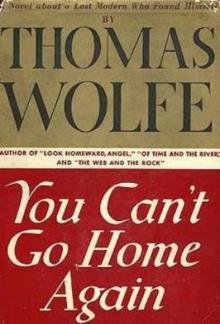
Thomas Wolfe, page 456



As I approached, I saw her thrust her hand into the pocket of her overcoat, a match flared, and for a moment I saw Edith plainly, the small flower of her face framed in the wavering light as she lowered her head to light her cigarette.
The light went out, I saw the small respiring glow of her cigarette before the white blur of her face, I passed her swiftly, head bent, without speaking, my heart filled with the sense of strangeness and wonder which the family had aroused in me.
Then I walked on up the road, muttering to myself. The house was dark when I got there, but when I entered my sitting room the place was still warmly and softly luminous with the glow of hot coals in the grate. I turned the lights on, shut the door behind me, and hurled several lumps of coal upon the bedded coals. In a moment the fire was blazing and crackling cheerfully, and getting a kind of comfort and satisfaction from its activity, I flung off my coat, went over to the sideboard, poured out a stiff drink of scotch from a bottle there, and coming back to the fire, flung myself into a chair, and began to stare sullenly into the dancing flames.
How long I sat there in this stupor of sullen and nameless fury, I did not know, but I was sharply roused at length by footsteps light and rapid on the gravel, shocked into a start of surprise by a figure that appeared suddenly at one of the French windows that opened directly from my sitting room to the level sward of velvet lawn before the house.
I peered through the glass for a moment with an astonished stare before I recognized the face of Edith Coulson. I opened the doors at once, she came in quickly, smiling at my surprise, and at the glass which I was holding foolishly, half-raised in my hand.
I continued to look at her with an expression of gape-mouthed astonishment and in a moment became conscious of her smiling glance, the cool sweet assurance of her young voice.
“I say!” she was saying cheerfully. “What a lucky thing to find you up! I came away without any key—I should have had to wake the whole house up—so when I saw your light—” she concluded briskly, “—what luck! I hope you don’t mind.”
“Why no-o, no,” I stammered foolishly, still staring dumbly at her. “No—no-o—not at all,” I blundered on. Then, suddenly coming to myself with a burst of galvanic energy, I shut the windows, pushed another chair before the fire, and said:
“Won’t you sit down and have a drink before you go?”
“Thanks,” she said crisply. “I will—yes. What a jolly fire you have.” As she talked, she took off her coat and hat swiftly and put them on a chair. Her face was flushed and rosy, beaded with small particles of rain, and for a moment she stood before the mirror arranging her hair, which had been tousled by the wind.
The girl was slender, tall, and very lovely with the kind of beauty they have when they are beautiful—a beauty so fresh, fair, and delicate that it seems to be given to just a few of them to compensate for all the grimly weathered ugliness of the rest. Her voice was also lovely, sweet, and musical, and when she talked, all the notes of tenderness and love were in it. But she had the same hard bright look in her eye that her mother had, the faint set smile around her mouth: as we stood there talking, she was standing very close to me, and I could smell the fragrance of her hair, and felt an intolerable desire to put my hand upon hers and was almost certain she would not draw away. But the hard bright look was in her eye, the faint set smile around her mouth, and I did nothing.
“What’ll you have?” I said. “Whiskey?”
“Yes, thank you,” she said with the same sweet crisp assurance with which she always spoke, “and a splash of soda.” I struck a match and held it for her while she lit the cigarette she was holding in her hand, and in a moment returned to her with the drink. Then she sat down, crossed her legs, and for a moment puffed thoughtfully at her cigarette, as she stared into the fire. The storm moaned in the great trees along the road, and near the house, and suddenly a swirl of rain struck the windows with a rattling blast. The girl stirred a little in her chair, restlessly, shivered:
“Listen!” she said. “What a night! Horrible weather we have here, isn’t it?”
“I don’t know. I don’t like the fog and rain so well. But this—the way it is tonight—” I nodded toward the window—“I like it.”
She looked at me for a moment.
“Oh,” she said non-committally. “You do.” Then, as she sipped her drink, she looked curiously about the room, her reflective glance finally resting on my table where there was a great stack of ledgers in which I wrote.
“I say,” she cried again. “What are you doing with all those big books there?”
“I write in them.”
“Really?” she said, in a surprised tone. “I should think it’d be an awful bother carrying them around when you travel.”
“It is. But it’s the best way I’ve found of keeping what I do together.”
“Oh,” she said, as before, and continued to stare curiously at me with her fair, lovely young face, the curiously hard, bright, and unrevealing glance of her eye. “I see. . . . But why do you come to such a place as this to write?” she said presently. “Do you like it here?”
“I do. As well as any place I’ve ever known.”
“Oh! . . . I should think a writer would want a different kind of place.”
“What kind?”
“Oh—I don’t know—Paris—London—some place like that where there is lots of life—people—fun—I should think you’d work better in a place like that.”
“I work better here.”
“But don’t you get awfully fed up sitting in here all day long and writing in those enormous books?”
“I do, yes.”
“I should think you would . . . I should think you’d want to get away from it sometime.”
“Yes. I do want to—every day—almost all the time.”
“Then why don’t you?” she said crisply. “Why don’t you go off some week-end for a little spree. I should think it would buck you up no end.”
“It would—yes. Where should I go?”
“Oh, Paris, I suppose. . . . Or London! London!” she cried. “London is quite jolly if you know it.”
“I’m afraid I don’t know it.”
“But you’ve been to London,” she said in a surprised tone.
“Oh, yes. I lived there for several months.”
“Then you know London,” she said impatiently. “Of course you do.”
“I’m afraid I don’t know it very well. I don’t know many people there—and after all, that’s the thing that counts, isn’t it?”
She looked at me curiously for a moment with the faint hard smile around the edges of her lovely mouth. “—Should think that might be arranged,” she said with a quiet, an enigmatic humor. Then, more directly, she added: “That shouldn’t be difficult at all. Perhaps I can introduce you to some people.”
“That would be fine. Do you know many people there?”
“A good many,” she said. “I go there often—whenever I can.” She got up with a swift decisive movement, put her glass down on the mantel and cast her cigarette into the fire. Then she faced me, looking at me with a curiously bold, an almost defiant directness of her hard bright eyes, and she fixed me with this glance for a full moment before she spoke.
“In fact,” she said slowly in a moment, as she looked at me, “in fact—I am going there this week—to meet a friend.”
“Oh,” I said, looking at her stupidly. “When?”
Her gaze did not waver.
“Saturday,” she said. “I am going to meet someone there Saturday—Good night,” she said crisply. “Thanks awfully for letting me in—and for the drink.”
“Good night,” I said, and she was gone before I could say more, and I had closed the door behind her, and I could hear her light swift footsteps going down the hall and up the steps. And then there was nothing in the house but sleep and silence, and storm and darkness in the world around me, and for a long time—until the fire had crumbled to a fading glow of coals—I sat there staring at the flame.
Mrs. Coulson came into my room just once or twice while I was there. One morning she came in, spoke crisply and cheerfully, and walked over to the window looking out upon the velvet lawn and at the dreary impenetrable gray of foggy air. Although the room was warm, and there was a good fire burning in the grate, she clasped her arms together as she looked and shivered a little:
“Wretched weather, isn’t it?” she said in her crisp tones, her gaunt weathered face and toothy mouth touched by the faint fixed grin as she looked out with her bright hard stare. “Don’t you find it frightfully depressing? Most Americans do,” she said, getting the sharp disquieting sound into the word.
“Yes. I do, a little. We don’t have this kind of weather very often. But this is the time of year you get it here, isn’t it? I suppose you’re used to it by now.”
“Used to it,” she said crisply, turning her hard bright gaze upon me. “Not at all. I’ve known it all my life, but I’ll never get used to it. It is a wretched climate.”
“Still, you wouldn’t feel at home anywhere else, would you? You wouldn’t want to live outside of England.”
“No?” she said, staring at me with the faint set grin around her toothy mouth. “Why do you think so?”
“Because your home is here.”
“My home? My home is where they have fine days, and where the sun is always shining.”
“I wouldn’t like that. I’d get tired of sunlight all the time. I’d want some gray days and some fog and snow.”
“Yes, I suppose you would. But then, you’ve been used to having fine days all your life, haven’t you? With us, it’s different. I’m so fed up with fog and rain that I could do without it nicely, thank you, if I never saw it again. . . . I don’t think you could understand how much the sunlight means to us,” she said slowly. She turned, and for a moment looked out the window with her hard bright stare, the faint set grin about her mouth. “Sunlight—warmth—fine days forever! Warmth everywhere—in the earth, the sky, in the lives of people all around you—nothing but warmth and sunlight and fine days!”
“And where would you go to find all that? Does it exist?”
“Oh, of course!” she said crisply and good-naturedly, turning to me again. “There’s only one place to live—only one country where I want to live.”
“Where is that?”
“Italy,” she said. “That’s my real home. . . . I’d live the rest of my life there if I could.” For a moment longer she looked out the window, then turned briskly, saying:
“Why don’t you run over to Paris some week-end? After all, it’s only seven hours from London: if you left here in the morning you’d be there in time for dinner. It would be a good change for you. I should think a little trip like that would buck you up tremendously.”
Her words gave me a wonderful feeling of confidence and hope: I think she had traveled a great deal, and she had the casual, assured way of speaking of a voyage that made it seem very easy, and filled one with a sense of joy and adventure when she spoke about it. When I tried to think of Paris by myself, it had seemed very far away and hard to reach: London stood between it and me, and when I thought of the huge smoky web of London, the soft gray skies above me, and the enormous weight of lives that were hidden somewhere in that impenetrable fog, gray desolation and weariness of the spirit filled me. It seemed to me that I must draw each breath of that soft gray air with heavy weary effort, and that every mile of my journey would be a ghastly struggle through some viscous and material substance of soft heavy gray that weighted down my steps and filled my heart with desolation.
But when Mrs. Coulson spoke to me about it, suddenly it all seemed wonderfully easy and good. England was magically small, the Channel to be taken at a stride, and all the thrill, the joy, the mystery of Paris mine again—the moment that I chose to make it mine.
I looked at her gaunt weathered face, her toothy mouth with the faint fixed grin, the hard bright armor of her eyes, and wondered how anything so clear, so sharp, so crisp, and so incisive could have been shaped and grown beneath these soft and humid skies that numbed me, mind and heart and body, with their thick numb substance of gray weariness and desolation.
A day or two before I left, Edith came into my room one afternoon bearing a tray with tea and jam and buttered bread. I was sitting in my chair before the fire, and had my coat off: when she came in I scrambled to my feet, reached for my coat and started to put it on. In her young crisp voice she told me not to, and put the tray down on the table, saying that the maid was having her afternoon away.
Then for a moment she stood looking at me with her faint and enigmatic smile.
“So you’re leaving us?” she said presently.
“Yes. Tomorrow.”
“And where will you go from here?” she said.
“To Germany, I think. Just for a short time—two or three weeks.”
“And after that?”
“I’m going home.”
“Home?”
“Back to America.”
“Oh,” she said slowly. “I see.” In a moment she added, “We shall miss you.”
I wanted to talk to her more than I had ever wanted to talk to anyone in my life, but when I spoke, all that I could say, lamely, muttering, was:
“I’ll miss you, too.”
“Will you?” She spoke so quietly that I could scarcely hear her. “I wonder for how long?” she said.
“Forever,” I said, flushing miserably at the sound of the word, and yet not knowing any other word to say.
The faint hard smile about her mouth was a little deeper when she spoke again.
“Forever? That’s a long time when one is as young as you,” she said.
“I mean it. I’ll never forget you as long as I live.”
“We shall remember you,” she said quietly. “And I hope you think of us sometime—back here buried, lost, in all the fog and rain and ruin of England. How good it must be to know that none of the failure of the past can pull you down—that there will always be another day for you—a new beginning. I wonder if you Americans will ever know how fortunate you are,” the girl said.
“And yet you could not leave all this,” I said with a kind of desperate hope. “This old country you’ve lived in, known all your life. A girl like you could never leave a place like this to live the kind of life we have in America.”
“Couldn’t I?” she said with a quiet but unmistakable passion of conviction. “There’s nothing I’d like better.”
I stared at her blindly, dumbly, for a moment; suddenly all that I wanted to say and had not been able to say found release in a movement of my hands. I gripped her by the shoulders and pulled her to me and began to plead with her:
“Then why don’t you? I’ll take you there!—Look here—” my words were crazy, and I knew it, but as I spoke them, I believed all I said—“Look here! I haven’t much money—but in America you can make it if you want to! I’m going back there. You come, too—I’ll take you when I go!”
She had not tried to free herself; she just stood there passive, unresisting, as I poured that frenzied proposal in her ears. Now, with the same passive and unyielding movement, the bright armor of her young eyes, she stepped away, and stood looking at me silently for a moment, the faint hard smile at the edges of her mouth. Then, slowly, with an almost imperceptible movement, she shook her head. “Oh, you’ll forget about us all,” she said quietly. “You’ll forget about our lives here—buried in fog—and rain—and failure—and defeat.”
“Failure and defeat won’t last forever.”
“Sometimes they do,” she said with a quiet finality that froze my heart.
“Not for you—they won’t!” I said, and took her by the hand again with desperate entreaty. “Listen to me—” I blundered on incoherently, with the old feeling of nameless shame and horror. “You don’t need to tell me what it is—I don’t want to know—but whatever it is for you—it doesn’t matter—you can get the best of it.”
She said nothing, but just looked at me through that hard bright armor of her eyes, the obdurate finality of her smile.
“Good-bye,” she said, “I’ll not forget you either.” She looked at me for a moment curiously before she spoke again. “I wonder,” she said slowly, “if you’ll ever understand just what it was you did for me by coming here.”
“What was it?”
“You opened a door that I thought had been closed forever,” she said, “a door that let me look in on a world I thought I should never see again—a new bright world, a new life and a new beginning—for us all. And I thought that was something which would never happen to anyone in this house again.”
“It will to you,” I said, and took her hand again with desperate eagerness. “It can happen to you whenever you want it to. It’s yours, I’ll swear it to you, if you’ll only speak.”
She looked at me with her direct hard glance, an almost imperceptible movement of her head.
“I tell you I know what I’m talking about.”
Again she shook her head.
“You don’t know,” she said. “You’re young. You’re an American. There are some things you’ll never be old enough to know. For some of us there’s no return. Go back,” she said, “go back to the life you know—the life you understand—where there can always be a new beginning—a new life.”
“And you—” I said dumbly, miserably.
“Good-bye, my dear,” she said so low and gently I could scarcely hear her. “Think of me sometime, won’t you—I’ll not forget you.” And before I could speak, she kissed me once and was gone, so light and swift that I did not know it, until the door had closed behind her. And for some time, like a man in a stupor, I stood there looking out the window at the gray wet light of England.