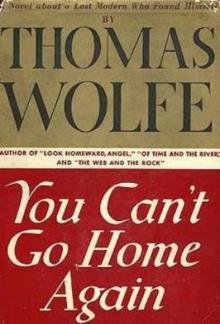
Thomas Wolfe, page 295



After she left him to greet some new arrivals, George stood there awkwardly for a moment with a scowl on his face and glanced about the room at the dazzling assemblage. In that attitude he cut a rather grotesque figure. The low brow with its frame of short black hair, the burning eves, the small, packed features, the long arms dangling to the knees, and the curved paws gave him an appearance more simian than usual, and the image was accentuated by his not-too-well-fitting dinner jacket. People looked at him and stared, then turned away indifferently and resumed their conversations.
“So!” he thought with somewhat truculent self-consciousness—“These are her fine friends! I might have known it!” he muttered to himself, without knowing at all what it was he might have known. The poise, assurance, and sophistication of all these sleek faces made him fancy a slight where none was offered or intended. “I’ll show them!” he growled absurdly beneath his breath, not having the faintest idea what he meant by that.
With this, he turned upon his heel and threaded his way through the brilliant throng toward the dining room.
“I mean! . . . You know! . . .”
At the sound of the words, eager, rapid, uttered in a rather hoarse yet strangely seductive tone of voice, Mrs. Jack smiled at the group to whom she had been talking. “There’s Amy!” she said.
Then, as she turned and saw the elflike head with its unbelievable harvest of ebony curls, the snub nose and the little freckles, and the lovely face so radiant with an almost boyish quality of animation and enthusiasm, she thought:
“Isn’t she beautiful! And—and—there is something so sweet, so—so good about her!”
Even as her mind framed its spontaneous tribute to the girlish apparition with the elflike head, Mrs. Jack knew that it was not true. No; Amy Carleton was many things, but no one could call her good. In fact, if she was not “a notorious woman,” the reason was that she had surpassed the ultimate limits of notoriety, even for New York. Everybody knew her, and knew all about her, yet what the truth was, or what the true image of that lovely counterfeit of youth and joy, no one could say.
Chronology? Well, for birth she had had the golden spoon. She had been born to enfabled wealth. Hers had been the childhood of a dollar princess, kept, costly, cabined, pruned, confined. A daughter of “Society,” her girlhood had been spent in rich schools and in travel, in Europe, Southampton, New York, and Palm Beach. By eighteen she was “out”—a famous beauty. By nineteen she was married. And by twenty she was divorced, her name tainted. It had been a sensational case which fairly reeked. Even at that time her conduct had been so scandalous that her husband had had no difficulty in winning a decree.
Since that time, seven years before, her career had defied the measurements of chronology. Although she was now only in her middle twenties, her life seemed to go back through aeons of iniquity. Thus one might remember one of the innumerable scandals that had been connected with her name, and then check oneself suddenly with a feeling of stunned disbelief. “Oh, no! It can’t be! That happened only three short years ago, and since then she’s—why she’s—” And one would stare in stupefaction at that elflike head, that snub nose, that boyishly eager face, like one who realized that he was looking at the dread Medusa, or at some enchantress of Circean cunning whose life was older than the ages and whose heart was old as hell.
It baffled time, it turned reality to phantasmal shapes. One could behold her as she was tonight, here in New York, this freckled, laughing image of happy innocence—and before ten days had made their round one might come upon her again in the corruptest gatherings of Paris, drugged fathoms deep in opium, foul-bodied and filth-bespattered, cloying in the embraces of a gutter rat, so deeply rooted in the cesspool that it seemed she must have been bred on sewage and had never known any other life.
Since her first marriage and divorce, she had been married twice again. The second marriage had lasted only twenty hours, and had been annulled. The third had ended when her husband shot himself.
And before and after that, and in between, and in and out, and during it and later on, and now and then, and here and there, and at home and abroad, and on the seven seas, and across the length and breadth of the five continents, and yesterday and tomorrow and forever—could it be said of her that she had been promiscous? No, that could not be said of her. For she had been as free as air, and one does not qualify the general atmosphere with such a paltry adjective as “promiscuous.” She had just slept with everybody—with white, black, yellow, pink, green, or purple—but she had never been promiscuous.
It was, in romantic letters, a period that celebrated the lady who was lost, the lovely creature in the green hat who was “never let off anything.” Her story was a familiar one: she was the ill-starred heroine of fate, a martyr to calamitous mischance, whose ruin had been brought about through tragic circumstances which she could not control, and for which she was not responsible.
Amy Carleton had her apologists who tried to cast her in this role. The stories told about her “start upon the downward path” were numerous. One touching version dated the beginning of the end from the time when, an innocent and fun-loving girl of eighteen, she had, in a moment of daring, lighted a cigarette at a dinner party in Southampton, attended by a large number of eminent dowagers. The girl’s downfall, according to this tale, had been brought about by this thoughtless and harmless little act. From that moment on—so the story went—the verdict of the dowagers was “thumbs down” on Amy. The evil tongues began to wag, scandal began to grow, her reputation was torn to shreds. Then, in desperation, the unhappy child did go astray: she took to drink, from drink to lovers, from lovers to opium, from opium to—everything.
All this, of course, was just romantic nonsense. She was the victim of a tragic doom indeed, but she herself had fashioned it. With her the fault, as with dear Brutus, lay not in her stars, but in herself. For, having been endowed with so many rare and precious things that most men lack—wealth, beauty, charm, intelligence, and vital energy—she lacked the will, the toughness, to resist. So, having almost all, but lacking this, she was the slave to her advantages. Her wealth had set a premium on every whim, and no one had ever taught her to say no.
In this she was the child of her own time. Her life expressed itself in terms of speed, sensational change, and violent movement, in a feverish tempo that never drew from its own energies exhaustion or surcease, but mounted constantly to insane excess. She had been everywhere and “seen everything”—in the way one might see things from the windows of an express train traveling eighty miles an hour. And, having quickly exhausted the conventional kaleidoscope of things to be seen, she had long since turned to an investigation of things more bizarre and sinister and hidden. Here, too, her wealth and powerful connections opened doors to her which were closed to other people.
So, now, she possessed an intimate and extensive acquaintance among the most sophisticated and decadent groups in “Society,” in all the great cities of the world. And her cult of the unusual had led to an exploration of the most shadowy border lines of life. She had an acquaintanceship among the underworld of New York, London, Paris, and Berlin which the police might have envied. And even with the police her wealth had secured for her dangerous privileges. In some way, known only to persons who control great power, financial or political, she had obtained a police card and was privileged to a reckless license in the operation of her low-slung racing car. Although she was near-sighted, she drove it at murderous speed through the seething highways of Manhattan, and as it flashed by she always got the courtesy of a police salute. All this in spite of the fact that she had demolished one car and killed a young man who had been driving with her, and in spite of the further fact that the police knew her as one who had been present at a drinking party at which one of the chieftains of the underworld had been slain.
It seemed, therefore, that her wealth and power and feverish energy could get her anything she wanted in any country of the world. People had once said: “What on earth is Amy going to do next?” But now they said: “What on earth is there left for her to do?” If life is to be expressed solely in terms of velocity and sensation, it seemed there was nothing left for her to do. Nothing but more speed, more change, more violence, more sensation—until the end. And the end? The end could only be destruction, and the mark of destruction was already apparent upon her. It was written in her eyes—in her tormented, splintered, and exploded vision. She had tried everything in life—except living. And she could never try that now because she had so long ago, and so irrevocably, lost the way. So there was nothing left for her to do except to die.
“If only—” people would think regretfully, as Mrs. Jack now thought as she looked at that elfin head—“oh, if only things had turned out differently for her!”—and then would seek back desperately through the labyrinthine scheme to find the clue to her disorder, saying: “Here—or here—or here—it happened here, you see!—If only——!”
If only men were so much clay, as they are blood, bone, marrow, passion, feeling! If they only were!
“I mean! . . . You know! . . .” With these words, so indicative of her undefined enthusiasm and inchoate thought, Amy jerked the cigarette away from her lips, laughed hoarsely and eagerly, and turned to her companions as if fairly burning with a desire to communicate to them something that filled her with exuberant elation. “I mean!” she cried again—“when you compare it with the stuff they’re doing nowadays!—I mean!—there’s simply no comparison!” Laughing jubilantly, as if the thought behind these splintered phrases must be perfectly clear to everyone, she drew furiously upon her cigarette again and jerked it from her lips.
The group of young people of which Amy was the radiant center, and which included not only the young Japanese who was her current lover but also the young Jew who had been his most recent predecessor, had moved over toward the portrait of Mrs. Jack above the mantel, and were looking up at it. The portrait deserved the praise that was now being heaped upon it. It was one of the best examples of Henry Mallows’ early work.
“When you look at it and think how long ago that was!—” cried Amy jubilantly, gesturing toward the picture with rapid thrusts of her cigarette—“and how beautiful she was then!—and how beautiful she is now!” she cried exultantly, laughed hoarsely, then cast her grey-green eyes around her in a glance of feverish exasperation—“I mean!—” she cried again, and drew impatiently on her cigarette—“there’s simply no comparison!” Then, realizing that she had not said what she had wanted to say, she went on: “Oh, I mean!—” she said in a tone almost of desperation and tossed her cigarette angrily away into the blazing fire—“the whole thing’s obvious!” she muttered, leaving everyone more bewildered than before. With a sudden and impulsive movement she turned toward Stephen Hook, who was still leaning with his elbow on one corner of the mantel, and demanded: “How long has it been, Steve? . . . I mean!—it’s been twenty years ago, hasn’t it?”
“Oh, quite all of that,” Hook answered in his cold, bored voice. In his agitation and embarrassment he moved still farther away until he almost had his back turned upon the group. “It’s been nearer thirty, I should think,” he tossed back over his shoulder, and then with an air of casual indifference he gave the date. “I should think it was done in nineteen-one or two—wasn’t it, Esther?” he said, turning to Mrs. Jack, who had now approached the group. “Around nineteen-one, wasn’t it?”
“What’s that?” said Mrs. Jack, and then went on immediately, “Oh, the picture! No, Steve. It was done in nineteen—” she checked herself so swiftly that it was not apparent to anyone but Hook—“in nineteen-six.” She saw just the trace of a smile upon his pale, bored face and gave him a quick, warning little look, but he just murmured:
“Oh. . . . I had forgotten it was as late as that.”
As a matter of fact, he knew the exact date, even to the month and day, when it had been finished. And, still musing on the vagaries of the sex, he thought: “Why will they be so stupid! She must understand that to anyone who knows the least thing about Mallows’ life the date is as familiar as the fourth of July!”
“Of course,” Mrs. Jack was saying rapidly, “I was just a child when it was made. I couldn’t have been more than eighteen at the time—if I was that.”
“Which would make you not more than forty-one now,” thought Hook cynically—“if you are that! Well, my dear, you were twenty when he painted you—and you had been married for more than two years. . . . Why do they do it!” he thought impatiently, and with a feeling of sharp annoyance. He looked at her and caught a quick expression—startled, almost pleading—in her eyes. He followed her glance, and saw the awkward figure of George Webber standing ill at ease in the doorway leading from the dining room. “Ah! It’s this boy!” he thought. “She’s told him then that—” and, suddenly, remembering her pleading look, he was touched with pity. Aloud, however, he merely murmured indifferently:
“Oh, yes, you couldn’t have been very old.”
“And God!” exclaimed Mrs. Jack, “but I was beautiful!”
She spoke the words with such innocent delight that they lost any trace of objectionable vanity they might have had, and people smiled at her affectionately. Amy Carleton, with a hasty little laugh, said impulsively:
“Oh, Esther! Honestly, you’re the most . . . ! But I mean!—” she cried impatiently, with a toss of her dark head, as if answering some invisible antagonist—“she is!”
“In all your days,” said Mrs. Jack, her face suffused with laughter, “you never saw the like of me! I was just like peaches and cream. I’d have knocked your eye out!”
“But, darling! You do now!” cried Amy. “What I mean to say is—darling, you’re the most . . . ! Isn’t she, Steve?” She laughed uncertainly, turning to Hook with feverish eagerness.
And he, seeing the ruin, the loss, the desperation in her splintered eyes, was sick with horror and with pity. He looked at her disdainfully, with weary, lidded eyes, said “What?” quite freezingly, and then turned away, saying with an accent of boredom: “Oh.”
Beside him was the smiling face of Mrs. Jack, and, above, the portrait of the lovely girl that she had been. And the anguish and the mystery of time stabbed through him.
“My God, here she is!” he thought. “Still featured like a child, still beautiful, still loving someone—a boy!—almost as lovely now as she was then when Mallows was a boy!”
1901! Ah, Time! The figures reeled in a drunken dance and he rubbed his hand before his eyes. In 1901! How many centuries ago was that? How many lives and deaths and floods, how many million days and nights of love, of hate, of anguish and of fear, of guilt, of hope, of disillusion and defeat here in the geologic æons of this monstrous catacomb, this riddled isle!—In 1901! Good God! It was the very Prehistoric Age of Man! Why, all that had happened several million years ago! Since then so much had begun and ended and been forgotten—so many untold lives of truth, of youth, of old age, so much blood and sweat and agony had gone below the bridge—why, he himself had lived through at least a hundred lives of it. Yes, he had lived and died through so many births and deaths and dark oblivions of it, had striven, fought, and hoped, and been destroyed through so many centuries of it, that even memory had failed—the sense of time had been wiped out—and all of it now seemed to have happened in a timeless dream. 1901! Looked at from here and now, it was a kind of Grand Canyon of the human nerves and bones and blood and brain and flesh and words and thought, all timeless now, all congealed, all solidified in an unchanging stratum there impossibly below, mixed into a general geologic layer with all the bonnets, bustles, and old songs, the straw hats and the derbies, the clatter of forgotten hooves, the thunder of forgotten wheels upon forgotten cobbles—all merged together now with the skeletons of lost ideas in a single stratum of the sunken world—while she——
—She! Why, surely she had been a part of it with him!
She had turned to speak to another group, and he could hear her saying:
“Oh yes, I knew Jack Reed. He used to come to Mabel Dodge’s place. We were great friends. . . . That was when Alfred Stieglitz had started his salon——”
Ah, all these names! Had he not been with these as well? Or, was it but another shape, a seeming, in this phantasmal shadow-show of time? Had he not been beside her at the launching of the ship? Had they not been captives together among Thracian faces? Had he not lighted tapers to the tent when she had come to charm remission from the lord of Macedon?—All these were ghosts—save she! And she—devouring child of time—had of this whole huge company of ghosts alone remained immortal and herself, had shed off the chrysalis of all these her former selves as if each life that she had lived was nothing but an outworn garment, and now stood here—here! Good God!—upon the burnt-out candle-end of time—with her jolly face of noon, as if she had just heard of this brave new world on Saturday—and would see if all of it was really true tomorrow!
Mrs. Jack had turned back once more at the sound of Amy’s voice and had bent forward to listen to the girl’s disjointed exclamations as if, by giving more concentrated attention, she could make sense of what the girl was trying to say.
“I mean! . . . You know! . . . But Esther! Darling, you’re the most . . . ! It’s the most . . . ! I mean, when I look at both of you, I simply can’t—” cried Amy with hoarse elation, her lovely face all sunning over with light—“Oh, what I mean to say is—” she cried, then shook her head strongly, tossed another cigarette away impatiently, and cried with the expiration of a long sigh—“Gosh!”
Poor child! Poor child! Hook turned pompously away to hide the naked anguish in his eyes. So soon to grow, to go, to be consumed and die like all of us! She was, he felt, like him, too prone to live her life upon the single instant, never saving out anything as a prudent remnant for the hour of peril or the day of ruin—too prone to use it all, to give it all, burning herself out like last night’s moths upon a cluster of hard light!