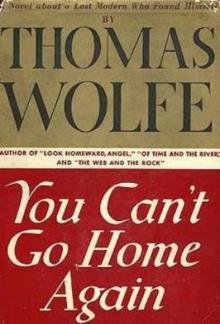
Thomas Wolfe, page 490



“Mr. Reed,” said Mrs. Crocker acidly. “I call it mighty funny.”
“Mr. Crocker,” Robert said, “if you’ll just let me have the three ones—”
“You get out of here, boy!” cried Mr. Crocker. “Now don’t you come in here again! There’s something funny about this whole business! If you can’t pay as other people do, then I don’t want your trade.”
“Mr. Crocker,” Robert said again, and underneath the olive skin his face was gray, “if you’ll just let me have those three—”
“You get out of here,” Mr. Crocker cried, and began to rock forward toward the boy. “If you don’t get out—”
“I’d call a policeman, that’s what I’d do,” Mrs. Crocker said.
Mr. Crocker came rocking up to Robert, took the boy and pushed him with his bony little hands. Robert felt sick and gray down to the hollow pit of his stomach.
“You’ve got to give me those three ones,” he said.
“You get out of here!” shrilled Mr. Crocker. He seized the screen door, pulled it open, and pushed Robert out. “Don’t you come back in here,” he said, pausing for a moment, working thinly at the lips. Then he turned and rocked back in the shop again. Robert stood there on the pavement. And light came and went and came again.
The boy stood there for a moment, and a wagon rattled past. There were some people passing by, but Robert did not notice them. He stood there blindly, in the watches of the sun, but something had gone out of the day.
He felt the soul-sickening guilt that all the children, all the good men of the earth, have felt since time began. And even anger had been drowned out, in the swelling tide of guilt. “There is the Square,” thought Robert as before. “This is Now. There is my father’s shop. And all of it is as it has always been—save I.”
And the Square reeled drunkenly around him, light went in blind gray motes before his eyes, the fountain sheeted out to rainbow iridescence and returned to its proud pulsing plume again. But all the brightness had gone out of day.
The scuffed boots of the lost boy moved and stumbled blindly over. The numb feet crossed the pavement—reached the sidewalk, crossed the plotted central Square—the grass plots, the flower-beds, so soon with red and packed geraniums.
“I want to be alone,” thought Robert, “where I can not go near him. Oh, God, I hope he never hears, that no one ever tells him—”
The plume blew out; the iridescent sheet of spray blew over him. He passed through, found the other side and crossed the street. “Oh, God, if Papa ever hears,” thought Robert, as his numb feet started up the steps into his father’s shop.
He found and felt the steps—the thickness of old lumber twenty feet in length. He saw it all: the iron columns on his father’s porch, painted with the dull anomalous black-green that all such columns in this land and weather come to; two angels, fly-specked, and the waiting stones. Beyond and all around, in the stonecutter’s shop, cold shapes of white and marble, rounded stone, the limestone base, the languid angel with strong marble hands of love.
He went on down the aisle; the white shapes stood around him. He went on back into the workroom. This he knew—the little cast-iron stove in the left-hand corner, the high, dirty window, looking down across the market square, the rude old shelves, upon the shelves the chisels and a layer of stone dust; an emery wheel with pump tread, and two trestles of coarse wood upon which rested gravestones. At one trestle was a man, at work.
The boy looked numbly, saw the name was Creasman: the carved analysis of John, the symmetry of S, the fine finality of Creasman—November, Nineteen-Three.
The man looked up and then returned to work. He was a man of fifty-three, immensely long and tall and gaunt. He wore good dark clothes, save he had no coat. He worked in shirt-sleeves with his vest on, a strong watch-chain stretching across his vest; wing collar and black tie, Adam’s apple, bony forehead, bony nose, light eyes, gray-green, undeep and cold, and somehow lonely-looking, a striped apron going up around his shoulders, and starched cuffs. And in one hand a tremendous rounded wooden mallet like a butcher’s bole; and in his other hand, implacable and cold, the chisel.
“How are you, son?”
He did not look up as he spoke. He spoke quietly, absently. He worked upon the chisel and the wooden mallet as delicately as a jeweler might work upon a watch, except that in the man and the wooden mallet there was power, too.
“What is it, son?” he said.
He moved around the table from the head, and started up on J again.
“Papa, I never stole the stamps,” said Robert.
The man put down the mallet, laid the chisel down. He came around the trestle.
“What?” he said. And Robert winked his tar-black eyes; they brightened; the hot tears shot out. “I never stole the stamps,” he said.
“Hey? What is this?” the man said. “What stamps?”
“That Mr. Reed gave to me, when the other boy was sick and I worked there for three days. . . . And old man Crocker,” Robert said, “he took all the stamps. And I told him Mr. Reed had given them to me. And now he owes me three ones—and old man Crocker says—he says—I must have taken them.”
“The stamps that Reed gave to you—hey?” the stonecutter said. “The stamps you had—” He wet his great thumb briefly on his lips, strode from his workshop out into the storeroom aisle.
The man came back, cleared his throat, and as he passed the old gray board-partition of his office, he cleared his throat and wet his thumb, and said: “I tell you, now—”
Then he turned and strode up toward the front again and cleared his throat and said: “I tell you, now—” And coming back, along the aisle between the rows of marshaled gravestones, he muttered underneath his breath: “By God, now—”
He took Robert by the hand. They went out flying down along the aisle by all the gravestones, the fly-specked angels waiting there, the wooden steps, across the cobbles and the central plot—across the whole thing, but they did not notice it.
And the fountain pulsed, the plume blew out in sheeted spray and swept across them, and an old gray horse, with a peaceful look about its torn lips, swucked up the cool, the flowing mountain water from the trough as Robert and his father went across the Square.
They went across the Square through the sheeted iridescence of the spray and to the other street and to the candy-shop. The man was dressed in his striped apron still; he was still holding Robert by the hand. He opened the screen door and stepped inside. “Give him the stamps,” he said.
Mr. Crocker came rocking forward behind the counter, with a prim and careful look that now was somewhat like a smile. “It was just—” he said.
“Give him the stamps,” the man said, and threw some coins down on the counter.
Mr. Crocker rocked away and got the stamps. “I just didn’t know—” he said.
The stonecutter took the stamps and gave them to the boy. And Mr. Crocker took the coins.
“It was just that—” Mr. Crocker said, and smiled.
The man in the apron cleared his throat: “You never were a father,” the man said. “You never knew the feeling of a child. And that is why you acted as you did. But a judgment is upon you. God has cursed you. He has afflicted you. He has made you lame and childless—and miserable as you are, you will go lame and childless to your grave—and be forgotten!”
And Crocker’s wife kept kneading her bony little hands and said imploringly: “Oh, no—oh, don’t say that! Please don’t say that!”
The stonecutter, the breath still hoarse in him, left the store. Light came again into the day.
“Well, son,” he said, and laid his hand on the boy’s back. “Now don’t you mind.”
They walked across the Square, the sheeted spray of iridescent light swept out on them; a horse swizzled at the water-trough.
“Well, son,” the gaunt man said again, “now don’t you mind.”
And he trod his own steps then with his great stride and went back again into his shop.
The lost boy stood upon the Square, close by the porch of his father’s shop: light came again into the Square. A car curved in, upon the billboard of the car-end was a poster and some words: “St. Louis” and “Excursion” and “The Fair.”
And light came and went into the Square, and Robert stood there thinking quietly: “Here is the Square that never changes; here is Time.”
And light came and went and came again into the Square—but now not quite the same as it had done before. He saw that pattern of familiar shapes, and knew that they were just the same as they had always been. But something had gone out of the day, and something had come in again: out of the vision of those quiet eyes some brightness had been lost; into their vision some deeper color come. He could not say, he did not know through what transforming shadows life had passed within that quarter-hour. He only knew that something had been gained forever—something lost.
As we went down through Indiana—you were too young, child, to remember it, but I always think of all of you, the way you looked that morning, when we went down through Indiana, going to the Fair. All of the apple trees were coming out, and it was April; all of the trees were coming out; it was the beginning of the spring in Indiana, and everything was getting green. Of course we don’t have farms at home like those in Indiana. The children had never seen such farms as those, and I reckon, kid-like, had to take it in.
So all of them kept running up and down the aisle—well, no, except for you and Robert—you were too young; you were just three; I kept you with me. As for Robert: well, I’m going to tell you about that. But the rest of them kept running up and down the aisle and from one window to another. They kept calling out and hollering to each other every time they saw something new. They kept trying to look out on all sides in every way at once, as if they wished they had eyes in the back of their heads. It was the first time any of them had been in Indiana, and I reckon, that, kid-like, it all seemed strange and new.
And so it seemed they couldn’t get enough. It seemed they never could be still.
You see, they were excited about going to St. Louis and so curious over everything they saw. They couldn’t help it, and they wanted to see everything. But “I’ll vow,” I said, “if you children don’t sit down and rest, you’ll be worn to a frazzle before we ever get to see St. Louis and the Fair!”
Except for Robert! He—no sir, not him! Now, boy, I want to tell you—I’ve raised the lot of you, and if I do say so, there wasn’t a numbskull in the lot. But Robert! Well, you’ve all grown up now, all of you have gone away, and none of you are children any more. . . . And of course, I hope that, as the fellow says, you have reached the dignity of man’s estate. . . . I suppose you have the judgment of a grown man. . . . But Robert! Robert had it, even then!
Oh, even as a child, you know—at a time I was almost afraid to trust the rest of you out of my sight—I could depend on Robert. I could send him anywhere, and I’d always know he’d get back safe, and do exactly what I told him to!
Why, I didn’t even have to tell him—you could send that child to market and tell him what you wanted, and he’d come home with twice as much as you could get yourself for the same money.
Now you know, I’ve always been considered a good trader, but Robert! Why, it got so finally that your papa said to me: “You’d be better off if you just tell him what you want and leave the rest to him. For,” your papa says, “damned if I don’t believe he’s a better trader than you are. . . . He gets more for the money than anyone I ever saw.”
Well, I had to admit it, you know. . . . I had to own up then. . . . Robert, even as a child, was a far better trader than I was. . . . Why, yes, they told it on him all over town, you know. . . . They said all of the market men, all of the farmers, would begin to laugh when they saw him coming. They’d say, “Look out! Here’s Robert! Here’s one trader you’re not going to fool!”
And they were right! . . . That child! . . . I’d say: “Robert, suppose you run uptown and see if they’ve got anything good to eat today. Suppose you take this dollar and just see what you can do with it.”
Well, sir, that was all that was needed. The minute that you told that child that you depended on his judgment, he’d have gone to the ends of the earth for you—and let me tell you something, he wouldn’t miss, either!
His eyes would get black as coals—oh, the way that child would look at you, the intelligence and sense in his expression! He’d say, “Yes, ma’am! Now don’t you worry, Mamma, you leave it all to me—and I’ll do good!” said Robert.
And he’d be off like a streak of lightning and oh, Lord! As your father said to me, “I’ve been living in this town for almost thirty years,” he said, “and I thought I knew everything there was to know about it—but that child,” your papa says, “he knows places that I never heard of!” Oh, he’d go right down there to that place below your papa’s shop where the draymen used to park their wagons—or he’d go down there to those old lots on Concord Street where the farmers used to keep their wagons. And child that he was, he’d go right in among them, sir—Robert would!—go right in and barter with them like a grown man!
And he’d come home with things he’d bought that would make your eyes stick out. . . . Here he comes one time with another boy, dragging a great bushel basket full of ripe termaters between them. “Why, Robert,” I says, “how on earth are we ever going to use them? Why, they’ll go bad on us before we’re half-way through them.” “Well, Mamma,” he says, “I know,”—oh, just as solemn as a judge—“but they were the last the man had,” he says, “and he wanted to go home, and so I got them for ten cents,” he says. “I thought it was a shame to let ’em go, and I figgered what we couldn’t eat—why,” says Robert, “you could put up!” Well, the way he said it, so earnest and so serious, I had to laugh. “But I’ll vow,” I said, “if you don’t beat all!” . . . But that was Robert the way he was in those days! As everyone said, boy that he was, he had the sense and judgment of a grown man. . . . Child, child, I’ve seen you all grow up, and all of you were bright enough, but for all-round intelligence, judgment, and general ability, Robert surpassed the whole crowd. . . . I’ve never seen his equal, and everyone who knew him as a child will say the same.
So that’s what I tell them now, when they ask me about all of you. I have to tell the truth. I always said that you were smart enough—but when they come around and brag to me about you, and I reckon how you have got on and have a kind of name—I don’t let on to them, I never say a word. Why, yes! Why, here, you know—oh, ’long about a month ago, this feller comes. He said he came from New Jersey, or somewhere up in that part of the country—and he began to ask me all sorts of questions, what you were like when you were a boy and all such stuff as that.
I just pretended to study it all over; then I said, “Well, yes,” real serious-like, you know. “Well, yes—I reckon I ought to know a little something about him: he was my child, just the same as all the others were; I brought him up just the the way I brought up all the others. And,” I says—oh, just as solemn as you please, “he wasn’t a bad sort of a boy. Why,” I says, “up to the time that he was twelve years old he was just about the same as any other boy—a good average normal sort of fellow.”
“Oh,” he says. “But didn’t you notice something? Didn’t you notice how brilliant he was? He must have been more brilliant than the rest!”
“Well, now,” I says, and pretended to study that all over, too. “Now let me see. . . . Yes,” I says—I just looked him in the eye, as solemn as you please. “I guess he was a fairly bright sort of a boy. I never had no complaints to make of him on that score. He was bright enough,” I says. “The only trouble with him was that he was lazy.”
“Lazy!” he says—oh, you should have seen the look upon his face, you know—he jumped like someone had stuck a pin in him. “Lazy!” he says, “Why, you don’t mean to tell me—”
“Yes,” I says, “I was telling him the same thing myself the last time that I saw him. I told him it was a mighty lucky thing for him that he had the gift of gab. Of course, he went off to college and read a lot of books, and I reckon that’s where he got this flow of language they say he has. . . . But as I said to him, ‘Now look a-here,’ I said, ‘if you can earn your living doing a light easy class of work like this you do,’ I says, ‘you’re mighty lucky, because none of the rest of your people had any such luck as that. They had to work hard for a living.’”
Oh, I told him, you know. I made no bones about it. And I tell you what—I wish you could have seen his face. It was a study.
“Well,” he says, at last, “you’ve got to admit this, haven’t you—he was the brightest boy you had, now wasn’t he?”
I just looked at him a moment. I had to tell the truth. I couldn’t fool him any longer. “No,” I says. “He was a good bright boy—I have no complaint to make about him on that score; but the brightest boy I had, the one that surpassed all the rest of them in sense, and in understanding, and in judgment—the best boy that I had, the smartest boy I ever saw, was—well, it wasn’t him,” I said. “It was another one.”
He looked at me a moment; then he said: “Which boy was that?”
Well, I just looked at him, and smiled. I shook my head. I wouldn’t tell him. “I never brag about my own,” I said. “You’ll have to find out for yourself.”
But—I’ll have to tell you: the best one of the whole lot was—Robert!
. . . And when I think of Robert as he was along about that time, I always see him sitting there, so grave and earnest-like, with his nose pressed to the window, as we went down through Indiana in the morning, to the Fair.
So Robert sat beside this gentleman and looked out the window. I never knew the man—I never asked his name—but I tell you what! He was certainly a fine-looking, well-dressed, good substantial sort of man, and I could see that he had taken a great liking to Robert, and Robert sat there looking out, and then turned to this gentleman, as grave and earnest as a grown-up man, and says: “What kind of crops grow here, sir?” Well, this gentleman threw his head back and just ha-ha-ed. “Well, I’ll see if I can tell you,” says this gentleman, and then, you know, he talked to him, and Robert took it all in, as solemn as you please, and asked this gentleman every sort of question—what the trees were, what was growing there, how big the farms were—all sorts of questions, which this gentleman would answer, until I said: “I’ll vow, Robert! You’ll bother the very life out of this gentleman.”