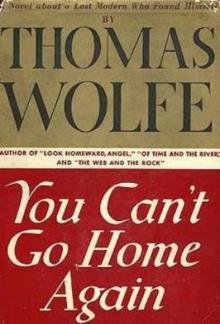
Thomas Wolfe, page 380



“Rapp! Rapp!” said Esther gently, lightly stroking the great hand upon her forehead. “You must stop it now. You are going to make me cry in a moment.”
For a moment, in fact, Esther’s eyes were full of tears, and her delicate rosy face seemed steeped in a memory of lost and irrevocable years, of the terrible mortality of flesh and beauty, of the vast and poignant sum of moments that could not be recalled, and of the merciless stroke of time which could not be stayed. And as she placed her strong delicate hand upon the old woman’s big gnarled fingers, one was conscious at this moment of a unity of love and loyalty which led them back among the scenes and persons of a buried life and a lost world, a unity that was like a living crimson thread and that was beyond life and death and beyond the terrible rush and glare of ten thousand city days, the hot blind insanity of change and movement. And instantly, one felt the same sense of bitter regret and pain that these two women felt over the loss of Esther’s youth and the passing of her beauty: under her crown of greying hair, and the webbing of her eyes—now tired and venous—one saw at once that her face had not changed at all since her childhood: the child’s face was indestructibly legible in the woman’s face, and the pain, the regret, the resentment was a child’s feeling over a loss it could not accept, a defeat it could not condone.
And suddenly, it was as if through the rich and living unity of her marvelous life she had bridged all the depth of sunken years, and through the warmth and actuality of her living touch had led one (me) back into the midst of unrecoverable moments, had made one so certainly a part of a buried and unvisited life that it lived again with every color, every tone and shading, every casual atom of the scenes which the mind forgets, so that the substance of a million buried moments are ours again, with all their freight of sound and movement, as actually as the scene before us. It was as if, through the union of her flesh with buried time, she took one back until he was able to recover the buried life as men in India through an intensity of contemplation are said to unravel their lives day by day back to the moment of birth, and then to merge their memory and their identity with the unlived past.
For, had not this same familiar voice uttered familiar words so long ago? Was not the seed of all this vanished time mingled and diffused within this living flesh? Had these eyes not looked on ten million moments of the buried life, and could one not, through the unity of this flesh, this life, this love, have inured oneself into the lost days, the buried years, until the sound of their voices, each moment’s flow and shift of movement, passed before him like this moment’s presence, like all the dusty tumult of this morning’s pavement.
Yes. The magic of time and memory was true: suddenly a vast nimbus of dead faces was blooming around Esther—the faces of people dead and gone as they swarmed along the pavements, as they thrust and jostled in great crowds, as they walked toward us through the delicate webbing of the Bridge, or as, with painter’s nostrils, they rushed through heat to the place of the murdered man, to the salty smell of hot spilt blood, here they were in all their heavy dignities of dress, the derbied mustached men, the women with their dusty length of skirts, their clumsily muttoned sleeves, their stiff precarious hats, their hard sensual corsettings, and yet beneath the ornate and sculptured conventions of these fashions, with something sly, potent, and female, like ornate and decorous concubines in temple dances. Around Esther was the smell of proud dark woods, of bitters and of orange peel, the fast and easy slatting of the wicker doors, and a style of easeful feet upon a polished rail, piled iridescences of gleaming thin-shelled glass behind the proud dark woods of bars, and the foaming and hoppy fragrance of pungent beer, wet, tidal, rolling. The shout of the children playing in the street, the cold and frozen rasp of sawn ice, and a sound of quiet voices, of the near and the far of laughter, on summer nights; the rustic of the leaves was there. The small jeweled flicker of bicycle lamps, the great vital thrum of a thousand wheels, the stamp of the hoof at night on mellow board, and the odors of hoof, of gleaming hide, of proud and costly leathers, the odors of horse and bit and rein, and of all the sweet rich sultriness of sweat-cured harness, and the fabulous and fragrant woods superbly turned and shaped: the craft and cunning of fine hands in hub, spring, axle, brace, shaft, and crossbar, in sills, panels, felloes, spokes, in woods as hard as lignum vitae, and in delicate tender woods as soft and spicy as pared cheese. The imperial princely union of fine horses and fine women: behind the trotting velvet rumps the women leaned and nodded in luxurious leathers—love mixed slowly with a tinge of ice around the heart, a spell of desire, exultant, trembling, stirred across the loins, and the smells of the trotting rumps, the leathers, and the ripe slow-smiling women were all good: in the freckled light of the leaves, the lovers bolted, they went across the daisied warmth of fields into the woods, they came out slowly as a waning sun, with smiles luxurious and tender, with heads uplifted to their crown of hair, pulling a burr from the hem of their long full-figured dress; and their laughter welled in darkness soft and deep. Always there was the smell and stump of the horses, in the streets ammoniac, in ten thousand stables thick and warm, and the hoof and the wheel struck forth its lean and lively music in the night. Always there were the horses, sweet-breathed, smoke-throated in the wintry air, huddled below their blankets, stooped dejectedly below all the savage and persistent cruelty of heat and cold—and Esther remembered them, as if they had been people, in a thousand scenes and attitudes.
She saw the lank and weary steeds that trotted along between loose climbing traces on the horse-car tracks: their lean heads tossed and nodded to the jaunting of their bells as if the laborious rhythm of their lives had warn itself into the structure of their flesh, and their heads turned toward each other constantly in a gesture that was mournful and resigned, steeped in all the infinite grief that finds acceptance in those who labor on the earth.
And there were the droppings of great beasts upon the cobbles, the ponderous truck teams, slow footed and sway-backed, mottled with solid greys, the drivers standing in their wagonbeds, cursing, the heavy sweating police cursing, the hot air sown with thick cursings, the vein swelling, the neck swelling, the thick snarl of the simian upper lip, the thick sweated brutishness of the corrupt and unspeakable Irish, the foul brown sensuality of the unwashed Italians, the stale rancid smell of pallid sweaty Jews, oozing with a desperate and deathless tenacity, the weary load of centuries beneath their bales of cloth, and these the faces of the lost Americans, the thousand styles of faces each with a quality of baffling similarity, a quality that was recognizable and lost.—What was it, token of all our wordless and incongruent hunger that one saw here, that has never been expressed, that was so imminent, so exasperating, so impalpably near, as if the opiate of finality we had sought for our exacerbated nerves, the complete nurture we needed to stop the jaws of Cerebus was here almost within our grasp, an inch away from hope, a hand’s breadth off from certainty.
Here were the faces of the lost, the dead, the buried men as they came toward us on the Bridge, as they streamed past us on the pavements, as they shifted, glanced, and passed in a thousand streets as dead, as lost, as buried as themselves: here was the lost world, the starved world, the world with all its blooms of time and magic as it grew outward now in all its myriad and magic evolutions from the rich annotation of Esther’s small, opulent and triumphant flesh. And suddenly, in this vanished world, we saw all that had not changed in us: we saw upon the faces of dead men what we could hardly see upon our own, we saw, through this permanent dimension of time done and cold, of moments finished and secure, the whole dark legend of our destiny, the vision of our hunger—as actual then as now: the vast loneliness of our inarticulation, the vast incongruence of our desire, the stupendous weight of our godless, wingless, formless, and undiscovered fears that press upon us from immense and lonely skies, from the piled masses of inhuman architecture, that comes to us like an invisible effluvia from all the tiny atoms of the man-swarm, lost, like ourselves, in the weariness of heat and distance, in a broad unsufferable light that beats and glares upon us till our earth is enclosed in that thick pocket of our impurity through which we struggle toward one another as through a marine consistency of foul depthless waters—drowned, our hope, our belief, all of our inner dignities—drowned deep in the thick stifling depths of weariness, horror, and stupendous triviality. Thus, these incongruent monsters of our fear, impalpable and immense, that hover over all our innocence and nakedness and that are mingled with all our wild exultancy and joy, had left their shadow as legibly on the faces of these dead men as on us: they, too, were guarded by this obscure and savage hunger, and they, too, must have felt that wordless but powerful desire to articulate some image to which these wild and restless longings of the spirit might be emitted and by which they could be assuaged, to articulate mighty and recognizable forms out of that unmistakable material which, we know, is everywhere around us, as certain as the joy, the exultancy, and the fear that springs from it.
This picture that she had of Georgia that day before the stable returned in later years, long after it had lost its power to awaken resentment or revulsion, to haunt her with a memory of pity and piercing wordless regret. For it is so with time and memory: the seed of our deepest feeling is buried under the rush of a momentary and violent one, there is in all feeling a quality of deception and evasion, and the meanings of the spirit become evident only in the light of a dispassionate distance. Thus, in later years her memory of Georgia was always attended somehow by one of the most evocative and moving memories of her life: this was the memory of men coming across the Bridge—she could not say what it meant, but she remembered their faces with a sense of loss and finality, as, poised high above the gleaming tide of water, they passed between two points in space two moments in lost time, and were gone forever; and yet she felt she had met them and knew in an instant all that could ever be known about them: the total legend of their destiny. So, later, when she remembered Georgia, that memory was mixed and shadowed by the Bridge: she remembered her as she stood talking to the man before the stable, and her clumsy indecision, and half-shy gesture as she swung her books by their strap, a gesture that was bewitching, awkwardly bold, and pitifully knowing—evoked in Esther later a vision of all that is wistful, stumbling, and moved by a shy and clumsy eagerness in youth. As the years passed, Esther’s sharper and more personal memories of Georgia, and of the relation of their ages, faded, until, mothered by memory, a woman looked with pity and compassion at the clumsy figure of a child, and before the child was the old red brick of stable, the stamp of vanished hooves, the odor of dark worn leathers, the fading light of a morning sun graining with golden dust before the stable door, with all that was sad and exultant in its wordless connotation, and all the forgotten words, the lost faces, the remembered footfalls of a buried life—a child who, now that all bitter memory of an evil moment was forgotten, had become the type of youth everywhere, its destiny caught in a flitting moment as permanently and completely as that of men who cross a bridge—caught with all of the universal hopefulness, clumsiness, cheapness and stupidity of youth.
As that Spring advanced they saw each other less and less frequently, until their relation dwindled almost to complete separation. Finally their companionship was utterly broken; when they saw each other they nodded, or spoke curtly: in Georgia a sullen and resentful pride smouldered even more stubbornly, she thought: “Well, if she’s goin’ to act like that, I’m not goin’ to run aftah her.” And Esther, although her stronger and deeper spirit was in later life not much troubled by the distorted vanity of such “pride,” which is really a kind of weakness and fear, a childish desire to out-wait and out-stare the other person, and not to be the first to speak—(Esther’s almost complete lack of such folly was one of the chief elements of strength in her direct, forceful, and healthy temperament)—was restrained from speaking a dozen times when she wanted to by a sense of indecision and doubt: later, she remembered this feeling, and wondered why she had not spoken.
Meanwhile, a rumor of disaster impending in the Barnhill family had spread throughout the street. It seemed to be a perception, an omen of ill fortune, which, without direct communications, had passed into men’s knowledge. One day Bella said to Esther:
“I understand the Barnhills are going to move.”
“Why?” Esther burst out sharply, and then regretted she had spoken.
“I don’t know,” said Bella. “I don’t think things have gone so well with them.” She paused a moment, then with an air of irrelevance, added:
“That poor man! . . . I wish there were something we could do for him. I feel so sorry for him.”
This feeling of sympathy for Barnhill seemed general among the people in the street, there was a sense of tacit agreement among people about him, and yet no one could have explained just why he was sorry for the man or why, in this communion of regret, the name of the woman was never mentioned. There was almost nothing about the man that could be remembered, no atom of personality to awaken either dislike or affection, and perhaps it was this very fact—that every element of personality had been stripped from him, that he had been spiritually caponized and every color of manhood, every mark of character taken from him, which awakened in people a sense of pity and shame. The little man with his wing collar, his drab clothing, his straggly sandy moustache, his feeble and polite laughter, and his soft colorless drawl which had never uttered a word that people could remember, cherish, or deny, remained, nevertheless, in the memory as someone who had been shamed and broken, and their hearts were with him. As one saw him come along the street and turn to mount the steps into his house, he seemed to pause and hesitate timidly, and then to enter with an air that was resigned and lost, and by which he seemed to surrender the last light of day, the last faint glimmer of personality. And, indeed, when the door had closed behind him the sense of his annihilation was complete: the front of solid and untelling brown had engulfed him as completely as an opening in the earth engulfs a rabbit, and until he again emerged into the light, every vestige of his identity was lost.
And then, as if to intensify this sense of his disappearance and engulfment they heard at night, one voice—the woman’s high drawling and insistent voice, addressed to him, but they never heard him answer: they could only judge from the brief infrequent pauses in her harangue that he had spoken a word or two. And even more than the things she said, the sound of her voice, which was not loud, but which had a drawling resonance that carried clearly through stone walls into the street, over the shouts of the playing children, between the lapse of the horse’s hoof, or entering into quietness and darkness with a quality that was naked, wet, and unclean. And these city people who had heard without warning so much that was hard, bitter, and violent—the curse of a drunken Irishman and the screams of his beaten wife, the threats and abuse of truck drivers, the jeers of the roughs, the constant mockery of disbelief and cynicism—these people who had accepted all this with indifference or laughter turned away with a sense of convulsive shame from the sound of this woman’s voice:
“. . . I knew it! I knew it! I knew it the first time I saw yo’ haid!”
At this time phrenology was still alive and flourishing and Mrs. Barnhill’s judgments of people were always touched by the size and shape of their “haid.”
“My mothah tol’ me but I wouldn’t listen: she tol’ me the first time you evah cume to see me that you couldn’t expect nothin’ from a man with a haid like that. . . . She tol’ me no man with a haid no widah than you got between the eahs would evah amount to a hill of beans. . . . She said, ‘As sauh as you live, if you go an’ marry that man you’ll cuss the day you ever laid eyes on him.’ I knew it! I knew it! But I wouldn’t listen. . . .”
Here, briefly, there was the pulse of silence: perhaps the man had made some answer no one could hear; but in a moment, the naked and near penetration of the shrew’s voice took up its tirade again, insulting darkness:
“She said, ‘You c’aint make somethin’ out of nothin’, an’ he just ain’t got it. . . . I nevah saw a man yet with eyes that close togethah who was with powah enough to kill him. . . . There nevah was a man yet’ (she said) ‘whose eyebrows grow straight across his haid like that who had sense enough to come in out of the rain. . . . Don’t you know what the Barnhills ah?’ (she said). ‘Don’t you know that evy’body in And’son county considahs them nothin’ but low-down po’ white trash? . . . If you marry that man, I’m bettin’ you right now, you ah goin’ to bring disgrace on yo’ family. . . . The Tolly’s ah the best people in this part of the state’ (she said). ‘. . . We got a long line o’ high-up people—leuovahs an’ preachahs an doctahs an’ all like that’ (she said). ‘. . . yo gran’fathah would tu’n right ovah in his grave’ (she said), ‘if he knew you was plannin’ to marry one of them little ole two-by fo’ Ba’nhills. . . .’”
There was another pause, during which the man apparently made no answer whatever, for suddenly she burst into a long sneering laugh, loaded with a full envenomed hate, a choking desire to slash and maim:
“Look at him! . . . With his po’ little peanut of a haid, pretendin’ he can read a papah! . . . Yaie! Go on! Read yo’ papah. . . . You won’t undahstan’ what you read, noway. . . . You ain’t foolin’ no one. Why, pshaw!” Here she laughed long and sneeringly. “You po’ little sorry excuse fo’ a man! . . . Pretendin’ you can read when you ain’t got sense enough to spell ‘cat’ an’ ‘rat’! . . . When I think of the chances I had, an’ the real sho-nuff men I tu’ned down in awdah to marry a thing lak you, I could beat my brains out against the wall. . . . You! . . . Why, you po’ little countah-jumpah! . . . You cheap little fifteen dollah a week ribbon clerk—fo’ that’s all you evah been—the on’y reason you evah got this job was because I went down on my knees befo’ my frien’s to get it fo’ you. . . . I might have known you wouldn’t have get-up enough to hold a real man’s job. . . . I might have known the only thing you was good enough fo’ was checkin’ in some cheap little dry-goods sto’. . . . Well!” she screamed suddenly. “Ah you goin’ to tawk? C’aint you say somethin’? Ah you goin’ to sit thah lak a dummy? Do you know what we’re goin’ to do now? . . . Have you thought what’s to become of yo’ wife an’ chile? . . . Do yo’ know wheah nex’ month’s rent’s to come from? . . . Have yo’ money enough to pay the fayah back home, or do we have to wawk? . . . Ain’t you got nothin’ to say?” she screamed.