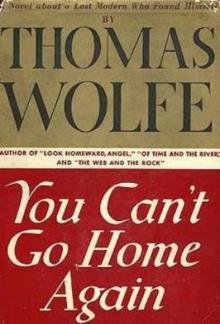
Thomas Wolfe, page 462


Talking in low excited voices, we would walk rapidly back toward town under the rustle of September leaves, in cool streets just grayed now with that still, that unearthly and magical first light of day which seems suddenly to rediscover the great earth out of darkness, so that the earth emerges with an awful, a glorious sculptural stillness, and one looks out with a feeling of joy and disbelief, as the first men on this earth must have done, for to see this happen is one of the things that men will remember out of life forever and think of as they die.
At the sculptural still square where at one corner, just emerging into light, my father’s shabby little marble shop stood with a ghostly strangeness and familiarity, my brother and I would “catch” the first street-car of the day bound for the “depot” where the circus was—or sometimes we would meet someone we knew, who would give us a lift in his automobile.
Then, having reached the dingy, grimy, and rickety depot section, we would get out, and walk rapidly across the tracks of the station yard, where we could see great flares and steamings from the engines, and hear the crash and bump of shifting freight cars, the swift sporadic thunders of a shifting engine, the tolling of bells, the sounds of great trains on the rails.
And to these familiar sounds, filled with their exultant prophecies of flight, the voyage, morning, and the shining cities—to all the sharp, thrilling odors of the trains—the smell of cinders, acrid smoke, of musty, rusty freight cars, the clean pine-board of crated produce, and the smells of fresh stored food—oranges, coffee, tangerines and bacon, ham and flour and beef—there would be added now, with an unforgettable magic and familiarity, all the strange sounds and smells of the coming circus.
The gay yellow sumptuous-looking cars in which the star performers lived and slept, still dark and silent, heavily and powerfully still, would be drawn up in long strings upon the tracks. And all around them the sounds of the unloading circus would go on furiously in the darkness. The receding gulf of lilac and departing night would be filled with the savage roar of lions, the murderously sudden snarling of great jungle cats, the trumpetings of the elephants, the stamp of the horses, and with the musty, pungent, unfamiliar odor of the jungle animals: the tawny camel smells, and the smells of panthers, zebras, tigers, elephants, and bears.
Then, along the tracks, beside the circus trains, there would be the sharp cries and oaths of the circus men, the magical swinging dance of lanterns in the darkness, the sudden heavy rumble of the loaded vans and wagons as they were pulled along the flats and gondolas, and down the runways to the ground. And everywhere, in the thrilling mystery of darkness and awakening light, there would be the tremendous conflict of a confused, hurried, and yet orderly movement.
The great iron-gray horses, four and six to a team, would be plodding along the road of thick white dust to a rattling of chains and traces and the harsh cries of their drivers. The men would drive the animals to the river which flowed by beyond the tracks, and water them; and as first light came, one could see the elephants wallowing in the familiar river and the big horses going slowly and carefully down to drink.
Then, on the circus grounds, the tents were going up already with the magic speed of dreams. All over the place (which was near the tracks and the only space of flat land in the town that was big enough to hold a circus) there would be this fierce, savagely hurried, yet orderly confusion. Great flares of gaseous circus lights would blaze down on the seared and battered faces of the circus toughs as, with the rhythmic precision of a single animal—a human riveting machine—they swung their sledges at the stakes, driving a stake into the earth with the incredible instancy of accelerated figures in a motion picture. And everywhere, as light came and the sun appeared, there would be a scene of magic, order, and of violence. The drivers would curse, and talk their special language to their teams; there would be the loud, gasping, and uneven labor of a gasoline engine, the shouts and curses of the bosses, the wooden riveting of the driven stakes, and the rattle of heavy chains.
Already in an immense cleared space of dusty beaten earth, the stakes were being driven for the main exhibition tent. And an elephant would lurch ponderously to the field, slowly lower his great swinging head at the command of a man who sat perched upon his skull, flourish his gray wrinkled snout a time or two, and then solemnly wrap it around a tent pole as big as the mast of a racing schooner. Then the elephant would back slowly away, dragging the great pole with him as if it were a stick of match-wood.
And when this happened, my brother would break into his great “whah-whah” of exuberant laughter, and prod me in the ribs with his clumsy fingers. And farther on, two town darkeys, who had watched the elephant’s performance with bulging eyes, would turn to each other with ape-like grins, bend double as they slapped their knees, and howl with swart rich nigger-laughter, saying to each other in a kind of rhythmic chorus of question and reply:
“He don’t play with it, do he?”
“No, suh! He don’t send no boy!”
“He don’t say, Wait a minute,’ do he?”
“No, suh! He say, ‘Come with me!’ That’s what he say!”
“He go ‘Boogety-boogety!’” said one, suiting the words with a prowling movement of his black face toward the earth.
“He go rootin’ faw it!” said the other, making a rooting movement with his head.
“He say, ‘Ar-rumpf!’” said one.
“He say, ‘Big boy, we is on ouah way!’” the other answered.
“Har! Har! Har! Har! Har!”—and they choked and screamed with their rich laughter, slapping their thighs with a solid smack as they described the elephant’s prowess to each other.
Meanwhile, the circus food-tent—a huge canvas top without concealing sides—had already been put up, and now we could see the performers seated at long trestled tables underneath the tent, as they ate breakfast. And the savor of the food they ate—mixed as it was with our strong excitement, with the powerful but wholesome smells of the animals, and with all the joy, sweetness, mystery, jubilant magic, and glory of the morning and the coming of the circus—seemed to us to be the most maddening and appetizing succulence of any food that we had ever known or eaten.
We could see the circus performers eating tremendous breakfasts, with all the savage relish of their power and strength: they ate big fried steaks, pork chops, rashers of bacon, a half dozen eggs, great slabs of fried ham and great stacks of wheat-cakes which a cook kept flipping in the air with the skill of a juggler, and which a husky-looking waitress kept rushing to their tables on loaded trays held high and balanced marvelously on the fingers of a brawny hand. And above all the maddening odors of the wholesome and succulent food, there brooded forever the sultry and delicious fragrance—that somehow seemed to add zest and sharpness to all the powerful and thrilling life of morning—of strong boiling coffee, which we could see sending off clouds of steam from an enormous polished urn, and which the circus performers gulped down, cup after cup.
And the circus men and women themselves—these star performers—were such fine-looking people, strong and handsome, yet speaking and moving with an almost stern dignity and decorum, that their lives seemed to us to be as splendid and wonderful as any lives on earth could be. There was never anything loose, rowdy, or tough in their comportment, nor did the circus women look like painted whores, or behave indecently with the men.
Rather, these people in an astonishing way seemed to have created an established community which lived an ordered existence on wheels, and to observe with a stern fidelity unknown in towns and cities the decencies of family life. There would be a powerful young man, a handsome and magnificent young woman with blonde hair and the figure of an Amazon, and a powerfully-built, thick-set man of middle age, who had a stern, lined, responsible-looking face and a bald head. They were probably members of a trapeze team—the young man and woman would leap through space like projectiles, meeting the grip of the older man and hurling back again upon their narrow perches, catching the swing of their trapeze in mid-air, and whirling thrice before they caught it, in a perilous and beautiful exhibition of human balance and precision.
But when they came into the breakfast tent, they would speak gravely yet courteously to other performers, and seat themselves in a family group at one of the long tables, eating their tremendous breakfasts with an earnest concentration, seldom speaking to one another, and then gravely, seriously, briefly.
And my brother and I would look at them with fascinated eyes: my brother would watch the man with the bald head for a while and then turn toward me, whispering:
“D-d-do you see that f-f-fellow there with the bald head? W-w-well he’s the heavy man,” he whispered knowingly. “He’s the one that c-c-catches them! That f-f-fellow’s got to know his business! You know what happens if he misses, don’t you?” said my brother.
“What?” I would say in a fascinated tone.
My brother snapped his fingers in the air.
“Over!” he said. “D-d-done for! W-w-why, they’d be d-d-d-dead before they knew what happened. Sure!” he said, nodding vigorously. “It’s a f-f-f-fact! If he ever m-m-m-misses, it’s all over! That boy has g-g-g-got to know his s-s-s-stuff!” my brother said. “W-w-w-why,” he went on in a low tone of solemn conviction, “it w-w-w-wouldn’t surprise me if they p-p-p-pay him seventy-five or a hundred dollars a week! It’s a fact!” my brother cried vigorously.
And we would turn our fascinated stare again upon these splendid and romantic creatures, whose lives were so different from our own, and whom we seemed to know with such familiar and affectionate intimacy. And at length, reluctantly, with full light come and the sun up, we would leave the circus grounds and start for home.
And somehow the memory of all we had seen and heard that glorious morning, and the memory of the food-tent with its wonderful smells, would waken in us the pangs of such a ravenous hunger that we could not wait until we got home to eat. We would stop off in town at lunch-rooms and, seated on tall stools before the counter, we would devour ham-and-egg sandwiches, hot hamburgers red and pungent at their cores with coarse spicy sanguinary beef, coffee, glasses of foaming milk and doughnuts, and then go home home to eat up everything in sight upon the breakfast table.
[¬]
HIS FATHER’S EARTH
[Modern Monthly, April 1935]
As the boy stood looking at the circus with his brother, there came to him two images, which had haunted his childhood and the life of every boy who ever lived, but were now for the first time seen together with an instant and magic congruence. And these two images were the images of the circus and his father’s earth.
He thought then he had joined a circus and started on the great tour of the nation with it. It was spring: the circus had started in New England and worked westward and then southward as the summer and autumn came on. His nominal duties—for, in his vision, every incident, each face and voice and circumstance were blazing real as life itself—were those of ticket seller, but in this tiny show, everyone did several things: the performers helped put up and take down the tents, load and unload the wagons, and the roustabouts and business people worked wherever they were needed.
The boy sold tickets, but he also posted bills and bartered with tradesmen and farmers in new places for fresh food. He became very shrewd and clever at this work, and loved to do it—some old, sharp, buried talent for shrewd trading, that had come to him from his mountain blood, now aided him. He could get the finest, freshest meats and vegetables at the lowest prices. The circus people were tough and hard, they always had a fierce and ravenous hunger, they would not accept bad food and cooking, they fed stupendously, and they always had the best of everything.
Usually the circus would arrive at a new town very early in the morning, before daybreak. He would go into town immediately: he would go to the markets, or with farmers who had come in for the circus. He felt and saw the purity of first light, he heard the sweet and sudden lutings of first birds, and suddenly he was filled with the earth and morning in new towns, among new men: he walked among the farmers’ wagons, and he dealt with them on the spot for the prodigal plenty of their wares—the country melons bedded in sweet hay of wagons, the cool sweet prints of butter wrapped in clean wet cloths, with dew and starlight still on them, the enormous battered cans foaming with fresh milk, the new laid eggs which he bought by the gross and hundred dozens, the tender limy pullets by the score, the rude country wagons laden to the rim with heaped abundancies—with delicate bunches of green scallions, the heavy red ripeness of huge tomatoes, the sweet-leaved lettuces crisp as celery, the fresh podded peas and the succulent young beans, as well as the potatoes spotted with the loamy earth, the powerful winey odor of the apples, the peaches, and the cherries, the juicy corn stacked up in shocks of living green, and the heavy blackened rinds of home-cured hams and bacons.
As the market opened, he would begin to trade and dicker with the butchers for their finest cuts of meat: they would hold great roasts up in their gouted fingers, they would roll up tubs of fresh ground sausage, they would smack with their long palms the flanks of beeves and porks: he would drive back to the circus with a wagon full of meat and vegetables.
At the circus ground the people were already in full activity. He could hear the wonderful timed tattoo of sledges on driven stakes, the shouts of men riding animals down to water, the slow clank and pull of mighty horses, the heavy rumble of the wagons as they rolled down off the circus flat cars. By now the eating table would be erected, and as he arrived, he could see the cooks already busy at their ranges, the long tables set up underneath the canvas with their rows of benches, their tin plates and cups, their strong readiness. There would be the amber indescribable pungency of strong coffee, and the smell of buckwheat batter.
And the circus people would come in for their breakfast: hard and tough, for the most part decent and serious people, the performers, the men and women, the acrobats, the riders, the tumblers, the clowns, the jugglers, the contortionists, and the balancers would come in quietly and eat with a savage and inspired intentness.
The food they ate was as masculine and fragrant as the world they dwelt in: it belonged to the stained world of mellow sun-warmed canvas, the clean and healthful odor of the animals, and the mild sweet lyric nature of the land in which they lived as wanderers, and it was there for the asking with a fabulous and stupefying plenty, golden and embrowned: they ate stacks of buckwheat cakes, smoking hot, soaked in hunks of yellow butter which they carved at will with a wide free gesture from the piled prints on the table, and which they garnished (if they pleased) with ropes of heavy black molasses, or with the lighter, freer maple syrup.
They ate big steaks for breakfast, hot from the pan and lashed with onions, they ate whole melons, crammed with the ripeness of the deep pink meat, rashers of bacon, and great platters of fried eggs, or eggs scrambled with calves’ brains, they helped themselves from pyramids of fruit piled up at intervals on the table—plums, peaches, apples, cherries, grapes, oranges, and bananas—they had great pitchers of thick cream to pour on everything, and they washed their hunger down with pint mugs of strong deep-savored coffee.
For their mid-day meal they would eat fiercely, hungrily, with wolfish gusts, mightily, with knit brows and convulsive movements of their corded throats. They would eat great roasts of beef with crackled hides, browned in their juices, rare and tender, hot chunks of delicate pork with hems of fragrant fat, delicate young boiled chickens, only a mouthful for these ravenous jaws, twelve-pound pot roasts cooked for hours in an iron pot with new carrots, onions, sprouts, and young potatoes, together with every vegetable that the season yielded: huge roasting ears of corn, smoking hot, stacked like cord wood on two-foot platters, tomatoes cut in slabs with wedges of okra and succotash, and raw onion, mashed potatoes whipped to a creamy smother, boats swimming with pure beef gravy, new carrots, turnips, fresh peas cooked in butter, and fat string beans seasoned with the flavor of big chunks of cooking-pork. In addition, they had every fruit that the place and time afforded: hot crusty apple, peach and cherry pies, encrusted with cinnamon, puddings and cakes of every sort, and blobbering cobblers inches deep.
Thus the circus moved across America, from town to town, from state to state, eating its way from Maine into the great plains of the West, eating its way along the Hudson and the Mississippi rivers, eating its way across the prairies and from the North into the South, eating its way across the flat farm lands of the Pennsylvania Dutch colony, the eastern shore of Maryland and back again across the states of Virginia, North Carolina, Tennessee, and Florida—eating all good things that this enormous, this inevitably bountiful and abundant cornucopia of a continent yielded.
They ate the cod, bass, mackerel, halibut, clams, and oysters of the New England coast, the terrapin of Maryland, the fat beeves, porks, and cereals of the Middle West, and they had, as well, the heavy juicy peaches, watermelons, cantaloupes of Georgia, the fat sweet shad of the Carolina coasts, and the rounded and exotic citrus fruits of the tropics: the oranges, tangerines, bananas, kumquats, lemons, guavas down in Florida, together with a hundred other fruits and meats—the Vermont turkeys, the mountain trout, the bunched heaviness of the Concord grapes, the red winey bulk of the Oregon apples, as well as the clawed, shelled, and crusted dainties, the crabs, the clams, the pink meated lobsters that grope their way along the sea-floors of America.
The boy awoke at morning in three hundred towns with the glimmer of starlight on his face; he was the moon’s man; then he saw light quicken in the east, he saw the pale stars drown, he saw the birth of light, he heard the lark’s wing, the bird tree, the first liquorous liquefied lutings, the ripe-aired trillings, the plumskinned birdnotes, and he heard the hoof and wheel come down the streets of the nation. He exulted in his work as food-producer for the circus people, and they loved him for it. They said there had never been anyone like him—they banqueted exultantly, with hoarse gulpings and with joy, and they loved him.