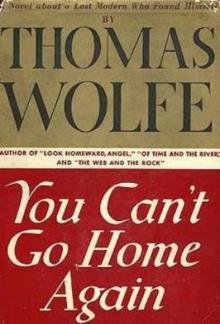
Thomas Wolfe, page 342


Certainly they could find no reason, unless he had done it to divert suspicion from their minds about his true intent. This was Adamowski’s theory, and it seemed to satisfy the woman. But George thought it more likely that the little man was in such a desperate state of nervous frenzy and apprehension that he had lost the power to reason clearly and had acted blindly, wildly, on the impulse of the moment. But they did not know. And now they would never find out the answer.
George was still worried about getting the man’s ten marks returned to him. The woman said that she had given the man her name and her address in Paris, and that if he were later allowed to complete his journey he could find her there. George then gave her his own address in Paris and asked her to inform the man where he was if she should hear from him. She promised, but they all knew that she would never hear from him again.
Late afternoon had come. The country had closed in around them. The train was winding through a pleasant, romantic landscape of hills and woods. In the slant of evening and the waning light there was a sense of deep, impenetrable forest and of cool, darkling waters.
They had long since passed the frontier, but the woman, who had been looking musingly and a little anxiously out of the window, hailed the conductor as he passed along the corridor and asked him if they were really in Belgium now. He assured her that they were. Adamowski gave him the little man’s hat and coat, and explained the reason. The conductor nodded, took them, and departed.
The woman had her hand upon her breast, and now when the conductor had gone she sighed slowly with relief. Then, quietly and simply, she said:
“Do not misunderstand me. I am a German and I love my country. But—I feel as if a weight has lifted from me here.” She put her hand upon her breast again. “You cannot understand, perhaps, just how it feels to us, but—” and for a moment she was silent, as if painfully meditating what she wished to say. Then, quickly, quietly: “We are so happy to be—out!”
Out? Yes, that was it. Suddenly George knew just how she felt. He, too, was “out” who was a stranger to her land, and yet who never had been a stranger in it. He, too, was “out” of that great country whose image had been engraved upon his spirit in childhood and youth, before he had ever seen it. He, too, was “out” of that land which had been so much more to him than land, so much more than place. It had been a geography of heart’s desire, an unfathomed domain of unknown inheritance. The haunting beauty of that magic land had been his soul’s dark wonder. He had known the language of its spirit before he ever came to it, had understood the language of its tongue the moment he had heard it spoken. He had framed the accents of its speech most brokenly from that first hour, yet never with a moment’s trouble, strangeness, or lack of comprehension. He had been at home in it, and it in him. It seemed that he had been born with this knowledge.
He had known wonder in this land, truth and magic in it, sorrow, loneliness, and pain in it. He had known love in it, and for the first time in his life he had tasted there the bright, delusive sacraments of fame. Therefore it was no foreign land to him. It was the other part of his heart’s home, a haunted part of dark desire, a magic domain of fulfillment. It was the dark, lost Helen that had been forever burning in his blood—the dark, lost Helen he had found.
And now it was the dark, found Helen he had lost. And he knew now, as he had never known before, the priceless measure of his loss. He knew also the priceless measure of his gain. For this was the way that henceforth would be forever closed to him—the way of no return. He was “out.” And, being “out,” he began to see another way, the way that lay before him. He saw now that you can’t go home again—not ever. There was no road back. Ended now for him, with the sharp and clean finality of the closing of a door, was the time when his dark roots, like those of a pot-bound plant, could be left to feed upon their own substance and nourish their own little self-absorbed designs. Henceforth they must spread outward—away from the hidden, secret, and unfathomed past that holds man’s spirit prisoner—outward, outward toward the rich and life-giving soil of a new freedom in the wide world of all humanity. And there came to him a vision of man’s true home, beyond the ominous and cloud-engulfed horizon of the here and now, in the green and hopeful and still-virgin meadows of the future.
“Therefore,” he thought, “old master, wizard Faust, old father of the ancient and swarm-haunted mind of man, old earth, old German land with all the measure of your truth, your glory, beauty, magic, and your ruin; and dark Helen burning in our blood, great queen and mistress, sorceress—dark land, dark land, old ancient earth I love—farewell!”
[¬]
BOOK VII
A WIND IS RISING, AND THE RIVERS FLOW
The experiences of that final summer in Germany had a profound effect upon George Webber. He had come face to face with something old and genuinely evil in the spirit of man which he had never known before, and it shook his inner world to its foundations. Not that it produced a sudden revolution in his way of thinking. For years his conception of the world and of his own place in it had been gradually changing, and the German adventure merely brought this process to its climax. It threw into sharp relief many other related phenomena which George had observed in the whole temper of the times, and it made plain to him, once and for all, the dangers that lurk in those latent atavistic urges which man has inherited from his dark past.
Hitlerism, he saw, was a recrudescence of an old barbarism. Its racial nonsense and cruelty, its naked worship of brute force, its suppression of truth and resort to lies and myths, its ruthless contempt for the individual, its anti-intellectual and anti-moral dogma that to one man alone belongs the right of judgment and decision, and that for all others virtue lies in blind, unquestioning obedience—each of these fundamental elements of Hitlerism was a throwback to that fierce and ancient tribalism which had sent waves of hairy Teutons swooping down out of the north to destroy the vast edifice of Roman civilization. That primitive spirit of greed and lust and force had always been the true enemy of mankind.
But this spirit was not confined to Germany. It belonged to no one race. It was a terrible part of the universal heritage of man. One saw traces of it everywhere. It took on many disguises, many labels. Hitler, Mussolini, Stalin—each had his own name for it. And America had it, too, in various forms. For wherever ruthless men conspired together for their own ends, wherever the rule of dog-eat-dog was dominant, there it bred. And wherever one found it, one also found that its roots sank down into something primitive in man’s ugly past. And these roots would somehow have to be eradicated, George felt, if man was to win his ultimate freedom and not be plunged back into savagery and perish utterly from the earth.
When George realized all this he began to look for atavistic yearnings in himself. He found plenty of them. Any man can find them if he is honest enough to look for them. The whole year that followed his return from Germany, George occupied himself with this effort of self-appraisal. And at the end of it he knew, and with the knowledge came the definite sense of new direction toward which he had long been groping, that the dark ancestral cave, the womb from which mankind emerged into the light, forever pulls one back—but that you can’t go home again.
The phrase had many implications for him. You can’t go back home to your family, back home to your childhood, back home to romantic love, back home to a young man’s dreams of glory and of fame, back home to exile, to escape to Europe and some foreign land, back home to lyricism, to singing just for singing’s sake, back home to æstheticism, to one’s youthful idea of “the artist” and the all-sufficiency of “art” and “beauty” and “love,” back home to the ivory tower, back home to places in the country, to the cottage in Bermuda, away from all the strife and conflict of the world, back home to the father you have lost and have been looking for, back home to someone who can help you, save you, ease the burden for you, back home to the old forms and systems of things which once seemed everlasting but which are changing all the time—back home to the escapes of Time and Memory.
In a way, the phrase summed up everything he had ever learned. And what he now knew led inexorably to a decision which was the hardest he had ever had to make. Throughout the year he wrestled with it, talked about it with his friend and editor, Foxhall Edwards, and fought against doing what he realized he would have to do. For the time had come to leave Fox Edwards. They had reached a parting of the ways. Not that Fox was one of the new barbarians. God, no! But Fox—well, Fox—Fox understood. And George knew that whatever happened, Fox would always remain his friend.
So in the end, after all their years together, they parted. And when it was over, George sat down and wrote to Fox. He wanted to leave the record clear. And this is what he wrote:
[¬]
CHAPTER 45
YOUNG ICARUS
I have of late, dear Fox [George wrote], been thinking of you very much, and of your strange but most familiar face. I never knew a man like you before, and if I had not known you, I never could have imagined you. And yet, to me you are inevitable, so that, having known you, I cannot imagine what life would have been for me without you. You were a polestar in my destiny. You were the magic thread in the great web which, being woven now, is finished and complete: the circle of our lives rounds out, full swing, and each of us in his own way now has rounded it: there is no further circle we can make. This, too—the end as the beginning—was inevitable: therefore, dear friend and parent of my youth, farewell.
Nine years have passed since first I waited in your vestibule. And I was not repulsed. No: I was taken in, was welcomed, was picked up and sustained just when my spirit reached its lowest ebb, was given life and hope, the restoration of my self-respect, the vindication of my self-belief, the renewal of my faith by the assurance of your own belief; and I was carried on, through all the struggle, doubt, confusion, desperation, effort of the years that were to follow, by your help and by the noble inspiration of your continued faith.
But now it ends—the road we were to go together. We two alone know how completely it has ended. But before I go, because few men can ever know, from first to last, a circle of such whole, superb finality, I leave this picture of it.
You may think it a little premature of me to start summing up my life at the age of thirty-seven. That is not my purpose here. But, although thirty-seven is not an advanced age at which one can speak of having learned many things, neither is it too early to have learned a few. By that time a man has lived long enough to be able to look back over the road he has come and see certain events and periods in a proportion and a perspective which he could not have had before. And because certain of the periods of my life represent to me, as I now look back on them, stages of marked change and development, not only in the spirit which animates the work I do, but also in my views on men and living, and my own relation to the world, I am going to tell you about them. Believe me, it is not egotism that prompts me to do this. As you will see, my whole experience swings round, as though through a predestined orbit, to you, to this moment, to this parting. So bear with me—and then, farewell.
To begin at the beginning (all is clear from start to finish):
Twenty years ago, when I was seventeen years old and a sophomore at Pine Rock College, I was very fond, along with many of my fellows, of talking about my “philosophy of life.” That was one of our favorite subjects of conversation, and we were most earnest about it. I’m not sure now what my “philosophy” was at that time, but I am sure I had one. Everybody had. We were deep in philosophy at Pine Rock. We juggled such formidable terms as “concepts,” “categorical imperatives,” and “moments of negation” in a way that would have made Spinoza blush.
And if I do say so, I was no slouch at it myself. At the age of seventeen I had an A-1 rating as a philosopher. “Concepts” held no terrors for my young life, and “moments of negation” were my meat. I could split a hair with the best of them. And now that I have turned to boasting, I may as well tell you that I made a One in Logic, and it was said to be the only One that had been given in that course for many a year. So when it comes to speaking of philosophy, I am, you see, a fellow who is privileged to speak.
I don’t know how it goes with students of this generation, but to those of us who were in college twenty years ago philosophy was serious business. We were always talking about “God.” In our interminable discussions we were forever trying to get at the inner essence of “truth,” “goodness,” and “beauty.” We were full of notions about all these things. And I do not laugh at them today. We were young, we were impassioned, and we were sincere.
One of the most memorable events of my college career occurred one day at noon when I was walking up a campus path and encountered, coming toward me, one of my classmates whose name was D. T. Jones. D. T.—sometimes known more familiarly as Delirium Tremens—was also a philosopher. And the moment I saw him approaching I knew that D. T. was in the throes. He came from a family of Primitive Baptists, and he was red-haired, gaunt, and angular, and now as he came toward me everything about him—hair, eyebrows, eyelids, eyes, freckles, even his large and bony hands—shone forth in the sunlight with an excessive and almost terrifying redness.
He was coming up from a noble wood in which we held initiations and took our Sunday strolls. It was also the sacred grove to which we resorted, alone, when we were struggling with the problems of philosophy. It was where we went when we were going through what was known as “the wilderness experience,” and it was the place from which, when “the wilderness experience” was done, we triumphantly emerged.
D. T. was emerging now. He had been there, he told me later, all night long. His “wilderness experience” had been a good one. He came bounding toward me like a kangaroo, leaping into the air at intervals, and the only words he said were:
“I’ve had a Concept!”
Then, leaving me stunned and leaning for support against an ancient tree, he passed on down the path, high-bounding every step or two, to carry the great news to the whole brotherhood.
And still I do not laugh at it. We took philosophy seriously in those days, and each of us had his own. And, together, we had our own “Philosopher.” He was a venerable and noble-hearted man—one of those great figures which almost every college had some years ago, and which I hope they still have. For half a century he had been a dominant figure in the life of the entire state. In his teaching he was a Hegelian. The process of his scholastic reasoning was intricate: it came up out of ancient Greece and followed through the whole series of “developments” down to Hegel. After Hegel—well, he did not supply the answer. But it didn’t matter, for after Hegel we had him—he was our own Old Man.
Our Philosopher’s “philosophy,” as I look back upon it, does not seem important now. It seems to have been, at best, a tortuous and patched-up scheme of other men’s ideas. But what was important was the man himself. He was a great teacher, and what he did for us, and for others before us for fifty years, was not to give us his “philosophy”—but to communicate to us his own alertness, his originality, his power to think. He was a vital force because he supplied to many of us, for the first time in our lives, the inspiration of a questioning intelligence. He taught us not to be afraid to think, to question; he taught us to examine critically the most sacrosanct of our native prejudices and superstitions. So of course, throughout the state, the bigots hated him; but his own students worshiped him to idolatry. And the seed he planted grew—long after Hegel, “concepts,” “moments of negation,” and all the rest of it had vanished into the limbo of forgotten things.
It was at about this time that I began to write. I was editor of the college newspaper, and I wrote stories and poems for our literary magazine, The Burr, of which I was also a member of the editorial staff. The war was going on then. I was too young to be in service, but my first literary attempts may be traced to the patriotic inspiration of the war. I remember one poem (my first, I believe) which was aimed directly at the luckless head of Kaiser Bill. It was called, defiantly, “The Gauntlet,” and was written in the style and meter of “The Present Crisis,” by James Russell Lowell. I remember, too, that it took a high note from the very beginning. The poet, it is said, is the prophet and the bard—the awakened tongue of all his folk. I was all of that. In the name of embattled democracy I let the Kaiser have the works. And I remember two lines in particular that seemed to me to ring out with the very voice of outraged Freedom:
“Thou hast given us the challenge—
Pay, thou dog, the cost, and go!”
I remember these lines because they were the occasion of an editorial argument. The more conservative members of the magazine’s staff felt that the epithet, “thou dog,” was too strong—not that the Kaiser didn’t deserve it, but that it jarred rudely upon the high moral elevation of the poem and upon the literary quality of The Burr. Over my vigorous protest, and without regard for the meter of the line, the two words were deleted.
Another poem that I wrote that year was a cheerful one about a peasant in a Flanders field who ploughed up a skull, and then went on quietly about his work while the great guns blasted away and “the grinning skull its grisly secret kept.” I also remember a short story—my first—which was called “A Winchester of Virginia,” and was about the recreant son of an old family who recovered his courage and vindicated his tarnished honor in the charge over the top that took his life. These, so far as I can recall them, were my first creative efforts; it will be seen what an important part the last war played in them.
I mention all this merely to fix the point from which I started. This was the beginning of the road.
In recent years there have been several attempts to explain what has happened to me since that time in terms of something that happened to me in college. I believe, Fox, that I never told you about that episode. Not that I was ashamed of my part in it or was afraid to talk about it. It just never came up; in a way, I had forgotten it. But now, at this moment of our parting, I think I had better speak of it, because it is vitally important to me to make one thing clear: that I am not the victim or the embittered martyr of anything that ever happened in the past. Oh, yes, there was a time, as you well know, when I was full of bitterness. There was a time when I felt that life had betrayed me. But that preciousness is gone now, and with it has gone my bitterness. This is the simple truth.