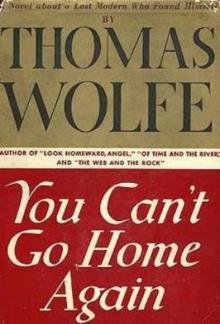
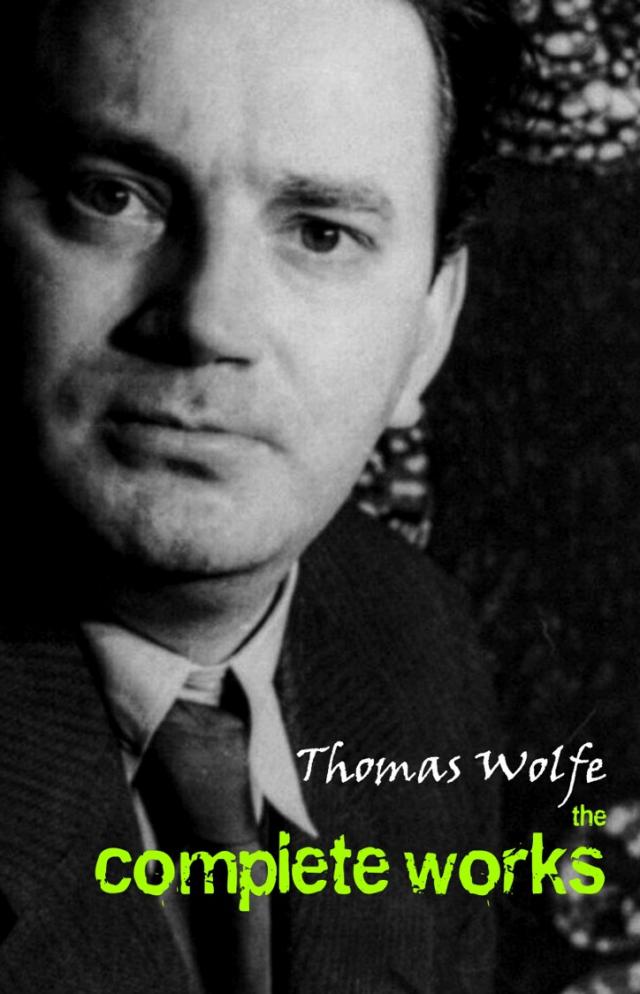
Thomas Wolfe, page 36


John Dorsey noted each whisper of disorder, or each failure in preparation, by careful markings in a book. Each afternoon he read the names of delinquents, amid a low mutter of sullen protest, and stated their penalties. Once Eugene got through an entire day without a mark. He stood triumphantly before Leonard while the master searched the record.
John Dorsey began to laugh foolishly; he gripped his hand affectionately around the boy’s arm.
“Well, sir!” he said. “There must be a mistake. I’m going to keep you in on general principles.”
He bent to a long dribbling suction of laughter. Eugene’s wild eyes were shot with tears of anger and surprise. He never forgot.
Miss Amy yawned, and smiled on him with slow powerful affectionate contempt.
“Go on!” she said, in her broad, lazy accent. “I don’t want to fool with you any more. You’re not worth powder enough to blow you up.”
Margaret came in, her face furrowed deeply between smoke-dark eyes, full of tender sternness and hidden laughter.
“What’s wrong with the rascal?” she asked. “Can’t he learn algebra?”
“He can learn!” drawled Miss Amy. “He can learn anything. He’s lazy—that’s what it is. Just plain lazy.”
She smacked his buttock smartly with a ruler.
“I’d like to warm you a bit with this,” she laughed, slowly and richly. “You’d learn then.”
“Here!” said Margaret, shaking her head in protest. “You leave that boy alone. Don’t look behind the faun’s ears. Never mind about algebra, here. That’s for poor folks. There’s no need for algebra where two and two make five.”
Miss Amy turned her handsome gypsy eyes on Eugene.
“Go on. I’ve seen enough of you.” She made a strong weary gesture of dismissal.
Hatless, with a mad whoop, he plunged through the door and leaped the porch rail.
“Here, boy!” Margaret called. “Where’s your hat?”
Grinning, he galloped back, picked up a limp rag of dirty green felt, and pulled it over his chaotic hair. Curly tufts stuck through the gaping crease-holes.
“Come here!” said Margaret gravely. Her nervous fingers pulled his frayed necktie around to the front, tugged down his vest, and buttoned his coat over tightly, while he peered at her with his strange devil’s grin. Suddenly she trembled with laughter.
“Good heavens, Amy,” she said. “Look at that hat.”
Miss Amy smiled at him with indifferent sleepy cat-warmth.
“You want to fix yourself up, ’Gene,” she said, “so the girls will begin to notice you.”
He heard the strange song of Margaret’s laughter.
“Can you see him out courting?” she said. “The poor girl would think she had a demon lover, sure.”
“As e’er beneath a waning moon was haunted
By woman wailing for her demon lover.”
His eyes burned on her face, flowing with dark secret beauty.
“Get along, you scamp!” she ordered.
He turned, and, crying fiercely in his throat, tore down the road with bounding strides.
All the dusk blurred in her eyes.
“Leave him alone!” she whispered to no one. “Leave him alone!”
A light wind of April fanned over the hill. There was a smell of burning leaves and rubble around the school. In the field on the hill flank behind the house a plowman drove his big horse with loose clanking traces around a lessening square of dry fallow earth. Gee, woa. His strong feet followed after. The big share bit cleanly down, cleaving a deep spermy furrow of moist young earth along its track.
John Dorsey Leonard stared fascinated out the window at the annual rejuvenation of the earth. Before his eyes the emergent nymph was scaling her hard cracked hag’s pelt. The golden age returned.
Down the road a straggling queue of boys were all gone into the world of light. Wet with honest sweat, the plowman paused at the turn, and wiped the blue shirting of his forearm across his beaded forehead. Meanwhile, his intelligent animal, taking advantage of the interval, lifted with slow majesty a proud flowing tail, and added his mite to the fertility of the soil with three moist oaty droppings. Watching, John Dorsey grunted approvingly. They also serve who only stand and wait.
“Please, Mr. Leonard,” said Eugene, carefully choosing his moment, “can I go?”
John Dorsey Leonard stroked his chin absently, and stared sightlessly at his book. Others abide our question, thou art free.
“Huh?” he purred vaguely. Then, with a high vacant snigger he turned suddenly, and said:
“You rascal, you! See if Mrs. Leonard wants you.” He fastened his brutal grip with keen hunger into the boy’s thin arm. April is the cruellest of months. Eugene winced, moved away, and then stood quietly, checked by memory of the old revolt from awe.
He found Margaret in the library reading to the children from The Water Babies.
“Mr. Leonard says to ask you if I can go?” he said.
And her eyes were darkened wholly.
“Yes, you scamp. Go on,” she said. “Tell me, boy,” she coaxed, softly, “can’t you be a little bit better?”
“Yes’m,” he promised, easily. “I’ll try.” Say not the struggle naught availeth.
She smiled at his high mettled prancing nervousness.
“In hell they’ll roast thee like a herrin’,” she said gently. “Get out of here.”
He bounded away from the nunnery of the chaste breast and quiet mind.
As he leaped down the stairs into the yard he heard Dirk Barnard’s lusty splashing bathtub solo. Sweet Thames, run softly till I end my song. Tyson Leonard, having raked into every slut’s corner of nature with a thin satisfied grin, emerged from the barn with a cap full of fresh eggs. A stammering cackle of protest followed him from angry hens who found too late that men betray. At the barnside, under the carriage shed, “Pap” Rheinhart tightened the bellyband of his saddled brown mare, swinging strongly into the saddle, and with a hard scramble of hoofs, came up the hill, wheeled in behind the house, and drew up by Eugene.
“Jump on, ’Gene,” he invited, patting the mare’s broad rump. “I’ll take you home.”
Eugene looked up at him grinning.
“You’ll take me nowhere,” he said. “I couldn’t sit down for a week last time.”
“Pap” boomed with laughter.
“Why, pshaw, boy!” he said. “That was nothing but a gentle little dog-trot.”
“Dog-trot your granny,” said Eugene. “You tried to kill me.”
“Pap” Rheinhart turned his wry neck down on the boy with grave dry humor.
“Come on,” he said gruffly. “I’m not going to hurt you. I’ll teach you how to ride a horse.”
“Much obliged, Pap,” said Eugene ironically. “But I’m thinking of using my tail a good deal in my old age. I don’t want to wear it out while I’m young.”
Pleased with them both, “Pap” Rheinhart laughed loud and deep, spat a brown quid back over the horse’s crupper, and, digging his heels in smartly, galloped away around the house, into the road. The horse bent furiously to his work, like a bounding dog. With four-hooved thunder he drummed upon the sounding earth. Quadrupedante putrem sonitu quatit ungula campum.
At the two-posted entry, by the bishop’s boundary, the departing students turned, split quickly to the sides, and urged the horseman on with shrill cries. “Pap” bent low, with loose-reined hands above the horse-mane, went through the gate like the whiz of a cross-bow. Then, he jerked the mare back on her haunches with a dusty skid of hoofs, and waited for the boys to come up.
“Hey!” With high bounding exultancy Eugene came down the road to join them. Without turning, stolid Van Yeats threw up his hand impatiently and greeted the unseen with a cheer. The others turned, welcoming him with ironical congratulation.
“‘Highpockets,’” said “Doc” Hines, comically puckering his small tough face, “how’d you happen to git out on time?” He had an affected, high-pitched nigger drawl. When he spoke he kept one hand in his coat pocket, fingering a leather thong loaded with buckshot.
“J. D. had to do his spring plowing,” said Eugene.
“Well, if it ain’t ole Handsome,” said Julius Arthur. He grinned squintily, revealing a mouthful of stained teeth screwed in a wire clamp. His face was covered with small yellow pustulate sores. How begot, how nourished?
“Shall we sing our little song for Handsome Hal?” said Ralph Rolls to his copesmate Julius. He wore a derby hat jammed over his pert freckled face. As he spoke he took a ragged twist of tobacco from his pocket and bit off a large chew with a rough air of relish.
“Want a chew, Jule?” he said.
Julius took the twist, wiped off his mouth with a loose male grin, and crammed a large quid into his cheek.
He brought me roots of relish sweet.
“Want one, Highpockets?” he asked Eugene, grinning.
I hate him that would upon the rack of this tough world stretch me out longer.
“Hell,” said Ralph Rolls. “Handsome would curl up and die if he ever took a chew.”
In Spring like torpid snakes my enemies awaken.
At the corner of Church Street, across from the new imitation Tudor of the Episcopal church, they paused. Above them, on the hill, rose the steeples of the Methodist and Presbyterian churches. Ye antique spires, ye distant towers!
“Who’s going my way?” said Julius Arthur. “Come on, ’Gene. The car’s down here. I’ll take you home.”
“Thanks, but I can’t,” said Eugene. “I’m going up-town.” Their curious eyes on Dixieland when I get out.
“You going home, Villa?”
“No,” said George Graves.
“Well, keep Hal out of trouble,” said Ralph Rolls.
Julius Arthur laughed roughly and thrust his hand through Eugene’s hair. “Old Hairbreadth Hal,” he said. “The cutthroat from Saw-Tooth Gap!”
“Don’t let ’em climb your frame, son,” said Van Yeats, turning his quiet pleasant face on Eugene. “If you need help, let me know.”
“So long, boys.”
“So long.”
They crossed the street, mixing in nimble horse-play, and turned down past the church along a sloping street that led to the garages. George Graves and Eugene continued up the hill.
“Julius is a good boy,” said George Graves. “His father makes more money than any other lawyer in town.”
“Yes,” said Eugene, still brooding on Dixieland and his clumsy deceptions.
A street-sweeper walked along slowly uphill, beside his deep wedge-bodied cart. From time to time he stopped the big slow-footed horse and, sweeping the littered droppings of street and gutter into a pan, with a long-handled brush, dumped his collections into the cart. Let not Ambition mock their useful toil.
Three sparrows hopped deftly about three fresh smoking globes of horse-dung, pecking out tidbits with dainty gourmandism. Driven away by the approaching cart, they skimmed briskly over to the bank, with bright twitters of annoyance. One too like thee, tameless, and swift, and proud.
George Graves ascended the hill with a slow ponderous rhythm, staring darkly at the ground.
“Say, ’Gene!” he said finally. “I don’t believe he makes that much.”
Eugene thought seriously for a moment. With George Graves, it was necessary to resume a discussion where it had been left off three days before.
“Who?” he said, “John Dorsey? Yes, I think he does,” he added, grinning.
“Not over $2,500, anyway,” said George Graves gloomily.
“No—three thousand, three thousand!” he said, in a choking voice.
George Graves turned to him with a sombre, puzzled smile. “What’s the matter?” he asked.
“O you fool! You damn fool!” gasped Eugene. “You’ve been thinking about it all this time.”
George Graves laughed sheepishly, with embarrassment, richly.
From the top of the hill at the left, the swelling unction of the Methodist organ welled up remotely from the choir, accompanied by a fruity contralto voice, much in demand at funerals. Abide with me.
Most musical of mourners, weep again!
George Graves turned and examined the four large black houses, ascending on flat terraces to the church, of Paston Place.
“That’s a good piece of property, ’Gene,” he said. “It belongs to the Paston estate.”
Fast falls the even-tide. Heaves the proud harlot her distended breast, in intricacies of laborious song.
“It will all go to Gil Paston some day,” said George Graves with virtuous regret. “He’s not worth a damn.”
They had reached the top of the hill. Church Street ended levelly a block beyond, in the narrow gulch of the avenue. They saw, with quickened pulse, the little pullulation of the town.
A negro dug tenderly in the round loamy flowerbeds of the Presbyterian churchyard, bending now and then to thrust his thick fingers gently in about the roots. The old church, with its sharp steeple, rotted slowly, decently, prosperously, like a good man’s life, down into its wet lichened brick. Eugene looked gratefully, with a second’s pride, at its dark decorum, its solid Scotch breeding.
“I’m a Presbyterian,” he said. “What are you?”
“An Episcopalian, when I go,” said George Graves with irreverent laughter.
“To hell with these Methodists!” Eugene said with an elegant, disdainful face. “They’re too damn common for us.” God in three persons—blessed Trinity. “Brother Graves,” he continued, in a fat well-oiled voice, “I didn’t see you at prayer-meeting Wednesday night. Where in Jesus’ name were you?”
With his open palm he struck George Graves violently between his meaty shoulders. George Graves staggered drunkenly with high resounding laughter.
“Why, Brother Gant,” said he, “I had a little appointment with one of the Good Sisters, out in the cow-shed.”
Eugene gathered a telephone pole into his wild embrace, and threw one leg erotically over its second foot-wedge. George Graves leaned his heavy shoulder against it, his great limbs drained with laughter.
There was a hot blast of steamy air from the Appalachian Laundry across the street and, as the door from the office of the washroom opened, they had a moment’s glimpse of negresses plunging their wet arms into the liquefaction of their clothes.
George Graves dried his eyes. Laughing wearily, they crossed over.
“We oughtn’t to talk like that, ’Gene,” said George Graves reproachfully. “Sure enough! It’s not right.”
He became moodily serious rapidly. “The best people in this town are church members,” he said earnestly. “It’s a fine thing.”
“Why?” said Eugene, with an idle curiosity.
“Because,” said George Graves, “you get to know all the people who are worth a damn.”
Worth being damned, he thought quickly. A quaint idea.
“It helps you in a business way. They come to know you and respect you. You won’t get far in this town, ’Gene, without them. It pays,” he added devoutly, “to be a Christian.”
“Yes,” Eugene agreed seriously, “you’re right.” To walk together to the kirk, with a goodly company.
He thought sadly of his lost sobriety, and of how once, lonely, he had walked the decent lanes of God’s Scotch town. Unbidden they came again to haunt his memory, the shaven faces of good tradesmen, each leading the well washed kingdom of his home in its obedient ritual, the lean hushed smiles of worship, the chained passion of devotion, as they implored God’s love upon their ventures, or delivered their virgin daughters into the holy barter of marriage. And from even deeper adyts of his brain there swam up slowly to the shores of his old hunger the great fish whose names he scarcely knew—whose names, garnered with blind toil from a thousand books, from Augustine, himself a name, to Jeremy Taylor, the English metaphysician, were brief evocations of scalded light, electric, phosphorescent, illuminating by their magic connotations the vast far depths of ritual and religion: They came—Bartholomew, Hilarius, Chrysostomos, Polycarp, Anthony, Jerome, and the forty martyrs of Cappadocia who walked the waves—coiled like their own green shadows for a moment, and were gone.
“Besides,” said George Graves, “a man ought to go anyway. Honesty’s the best policy.”
Across the street, on the second floor of a small brick three-story building that housed several members of the legal, medical, surgical, and dental professions, Dr. H. M. Smathers pumped vigorously with his right foot, took a wad of cotton from his assistant, Miss Lola Bruce, and thrusting it securely into the jaw of his unseen patient, bent his fashionable bald head intently. A tiny breeze blew back the thin curtains, and revealed him, white-jacketed, competent, drill in hand.
“Do you feel that?” he said tenderly.
“Wrogd gdo gurk!”
“Spit!” With thee conversing, I forget all time.
“I suppose,” said George Graves thoughtfully, “the gold they use in people’s teeth is worth a lot of money.”
“Yes,” said Eugene, finding the idea attractive, “if only one person in ten has gold fillings that would be ten million in the United States alone. You can figure on five dollars’ worth each, can’t you?”
“Easy!” said George Graves. “More than that.” He brooded lusciously a moment. “That’s a lot of money,” he said.
In the office of the Rogers-Malone Undertaking Establishment the painful family of death was assembled, “Horse” Hines, tilted back in a swivel chair, with his feet thrust out on the broad window-ledge, chatted lazily with Mr. C. M. Powell, the suave silent partner. How sleep the brave, who sink to rest. Forget not yet.
“There’s good money in undertaking,” said George Graves. “Mr. Powell’s well off.”
Eugene’s eyes were glued on the lantern face of “Horse” Hines. He beat the air with a convulsive arm, and sank his fingers in his throat.
“What’s the matter?” cried George Graves.
“They shall not bury me alive,” he said.
“You can’t tell,” George Graves said gloomily. “It’s been known to happen. They’ve dug them up later and found them turned over on their faces.”