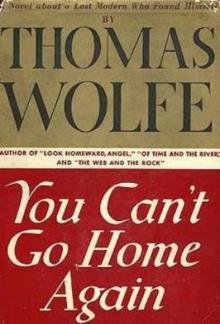
Thomas Wolfe, page 89



Yet, the words gave him a strange happiness and content, as well. He felt a feeling of tenderness for the people who had written them, for the owners of the restaurant who had solemnly and triumphantly thought them out, for all the doctrines of “taste,” “class,” and “refinement” they evoked, for something mistaken and most pitiful that had got into our lives, and that was everywhere, something grotesquely wrong, ridiculous and confused that made one somehow feel a warm, a wordless affection for its victims.
But this was the reason why these things could never be forgotten—because we are so lost, so naked and so lonely in America. Immense and cruel skies bend over us, and all of us are driven on forever and we have no home. Therefore, it is not the slow, the punctual sanded drip of the unnumbered days that we remember best, the ash of time; nor is it the huge monotone of the lost years, the unswerving schedules of the lost life and the well-known faces, that we remember best. It is a face seen once and lost forever in a crowd, an eye that looked, a face that smiled and vanished on a passing train, it is a prescience of snow upon a certain night, the laughter of a woman in a summer street long years ago, it is the memory of a single moon seen at the pine’s dark edge in old October—and all of our lives is written in the twisting of a leaf upon a bough, a door that opened, and a stone.
For America has a thousand lights and weathers and we walk the streets, we walk the streets forever, we walk the streets of life alone.
It is the place of the howling winds, the hurrying of the leaves in old October, the hard clean falling to the earth of acorns. The place of the storm-tossed moaning of the wintry mountainside, where the young men cry out in their throats and feel the savage vigor, the rude strong energies; the place also where the trains cross rivers.
It is a fabulous country, the only fabulous country; it is the one place where miracles not only happen, but where they happen all the time.
It is the place of exultancy and strong joy, the place of the darkened brooding air, the smell of snow; it is the place of all the fierce, the bitten colors in October, when all of the wild, sweet woods flame up; it is also the place of the cider press and the last brown oozings of the York Imperials. It is the place of the lovely girls with good jobs and the husky voices, who will buy a round of drinks; it is the place where the women with fine legs and silken underwear lie in the pullman berth below you, it is the place of the dark-green snore of the pullman cars, and the voices in the night-time in Virginia.
It is the place where great boats are baying at the harbor’s mouth, where great ships are putting out to sea; it is the place where great boats are blowing in the gulf of night, and where the river, the dark and secret river, full of strange time, is forever flowing by us to the sea.
The tugs keep baying in the river; at twelve o’clock the Berengaria moans, her lights slide gently past the piers beyond Eleventh Street; and in the night a tall tree falls in Old Catawba, there in the hills of home.
It is the place of autumnal moons hung low and orange at the frosty edges of the pines; it is the place of frost and silence; of the clean dry shocks and the opulence of enormous pumpkins that yellow on hard clotted earth; it is the place of the stir and feathery stumble of the hens upon their roost, the frosty, broken barking of the dogs, the great barn-shapes and solid shadows in the running sweep of the moon-whited countryside, the wailing whistle of the fast express. It is the place of flares and steamings on the tracks, and the swing and bob and tottering dance of lanterns in the yards; it is the place of dings and knellings and the sudden glare of mighty engines over sleeping faces in the night; it is the place of the terrific web and spread and smouldering, the distant glare of Philadelphia and the solid rumble of the sleepers; it is also the place where the Transcontinental Limited is stroking eighty miles an hour across the continent and the small dark towns whip by like bullets, and there is only the fanlike stroke of the secret, immense and lonely earth again.
I have foreseen this picture many times: I will buy passage on the Fast Express.
It is the place of the wild and exultant winter’s morning and the wind, with the powdery snow, that has been howling all night long; it is the place of solitude and the branches of the spruce and hemlock piled with snow; it is the place where the Fall River boats are tethered to the wharf, and the wild gray snow of furious, secret, and storm-whited morning whips across them. It is the place of the lodge by the frozen lake and the sweet breath and amorous flesh of sinful woman; it is the place of the tragic and lonely beauty of New England; it is the place of the red barn and the sound of the stabled hooves and of bright tatters of old circus posters; it is the place of the immense and pungent smell of breakfast, the country sausages and the ham and eggs, the smoking wheat cakes and the fragrant coffee, and of lone hunters in the frosty thickets who whistle to their lop-eared hounds.
Where is old Doctor Ballard now with all his dogs? He held that they were sacred, that the souls of all the dear lost dead went into them. His youngest sister’s soul sat on the seat beside him; she had long ears and her eyes were sad. Two dozen of his other cherished dead trotted around the buggy as he went up the hill past home. And that was eleven years ago, and I was nine years old; and I stared gravely out the window of my father’s house at old Doctor Ballard.
It is the place of the straight stare, the cold white bellies and the buried lust of the lovely Boston girls; it is the place of ripe brainless blondes with tender lips and a flowery smell, and of the girls with shapely arms who stand on ladders picking oranges; it is also the place where large slow-bodied girls from Kansas City, with big legs and milky flesh, are sent East to school by their rich fathers, and there are also immense and lovely girls, with the grip of a passionate bear, who have such names as Neilson, Lundquist, Jorgenson, and Brandt.
I will go up and down the country, and back and forth across the country on the great trains that thunder over America. I will go out West where States are square; Oh, I will go to Boise, and Helena and Albuquerque. I will go to Montana and the two Dakotas and the unknown places.
It is the place of violence and sudden death; of the fast shots in the night, the club of the Irish cop, and the smell of brains and blood upon the pavement; it is the place of the small-town killings, and the men who shoot the lovers of their wives; it is the place where the negroes slash with razors and the hillmen kill in the mountain meadows; it is the place of the ugly drunks and the snarling voices and of foul-mouthed men who want to fight; it is the place of the loud word and the foolish boast and the violent threat; it is also the place of the deadly little men with white faces and the eyes of reptiles, who kill quickly and casually in the dark; it is the lawless land that feeds on murder.
“Did you know the two Lipe girls?” he asked. “Yes,” I said. “They lived in Biltburn by the river, and one of them was drowned in the flood. She was a cripple, and she wheeled herself along in a chair. She was strong as a bull.” “That’s the girl,” he said.
It is the place of the crack athletes and of the runners who limber up in March; it is the place of the ten-second men and the great jumpers and vaulters; it is the place where Spring comes, and the young birch trees have white and tender barks, of the thaw of the earth, and the feathery smoke of the trees; it is the place of the burst of grass and bud, the wild and sudden tenderness of the wilderness, and of the crews out on the river and the coaches coming down behind them in the motor-boats, the surges rolling out behind when they are gone with heavy sudden wash. It is the place of the baseball players, and the easy lob, the soft spring smackings of the glove and mit, the crack of the bat; it is the place of the great batters, fielders, and pitchers, of the nigger boys and the white, drawling, shirt-sleeved men, the bleachers and the resinous smell of old worn wood; it is the place of Rube Waddell, the mighty untamed and ill-fated pitcher when his left arm is swinging like a lash. It is the place of the fighters, the crafty Jewish lightweights and the mauling Italians, Leonard, Tendler, Rocky Kansas, and Dundee; it is the place where the champion looks over his rival’s shoulder with a bored expression.
I shall wake at morning in a foreign land thinking I heard a horse in one of the streets of home.
It is the place where they like to win always, and boast about their victories; it is the place of quick money and sudden loss; it is the place of the mile-long freights with their strong, solid, clanking, heavy loneliness at night, and of the silent freight of cars that curve away among raw piney desolations with their promise of new lands and unknown distances—the huge attentive gape of emptiness. It is the place where the bums come singly from the woods at sunset, the huge stillness of the water-tower, the fading light, the rails, secret and alive, and trembling with the oncoming train; it is the place of the great tramps, Oklahoma Red, Fargo Pete, and the Jersey Dutchman, who grab fast rattlers for the Western shore; it is the place of old blown bums who come up in October skirls of dust and wind and crumpled newspapers and beg, with canned heat on their breaths: “Help Old McGuire: McGuire’s a good guy, kid. You’re not so tough, kid: McGuire’s your pal, kid: How about McGuire, McGuire——?”
It is the place of the poolroom players and the drug-store boys; of the town whore and her paramour, the tough town driver; it is the place where they go to the woods on Sunday and get up among the laurel and dogwood bushes and the rhododendron blossoms; it is the place of the cheap hotels and the kids who wait with chattering lips while the nigger goes to get them their first woman; it is the place of the drunken college boys who spend the old man’s money and wear fur coats to the football games; it is the place of the lovely girls up North who have rich fathers, of the beautiful wives of business men.
The train broke down somewhere beyond Manassas, and I went forward along the tracks with all the other passengers. “What’s the matter?” I said to the engineer. “The eccentric strap is broken, son,” he said. It was a very cold day, windy and full of sparkling sun. This was the farthest north I’d ever been, and I was twelve years old and on my way to Washington to see Woodrow Wilson inaugurated. Later I could not forget the face of the engineer and the words “eccentric strap.”
It is the place of the immense and lonely earth, the place of fat ears and abundance where they grow cotton, corn, and wheat, the wine-red apples of October, and the good tobacco.
It is the place that is savage and cruel, but it is also the innocent place; it is the wild lawless place, the vital earth that is soaked with the blood of the murdered men, with the blood of the countless murdered men, with the blood of the unavenged and unremembered murdered men; but it is also the place of the child and laughter, where the young men are torn apart with ecstasy, and cry out in their throats with joy, where they hear the howl of the wind and the rain and smell the thunder and the soft numb spitting of the snow, where they are drunk with the bite and sparkle of the air and mad with the solar energy, where they believe in love and victory and think that they can never die.
It is the place where you come up through Virginia on the great trains in the night-time, and rumble slowly across the wide Potomac and see the morning sunlight on the nation’s dome at Washington, and where the fat man shaving in the pullman washroom grunts, “What’s this? What’s this we’re coming to—Washington?”—And the thin man glancing out the window says, “Yep, this is Washington. That’s what it is, all right. You gettin’ off here?”—And where the fat man grunts, “Who—me? Naw—I’m goin’ on to Baltimore.” It is the place where you get off at Baltimore and find your brother waiting.
Where is my father sleeping on the land? Buried? Dead these seven years? Forgotten, rotten in the ground? Held by his own great stone? No, no! Will I say, “Father” when I come to him? And will he call me, “Son”? Oh, no, he’ll never see my face: we’ll never speak except to say——
It is the place of the fast approach, the hot blind smoky passage, the tragic lonely beauty of New England, and the web of Boston; the place of the mighty station there, and engines passive as great cats, the straight dense plumes of engine smoke, the acrid and exciting smell of trains and stations, and of the man-swarm passing ever in its million-footed weft, the smell of the sea in harbors and the thought of voyages—and the place of the goat cry, the strong joy of our youth, the magic city, when we knew the most fortunate life on earth would certainly be ours, that we were twenty and could never die.
And always America is the place of the deathless and enraptured moments, the eye that looked, the mouth that smiled and vanished, and the word; the stone, the leaf, the door we never found and never have forgotten. And these are the things that we remember of America, for we have known all her thousand lights and weathers, and we walk the streets, we walk the streets forever, we walk the streets of life alone.
[¬]
XV
Now at Cambridge, in the house of the Murphys on Trowbridge Street, he found himself living with the Irish for the first time, and he discovered that the Murphys were utterly different from all the Irish he had known before, and all that he had felt and believed about them. He soon discovered that the Murphys were a typical family of the Boston Irish. It was a family of five: there were Mr. and Mrs. Murphy, two sons and a daughter. Mrs. Murphy ran the house on Trowbridge Street, which they owned, and rented the rooms to lodgers, Mr. Murphy was night watchman in a warehouse on the Boston waterfront, the girl was a typist in an Irish business house in Boston, the older boy, Jimmy, had a clerical position in the Boston City Hall, and the youngest boy, Eddy, whom the youth knew best, was a student at Boston College. In addition there were two Irish lodgers who had lived with them for years: Mr. Feeney, a young man who worked at Raymond’s, a department store in Washington Street, Boston, and Mr. O’Doul, a middle-aged man, unmarried, who occupied the front room upstairs just over the boy’s own room. Mr. O’Doul was a civil engineer, he drank very heavily, and he would sometimes be confined to his bed for days at a time with terrible attacks of rheumatism which would bend, gnarl, and twist him, and render him incapable of movement.
But in the Murphys the boy discovered none of the richness, wildness, extravagance, and humor of such people as Mike Fogarty, Tim Donovan, or the MacReadys—the Irish he had known at home. The Murphys were hard, sterile, arid, meagre, and cruel: they were disfigured by a warped and infuriated puritanism, and yet they were terribly corrupt. There was nothing warm, rich, or generous about them or their lives: it seemed as if the living roots of nature had grown gnarled and barren among the walls and pavements of the city, it seemed that everything that is wild, sudden, capricious, whimsical, passionate, and mysterious in the spirit of the race had been dried and hardened out of them by their divorce from the magical earth their fathers came from, as if the snarl and jangle of the city streets, the barren and earthless angularity of steel and stone and brick, had entered their souls. Even their speech had become hard, gray, and sterile: the people were almost inarticulate, it is doubtful if one of them had three hundred words in his vocabulary: the boy noticed that the men especially—Murphy, his two sons, Feeney, and O’Doul—made constant use of a few arid words and phrases, which, with the intonation of the voice, and a slight convulsive movement of the arms and hands, filled in enormous vacancies in thought and feeling, and said all that they could say, or wished to say. Chief among these words or phrases was “You know? . . . or “You know what I mean?”—words which were uttered with a slight protesting emphasis on “You,” a slight and painful movement of the hands or shoulders, and an air that the listener must fill in for himself all that they wanted to imply. For epithets of rich resounding rage, for curses thick and opulent with fury, in which he had believed their tongues were apt and their spirits prodigal, he discovered that they had no more to offer than “Chee!” or “Jeez!” or “Ho-ly Jeez!” or “Christ!” or “Ho-ly Christ!” or occasionally “Ho-ly Mary!” Finally, they made a constant and stupefying use of that terrible gray abortion of a word “guy”: it studded their speech with the numberless monotony of paving brick, without it they would have been completely speechless and would have had to communicate by convulsions of their arms and hands and painful croakings from their tongueless throats—the word fell upon the spirit of the listener with the gray weariness of a cold incessant drizzle, it flowed across the spirit like a river of concrete; hope, joy, the power to feel and think were drowned out under the relentless and pitiless aridity of its flood.
At first, he thought these words and phrases were part of a meagre but sufficient pattern which they had learned in order to meet the contingencies of life and business with alien and Protestant spirits, as waiters in European cafés, restaurants, and dining-cars will learn a few words of English in order to serve the needs of British and American tourists—he thought this because he saw something sly, closed, conspiratorial, mocking and full of hatred and mistrust, in their relations with people who were not members of their race and their religion; he thought they had a warm, secret and passionate life of their own which never could be known by a stranger. But he soon found that this belief was untrue: even in their conversations with one another, they were almost inarticulate—a race which thought, felt, and spoke with the wooden insensitivity of automatons or dummies on whose waxen souls a few banal formulas for speech and feeling had been recorded. He heard some amazing performances: every evening toward six o’clock the family would gather in their dingy living-room at the end of the hall, Mr. Feeney and Mr. O’Doul would join them, and then he could hear the voices of the men raised in argument, protest, agreement, denial, affirmation and belief, or skepticism, evoking a ghastly travesty of all of man’s living moments of faith, doubt, and passion, and yet speaking for hours at a time, with the idiot repetitions of a gramophone held by its needle to a single groove, a blunted jargon of fifty meaningless words: