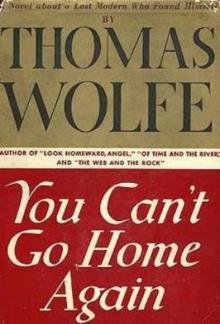
Thomas Wolfe, page 412



“How’s this one Elizabeth?” He read:
“She went away in beauty’s flower,
Before her youth was spent,
Ere life and love had lived its hour
God called her and she went.
Yet whispers Faith upon the wind:
No grief to her was given.
She left your love and went to find
A greater one in heaven.”
“Oh, that’s lovely—lovely!” she said. “I want that one.”
“Yes,” he agreed, “I think that’s the best one.”
In the musty, cool smell of his little office they got up. Her gallant figure reached his shoulder. She buttoned her kid gloves over the small pink haunch of her palms and glanced about her. His battered sofa filled one wall, the line of his long body was printed in the leather. She looked up at him. Her face was sad and grave. They remembered.
“It’s been a long time, Elizabeth,” he said.
They walked slowly to the front through aisled marbles. Sentineled just beyond the wooden doors, the angel leered vacantly down. Jannadeau drew his great head turtlewise a little farther into the protective hunch of his burly shoulders. They went out onto the porch.
The moon stood already like its own phantom in the clear-washed skies of evening. A little boy with an empty paper delivery-bag swung lithely by, his freckled nostrils dilating pleasantly with hunger and the fancied smell of supper. He passed, and for a moment, as they stood at the porch edge, all life seemed frozen in a picture: the firemen and Fagg Sluder had seen Gant, whispered, and were now looking toward him; a policeman, at the high side-porch of the police court, leaned on the rail and stared; at the edge of the central plot below the fountain a farmer bent for water at a bubbling jet, rose dripping, and stared; from the tax collector’s office, city hall, upstairs, Yancy, huge, meaty, shirt-sleeved, stared.
And at that second the slow pulse of the fountain was suspended, life was held, like an arrested gesture, in photographic abeyance, and Gant felt himself alone move deathward in a world of seemings as, in 1910, a man might find himself again in a picture taken on the grounds of the Chicago Fair, when he was thirty, and his mustache black; and noting the bustled ladies and the derbied men fixed in the second’s pullulation, remember the dead instant, seek beyond the borders for what (he knew) was there. Or as a veteran who finds himself upon his elbow near Ulysses Grant before the march, in pictures of the Civil War, and sees a dead man on a horse. Or, I should say, like some completed Don, who finds himself again before a tent in Scotland in his youth, and notes a cricket-bat, long lost and long forgotten; the face of a poet who had died, and young men and the tutor as they looked that Long Vacation when they read nine hours a day for greats.
Where now? Where after? Where then?
[¬]
A PORTRAIT OF BASCOM HAWKE
[Scribner’s Magazine, April 1932]
During the first twenty-five years of this century, business people who had their offices in or near State Street, Boston, no doubt grew very familiar with the cadaverous and extraordinary figure of my uncle, Bascom Hawke. Shortly before nine o’clock of every working day he would emerge from a subway exit near the head of the street and pause vaguely for a moment, making a craggy eddy in the tide of issuing workers that foamed swiftly about him while he stood with his enormous bony hands clutched comically before him at the waist, as if holding himself in, at the same time making the most horrible grimaces with his lean and amazingly flexible features. These grimaces were made by squinting his small sharp eyes together, widening his mouth in a ghastly travesty of a grin, and convolving his chin and cheek in a rapid series of pursed lips and horrible squints as he swiftly pressed his rubbery underlip against a few enormous horse teeth that decorated his upper jaw. Having completed these facial evolutions, he glanced quickly and, it must be supposed, blindly, in every direction; for he then plunged heedlessly across the street, sometimes choosing the moment when traffic had been halted, and pedestrians were hurrying across, sometimes diving into the midst of a roaring chaos of motor cars, trucks, and wagons, through which he sometimes made his way in safety, accompanied only by a scream of brake bands, a startled barking of horns, and the hearty curses of frightened drivers, or from which, howling with terror in the centre of a web of traffic which he had snarled hopelessly and brought to a complete standstill, he was sometimes rescued by a red-faced and cursing young Irishman who was on point duty at that corner.
But Bascom was a fated man and he escaped. Once, it is true, a bright mindless beetle of machinery, which had no thought for fated men, had knocked him down and skinned and bruised him; again, an uninstructed wheel had passed across the soft toe-end of his shoe and held him prisoner, as if he were merely some average son of destiny—but he escaped. He escaped because he was a fated man and because the providence which guides the steps of children and the blind was kind to him; and because this same policeman whose simian upper lip had once been thick and twisted with its curses had long since run the scale from anger to wild fury, and thence to madness and despair and resignation, and had now come to have a motherly affection for this stray sheep, kept his eye peeled for its appearance every morning or, failing this, at once shrilled hard upon his whistle when he heard the well-known howl of terror and surprise, plunged to the centre of the stalled traffic snarl, plucked Bascom out to safety under curse and shout and scream of brake, and marched him tenderly to the curb, gripping his brawny hand around my uncle’s arm, feeling his joints, testing his bones, massaging anxiously his sinewy carcass, and calling him “bud”—although my uncle was old enough to be his grandfather. “Are you all right, bud? You’re not hurt, are you, bud? Are you O. K.?”—to which Bascom if his shock and terror had been great, could make no answer for a moment save to pant hoarsely and to howl loudly and huskily from time to time “Ow! Ow! Ow! Ow!”
At length, becoming more coherent, if not more calm, he would launch into an ecclesiastical indictment of motor cars and their drivers delivered in a high, howling, and husky voice that suggested the pronouncements of a prophet from a mountain. This voice had a quality of strange remoteness and, once heard, would never be forgotten. It actually had a howling note in it, and carried to great distances, and yet it was not loud: it was very much as if Mr. Bascom Hawke were standing on a mountain and shouting to some one in a quiet valley below—the sounds came to one plainly but as if from a great distance, and it was full of a husky, unearthly passion. It was really an ecclesiastical voice, the voice of a great preacher; one felt that it should be heard in churches, which was exactly where it once was heard, for my uncle Bascom had at various times and with great conviction, in the course of his long and remarkable life, professed and preached the faith of the Episcopalians, the Presbyterians, the Methodists, the Baptists, and the Unitarians.
Quite often, in fact, as now, when he had narrowly escaped disaster in the streets, Bascom Hawke still preached from the corner: as soon as he recovered somewhat from his shock, he would launch forth into a sermon of eloquent invective against any driver of motor cars within hearing, and if any of them entered the fray, as sometimes happened, a very interesting performance occurred.
“What happened to you?” the motorist might bitterly remark. “Do the keepers know you’re out?”
Mr. Hawke would thereupon retort with an eloquent harangue, beginning with a few well-chosen quotations from the more violent prophets of the Old Testament, a few predictions of death, destruction and damnation for the owners of motor cars, and a few apt references to Days of Judgment and Reckoning, Chariots of Moloch, and Beasts of the Apocalypse.
“Oh, for God’s sake!” the exasperated motorist might reply. “Are you blind? Where do you think you are? In a cow-pasture? Can’t you read the signals? Didn’t you see the cop put his hand up? Don’t you know when it says to ‘Stop’ or ‘Go’? Did you ever hear of the traffic law?”
“The traffic law!” my uncle Bascom sneeringly exclaimed, as if the mere use of the word by the motorist evoked his profoundest contempt. His voice now had a precise and meticulous way of speech, there was something sneering and pedantical in the way he pronounced each word, biting it off with a prim, nasal and heavily accented enunciation in the manner of certain pedants and purists who suggest by their pronunciation that language in the mouths of most people is vilely and carelessly treated, that each word has a precise, subtle, and careful meaning of its own, and that they—they alone—understand these matters. “The traffic law!” he repeated again: then he squinted his eyes together, pursed his rubbery lip against the big horsy upper teeth, and laughed down his nose in a forced, sneering manner, “The traffic law!” he said. “Why, you pit-i-ful ig-no-ram-us! You il-lit-ter-ate ruffian! You dare to speak to me—to me!” he howled suddenly with an ecclesiastical lift of his voice, striking himself on his bony breast and glaring with a majestical fury as if the word of a mighty prophet had been contradicted by an upstart—“of the traffic law, when it is doubtful if you could read the law if you saw it,”—he sneered—“and it is obvious to any one with the perception of a schoolboy that you would not have intelligence enough to understand it, and”—here his voice rose to a howling emphasis and he held one huge bony finger up to command attention—“and to interpret it, if you could read.”
“Is that so!” the motorist heavily remarked. “A wise guy, eh? One of these guys who knows it all, eh? You’re a pretty wise guy, aren’t you?” the motorist continued bitterly, as if caught up in the circle of his refrain and unable to change it. “Well, let me tell you something. You think you’re pretty smaht, don’t you? Well, you’re not. See? It’s wise guys like you who go around looking for a good bust on the nose. See? That’s how smaht you are. If you wasn’t an old guy I’d give you one, too,” he said, getting a moody satisfaction from the thought.
“Ow-w! Ow-w! Ow-w!” Bascom howled in sudden terror.
“If you know so much, if you’re so smaht as you think you are, what is the traffic law?”
Then, assuredly, if there was a traffic law, the unfortunate motorist was lost, for my uncle Bascom would deliver it to him verbatim, licking his lips with joy over all the technicalities of legal phrasing and pronouncing each phrase with a meticulous and pedantical enunciation.
“And furthermore!” he howled, holding up his big bony finger, “the Commonwealth of Massachusetts has decreed, by a statute that has been on the books since 1856, by a statute that is irrevocably, inexorably, ineluctably plain that any driver, director, governor, commander, manager, agent or conductor, or any other person who shall conduct or cause to be conducted any vehicular instrument, whether it be of two, four, six, eight or any number of wheels whatsoever, whether it be in the public service, or in the possession of a private individual, whether it be—” but by this time, the motorist, if he was wise, had had enough, and had escaped.
If, however, it had been one of his more fortunate mornings, if he had blindly but successfully threaded the peril of roaring traffic, my uncle Bascom proceeded rapidly down State Street, still clutching his raw bony hands across his meagre waist, still contorting his remarkable face in its endless series of pursed grimaces, and presently turned in to the entrance of a large somewhat dingy-looking building of blackened stone, one of those solid, unpretending, but very valuable properties which smells and looks like the early 1900’s, and which belongs to that ancient and enormously wealthy corporation which lies across the river and is known as Harvard University.
Here, my uncle Bascom, still clutching himself together across the waist, mounted a flight of indented marble entry steps, lunged through revolving doors into a large marble corridor that was redolent with vibrating waves of hot steamy air, wet rubbers and galoshes, sanitary disinfectant, and serviceable but somewhat old-fashioned elevators and, entering one of the cars which had just plunged down abruptly, banged open its door, belched out two or three people and swallowed a dozen more, he was finally deposited with the same abruptness on the seventh floor, where he stepped out into a wide dark corridor, squinted and grimaced uncertainly to right and left as he had done for twenty-five years, and then went left along the corridor, past rows of lighted offices in which one could hear the preliminary clicking of typewriters, the rattling of crisp papers, and the sounds of people beginning their day’s work. At the end of the corridor Bascom Hawke turned right along another corridor and at length paused before a door which bore this inscription across the familiar glazed glass of American business offices: The John T. Brill Realty Co.—Houses For Rent or Sale. Below this bold legend in much smaller letters was printed: Bascom Hawke—Att’y at Law—Conveyancer and Title Expert.
—
And now, before we enter this interesting office, let us give a closer and more particular scrutiny to the appearance of this singular man.
The appearance of this strange figure in State Street, or anywhere else, had always been sufficiently curious to attract attention and to draw comment. Bascom Hawke, if he had straightened to his full height, would have been six feet and three or four inches tall, but he had always walked with a stoop and as he grew older, the stoop had become confirmed: he presented a tall, gnarled, bony figure, cadaverous and stringy, but tough as hickory. He was of that race of men who seem never to wear out, or to grow old, or to die: they live with almost undiminished vitality to great ages, and when they die they die suddenly. There is no slow wastage and decay because there is so little to waste or decay: their mummied and stringy flesh has the durability of granite.
Bascom Hawke clothed his angular figure with an assortment of odd garments which seemed to have the same durability: they were immensely old and worn, but they also gave no signs of ever wearing out, for by their cut and general appearance of age, it seemed that his frugal soul had selected in the Nineties materials which it hoped would last forever. His coat, which was originally of a dark dull pepper-and-salt gray, had gone green at the seams and pockets, and moreover it was a ridiculously short skimpy coat for a gaunt big-boned man like this: it was hardly more than a jacket, his great wristy hands burst out of it like lengths of cord-wood, and the mark of his high humped narrow shoulders cut into it with a knife-like sharpness. His trousers were also tight and skimpy, of a lighter gray and of a rough woolly texture from which all fuzz and fluff had long ago been rubbed, he wore rough country brogans with raw-hide laces, and a funny little flat hat of ancient black felt, which had also gone green along the band. One understands now why the policeman called him “Bud”: this great bony figure seemed ruthlessly to have been crammed into garments in which a country fledgling of the eighties might have gone to see his girl, clutching a bag of gumdrops in his large red hand. A stringy little necktie, a clean but dilapidated collar which by its bluish and softly mottled look Bascom Hawke must have laundered himself (a presumption which is quite correct since my uncle did all his own laundry work, as well as his mending, repairing, and cobbling)—this was his costume, winter and summer, and it never changed, save that in winter he supplemented it with an ancient blue sweater which he wore buttoned to the chin and whose frayed ends and cuffs projected inches below the scanty little jacket. He had never been known to wear an overcoat, not even on the coldest days of those long, raw, and formidable winters which Boston suffers.
—
The mark of my uncle’s madness was plain upon him: intuitively men knew he was not a poor man, and the people who had seen him so many times in State Street would nudge one another, saying: “You see that old guy? You’d think he was waitin’ for a handout from the Salvation Army, wouldn’t you? Well, he’s not. He’s got it, brother. Believe me, he’s got it good and plenty: he’s got it salted away where no one ain’t goin’ to touch it. That guy’s got a sock full of dough!”
“Jesus!” another remarks. “What good’s it goin’ to do an old guy like that? He can’t take any of it with him, can he?”
“You said it, brother,” and the conversation would become philosophical.
Bascom Hawke was himself conscious of his parsimony, and although he sometimes asserted that he was “only a poor man” he realized that his exaggerated economies could not be justified to his business associates on account of poverty: they taunted him slyly, saying, “Come on, Hawke, let’s go to lunch. You can get a good meal at the Pahkeh House for a couple of bucks.” Or “Say, Hawke, I know a place where they’re havin’ a sale of winter overcoats: I saw one there that would just suit you—you can get it for sixty dollars.” Or “Do you need a good laundry, Reverend? I know a couple of Chinks who do good work.”
To which Bascom, with the characteristic evasiveness of parsimony, would reply, snuffling derisively down his nose: “No, sir! You won’t catch me in any of their stinking restaurants. You never know what you’re getting: if you could see the dirty, nasty, filthy kitchens where your food is prepared you’d lose your appetite quick enough.” His parsimony had resulted in a compensating food mania: he declared that “in his young days” he “ruined his digestion by eating in restaurants,” he painted the most revolting pictures of the filth of these establishments, laughing scornfully down his nose as he declared: “I suppose you think it tastes better after some dirty, nasty, stinking nigger has wiped his old hands all over it” (phuh-phuh-phuh-phuh-phuh!)—here he would contort his face and snuffle scornfully down his nose; and he was bitter in his denunciation of “rich foods,” declaring they had “destroyed more lives than all the wars and all the armies since the beginning of time.”
As he had grown older he had become more and more convinced of the healthy purity of “raw foods,” and he prepared for himself at home raw revolting messes of chopped-up carrots, onions, turnips, even raw potatoes, which he devoured at table, smacking his lips with an air of keen relish, and declaring to his wife: “You may poison yourself on your old roasts and oysters and turkeys if you please: you wouldn’t catch me eating that stuff. No, sir! Not on your life! I think too much of my stomach!” But his use of the pronoun “you” was here universal rather than particular because if that lady’s longevity had depended on her abstinence from “roasts and oysters and turkeys” there was no reason why she should not have lived forever.