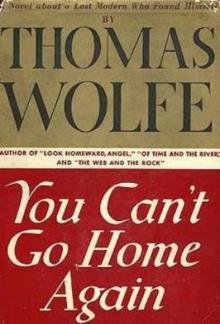
Thomas Wolfe, page 42



Helen laughed huskily.
“Well,” said Eliza, “how’d you leave Daisy and the children?”
“They’re all right, I suppose,” said Helen wearily. “Oh, my God! Deliver me!” she laughed. “You never saw such pests! I spent fifty dollars on them in toys and presents alone! You’d never think it from the thanks I get. Daisy takes it all as her due! Selfish! Selfish! Selfish!”
“For G-g-god’s sake!” said Luke loyally.
She was one fine girl.
“I paid for everything I got at Daisy’s, I can assure you!” she said, sharply, challengingly. “I spent no more time there than I had to. I was at Mrs. Selborne’s nearly all the time. I had practically all my meals there.”
Her need for independence had become greater; her hunger for dependents acute. Her denial of obligation to others was militant. She gave more than she received.
“Well, I’m in for it,” she said presently, trying to mask her strong eagerness.
“In for what?” asked Luke.
“I’ve gone and done it at last,” she said.
“Mercy!” shrieked Eliza. “You’re not married, are you?”
“Not yet,” said Helen, “but I will be soon.”
Then she told them about Mr. Hugh T. Barton, the cash register salesman. She spoke loyally and kindly of him, without great love.
“He’s ten years older than I am,” she said.
“Well,” said Eliza thoughtfully, moulding her lips. “They sometimes make the best husbands.” After a moment, she asked: “Has he got any property?”
“No,” said Helen, “they live up all he makes. They live in style, I tell you. There are two servants in that house all the time. The old lady doesn’t turn her hand over.”
“Where are you going to live?” said Eliza sharply. “With his folks?”
“Well, I should say not! I should say not!” said Helen slowly and emphatically. “Good heavens, mama!” she continued irritably. “I want a home of my own. Can’t you realize that? I’ve been doing for others all my life. Now I’m going to let them do for me. I want no in-laws about. No, sir!” she said emphatically.
Luke bit his nails nervously.
“Well, he’s g-g-getting a great g-g-girl,” he said. “I hope he has sense enough to realize that.”
Moved, she laughed bigly, ironically.
“I’ve got one booster, haven’t I?” she said. She looked at him seriously with clear affectionate eyes. “Well, thanks, Luke. You’re one of the lot that’s always had the interests of the family at heart.”
Her big face was for a moment tranquil and eager. A great calm lay there: the radiant decent beauty of dawn and rainwater. Her eyes were as luminous and believing as a child’s. No evil dwelt in her. She had learned nothing.
“Have you told your papa?” said Eliza, presently.
“No,” she said, after a pause, “I haven’t.”
They thought of Gant in silence, with wonder. Her going was a marvel.
“I have a right to my own life,” said Helen angrily, as if some one disputed that right, “as much as any one. Good heavens, mama! You and papa have lived your lives—don’t you know that? Do you think it’s right that I should go on forever looking after him? Do you?” Her voice rose under the stress of hysteria.
“Why, no-o. I never said—” Eliza began, flustered and conciliatory.
“You’ve spent your life f-f-finking of others and not of yourself,” said Luke. “That’s the trouble. They don’t appreciate it.”
“Well, I’m not going to any longer. That’s one thing sure! No, indeed! I want a home and some children. I’m going to have them!” she said defiantly. In a moment, she added tenderly:
“Poor old papa! I wonder what he’s going to say?”
He said very little. The Gants, after initial surprise, moulded new events very quickly into the texture of their lives. Abysmal change widened their souls out in a brooding unconsciousness.
Mr. Hugh Barton came up into the hills to visit his affianced kin. He came, to their huge delight, lounging in the long racing chassis of a dusty brown 1911 Buick roadster. He came, in a gaseous coil, to the the roaring explosion of great engines. He descended, a tall, elegant figure, dyspeptic, lean almost to emaciation, very foppishly laundered and tailored. He looked the car over slowly, critically, a long cigar clamped in the corner of his saturnine mouth, drawing his gauntlets off deliberately. Then, in the same unhurried fashion, he removed from his head the ten-gallon gray sombrero—the only astonishing feature of his otherwise undebatable costume—and shook each long thin leg delicately for a moment to straighten out the wrinkles. But there were none. Then, deliberately, he came up the walk to Dixieland, where the Gants were assembled. As he came, unhurried, he took the cigar from his mouth calmly and held it in the fingers of his lean, hairy, violently palsied hand. His thin black hair, fine spun, was fanned lightly from its elegance by a wantoning breeze. He espied his betrothed and grinned, with dignity, sardonically, with big nuggets of gold teeth. They greeted and kissed.
“This is my mother, Hugh,” said Helen.
Hugh Barton bent slowly, courteously, from his thin waist. He fastened on Eliza a keen penetrating stare that discomposed her. His lips twisted again in an impressive sardonic smile. Every one felt he was going to say something very, very important.
“How do you do?” he asked, and took her hand.
Every one then felt that Hugh Barton had said something very, very important.
With equal slow gravity he greeted each one. They were somewhat awed by his lordliness. Luke, however, burst out uncontrollably:
“You’re g-g-getting a fine girl, Mr. B-b-barton.”
Hugh Barton turned on him slowly and fixed him with his keen stare.
“I think so,” he said gravely. His voice was deep, deliberate, with an impressive rasp. He was selling himself.
In an awkward silence he turned, grinning amiably, on Eugene.
“Have a cigar?” he asked, taking three long powerful weeds from his upper vest pocket, and holding them out in his clean twitching fingers.
“Thanks,” said Eugene with a dissipated leer, “I’ll smoke a Camel.”
He took a package of cigarettes from his pocket. Gravely, Hugh Barton held a match for him.
“Why do you wear the big hat?” asked Eugene.
“Psychology,” he said. “It makes ’em talk.”
“I tell you what!” said Eliza, beginning to laugh. “That’s pretty smart, isn’t it?”
“Sure!” said Luke. “That’s advertising! It pays to advertise!”
“Yes,” said Mr. Barton slowly, “you’ve got to get the other fellow’s psychology.”
The phrase seemed to describe an action of modified assault and restrained pillage.
They liked him very much. They all went into the house.
Hugh Barton’s mother was in her seventy-fourth year, but she had the strength of a healthy woman of fifty, and the appetite of two of forty. She was a powerful old lady, six feet tall, with the big bones of a man, and a heavy full-jawed face, sensuous and complacent, and excellently equipped with a champing mill of strong yellow horse-teeth. It was cake and pudding to see her at work on corn on the cob. A slight paralysis had slowed her tongue and thickened her speech a little, so that she spoke deliberately, with a ponderous enunciation of each word. This deformity, which she carefully hid, added to, rather than subtracted from, the pontifical weight of her opinions: she was an earnest Republican—in memory of her departed mate—and she took a violent dislike to any one who opposed her political judgment. When thwarted or annoyed in any way, the heavy benevolence of her face was dislodged by a thunder-cloud of petulance, and her wide pouting underlip rolled out like a window-shade. But, as she barged slowly along, one big hand gripping a heavy stick on which she leaned her massive weight, she was an impressive dowager.
“She’s a lady—a real lady,” said Helen proudly. “Any one can see that! She goes out with all the best people.”
Hugh Barton’s sister, Mrs. Genevieve Watson, was a sallow woman of thirty-eight years, tall, wren-like and emaciated, like her brother; dyspeptic, and very elegantly kept. The divorced Watson was conspicuous for his absence from all conversations: there was once or twice a heavy flutter around his name, a funereal hush, and a muttered suggestion of oriental debauchery.
“He was a beast,” said Hugh Barton, “a low dog. He treated sister very badly.”
Mrs. Barton wagged her great head with the slow but emphatic approval she accorded all her son’s opinions.
“O-o-h!” she said. “He was a ter-rib-bul man.”
He had, they inferred, been given to hellish practices. He had “gone after other women.”
Sister Veve had a narrow discontented face, a metallic vivacity, an effusive cordiality. She was always very smartly dressed. She had somewhat vague connections in the real estate business; she spoke grandly of obscure affairs; she was always on the verge of an indefinite “Big Deal.”
“I’m getting them lined up, brother,” she would say with cheerful confidence. “Things are coming my way. J. D. came in to-day and said: ‘Veve—you’re the only woman in the world that can put this thing across. Go to it, little girl. There’s a fortune in it for you.’” And so on.
Her conversation, Eugene thought, was not unlike Brother Steve’s.
But their affection and loyalty for one another was beautiful. Its unaccustomed faith, its abiding tranquillity, puzzled and disturbed the Gants. They were touched indefinably, a little annoyed, because of it.
The Bartons came to Woodson Street two weeks before the wedding. Within three days after their arrival, Helen and old lady Barton were at odds. It was inevitable. The heat of the girl’s first affection for Barton’s family wore off very quickly: her possessive instinct asserted itself—she would halve no one’s love, she would share with no other a place in the heart. She would own, she would possess completely. She would be generous, but she would be mistress. She would give. It was the law of her nature.
She began immediately, by force of this essential stress, to make out a case against the old woman.
Mrs. Barton, too, felt the extent of her loss. She wanted to be sure that Helen realized the extent of her acquisition of one of the latter-day saints.
Rocking ponderously in the dark on Gant’s veranda, the old woman would say:
“You are get-ting a good boy, Hel-en.” She would wag her powerful head from side to side, pugnaciously emphatic. “Though I do say it myself, you are get-ting one good boy, Hel-en. A bet-ter boy than Hugh does-ent live.”
“Oh, I don’t know!” said Helen, annoyed. “I don’t think it’s such a bad bargain for him either, you know. I think pretty well of myself, too.” And she would laugh, huskily, heartily, trying in laughter to conceal her resentment, but visibly, to every eye but Mrs. Barton’s, angered.
A moment later, on some pretext, she would be back into the house, where, with a face contorted by her rising hysteria, to Luke, Eugene, or any sympathetic audience, she would burst out:
“You heard that, didn’t you? You heard that? You see what I’ve got to put up with, don’t you? Do you see? Do you blame me for not wanting that damned old woman around? Do you? You see how she wants to run things, don’t you? Do you see how she rubs it into me whenever she gets a chance? She can’t bear to give him up. Of course not! He’s her meal-ticket. They’ve bled him white. Why, even now, if it came to a question of choosing between us—” her face worked strongly. She could not continue. In a moment she quieted herself, and said decisively: “I suppose you know now why we’re going to live away from them. You see, don’t you? Do you blame me?”
“No’m,” said Eugene, obedient after pumping.
“It’s a d-d-damn shame!” said Luke loyally.
At this moment Mrs. Barton, kindly but authoritative, called from the veranda:
“Hel-en! Where are you, Hel-en?”
“O gotohell. Gotohell!” said Helen, in a comic undertone.
“Yes? What is it?” she called out sharply.
You see, don’t you?
She was married at Dixieland, because she was having a big wedding. She knew a great many people.
As her wedding-day approached, her suppressed hysteria mounted. Her sense of decorum grew militant: she attacked Eliza bitterly for keeping certain dubious people in the house.
“Mama, in heaven’s name! What do you mean by allowing such goings-on right in the face of Hugh and his people? What do you suppose they think of it? Have you no respect for my feelings? Good heavens, are you going to have the house full of chippies on the night of my wedding?” Her voice was high and cracked. She almost wept.
“Why, child!” said Eliza, with troubled face. “What do you mean? I’ve never noticed anything.”
“Are you blind! Every one’s talking about it! They’re practically living together!” This last was a reference to a condition existing between a dissipated and alcoholic young man and a darkly handsome young woman, slightly tubercular.
To Eugene was assigned the task of digging this couple out of their burrow. He waited sternly outside the girl’s room, watching the shadow dance at the door crack. At the end of the sixth hour, the besieged surrendered—the man came out. The boy—pallid, but proud of his trust—told the house-defiler that he must go. The young man agreed with cheerful alcoholism. He went at once.
Mrs. Pert was saved in the house-cleaning.
“After all,” said Helen, “what do we know about her? They can say what they like about Fatty. I like her.”
Ferns, flowers, potted plants, presents and guests arriving. The long nasal drone of the Presbyterian minister. The packed crowd. The triumphant booming of “The Wedding March.”
A flashlight: Hugh Barton and his bride limply astare—frightened; Gant, Ben, Luke, and Eugene, widely, sheepishly agrin; Eliza, high-sorrowful and sad; Mrs. Selborne and a smile of subtle mystery; the pert flower-girls; Pearl Hines’ happy laughter.
When it was over, Eliza and her daughter hung in each other’s arms, weeping.
Eliza repeated over and over, from guest to guest:
“A son is a son till he gets him a wife,
But a daughter’s a daughter all the days of her life.”
She was comforted.
They escaped at length, wilted, from the thronging press of well-wishing guests. White-faced, scared witless, Mr. and Mrs. Hugh Barton got into a closed car. It was done! They would spend the night at the Battery Hill. Ben had engaged the wedding-suite. To-morrow, a honeymoon to Niagara.
Before they went, the girl kissed Eugene with something of the old affection.
“I’ll see you in the Fall, honey. Come over as soon as you’re settled.”
For Hugh Barton was beginning life with his bride in a new place. He was going to the capital of the State. And it had already been determined, chiefly by Gant, that Eugene was going to the State University.
But Hugh and Helen did not go honeymooning the next morning, as they had planned. During the night, as she lay at Dixieland, old Mrs. Barton was taken with a violent, a retching sickness. For once, her massive digestive mechanism failed to meet the heavy demands she had put upon it during the pre-nuptial banqueting. She came near death.
Hugh and Helen returned abruptly next morning to a scene of dismal tinsellings and jaded lilies. Helen hurled her vitality into the sick woman’s care; dominant, furious, all-mastering, she blew back her life into her. Within three days, Mrs. Barton was out of danger; but her complete recovery was slow, ugly, and painful. As the days lengthened out wearily, the girl became more and more bitter over her thwarted honeymoon. Rushing out of the sick-room, she would enter Eliza’s kitchen with writhen face, unable to control her anger:
“That damned old woman! Sometimes I believe she did it on purpose. My God, am I to get no happiness from life? Will they never leave me alone? Urr-p! Urr-p!”—Her rough bacchic smile played loosely over her large unhappy face. “Mama, in God’s name where does it all come from?” she said, grinning tearfully. “I do nothing but mop up after her. Will you please tell me how long it’s going to last?”
Eliza laughed slyly, passing her finger under her broad nosewing.
“Why, child!” she said. “What in the world! I’ve never seen the like! She must have saved up for the last six months.”
“Yes, sir!” said Helen, looking vaguely away, with a profane smile playing across her mouth, “I’d just like to know where the hell it all comes from. I’ve had everything else,” she said, with a rough angry laugh, “I’m expecting one of her kidneys at any minute.”
“Whew-w!” cried Eliza, shaken with laughter.
“Hel-en! Oh Hel’en!” Mrs. Barton’s voice came feebly in to them.
“O gotohell!” said the girl, sotto-voce. “Urr-p! Urr-p!” She burst suddenly into tears: “Is it going to be like this always! I sometimes believe the judgment of God is against us all. Papa was right.”
“Pshaw!” said Eliza, wetting her fingers, and threading a needle before the light. “I’d go on and pay no more attention to her. There’s nothing wrong with her. It’s all imagination!” It was Eliza’s rooted conviction that most human ills, except her own, were “all imagination.”
“Hel-en!”
“All right! I’m coming!” the girl cried cheerfully, turning an angry grin on Eliza as she went. It was funny. It was ugly. It was terrible.
It seemed, in fact, that papa was right, and that the chief celestial Cloud-Pusher, the often hymned, whom our bitter moderns have sometimes called “the ancient Jester”—had turned his frown upon their fortunes.
It began to rain—rain incessant, spouting, torrential rain, fell among the reeking hills, leaving grass and foliage drowned upon the slopes, starting the liquid avalanche of earth upon a settlement, glutting lean rocky mountain-streams to a foaming welter of yellow flood. It mined the yellow banks away with unheard droppings; it caved in hillsides; it drank the steep banked earth away below the rails, leaving them strung to their aerial ties across a gutted canyon.
“Well,” said Eliza, “how’d you leave Daisy and the children?”
“They’re all right, I suppose,” said Helen wearily. “Oh, my God! Deliver me!” she laughed. “You never saw such pests! I spent fifty dollars on them in toys and presents alone! You’d never think it from the thanks I get. Daisy takes it all as her due! Selfish! Selfish! Selfish!”
“For G-g-god’s sake!” said Luke loyally.
She was one fine girl.
“I paid for everything I got at Daisy’s, I can assure you!” she said, sharply, challengingly. “I spent no more time there than I had to. I was at Mrs. Selborne’s nearly all the time. I had practically all my meals there.”
Her need for independence had become greater; her hunger for dependents acute. Her denial of obligation to others was militant. She gave more than she received.
“Well, I’m in for it,” she said presently, trying to mask her strong eagerness.
“In for what?” asked Luke.
“I’ve gone and done it at last,” she said.
“Mercy!” shrieked Eliza. “You’re not married, are you?”
“Not yet,” said Helen, “but I will be soon.”
Then she told them about Mr. Hugh T. Barton, the cash register salesman. She spoke loyally and kindly of him, without great love.
“He’s ten years older than I am,” she said.
“Well,” said Eliza thoughtfully, moulding her lips. “They sometimes make the best husbands.” After a moment, she asked: “Has he got any property?”
“No,” said Helen, “they live up all he makes. They live in style, I tell you. There are two servants in that house all the time. The old lady doesn’t turn her hand over.”
“Where are you going to live?” said Eliza sharply. “With his folks?”
“Well, I should say not! I should say not!” said Helen slowly and emphatically. “Good heavens, mama!” she continued irritably. “I want a home of my own. Can’t you realize that? I’ve been doing for others all my life. Now I’m going to let them do for me. I want no in-laws about. No, sir!” she said emphatically.
Luke bit his nails nervously.
“Well, he’s g-g-getting a great g-g-girl,” he said. “I hope he has sense enough to realize that.”
Moved, she laughed bigly, ironically.
“I’ve got one booster, haven’t I?” she said. She looked at him seriously with clear affectionate eyes. “Well, thanks, Luke. You’re one of the lot that’s always had the interests of the family at heart.”
Her big face was for a moment tranquil and eager. A great calm lay there: the radiant decent beauty of dawn and rainwater. Her eyes were as luminous and believing as a child’s. No evil dwelt in her. She had learned nothing.
“Have you told your papa?” said Eliza, presently.
“No,” she said, after a pause, “I haven’t.”
They thought of Gant in silence, with wonder. Her going was a marvel.
“I have a right to my own life,” said Helen angrily, as if some one disputed that right, “as much as any one. Good heavens, mama! You and papa have lived your lives—don’t you know that? Do you think it’s right that I should go on forever looking after him? Do you?” Her voice rose under the stress of hysteria.
“Why, no-o. I never said—” Eliza began, flustered and conciliatory.
“You’ve spent your life f-f-finking of others and not of yourself,” said Luke. “That’s the trouble. They don’t appreciate it.”
“Well, I’m not going to any longer. That’s one thing sure! No, indeed! I want a home and some children. I’m going to have them!” she said defiantly. In a moment, she added tenderly:
“Poor old papa! I wonder what he’s going to say?”
He said very little. The Gants, after initial surprise, moulded new events very quickly into the texture of their lives. Abysmal change widened their souls out in a brooding unconsciousness.
Mr. Hugh Barton came up into the hills to visit his affianced kin. He came, to their huge delight, lounging in the long racing chassis of a dusty brown 1911 Buick roadster. He came, in a gaseous coil, to the the roaring explosion of great engines. He descended, a tall, elegant figure, dyspeptic, lean almost to emaciation, very foppishly laundered and tailored. He looked the car over slowly, critically, a long cigar clamped in the corner of his saturnine mouth, drawing his gauntlets off deliberately. Then, in the same unhurried fashion, he removed from his head the ten-gallon gray sombrero—the only astonishing feature of his otherwise undebatable costume—and shook each long thin leg delicately for a moment to straighten out the wrinkles. But there were none. Then, deliberately, he came up the walk to Dixieland, where the Gants were assembled. As he came, unhurried, he took the cigar from his mouth calmly and held it in the fingers of his lean, hairy, violently palsied hand. His thin black hair, fine spun, was fanned lightly from its elegance by a wantoning breeze. He espied his betrothed and grinned, with dignity, sardonically, with big nuggets of gold teeth. They greeted and kissed.
“This is my mother, Hugh,” said Helen.
Hugh Barton bent slowly, courteously, from his thin waist. He fastened on Eliza a keen penetrating stare that discomposed her. His lips twisted again in an impressive sardonic smile. Every one felt he was going to say something very, very important.
“How do you do?” he asked, and took her hand.
Every one then felt that Hugh Barton had said something very, very important.
With equal slow gravity he greeted each one. They were somewhat awed by his lordliness. Luke, however, burst out uncontrollably:
“You’re g-g-getting a fine girl, Mr. B-b-barton.”
Hugh Barton turned on him slowly and fixed him with his keen stare.
“I think so,” he said gravely. His voice was deep, deliberate, with an impressive rasp. He was selling himself.
In an awkward silence he turned, grinning amiably, on Eugene.
“Have a cigar?” he asked, taking three long powerful weeds from his upper vest pocket, and holding them out in his clean twitching fingers.
“Thanks,” said Eugene with a dissipated leer, “I’ll smoke a Camel.”
He took a package of cigarettes from his pocket. Gravely, Hugh Barton held a match for him.
“Why do you wear the big hat?” asked Eugene.
“Psychology,” he said. “It makes ’em talk.”
“I tell you what!” said Eliza, beginning to laugh. “That’s pretty smart, isn’t it?”
“Sure!” said Luke. “That’s advertising! It pays to advertise!”
“Yes,” said Mr. Barton slowly, “you’ve got to get the other fellow’s psychology.”
The phrase seemed to describe an action of modified assault and restrained pillage.
They liked him very much. They all went into the house.
Hugh Barton’s mother was in her seventy-fourth year, but she had the strength of a healthy woman of fifty, and the appetite of two of forty. She was a powerful old lady, six feet tall, with the big bones of a man, and a heavy full-jawed face, sensuous and complacent, and excellently equipped with a champing mill of strong yellow horse-teeth. It was cake and pudding to see her at work on corn on the cob. A slight paralysis had slowed her tongue and thickened her speech a little, so that she spoke deliberately, with a ponderous enunciation of each word. This deformity, which she carefully hid, added to, rather than subtracted from, the pontifical weight of her opinions: she was an earnest Republican—in memory of her departed mate—and she took a violent dislike to any one who opposed her political judgment. When thwarted or annoyed in any way, the heavy benevolence of her face was dislodged by a thunder-cloud of petulance, and her wide pouting underlip rolled out like a window-shade. But, as she barged slowly along, one big hand gripping a heavy stick on which she leaned her massive weight, she was an impressive dowager.
“She’s a lady—a real lady,” said Helen proudly. “Any one can see that! She goes out with all the best people.”
Hugh Barton’s sister, Mrs. Genevieve Watson, was a sallow woman of thirty-eight years, tall, wren-like and emaciated, like her brother; dyspeptic, and very elegantly kept. The divorced Watson was conspicuous for his absence from all conversations: there was once or twice a heavy flutter around his name, a funereal hush, and a muttered suggestion of oriental debauchery.
“He was a beast,” said Hugh Barton, “a low dog. He treated sister very badly.”
Mrs. Barton wagged her great head with the slow but emphatic approval she accorded all her son’s opinions.
“O-o-h!” she said. “He was a ter-rib-bul man.”
He had, they inferred, been given to hellish practices. He had “gone after other women.”
Sister Veve had a narrow discontented face, a metallic vivacity, an effusive cordiality. She was always very smartly dressed. She had somewhat vague connections in the real estate business; she spoke grandly of obscure affairs; she was always on the verge of an indefinite “Big Deal.”
“I’m getting them lined up, brother,” she would say with cheerful confidence. “Things are coming my way. J. D. came in to-day and said: ‘Veve—you’re the only woman in the world that can put this thing across. Go to it, little girl. There’s a fortune in it for you.’” And so on.
Her conversation, Eugene thought, was not unlike Brother Steve’s.
But their affection and loyalty for one another was beautiful. Its unaccustomed faith, its abiding tranquillity, puzzled and disturbed the Gants. They were touched indefinably, a little annoyed, because of it.
The Bartons came to Woodson Street two weeks before the wedding. Within three days after their arrival, Helen and old lady Barton were at odds. It was inevitable. The heat of the girl’s first affection for Barton’s family wore off very quickly: her possessive instinct asserted itself—she would halve no one’s love, she would share with no other a place in the heart. She would own, she would possess completely. She would be generous, but she would be mistress. She would give. It was the law of her nature.
She began immediately, by force of this essential stress, to make out a case against the old woman.
Mrs. Barton, too, felt the extent of her loss. She wanted to be sure that Helen realized the extent of her acquisition of one of the latter-day saints.
Rocking ponderously in the dark on Gant’s veranda, the old woman would say:
“You are get-ting a good boy, Hel-en.” She would wag her powerful head from side to side, pugnaciously emphatic. “Though I do say it myself, you are get-ting one good boy, Hel-en. A bet-ter boy than Hugh does-ent live.”
“Oh, I don’t know!” said Helen, annoyed. “I don’t think it’s such a bad bargain for him either, you know. I think pretty well of myself, too.” And she would laugh, huskily, heartily, trying in laughter to conceal her resentment, but visibly, to every eye but Mrs. Barton’s, angered.
A moment later, on some pretext, she would be back into the house, where, with a face contorted by her rising hysteria, to Luke, Eugene, or any sympathetic audience, she would burst out:
“You heard that, didn’t you? You heard that? You see what I’ve got to put up with, don’t you? Do you see? Do you blame me for not wanting that damned old woman around? Do you? You see how she wants to run things, don’t you? Do you see how she rubs it into me whenever she gets a chance? She can’t bear to give him up. Of course not! He’s her meal-ticket. They’ve bled him white. Why, even now, if it came to a question of choosing between us—” her face worked strongly. She could not continue. In a moment she quieted herself, and said decisively: “I suppose you know now why we’re going to live away from them. You see, don’t you? Do you blame me?”
“No’m,” said Eugene, obedient after pumping.
“It’s a d-d-damn shame!” said Luke loyally.
At this moment Mrs. Barton, kindly but authoritative, called from the veranda:
“Hel-en! Where are you, Hel-en?”
“O gotohell. Gotohell!” said Helen, in a comic undertone.
“Yes? What is it?” she called out sharply.
You see, don’t you?
She was married at Dixieland, because she was having a big wedding. She knew a great many people.
As her wedding-day approached, her suppressed hysteria mounted. Her sense of decorum grew militant: she attacked Eliza bitterly for keeping certain dubious people in the house.
“Mama, in heaven’s name! What do you mean by allowing such goings-on right in the face of Hugh and his people? What do you suppose they think of it? Have you no respect for my feelings? Good heavens, are you going to have the house full of chippies on the night of my wedding?” Her voice was high and cracked. She almost wept.
“Why, child!” said Eliza, with troubled face. “What do you mean? I’ve never noticed anything.”
“Are you blind! Every one’s talking about it! They’re practically living together!” This last was a reference to a condition existing between a dissipated and alcoholic young man and a darkly handsome young woman, slightly tubercular.
To Eugene was assigned the task of digging this couple out of their burrow. He waited sternly outside the girl’s room, watching the shadow dance at the door crack. At the end of the sixth hour, the besieged surrendered—the man came out. The boy—pallid, but proud of his trust—told the house-defiler that he must go. The young man agreed with cheerful alcoholism. He went at once.
Mrs. Pert was saved in the house-cleaning.
“After all,” said Helen, “what do we know about her? They can say what they like about Fatty. I like her.”
Ferns, flowers, potted plants, presents and guests arriving. The long nasal drone of the Presbyterian minister. The packed crowd. The triumphant booming of “The Wedding March.”
A flashlight: Hugh Barton and his bride limply astare—frightened; Gant, Ben, Luke, and Eugene, widely, sheepishly agrin; Eliza, high-sorrowful and sad; Mrs. Selborne and a smile of subtle mystery; the pert flower-girls; Pearl Hines’ happy laughter.
When it was over, Eliza and her daughter hung in each other’s arms, weeping.
Eliza repeated over and over, from guest to guest:
“A son is a son till he gets him a wife,
But a daughter’s a daughter all the days of her life.”
She was comforted.
They escaped at length, wilted, from the thronging press of well-wishing guests. White-faced, scared witless, Mr. and Mrs. Hugh Barton got into a closed car. It was done! They would spend the night at the Battery Hill. Ben had engaged the wedding-suite. To-morrow, a honeymoon to Niagara.
Before they went, the girl kissed Eugene with something of the old affection.
“I’ll see you in the Fall, honey. Come over as soon as you’re settled.”
For Hugh Barton was beginning life with his bride in a new place. He was going to the capital of the State. And it had already been determined, chiefly by Gant, that Eugene was going to the State University.
But Hugh and Helen did not go honeymooning the next morning, as they had planned. During the night, as she lay at Dixieland, old Mrs. Barton was taken with a violent, a retching sickness. For once, her massive digestive mechanism failed to meet the heavy demands she had put upon it during the pre-nuptial banqueting. She came near death.
Hugh and Helen returned abruptly next morning to a scene of dismal tinsellings and jaded lilies. Helen hurled her vitality into the sick woman’s care; dominant, furious, all-mastering, she blew back her life into her. Within three days, Mrs. Barton was out of danger; but her complete recovery was slow, ugly, and painful. As the days lengthened out wearily, the girl became more and more bitter over her thwarted honeymoon. Rushing out of the sick-room, she would enter Eliza’s kitchen with writhen face, unable to control her anger:
“That damned old woman! Sometimes I believe she did it on purpose. My God, am I to get no happiness from life? Will they never leave me alone? Urr-p! Urr-p!”—Her rough bacchic smile played loosely over her large unhappy face. “Mama, in God’s name where does it all come from?” she said, grinning tearfully. “I do nothing but mop up after her. Will you please tell me how long it’s going to last?”
Eliza laughed slyly, passing her finger under her broad nosewing.
“Why, child!” she said. “What in the world! I’ve never seen the like! She must have saved up for the last six months.”
“Yes, sir!” said Helen, looking vaguely away, with a profane smile playing across her mouth, “I’d just like to know where the hell it all comes from. I’ve had everything else,” she said, with a rough angry laugh, “I’m expecting one of her kidneys at any minute.”
“Whew-w!” cried Eliza, shaken with laughter.
“Hel-en! Oh Hel’en!” Mrs. Barton’s voice came feebly in to them.
“O gotohell!” said the girl, sotto-voce. “Urr-p! Urr-p!” She burst suddenly into tears: “Is it going to be like this always! I sometimes believe the judgment of God is against us all. Papa was right.”
“Pshaw!” said Eliza, wetting her fingers, and threading a needle before the light. “I’d go on and pay no more attention to her. There’s nothing wrong with her. It’s all imagination!” It was Eliza’s rooted conviction that most human ills, except her own, were “all imagination.”
“Hel-en!”
“All right! I’m coming!” the girl cried cheerfully, turning an angry grin on Eliza as she went. It was funny. It was ugly. It was terrible.
It seemed, in fact, that papa was right, and that the chief celestial Cloud-Pusher, the often hymned, whom our bitter moderns have sometimes called “the ancient Jester”—had turned his frown upon their fortunes.
It began to rain—rain incessant, spouting, torrential rain, fell among the reeking hills, leaving grass and foliage drowned upon the slopes, starting the liquid avalanche of earth upon a settlement, glutting lean rocky mountain-streams to a foaming welter of yellow flood. It mined the yellow banks away with unheard droppings; it caved in hillsides; it drank the steep banked earth away below the rails, leaving them strung to their aerial ties across a gutted canyon.