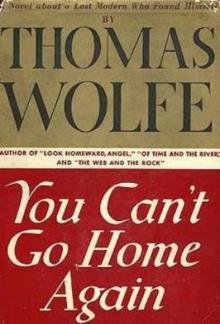
Thomas Wolfe, page 314



If George Webber had never gone beyond the limits of the neighborhood in which he lived, the whole chronicle of the earth would have been there for him just the same. South Brooklyn was a universe.
The people in the houses all around him, whose lives in the cold, raw days of winter always seemed hermetic, sterile, and remote, as shut out from him as though they were something sealed up in a tin, became in spring and summer so real to him it seemed that he had known them from his birth. For, as the days and nights grew warmer, everybody kept their windows open, and all the dwellers in these houses conducted their most intimate affairs in loud and raucous voices which carried to the street and made the casual passer-by a confidant of every family secret.
God knows he saw squalor and filth and misery and despair enough, violence and cruelty and hate enough, to crust his lips forever with the hard and acrid taste of desolation. He found a sinister and demented Italian grocer whose thin mouth writhed in a servile smile as he cringed before his customers, and the next moment was twisted in a savage snarl as he dug his clawlike fingers into the arm of his wretched little son. And on Saturdays the Irishmen would come home drunk, and then would beat their wives and cut one another’s throats, and the whole course and progress of their murderous rages would be published nakedly from their open windows with laugh, shout, scream, and curse.
But he found beauty in South Brooklyn, too. There was a tree that leaned over into the narrow alley where he lived, and George could stand at his basement window and look up at it and watch it day by day as it came into its moment’s glory of young and magic green. And then toward sunset, if he was tired, he could lie down to rest a while upon his iron bed and listen to the dying birdsong in the tree. Thus, each spring, in that one tree, he found all April and the earth. He also found devotion, love, and wisdom in a shabby little Jewish tailor and his wife, whose dirty children were always tumbling in and out of the dingy suffocation of his shop.
In the infinite variety of such common, accidental, oft-unheeded things one can see the web of life as it is spun. Whether we wake at morning in the city, or lie at night in darkness in the country towns, or walk the streets of furious noon in all the dusty, homely, and enduring lights of present time, the universe around us is the same. Evil lives forever—so does good. Man alone has knowledge of these two, and he is such a little thing.
For what is man?
First, a child, soft-boned, unable to support itself on its rubbery legs, befouled with its excrement, that howls and laughs by turns, cries for the moon but hushes when it gets its mother’s teat; a sleeper, eater, guzzler, howler, laugher, idiot, and a chewer of its toe; a little tender thing all blubbered with its spit, a reacher into fires, a beloved fool.
After that, a boy, hoarse and loud before his companions, but afraid of the dark; will beat the weaker and avoid the stronger; worships strength and savagery, loves tales of war and murder, and violence done to others; joins gangs and hates to be alone; makes heroes out of soldiers, sailors, prize fighters, football players, cowboys, gunmen, and detectives; would rather die than not out-try and out-dare his companions, wants to beat them and always to win, shows his muscle and demands that it be felt, boasts of his victories and will never own defeat.
Then the youth: goes after girls, is foul behind their backs among the drugstore boys, hints at a hundred seductions, but gets pimples on his face; begins to think about his clothes, becomes a fop, greases his hair, smokes cigarettes with a dissipated air, reads novels, and writes poetry on the sly. He sees the world now as a pair of legs and breasts; he knows hate, love, and jealousy; he is cowardly and foolish, he cannot endure to be alone; he lives in a crowd, thinks with the crowd, is afraid to be marked off from his fellows by an eccentricity. He joins clubs and is afraid of ridicule; he is bored and unhappy and wretched most of the time. There is a great cavity in him, he is dull.
Then the man: he is busy, he is full of plans and reasons, he has work. He gets children, buys and sells small packets of everlasting earth, intrigues against his rivals, is exultant when he cheats them. He wastes his little three score years and ten in spendthrift and inglorious living; from his cradle to his grave he scarcely sees the sun or moon or stars; he is unconscious of the immortal sea and earth; he talks of the future and he wastes it as it comes. If he is lucky, he saves money. At the end his fat purse buys him flunkeys to carry him where his shanks no longer can; he consumes rich food and golden wine that his wretched stomach has no hunger for; his weary and lifeless eyes look out upon the scenery of strange lands for which in youth his heart was panting. Then the slow death, prolonged by costly doctors, and finally the graduate undertakers, the perfumed carrion, the suave ushers with palms outspread to leftwards, the fast motor hearses, and the earth again.
This is man: a writer of books, a putter-down of words, a painter of pictures, a maker of ten thousand philosophies. He grows passionate over ideas, he hurls scorn and mockery at another’s work, he finds the one way, the true way, for himself, and calls all others false—yet in the billion books upon the shelves there is not one that can tell him how to draw a single fleeting breath in peace and comfort. He makes histories of the universe, he directs the destiny of nations, but he does not know his own history, and he cannot direct his own destiny with dignity or wisdom for ten consecutive minutes.
This is man: for the most part a foul, wretched, abominable creature, a packet of decay, a bundle of degenerating tissues, a creature that gets old and hairless and has a foul breath, a hater of his kind, a cheater, a scorner, a mocker, a reviler, a thing that kills and murders in a mob or in the dark, loud and full of brag surrounded by his fellows, but without the courage of a rat alone. He will cringe for a coin, and show his snarling fangs behind the giver’s back; he will cheat for two sous, and kill for forty dollars, and weep copiously in court to keep another scoundrel out of jail.
This is man, who will steal his friend’s woman, feel the leg of his host’s wife below the table cloth, dump fortunes on his whores, bow down in worship before charlatans, and let his poets die. This is man, who swears he will live only for beauty, for art, for the spirit, but will live only for fashion, and will change his faith and his convictions as soon as fashion changes. This is man, the great warrior with the flaccid gut, the great romantic with the barren loins, the eternal knave devouring the eternal fool, the most glorious of all the animals, who uses his brain for the most part to make himself a stench in the nostrils of the Bull, the Fox, the Dog, the Tiger, and the Goat.
Yes, this is man, and it is impossible to say the worst of him, for the record of his obscene existence, his baseness, lust, cruelty, and treachery, is illimitable. His life is also full of toil, tumult, and suffering. His days are mainly composed of a million idiot repetitions—in goings and comings along hot streets, in sweatings and freezings, in the senseless accumulation of fruitless tasks, in decaying and being patched, in grinding out his life so that he may buy bad food, in eating bad food so that he may grind his life out in distressful defecations. He is the dweller in that ruined tenement who, from one moment’s breathing to another, can hardly forget the bitter weight of his uneasy flesh, the thousand diseases and distresses of his body, the growing incubus of his corruption. This is man, who, if he can remember ten golden moments of joy and happiness out of all his years, ten moments unmarked by care, unseamed by aches or itches, has power to lift himself with his expiring breath and say: “I have lived upon this earth and known glory!”
This is man, and one wonders why he wants to live at all. A third of his life is lost and deadened under sleep; another third is given to a sterile labor; a sixth is spent in all his goings and his comings, in the moil and shuffle of the streets, in thrusting, shoving, pawing. How much of him is left, then, for a vision of the tragic stars? How much of him is left to look upon the everlasting earth? How much of him is left for glory and the making of great songs? A few snatched moments only from the barren glut and suck of living.
Here, then, is man, this moth of time, this dupe of brevity and numbered hours, this travesty of waste and sterile breath. Yet if the gods could come here to a desolate, deserted earth where only the ruin of man’s cities remained, where only a few marks and carvings of his hand were legible upon his broken tablets, where only a wheel lay rusting in the desert sand, a cry would burst out of their hearts and they would say: “He lived, and he was here!”
Behold his works:
He needed speech to ask for bread—and he had Christ! He needed songs to sing in battle—and he had Homer! He needed words to curse his enemies—and he had Dante, he had Voltaire, he had Swift! He needed cloth to cover up his hairless, puny flesh against the seasons—and he wove the robes of Solomon, he made the garments of great kings, he made the samite for the young knights! He needed walls and a roof to shelter him—and he made Blois! He needed a temple to propitiate his God—and he made Chartres and Fountains Abbey! He was born to creep upon the earth—and he made great wheels, he sent great engines thundering down the rails, he launched great wings into the air, he put great ships upon the angry sea!
Plagues wasted him, and cruel wars destroyed his strongest sons, but fire, flood, and famine could not quench him. No, nor the inexorable grave—his sons leaped shouting from his dying loins. The shaggy bison with his thews of thunder died upon the plains; the fabled mammoths of the unrecorded ages are vast scaffoldings of dry, insensate loam; the panthers have learned caution and move carefully among tall grasses to the water hole; and man lives on amid the senseless nihilism of the universe.
For there is one belief, one faith, that is man’s glory, his triumph, his immortality—and that is his belief in life. Man loves life, and, loving life, hates death, and because of this he is great, he is glorious, he is beautiful, and his beauty is everlasting. He lives below the senseless stars and writes his meanings in them. He lives in fear, in toil, in agony, and in unending tumult, but if the blood foamed bubbling from his wounded lungs at every breath he drew, he would still love life more dearly than an end of breathing. Dying, his eyes burn beautifully, and the old hunger shines more fiercely in them—he has endured all the hard and purposeless suffering, and still he wants to live.
Thus it is impossible to scorn this creature. For out of his strong belief in life, this puny man made love. At his best, he is love. Without him there can be no love, no hunger, no desire.
So this is man—the worst and best of him—this frail and petty thing who lives his day and dies like all the other animals, and is forgotten. And yet, he is immortal, too, for both the good and evil that he does live after him. Why, then, should any living man ally himself with death, and, in his greed and blindness, batten on his brother’s blood?
[¬]
CHAPTER 28
THE FOX
During all these desperate years in Brooklyn, when George lived and worked alone, he had only one real friend, and this was his editor, Foxhall Edwards. They spent many hours together, wonderful hours of endless talk, so free and full that it combed the universe and bound the two of them together in bonds of closest friendship. It was a friendship founded on many common tastes and interests, on mutual liking and admiration of each for what the other was, and on an attitude of respect which allowed unhampered expression of opinion even on those rare subjects which aroused differences of views and of belief. It was, therefore, the kind of friendship that can exist only between two men. It had in it no element of that possessiveness which always threatens a woman’s relations with a man, no element of that physical and emotional involvement which, while it serves nature’s end of bringing a man and woman together, also tends to thwart their own dearest wish to remain so by throwing over their companionship a constricting cloak of duty and obligation, of right and vested interest.
The older man was not merely friend but father to the younger. Webber, the hot-blooded Southerner, with his large capacity for sentiment and affection, had lost his own father many years before and now had found a substitute in Edwards. And Edwards, the reserved New Englander, with his deep sense of family and inheritance, had always wanted a son but had had five daughters, and as time went on he made of George a kind of foster son. Thus each, without quite knowing that he did it, performed an act of spiritual adoption.
So it was to Foxhall Edwards that George now turned whenever his loneliness became unbearable. When his inner turmoil, confusion, and self-doubts overwhelmed him, as they often did, and his life went dead and stale and empty till it sometimes seemed that all the barren desolation of the Brooklyn streets had soaked into his very blood and marrow—then he would seek out Edwards. And he never went to him in vain. Edwards, busy though he always was, would drop whatever he was doing and would take George out to lunch or dinner, and in his quiet, casual, oblique, and understanding way would talk to him and draw him out until he found out what it was that troubled him. And always in the end, because of Edwards’ faith in him, George would be healed and find himself miraculously restored to self-belief.
What manner of man was this great editor and father-confessor and true friend—he of the quiet, shy, sensitive, and courageous heart who often seemed to those who did not know him well an eccentric, cold, indifferent fellow—he who, grandly christened Foxhall, preferred to be the simple, unassuming Fox?
The Fox asleep was a breathing portrait of guileless innocence. He slept on his right side, legs doubled up a little, hands folded together underneath the ear, his hat beside him on the pillow. Seen so, the sleeping figure of the Fox was touching—for all his five and forty years, it was so plainly boylike. By no long stretch of fancy the old hat beside him on the pillow might have been a childish toy brought to bed with him the night before—and this, in fact, it was!
It was as if, in sleep, no other part of Fox was left except the boy. Sleep seemed to have resumed into itself this kernel of his life, to have excluded all transitions, to have brought the man back to his acorn, keeping thus inviolate that which the man, indeed, had never lost, but which had passed through change and time and all the accretions of experience—and now had been restored, unwoven back into the single oneness of itself.
And yet it was a guileful Fox, withal. Oh, guileful Fox, how innocent in guilefulness and in innocence how full of guile! How straight in cunning, and how cunning-straight, in all directions how strange-devious, in all strange-deviousness how direct! Too straight for crookedness, and for envy too serene, too fair for blind intolerance, too just and seeing and too strong for hate, too honest for base dealing, too high for low suspiciousness, too innocent for all the scheming tricks of swarming villainy—yet never had been taken in a horse trade yet!
So, then, life’s boy is he, life’s trustful child; life’s guileful-guileless Fox is he, but not life’s angel, not life’s fool. Will get at all things like a fox—not full-tilt at the fences, not head-on, but through coverts peering, running at fringes of the wood, or by the wall; will swing round on the pack and get behind the hounds, cross them up and be away and gone when they are looking for him where he’s not—he will not mean to fox them, but he will.
Gets round the edges of all things the way a fox does. Never takes the main route or the worn handle. Sees the worn handle, what it is, says, “Oh,” but knows it’s not right handle though most used: gets right handle right away and uses it. No one knows how it is done, neither knows the Fox, but does it instantly. It seems so easy when Fox does it, easy as a shoe, because he has had it from his birth. It is a genius.
Our Fox is never hard or fancy, always plain. He makes all plays look easy, never brilliant; it seems that anyone can do it when Fox does it. He covers more ground than any other player in the game, yet does not seem to do so. His style is never mannered, seems no style at all; the thrilled populace never holds its breath in hard suspense when he takes aim, because no one ever saw the Fox take aim, and yet he never misses. Others spend their lives in learning to take aim: they wear just the proper uniform for taking aim, they advance in good order, they signal to the breathless world for silence—“We are taking aim!” they say, and then with faultless style and form, with flawless execution, they bring up their pieces, take aim—and miss! The great Fox never seems to take aim, and never misses. Why? He was just born that way—fortunate, a child of genius, innocent and simple—and a Fox!
“And ah!—a cunning Fox!” the Aimers and the Missers say. “A damned subtle, devilish, and most cunning Fox!” they cry, and grind their teeth. “Be not deceived by his appearance—’tis a cunning Fox! Put not your faith in Foxes, put not your faith in this one, he will look so shy, and seem so guileless and so bewildered—but he will never miss!
“But how—” the Aimers and the Missers plead with one another in exasperation—“how does he do it? What has the fellow got? He’s nothing much to look at—nothing much to talk to. He makes no appearance! He never goes out in the world—you never see him at receptions, parties, splendid entertainments—he makes no effort to meet people—no, or to talk to them! He hardly talks at all! . . . What has he got? Where does it come from? Is it chance or luck? There is some mystery——”
“Well, now,” says one, “I’ll tell you what my theory is——”
Their heads come close, they whisper craftily together until——
“No!” another cries. “It is not that. I tell you what he does, it’s——”
And again they whisper close, argue and deny, get more confused than ever, and finally are reduced to furious impotence:
“Bah!” cries one. “How does the fellow do it, anyway? How does he get away with it? He seems to have no sense, no knowledge, no experience. He doesn’t get around the way we do, lay snares and traps. He doesn’t seem to know what’s going on, or what the whole thing’s all about—and yet——”
“He’s just a snob!” another snarls. “When you try to be a good fellow, he high-hats you! You try to kid him, he just looks at you! He never offers to shake hands with you, he never slaps you on the back the way real fellows do! You go out of your way to be nice to him—to show him you’re a real guy and that you think he is, too—and what does he do? He just looks at you with that funny little grin and turns away—and wears that damned hat in the office all day long—I think he sleeps with it! He never asks you to sit down—and gets up while you’re talking to him—leaves you cold—begins to wander up and down outside, staring at everyone he sees—his own associates—as if he were some half-wit idiot boy—and wanders back into his office twenty minutes later—stares at you as if he never saw your face before—and jams that damned hat further down around his ears, and turns away—takes hold of his lapels—looks out the window with that crazy grin—then looks at you again, looks you up and down, stares at your face until you wonder if you’ve changed suddenly into a baboon—and turns back to the window without a word—then stares at you again—finally pretends to recognize you, and says: ‘Oh, it’s you!’ . . . I tell you he’s a snob, and that’s his way of letting you know you don’t belong! Oh, I know about him—I know what he is! He’s an old New Englander—older than God, by God! Too good for anyone but God, by God!—and even God’s a little doubtful! An aristocrat—a rich man’s son—a Groton-Harvard boy—too fine for the likes of us, by God!—too good for the ‘low bounders’ who make up this profession! He thinks we’re a bunch of business men and Babbitts—and that’s the reason that he looks at us the way he does—that’s the reason that he grins his grin, and turns away, and catches at his coat lapels, and doesn’t answer when you speak to him——”