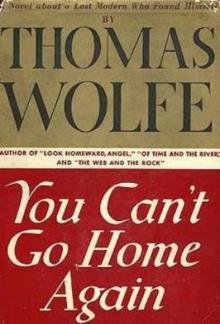
Thomas Wolfe, page 239



“Long, long into the night I lay awake——”
(One!)
Come, mild sleep, seal up the porches of our memory. . . .
(Two!)
Come, magnificent sleep, blot out the vision of lost days. . . .
(Three!)
For we are strange and beautiful asleep, we are all strange and beautiful asleep. . . .
(Four!)
For we are dying in the darkness, and we know no death, there is no death in sleep. . . .
O daughter of unmemoried hours, empress of labor and of weariness, merciful sister of dark death and all forgetfulness, enchantress and redeemer, hail!
[¬]
27
STEIN AND ROSEN’S
One evening when the world was a great deal younger than it is now, Mr. Rosen, who then had only a modest shop in lower Fifth Avenue, was at the theatre with his wife. Mr. Rosen saw a great many people he knew in the audience. This was not surprising, for the star of the piece was a very brilliant Russian actress named Alla Nazimova who had recently come to America, and the piece in which she was playing was A Doll’s House. Mr. Rosen walked about during the interval between the acts, greeting his friends and noting what the ladies were wearing. His friends were, for the most part, wealthy and cultivated Jews. The women were very elegant and fashionable, beautifully gowned, dark, tall, some of them exotically lovely. Most of these people had known one another since childhood, they belonged to a very limited and exclusive group; some of them valued fine intelligence and the ability to create more than they valued money, but most of them had both.
Moving among this brilliant crowd on his soft and powerful tread, Mr. Rosen saw the two Linder girls. He always thought of them as “the two Linder girls,” although the older one, Esther, was now a very beautiful woman of thirty, and married to a man named Frederick Jack. The other sister, Edith, was five years younger than Esther. People liked her and thought she was “a clever girl,” although she had never been known to say anything. She went about a great deal with Esther. She was always perfectly composed, and absolutely silent—if she contributed a half dozen words to an evening’s conversation, she had been talkative.
Mr. Rosen knew the Linder girls very well, and was a little in awe of them. His own position had been won with difficulty—he had come from plodding Jews of the middle class. But there was a reckless and romantic strain in the Linder family that he admired and mistrusted: they did difficult things with brilliant ease, spent money extravagantly, made fortunes, lost them, remade them.
He had known the father of the two girls—Joe Linder. Joe had been an actor, well known in his day, but he had died before his fiftieth year. Mr. Rosen remembered him vividly as a handsome man with hair which had been silver since his youth—a man who was always making a joke of everything. He had played with Mansfield, and when he was drinking he would quote Shakespeare by the yard with tears in his eyes. Joe Linder had been half Christian—his mother was a Gentile—and it was to this foreign strain that Mr. Rosen attributed his instability and downfall. Mr. Rosen remembered that two of Joe’s boon companions had been Catholic priests—Father O’Rourke and Father Dolan. They used to meet Joe after the theatre and go to White’s, where they all drank as much as they could before midnight. Then, if the priests were conducting Mass the next morning, they stopped. And, with somewhat troubled spirit, Mr. Rosen now recalled that Edith, the younger of Joe Linder’s girls, had been educated in a Catholic convent in the Bronx.
Mr. Rosen remembered the girls’ mother. She had died before her husband when the children were very young. She had been entirely Jewish, and of the finest stock—her parents were Dutch. Her father, a lawyer, had made a fortune in New York and left her whole blocks of houses. But she had been even more extravagant than Joe. If she wanted a diamond necklace, she sold a house; if she wanted a dress, she sold the necklace, or part of it. With keen pain Mr. Rosen remembered that she used to bite the diamonds off one at a time and send them to the pawnbroker when she wanted money. At the memory he shook his head sadly.
But now, with dark excitement, he approached the two young women, closing his eyes with rapture as he came near to them.
“Where—where—” he whispered somewhat hoarsely to Esther, clasping his hands and shaking them prayerfully before him, for want of adequate tribute, “—where did you get that dress?”
“Do you like it?” she said.
“My dear, it’s a dream.”
“Well, as Daddy used to say,” said Esther, “it’s better than a kick in the eye, isn’t it?”
Mr. Rosen groaned at the sacrilege, then demanded impatiently:
“But where did you get it? You must tell me.”
“Will you promise not to tell anyone if I let you know?” she asked.
“Yes, of course,” said Mr. Rosen feverishly.
“Well,” said Esther solemnly, “I’ll tell you then. I got it in Macy’s bargain basement.”
Mr. Rosen groaned loudly and smote his forehead. This was the way Joe Linder used to talk, and, in Mr. Rosen’s opinion, it had probably had something to do with his untimely death. There was a time and place for levity, but one must not trifle with sacred things.
“Macy’s!” said Mr. Rosen. “You insult my intelligence! There’s not a shop in New York making frocks like that.”
“Well, I did just the same,” said Esther, laughing. “I bought the material there.”
“Damn the material!” said Mr. Rosen. “Who made the dress?”
“My sister Edith,” said Esther triumphantly. “You didn’t know she was so smart, did you?” She took Edith’s hand affectionately. “You know, Mr. Rosen,” she said happily, “I haven’t got any sense myself, but Edith’s awfully smart. She can do anything. She’s just like Daddy.”
And she stood there holding Edith by the hand, and looking up at Mr. Rosen, flushed, radiant, happy, and delighted “not to have any sense” as long as everyone was so nice and one had such a smart sister.
Mr. Rosen turned slowly and commandingly upon the other young lady, who had kept her silence during this entire conversation with perfect composure, and who now stood with her hand in her sister’s, looking from one to the other with a very calm glance of her large, dark eyes.
“Edith!” said Mr. Rosen, sternly. “Did you make that dress?”
“Yes,” said Edith, in her talkative way.
“Edith,” said Mr. Rosen, his tone becoming soft and winning, “how would you like a job?”
“Doing what?” said Edith, with a burst of eloquence.
“Designing dresses,” said Mr. Rosen tenderly. “Designing dresses,” he murmured luxuriously, “like this one here.”
“I should like it,” said Edith, fatigued by so much speech-making.
Mr. Rosen’s soul rushed out of him. He enveloped them all in his blessing.
“Come to my shop,” he whispered hoarsely. “Come to my shop Monday morning.”
Then he left them.
By Monday morning, however, both sisters had completely forgotten the incident, and Edith came as near the animation of surprise as she ever did when her maid came to her room at ten o’clock to tell her Mr. Rosen had telephoned and wanted to talk to her at once. She got out of bed and went into Esther’s room, where there was a phone extension.
“Well?” the impatient voice of Mr. Rosen demanded. “Why didn’t you come to the shop?”
“For what?”
“For the job I offered you.”
“I forgot about it. I didn’t think you meant it.”
“Of course I meant it. Why should I waste my time if I didn’t mean it?”
“Do you still want me?”
“Yes!” he shouted. “Come down at once!”
Edith dressed, and went downtown.
In this leisurely, half-accidental way Edith had started to work for Mr. Rosen. She was now vice-president, and she also owned a share in the business.
The firm of Stein and Rosenberg had moved a long way uptown, from Grand Street to Fifth Avenue, and in its prosperous migration had lost its name. Mr. Stein was dead, and Mr. Rosenberg—well, Mr. Rosenberg was now Mr. Rosen, with a son at Oxford, and a daughter who preferred to live in Paris.
Mr. Rosen was now fifty-five, a handsome and powerful man, very Jewish-looking, dark, fiercely Oriental. He had changed his name, but he had made no effort to change his race or his identity. A photograph of his dead partner, Saul Stein, had never left the desk top in his office: the wide, grinning face, with its immense, putty-colored nose, smiled down on him, evoking pictures full of pain and tenderness, of a time when he had sat next to this dead man cross-legged on a tailor’s table, and of other days when they had stood outside their East Side shop inviting to come buy all the dark swarm of Jewry that the fine, warm days of May had drawn out.
No; he had not forgotten, and he was not ashamed. He walked with soft and powerful tread along the rich carpets of his big shop, he wore pin-stripe trousers and a cutaway coat, and he bowed and spoke gently to his clients, the fabulously rich of the nation—but he had not forgotten. There was in him a vast pride of race, a vast pride in the toil and intelligence which had brought him wealth. For this reason, Mr. Rosen had a very princely quality—the princely quality that almost all rich Jews have, and that few rich Christians ever get. Wealth is difficult to attain, but it is good, pleasant, desirable—therefore let those with wealth enjoy it.
There is, of course, no greater fallacy than the one about the stinginess of Jews. They are the most lavish and opulent race on earth. Mr. Rosen went to Paris twice a year on the Ile de France: he had a suite and a private deck, and his wife was the best and most expensively dressed woman on the ship. In Summer, Mr. Rosen must spend a great deal of time in Paris buying clothes, but his wife and children went to Deauville. Mr. Rosen flew down to join them in the evening, and the family swam and danced and drank cocktails.
Further, Mr. Rosen had always lived over his shop. He began it in two rooms on Grand Street, and he continued it now in two floors and eighteen rooms on Fifth Avenue. And he will continue it, also, in the new and more splendid building now being erected farther uptown. There he will have the top three floors, twenty-four rooms, and the best view in town. When a Christian makes money out of his shop, or another man’s shop, he moves out as soon as he can. He goes up the Hudson, buys a thousand acres and forty rooms, and gets gardeners and hostlers from England. Not so Mr. Rosen. His ideas went back to the Fuggers, the Cabots, the early Rothschilds. He lived over his shop and had lots of the very best champagne for dinner.
As for Stein and Rosen’s, it had become one of the most fashionable and expensive shops in the country, and its victorious journey uptown was shortly to be consummated when it moved into its magnificent new building. The authors of society novels made their characters speak of it: Rita (or Leila or Sheila) is going along thinking about Bruce, with her fine, dark head “and strong, brown hands,” and of the disquieting way Hilary, the artist, looked at her “out of his slanting, almost Oriental eyes” the night before, when suddenly she sees Jenifer Delamar going into Stein and Rosen’s.
Under this success, Mr. Rosen had burst into a full, rich bloom. His well-fed body took on an added richness of hue. He was of a princely tissue, and as he walked up and down with soft and powerful tread he suggested a fine prize bull. The presence of this strong, luxurious flesh in the French elegance of the shop, surrounded by gossamer webs and smoky silks, was not at all incongruous: the delicate fabrics might have come from this rich body like an ectoplasm. And the great ladies who bought at Stein and Rosen’s must have felt a delicious sensation of comfort and mystery when they looked at him, for his dark, smiling face, with its perfection of large, pearl teeth, and full nose, with the wide, fleshy volutes of the nostrils, gave him a touch of Oriental wizardry. They felt that in his inexhaustible princeliness he had only to clap his large, pink hands together, and a procession of slaves would enter, balancing treasure of baled stuffs upon their heads.
This, in fact, he could and did do, although in place of ebony eunuchs he offered something better—slim, luscious houris clothed in magic.
A good part of the magic, he knew, was Edith Linder’s. Mr. Rosen’s voice when he mentioned her name had a husk of religious sanctity—he called her “a great woman” and felt the mild inadequacy of language. The feeling of awe which he had always had in reference to the Linders had grown deeper. They could do anything, and they could do anything with ease. Although he knew very well how indefatigably Edith had worked in developing the business, there was for him in everything she did magic and ease. And this was the impression everyone got.
She had grown more silent and more emaciated as she grew older. Her silence had turned in upon her and devoured her. Perpetual weariness rested on her flesh like a subtle perfume, but she never rested. She worked ceaselessly, silently, doing the magic, costly things with her hands that brought great wealth to Stein and Rosen’s. Throughout the day one heard her name on every floor of the shop. Where was she? Could she come at once? She came, saying nothing—a weary, meager elegance dressed in eight hundred dollars’ worth of simple black. Around her small, bony ankle was strapped a pedometer, and around her fragile wrist, netted with veins in fine blue ink and drawn taut like the bones of a bird, was a diamond-encrusted wrist watch, a miracle of delicate workmanship, that ticked off time—strange, tragic time—in a faultless shell no bigger than a thimble.
Mr. Rosen’s dark face was radiant with power and pleasure. He had two handsome children. He had a beautiful wife. He was himself as handsome as a prize bull. They all loved one another dearly. Yes, Mr. Rosen had come far, far uptown, since those old hard days of first endeavor. . . . Softly, softly, on dark, powerful tread, he moved up and down his shop.
He was very, very happy.
[¬]
28
APRIL, LATE APRIL
Autumn was kind to them, Winter was long to them—but in April, late April, all the gold sang.
Spring came that year like magic and like music and like song. One day its breath was in the air, a haunting premonition of its spirit filled the hearts of men with its transforming loveliness, working its sudden and incredible sorcery upon grey streets, grey pavements, and on grey faceless tides of manswarm ciphers. It came like music faint and far, it came with triumph and a sound of singing in the air, with lutings of sweet bird cries at the break of day and the high, swift passing of a wing, and one day it was there upon the city streets with a strange, sudden cry of green, its sharp knife of wordless joy and pain.
Not the whole glory of the great plantation of the earth could have outdone the glory of the city streets that Spring. Neither the cry of great, green fields, nor the song of the hills, nor the glory of young birch trees bursting into life again along the banks of rivers, nor the oceans of bloom in the flowering orchards, the peach trees, the apple trees, the plum and cherry trees—not all of the singing and the gold of Spring, with April bursting from the earth in a million shouts of triumph, and the visible stride, the flowered feet of the Springtime as it came on across the earth, could have surpassed the wordless and poignant glory of a single tree in a city street that Spring.
Monk had given up his tiny room in the dingy little hotel and had taken possession of the spacious floor in the old house on Waverly Place. There had been a moment’s quarrel when he had said that from that time on he would pay the rent. She had objected that the place was hers, that she had found it—she wanted him to come, she would like to think of him as being there, it would make it seem more “theirs”—but she had been paying for it, and would continue, and it didn’t matter. But he was adamant and said he wouldn’t come at all unless he paid his way, and in the end she yielded.
And now each day he heard her step upon the stairs at noon. At noon, at high, sane, glorious noon, she came, the mistress of that big, disordered room, the one whose brisk, small step on the stairs outside his door woke a leaping jubilation in his heart. Her face was like a light and like a music in the light of noon: it was jolly, small, and tender, as delicate as a plum, and as rosy as a flower. It was young and good and full of health and delight; its sweetness, strength, and noble beauty could not be equaled anywhere on earth. He kissed it a thousand times because it was so good, so wholesome, and so radiant in its loveliness.
Everything about her sang out with hope and morning. Her face was full of a thousand shifting plays of life and jolly humor, as swift and merry as a child’s, and yet had in its always, like shadows in the sun, all of the profound, brooding, and sorrowful depths of beauty.
Thus, when he heard her step upon the stairs at noon, her light knuckles briskly rapping at the door, her key turning in the lock, she brought the greatest health and joy to him that he had ever known. She came in like a cry of triumph, like a shout of music in the blood, like the deathless birdsong in the first light of the morning. She was the bringer of hope, the teller of good news. A hundred sights and magical colors which she had seen in the streets that morning, a dozen tales of life and work and business, sprang from her merry lips with the eager insistence of a child.
She got into the conduits of his blood, she began to sing and pulse through the vast inertia of his flesh, still heavied with great clots of sleep, until he sprang up with the goat cry in his throat, seized, engulfed, and devoured her, and felt there was nothing on earth he could not do, nothing on earth he could not conquer. She gave a tongue to all the exultant music of the Spring whose great pulsations trembled in the gold and sapphire singing of the air. Everything—the stick-candy whippings of a flag, the shout of a child, the smell of old, worn plankings in the sun, the heavy, oily, tarry exhalations of the Spring-warm streets, the thousand bobbing and weaving colors and the points of light upon the pavements, the smell of the markets, of fruits, flowers, vegetables, and loamy earth, and the heavy shattering baugh of a great ship as it left its wharf at noon on Saturday—was given intensity, structure, and a form of joy because of her.