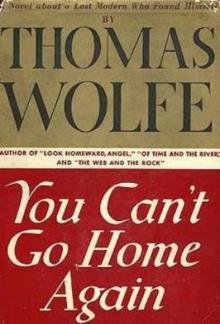
Thomas Wolfe, page 282



“What’s that? What did you say, Sam?” he said rapidly. “How much did they offer you for it? Don’t sell, don’t sell!” he said suddenly and with great emphasis. “Now’s the time to buy, not to sell. The trend is upward. Buy! Buy! Don’t take it. Don’t sell. That’s my advice!”
“I’m not selling, Tim,” Sam cried excitedly. “I’m thinking of buying.”
“Oh—yes, yes, yes!” Tim muttered rapidly. “I see, I see.” He turned now for the first time and fixed his eyes upon his questioner. “Where did you say it was?” he demanded sharply. “Deepwood? Good! Good! Can’t go wrong! Buy! Buy!”
He started to walk away into the drug store, and the lounging idlers moved aside deferentially to let him pass. Sam rushed after him frantically and caught him by the arm, shouting:
“No, no, Tim! It’s not Deepwood! It’s the other way. . . . I’ve been telling you. . . . It’s West Libya!”
“What’s that?” Tim cried sharply. “West Libya? Why didn’t you say so? That’s different. Buy! Buy! Can’t go wrong! Whole town’s moving in that direction. Values double out there in six months. How much do they want?”
“Seventy-five thousand,” Sam panted. “Option expires tomorrow. . . . Five years to pay it up.”
“Buy! Buy!” Tim barked, and walked off into the drug store.
Sam strode back toward George, his eyes blazing with excitement.
“Did you hear him? Did you hear what he said?” he demanded hoarsely. “You heard him, didn’t you? . . . Best damned judge of real estate that ever lived. . . . Never known to make a mistake! . . . ‘Buy! Buy! Will double in value in six months!’ . . . You were standing right here—” he said hoarsely and accusingly, glaring at George—“you heard what he said, didn’t you?”
“Yes, I heard him.”
Sam glanced wildly about him, passed his hand nervously through his hair several times, and then said, sighing heavily and shaking his head in wonder:
“Seventy-five thousand dollars’ profit in one deal! . . . Never heard anything like it in my life! . . . Lord, Lord!” he cried. “What are we coming to?”
Somehow the news had gotten around that George had written a book and that it would soon be published. The editor of the local paper heard of it and sent a reporter to interview him, and printed a story about it.
“So you’ve written a book?” said the reporter. “What kind of a book is it? What’s it about?”
“Why—I—I hardly know how to tell you,” George stammered. “It—it’s a novel——”
“A Southern novel? Anything to do with this part of the country?”
“Well—yes—that is—it’s about the South, all right—about an Old Catawba family—but——”
LOCAL BOY WRITES ROMANCE OF THE OLD SOUTH
George Webber, son of the late John Webber and nephew of Mark Joyner, local hardware merchant, has written a novel with a Libya Hill background which the New York house of James Rodney & Co. will publish this fall.
When interviewed last night, the young author stated that his book was a romance of the Old South, centering about the history of a distinguished antebellum family of this region. The people of Libya Hill and environs will await the publication of the book with special interest, not only because many of them will remember the author, who was born and brought up here, but also because that stirring period of Old Catawba’s past has never before been accorded its rightful place of honor in the annals of Southern literature.
“We understand you have traveled a great deal since you left home. Been to Europe several times?”
“Yes, I have.”
“In your opinion, how does this section of the country compare with other places you have seen?”
“Why—why—er—why good! . . . I mean, fine! That is——”
LOCAL PARADISE COMPARES FAVORABLY
In answer to the reporter’s question as to how this part of the country compared to other places he had seen, the former Libya man declared:
“There is no place I have ever visited—and my travels have taken me to England, Germany, Scotland, Ireland, Wales, Norway, Denmark, Sweden, to say nothing of the south of France, the Italian Riviera, and the Swiss Alps—which can compare in beauty with the setting of my native town.
“We have here,” he said enthusiastically, “a veritable Paradise of Nature. Air, climate, scenery, water, natural beauty, all conspire to make this section the most ideal place in the whole world to live.”
“Did you ever think of coming back here to live?”
“Well—yes—I have thought of it—but—you see——”
WILL SETTLE AND BUILD HERE
When questioned as to his future plans, the author said:
“For years, my dearest hope and chief ambition has been that one day I should be able to come back here to live. One who has ever known the magic of these hills cannot forget them. I hope, therefore, that the time is not far distant when I may return for good.
“Here, I feel, as nowhere else,” the author continued wistfully, “that I will be able to find the inspiration that I must have to do my work. Scenically, climatically, geographically, and in every other way, the logical spot for a modern renaissance is right here among these hills. There is no reason why, in ten years’ time, this community should not be a great artistic colony, drawing to it the great artists, the music and the beauty lovers, of the whole world, as Salzburg does now. The Rhododendron Festival is already a step in the right direction.
“It shall be a part of my purpose from now on,” the earnest young author added, “to do everything in my power to further this great cause, and to urge all my writing and artistic friends to settle here—to make Libya Hill the place it ought to be—The Athens of America.”
“Do you intend to write another book?”
“Yes—that is—I hope so. In fact——”
“Would you care to say anything about it?”
“Well—I don’t know—it’s pretty hard to say——”
“Come on, son, don’t be bashful. We’re all your home folks here. . . . Now, take Longfellow. There was a great writer! You know what a young fellow with your ability ought to do? He ought to come back here and do for this section what Longfellow did for New England. . . .”
PLANS NATIVE SAGA
When pressed for details about the literary work he hopes to do hereafter, the author became quite explicit:
“I want to return here,” he said, “and commemorate the life, history, and development of Western Catawba in a series of poetic legends comparable to those with which the poet Longfellow commemorated the life of the Acadians and the folklore of the New England countryside. What I have in mind is a trilogy that will begin with the early settlement of the region by the first pioneers, among them my own forebears, and will trace the steady progress of Libya Hill from its founding and the coming of the railroad right down to its present international prominence and the proud place it occupies today as ‘The Gem City of the Hills.’”
George writhed and swore when he read the article. There was hardly an accurate statement in it. He felt angry and sheepish and guilty all at the same time.
He sat down and wrote a scathing letter to the paper, but when he had finished he tore it up. After all, what good would it do? The reporter had spun his story out of nothing more substantial than his victim’s friendly tones and gestures, a few words and phrases which he had blurted out in his confusion, and, above all, his reticence to talk about his work; yet the fellow had obviously been so steeped in the booster spirit that he had been able to concoct this elaborate fantasy—probably without quite knowing that it was a fantasy.
Then, too, he reflected, people would take an emphatic denial of the statements that had been attributed to him as evidence that he was a sorehead, full of conceit about his book. You couldn’t undo the effect of a thing like this with a simple negative. If he gave the lie to all that gush, everybody would say he was attacking the town and turning against those who had nurtured him. Better let bad enough alone.
So he did nothing about it. And after that, strangely enough, it seemed to George that the attitude of people changed toward him. Not that they had been unfriendly before. It was only that he now felt they approved of him. This in itself gave him a quiet sense of accomplishment, as if the stamp of business confirmation had been put upon him.
Like all Americans, George had been amorous of material success, so it made him happy now to know that the people of his home town believed he had got it, or at any rate was at last on the highroad to it. One thing about the whole affair was most fortunate. The publisher who had accepted his book had an old and much respected name; people knew the name, and would meet him on the street and wring his hand and say:
“So your book is going to be published by James Rodney & Co.?”
That simple question, asked with advance knowledge of the fact, had a wonderful sound. It had a ring, not only of congratulation that his book was being published, but also of implication that the distinguished house of Rodney had been fortunate to secure it. That was the way it sounded, and it was probably also the way it was meant. He had the feeling, therefore, that in the eyes of his own people he had “arrived.” He was no longer a queer young fellow who had consumed his substance in the deluded hope that he was—oh, loaded word!—“a writer.” He was a writer. He was not only a writer, but a writer who was about to be published, and by the ancient and honorable James Rodney & Co.
There is something good in the way people welcome success, or anything—no matter what—that is stamped with the markings of success. It is not an ugly thing, really. People love success because to most of them it means happiness, and, whatever form it takes, it is the image of what they, in their hearts, would like to be. This is more true in America than anywhere else. People put this label on the image of their heart’s desire because they have never had an image of another kind of happiness. So, essentially, this love of success is not a bad thing, but a good thing. It calls forth a general and noble response, even though the response may also be mixed with self-interest. People are happy for your happiness because they want so much to be happy themselves. Therefore it’s a good thing. The idea behind it is good, anyhow. The only trouble with it is that the direction is misplaced.
That was the way it seemed to George. He had gone through a long and severe period of probation, and now he was approved. It made him very happy. There is nothing in the world that will take the chip off of one’s shoulder like a feeling of success. The chip was off now, and George didn’t want to fight anybody. For the first time he felt that it was good to be home again.
Not that he did not have his apprehensions. He knew what he had written about the people and the life of his home town. He knew, too, that he had written about them with a nakedness and directness which, up to that time, had been rare in American fiction. He wondered how they would take it. Even when people congratulated him about the book he could not altogether escape a feeling of uneasiness, for he was afraid of what they would say and think after the book came out and they had read it.
These apprehensions took violent possession of him one night in a most vivid and horrible dream. He thought he was running and stumbling over the blasted heath of some foreign land, fleeing in terror from he knew not what. All that he knew was that he was filled with a nameless shame. It was wordless, and as shapeless as a smothering fog, yet his whole mind and soul shrank back in an agony of revulsion and self-contempt. So overwhelming was his sense of loathing and guilt that he coveted the place of murderers on whom the world had visited the fierceness of its wrath. He envied the whole list of those criminals who had reaped the sentence of mankind’s dishonor—the thief, the liar, the trickster, the outlaw, and the traitor—men whose names were anathema and were spoken with a curse, but which were spoken; for he had committed a crime for which there was no name, he was putrescent with a taint for which there was neither comprehension nor cure, he was rotten with a vileness of corruption that placed him equally beyond salvation or vengeance, remote alike from pity, love, and hatred, and unworthy of a curse. Thus he fled across the immeasurable and barren heath beneath a burning sky, an exile in the center of a planetary vacancy which, like his own shameful self, had no place either among things living or among things dead, and in which there was neither vengeance of lightning nor mercy of burial; for in all that limitless horizon there was no shade or shelter, no curve or bend, no hill or tree or hollow: there was only one vast, naked eye—searing and inscrutable—from which there was no escape, and which bathed his defenseless soul in its fathomless depths of shame.
And then, with bright and sharp intensity, the dream changed, and suddenly he found himself among the scenes and faces he had known long ago. He was a traveler who had returned after many years of wandering to the place he had known in his childhood. The sense of his dreadful but nameless corruption still hung ominously above him as he entered the streets of the town again, and he knew that he had returned to the springs of innocence and health from whence he came, and by which he would be saved.
But as he came into the town he became aware that the knowledge of his guilt was everywhere about him. He saw the men and women he had known in childhood, the boys with whom he had gone to school, the girls he had taken to dances. They were engaged in all their varied activities of life and business, and they showed their friendship toward one another, but when he approached and offered his hand in greeting they looked at him with blank stares, and in their gaze there was no love, hatred, pity, loathing, or any feeling whatsoever. Their faces, which had been full of friendliness and affection when they spoke to one another, went dead; they gave no sign of recognition or of greeting; they answered him briefly in toneless voices, giving him what information he asked, and repulsed every effort he made toward a resumption of old friendship with the annihilation of silence and that blank and level stare. They did not laugh or mock or nudge or whisper when he passed; they only waited and were still, as if they wanted but one thing—that he should depart out of their sight.
He walked on through the old familiar streets, past houses and places that lived again for him as if he had never left them, and by people who grew still and waited until he had gone, and the knowledge of wordless guilt was rooted in his soul. He knew that he was obliterated from their lives more completely than if he had died, and he felt that he was now lost to all men.
Presently he had left the town, and was again upon the blasted heath, and he was fleeing across it beneath the pitiless sky where flamed the naked eye that pierced him with its unutterable weight of shame.
[¬]
CHAPTER 8
THE COMPANY
George considered himself lucky to have the little room over the Shepperton garage. He was also glad that his visit had overlapped that of Mr. David Merrit, and that Mr. Merrit had been allowed to enjoy undisturbed the greater comfort of the Shepperton guest room, for Mr. Merrit had filled him with a pleasant glow at their first meeting. He was a ruddy, plump, well-kept man of forty-five or so, always ready with a joke and immensely agreeable, with pockets bulging with savory cigars which he handed out to people on the slightest provocation. Randy had spoken of him as “the Company’s man,” and, although George did not know what the duties of a “Company’s man” were, Mr. Merrit made them seem very pleasant.
George knew, of course, that Mr. Merrit was Randy’s boss, and he learned that Mr. Merrit was in the habit of coming to town every two or three months. He would arrive like a benevolent, pink-cheeked Santa Claus, making his jolly little jokes, passing out his fat cigars, putting his arm around people’s shoulders, and, in general, making everyone feel good. As he said himself:
“I’ve got to turn up now and then just to see that the boys are behaving themselves, and not taking in any wooden nickels.”
Here he winked at George in such a comical way that all of them had to grin. Then he gave George a big cigar.
His functions seemed to be ambassadorial. He was always taking Randy and the salesmen of the Company out to lunch or dinner, and, save for brief visits to the office, he seemed to spend most of his time inaugurating an era of good feeling and high living. He would go around town and meet everybody, slapping people on the back and calling them by their first names, and for a week after he had left the business men of Libya Hill would still be smoking his cigars. When he came to town he always stayed “out at the house,” and one knew that Margaret would prepare her best meals for him, and that there would be some good drinks. Mr. Merrit supplied the drinks himself, for he always brought along a plentiful store of expensive beverages. George could see at their first meeting that he was the kind of man who exudes an aura of good fellowship, and that was why it was so pleasant to have Mr. Merrit staying in the house.
Mr. Merrit was not only a nice fellow. He was also “with the Company,” and George soon realized that “the Company” was a vital and mysterious force in all their lives. Randy had gone with it as soon as he left college. He had been sent to the main office, up North somewhere, and had been put through a course of training. Then he had come back South and had worked his way up from salesman to district agent—an important member of the sales organization.
“The Company,” “district agent,” “the sales organization”—mysterious titles all of them, but most comforting. During the week George was in Libya Hill with Randy and Margaret, Mr. Merrit was usually on hand at meal times, and at night he would sit out on the front porch with them and carry on in his jolly way, joking and laughing and giving them all a good time. Sometimes he would talk shop with Randy, telling stories about the Company and about his own experiences in the organization, and before long George began to pick up a pretty good idea of what it was all about.
The Federal Weight, Scales, and Computing Company was a far-flung empire which had a superficial aspect of great complexity, but in its essence it was really beautifully simple. Its heart and soul—indeed, its very life—was its sales organization.