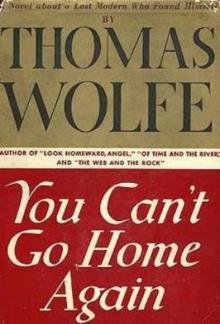
Thomas Wolfe, page 459



No, sir, I don’t mind. We don’t mind, he, she, it, or they don’t mind. Nobody minds, sir, nobody minds, Because, just as you say, sir, oceans are between us, seas have sundered us, there is a magic in you that we cannot fathom—a light, a flame, a glory—an impalpable, indefinable, incomprehensible, undeniable something-or-other which I can never understand or measure because—just as you say, sir, with such compassionate regret—I am—I am—a Yank.
’Tis true, my brother, we are Yanks. Oh, ’tis true, ’tis true! I am a Yank! Yet, wherefore Yank, good brother? Hath not a Yank ears? Hath not a Yank lies, truths, bowels of mercy, fears, joys, and lusts? Is he not warmed by the same sun, washed by the same ocean, rotted by the same decay, and eaten by the same worms as a German is? If you kill him, does he not die? If you sweat him, does he not stink? If you lie with his wife or mistress, does she not whore, lie, fornicate, betray, even as a Frenchman does? If you strip him, is he not naked as a Swede? Is his hide less white than Baudelaire’s? Is his breath more foul than the King of Spain’s? Is his belly bigger, his neck fatter, his face more hoggish, and his eyes more shiny than a Munich brewer’s? Will he not cheat, rape, thieve, whore, curse, hate, and murder like any European? Aye—Yank! But wherefore, wherefore, Yank, good brother?
My brother did not answer: the great stars blazed above us, shining faintly on his knit brows, his restless frenzied eyes, his drawn face, as the immense and mournful earth wheeled on around us, and we rushed forward forever into the limitless gulf of night.
Brother, I know and I know, and many years have passed since we rushed forward in the dark together, and the river has flowed onward in the night, and yet it will always be the same forever.
Wandering forever and the earth again! Yes, brother, we were living before that, and also we are living after—save that we stoop a little more, and go more slowly, and our eyes are worn a little more by hauntings of old things, and there are many things now we can’t forget.
Brother, have we forgotten how the peach trees leaned across a wall, and how the blossoms drifted to the earth in Spring, in April, in the orchard of our father’s house? Have we forgotten the cool and purple glade of evening marching up the hill’s steep side, the dogs barking, and the soft, the sad, the come-to-meeting bells across the hush of evening countrysides? And did the broken tinkling of the fat-bellied cows as they plod home in bedded dust at night, never make echoes in an exile’s brain? And then the cool, the dew-cool of the night, the after-supper sounds on the high front porches, the great rise of our father’s voice, the smell of honeysuckle sagging on the old wire fence, and all of the fire-flies trembling in the dark, and over all, like time, like sleep, like blessed peace and certitude, the vast low stammer of the night?
Will they never come back to us, never again—the forgotten faces, the old lost scenes? Will we never go back to them, never feel pain for them, never return to them, never again? Have we forgotten these things and our father’s face: will we rush blindly into night forever—brother and stranger and friend?
Oh, I know and I know, and it will always be the same forever. For I have lived alone ten thousand nights of solitude and darkness, and waked at morning in a foreign land, and thought of home. And the years walked proudly in my brain, my father’s voice was sounding in my ear, and in the pulses of my blood the substance of my earth remained and would not die.
Oh, stored with memory our living dust, within the shadow of our eyes were held the faces of the dead who died and live forever, two hundred million men were walking in our bones, and when we heard the howling of the wind around forgotten eaves in old October, we could not sleep. And by the waters of life, by time, by time, we stood and watched the rivers of this earth flow under us, and we knew it would be the same with us forever!
Brother, have we come then from a fated stock? Augured from its birth, announced by two dark angels, named in our mother’s womb? And for what? Fatherless, to grope our feelers in the sea’s dark bed, among the polyped squirms, the blind sucks and crawls, the seavalves of the brain, loaded with memory that will not die? To cry our love out in the wilderness, to wake always in the night, smiting the pillow in some foreign land, thinking forever of the myriad sights and sounds of home?
“While Paris Sleeps!”—By God, while Paris sleeps, to wake and walk and not to sleep; to wake and walk and sleep and wake, and sleep again, seeing dawn come before the window square that cast its wedge before our glazed, half-sleeping eyes, seeing soft hated foreign light, and breathing soft dull languid air that could not bite and tingle up the blood. Seeing legend and lie and fable wither in our sight, as we saw what we saw, we knew what we knew.
Sons of the lost and lonely father, sons of the wanderers, children of the hardy loins, the savage earth, the pioneers, what had we to do with all their bells and churches? Could we feed our hunger on portraits of the Spanish king? Brother, for what? For what? To kill the giant of loneliness and fear, to slay the hunger that would not give us rest.
Of wandering forever and the earth again. Brother, for what? For what? For the wilderness, the immense and lonely land. For the unendurable hunger, the unendurable ache, the incurable loneliness. For the exultancy whose only answer is the wild goat-cry. For a million memories, ten thousand sights and sounds and shapes and smells and names of things that only we can know.
For what? For what? Not for a nation. Not for a people, not for an empire, not for a thing we love or hate.
For what? For a cry, a space, an ecstasy. For a savage and nameless hunger. For a living and intolerable memory that may not for a second be forgotten, since it includes all the moments of our lives, it includes all we do and are. For a living memory; for ten thousand memories; for a million sights and sounds and moments; for something like nothing else on earth; for something which possesses us.
For something under our feet, and around us and over us; something that is in us and part of us, and proceeds from us, that beats in the pulses of our blood.
Brother, for what?
First, for the thunder of the imperial names, the names of men and battles, the names of places and great rivers, the mighty names of the States. The name of the Wilderness; the names of Antietam, Chancellorsville, Shiloh, Bull Run, Fredricksburg, Cold Harbor, the Wheat Fields, Ball’s Bluff, and the Devil’s Den; the name of Cowpens, Brandywine, and Saratoga; of Death Valley, Chickamauga, and the Cumberland Gap. The names of the Nantahalas, the Bad Lands, the Painted Desert, the Yosemite, and the Little Big Horn; the names of Yancey and Cabarras counties; and the terrible name of Hatteras.
Then for the continental thunder of the States: the names of Montana, Texas, Arizona, Colorado, Michigan, Maryland, Virginia, and the two Dakotas, the names of Oregon and Indiana, of Kansas and the rich Ohio; the powerful name of Pennsylvania, and the name of Old Kentucky; the undulance of Alabama; the names of Florida and North Carolina.
In the red-oak thickets at the break of day long hunters lay for bear: the rattle of arrows in laurel leaves, the war-cries round the painted buttes, and the majestical names of the Indian nations: the Pawnees, the Algonquins, the Cherokees, the Sioux, the Hurons, the Mohawks, the Navahos, the Utes, the Omahas, the Onandagas, the Chippewas, the Creeks, the Chickasaws, the Arapahos, the Catawbas, the Dakotas, the Apaches, the Croatans, and the Tuscaroras. The names of Powhatan and Sitting Bull, and the name of Great Chief Rain-In-The-Face.
Of wandering forever and the earth again: in red-oak thickets at the break of day long hunters lay for bear. The arrows rattle in the laurel leaves, and the elmroots thread the bones of buried lovers. There have been war-cries on the western trails, and on the plains the gunstock rusts into a handful of bleached bones. The barren earth? Was no love living in the wilderness?
The rails go westward in the dark. Brother, have you seen the starlight on the rails? Have you heard the thunder of the fast express?
Of wandering forever and the earth again: the names of the mighty rails that bind the nation, the wheeled thunder of the names that net the continent: the Pennsylvania, the Union Pacific, the Santa Fe, the Baltimore and Ohio, the Chicago and Northwestern, the Southern, the Louisiana and Northern, the Seaboard Air Line, the Chicago, Milwaukee, and St. Paul; the Lackawanna; the New York, New Haven, and Hartford; the Florida East Coast; the Rock Island; and the Denver and Rio Grande.
Brother, the names of the engines, the engineers, and the sleeping cars: the great engines of the Pacific type, the articulated mallets with three sets of eight-yoked driving wheels, the four hundred ton thunderbolts with J. T. Cline, T. J. McRae, and the demon hawkeyes of H. D. Campbell on the rails.
The names of the great tramps who range the nation on the fastest trains: the names of the great tramps Oklahoma, Red Fargo Pete, Dixie Joe, Iron Mike, the Frisco Kid, Nigger Dick, Ike the Kike, and the Jersey Dutchman.
By the waters of life, by time, by time, Lord Tennyson stood among the rocks, and stared. He had long hair, his eyes were deep and somber, and he wore a cape; he was a poet, and there was magic and mystery in his touch, for he had heard the horns of Elfland faintly blowing. And by the waters of life, by time, by time, Lord Tennyson stood among the cold gray rocks and commanded the sea to break—break—break! And the sea broke, by the waters of life, by time, by time, as Lord Tennyson commanded it to do, and his heart was sad and lonely as he watched the stately ships (of the Hamburg-American Packet Company, fares forty-five dollars and up, first class) go on to their haven under the hill, and Lord Tennyson would that his heart could utter the thoughts that arose in him.
By the waters of life, by time, by time: the names of the mighty rivers, the alluvial gluts, the drains of the continent, the throats that drink America (Sweet Thames, flow gently till I end my song). The names of the men who pass and the myriad names of the earth that abides forever: the names of the men who are doomed to wander and the name of that immense and lonely land on which they wander, to which they return, in which they will be buried—America! The immortal earth that waits forever, the trains that thunder on the continent, the men who wander, and the women who cry out, “Return.”
Finally, the names of the great rivers that are flowing in the darkness (Sweet Thames, flow gently till I end my song).
By the waters of life, by time, by time: the names of the great mouths, the mighty maws, the vast wet coiling never glutted and unending snakes that drink the continent. Where, sons of men, and in what other land, will you find others like them, and where can you match the mighty music of their names?—the Monongahela, the Colorado, the Rio Grande, the Columbia, the Tennessee, the Hudson (Sweet Thames!); the Kennebec, the Rappahannock, the Delaware, the Penobscot, the Wabash, the Chesapeake, the Swannanoa, the Indian River, the Niagara (Sweet Afton!), the Saint Lawrence, the Susquehanna, the Tombigbee, the Nantahala, the French Broad, the Chattahoochee, the Arizona, and the Potomac (Father Tiber!)—these are a few of their great proud glittering names, fit for the immense and lonely land that they inhabit.
O Tiber! Father Tiber! You’d only be a suckling in that mighty land! And as for you, Sweet Thames, flow gently till I end my song: flow gently, gentle Thames, be well-behaved, sweet Thames, speak softly and politely, little Thames, flow gently till I end my song.
By the waters of life, by time, by time, and of the yellow cat that smites the nation, of the belly of the snake that coils across the land—of the terrible names of the rivers in flood, the rivers that foam and welter in the dark, that smash the levees, that flood the lowlands for two thousand miles, that carry the bones of the cities seaward on their tides: of the awful names of the Tennessee, the Arkansas, the Missouri, the Mississippi, and even the little mountain rivers, brother, in the season of the floods.
Delicately they dive for Greeks before the railway station: the canoe glides gently through the portals of the waiting room (for whites). Full fathom five the carcass of old man Lype is lying (of his bones is coral made) and delicately they dive for lunch-room Greeks before the railway station.
Brother, what fish are these? The floatage of sunken rooms, the sodden bridal veils of poverty, the slime of ruined parlor plush, drowned faces in the family album; and the blur of long-drowned eyes, blurred features, white, bloated flesh.
Delicately they dive for Greeks before the railway station. The stern good half-drowned faces of the brothers Trade and Mark survey the tides. Cardui! Miss Lillian Leitzel twists upon one arm above the flood, the clown, half-sunken to the waist, swims upward out of the swirling yellow, the tiger bares his teeth above the surges of a river he will never drink. The ragged tatters of circus posters are plastered on soaked boards. And delicately they dive for Greeks before the railway stations.
Have you not seen them, brother?
And finally, brother, the mighty name of the earth itself, on which we live and move, that wheels past us with immortal stroke and calm and silence, as we rush onward into the night.
For only the earth endures, but this earth is America, and America is this earth, and while this earth endures, America endures. America is immense and everlasting: it must endure forever. The wheel will rust, the tallest towers will topple down like smoke, the hundred thousand towns and cities, the new and old, the permanent and the impermanent, those built for a day and those built forever, will melt before the waters of time. They will be compacted into earth and dust as the bones of the wanderers and those weary of wandering have been compacted into earth and dust, but the great rivers of America will drink the continent, and the earth will endure forever.
For only the earth endures, the immense and everlasting earth whereon we have all lived as wanderers and strangers. Only the earth endures, the terrific earth that needed giants, and that broke the backs of mighty men. Only the earth endures, the enormous earth with its incredible beauty, its terrific desolation, the American earth that can never be remembered, that can never be forgotten, and that has never been described. Only the earth endures, that strange and lonely continent of earth that bred the race of wanderers, that secret and mysterious earth which has always been unknown.
Brother, it has possessed the bones of our father, it has possessed and knit with elmroot the bones of buried lovers, it has possessed and made its own the million secret moments of our lives. In it is our life and our destiny, and our immense and secret history.
By the waters of life, by time, by time, the slow tides and secret movings of dark time, the dust of our cities melts into earth: it will possess and drink into itself the bones of the cities, the ruins of great towers and ten million streets—yes! it will possess strong steel and the iron of great wheels and make its own great engines, as it makes our dust its own.
For what are we, brother? We are a phantom flare of grieved desire, the ghostling and phosphoric flickers of immortal time, a brevity of days haunted by the eternity of the earth. We are an unspeakable utterance, an insatiable hunger, an unquenchable thirst; a lust that bursts our sinews, explodes our brains, sickens and rots our guts, and rips our heart asunder. We are a twist of passion, a moment’s flame of love and ecstasy, a sinew of bright blood and agony, a lost cry, a music of pain and joy, a haunting of brief sharp hours, an almost captured beauty, a demon’s whisper of unbodied memory. We are the dupes of time.
We are the sons of our father, whose face we shall never see again, we are the sons of our father, whose voice we shall hear no more, we are the sons of our father, to whom we have cried for strength and comfort in our agony, we are the sons of our father, whose life like ours was lived in solitude and darkness, we are the sons of our father, to whom only can we wreak out the strange dark burden of our heart and spirit, we are the sons of our father who is dead, and we shall follow the print of his foot forever.
[¬]
FOR PROFESSIONAL APPEARANCE
(A Satire)
[Modern Monthly, January 1935]
The purposes of Professor Hatcher’s celebrated school for dramatists seemed, as stated, to be plain and reasonable enough. Professor Hatcher himself prudently forbore from making extravagant claims concerning the benefits to be derived from his course. He did not say that he could make a dramatist out of any man who came to take his course. He did not predict a successful career in the professional theater for every student who had been a member of his class. He did not even say he could teach a student how to write plays. No. He made, in fact, no claims at all. Whatever he said about his course was very reasonably, prudently, and temperately put: it was impossible to quarrel with it.
All Professor Hatcher said about his course was that if a man had a genuine dramatic and theatrical talent to begin with, he might be able to derive from Professor Hatcher’s course a technical and critical guidance which it would be hard to get elsewhere, and which he might find for himself only after years of painful and even wasteful experiment.
Certainly this seemed reasonable enough. Moreover, Professor Hatcher felt that the artist would benefit by what was known as the “round table discussion”—that is, by the comment and criticism of the various members of the class, after Professor Hatcher had read them a play by one of their group. He felt that the spirit of working together, of seeing one’s play produced and assisting in the production, of being familiar with all the “arts” of the theater—lighting, designing, directing, acting, and so on—was an experience which should be of immense value to the young dramatist of promise and talent. In short, although he made no assertion that he could create a talent where none was, or give life by technical expertness to the substance of a work that had no real life of its own, Professor Hatcher did feel that he might trim the true lamp to make it burn more brightly by the beneficent tutelage of this influence.