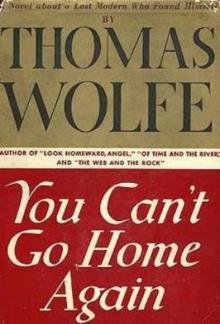
Thomas Wolfe, page 529



For him, at any rate, that had become the only thing for which he cared—to keep his own heart beating, to avoid in every way he could the brutal shocks of life and business, of speed, confusion, noise, and violence, of love, of grief, of happiness and heartbreak! Great God! Would people never learn? Would they never understand that the frail and naked heart could not be used as a football, kicked about by all the brutal and indifferent feet of life? Oh, if he could only tell them how slight a thing it took to plunge the anguish of a cureless hurt into the heart’s deep core—how slight a thing—a tread upon the stairs, the intonation of a voice, the opening of a door—could fill the heart with joy and anguish—if he could only tell them how slight a thing it took to make hearts break!
Therefore, no more, no more! For him, at any rate, his care henceforth would be to keep his heart in one small cell, and so to spare his heart and hearts of other people. No more to dare adventure, or to risk defeat with this frail heart! No more to endure the agony of grief, the cureless pain of loss, the insane devotion, and the wound remediless of love! No more friendship; no more love and no more hatred, no more conflict, no more desire, no more happiness, no more men and no more women.
No more streets! He heard again the heavy thunder of the traffic on First Avenue; again he saw that violence of speed and hot machinery—but no more streets!
George turned his head, and for a moment looked about the room with tired eyes. In the cool sweet light of early morning his beautiful little apartment was spotless as a pin. He did not have much furniture: a table or two, a few good chairs, designed in the clean planes and angles of the modern fashion. There was a fireplace with a small clock upon the mantel and over it a long panoramic photograph of a noble river, with grand special vistas of high buttes and grandly wooded shores.
The piece that dominated the room was George’s grand piano, a shining shape of grace and power; his face softened, and he smiled a little as he looked at it. Then he reached out of bed and got his glasses, adjusted them, and began to read the memorandum that lay beside him on the table.
The schedule of the day’s activity lay neatly mapped out before him in the pages of the little leather book. Mr. Robert Carpenter was due at ten o’clock; Mr. Milton Weisenborn at eleven; Mr. John Michael at noon. He began again at two o’clock when he received Mr. Tony Bertilotti; Mr. Peter Jorgensen at three; and Mr. Joseph Silverstein, perhaps the most talented of all his students, at four.
This was his program for the day. He was a teacher to young pianists who had shown distinguished promise and who were studying with a view to appearances on the concert stage. That had also been his own life formerly—before he had found out about his heart. He had known some of the most eminent people; he had studied under some of the ablest teachers—they had warned him about all sorts of things, but none of them had ever spoken of the heart.
If someone, in all those years of study and of preparation, had only told him a few very simple, fundamental things. If someone had only told him that before playing he would always feel not ready. If they’d only told him that he’d always feel—no matter how many times he practiced—that if he only had one more day he’d be sure he’d be ready to play the piece. If someone, out of all his teachers, in all the weary years of grinding and incessant practice, had only told him of some way in which he could feel sure of what he knew, of some way in which he could control his nerves—so that his subconscious mind would take him through!
But no one ever told him—and George glanced swiftly, briefly, at his wrist watch and then again at the little leather notebook of his day’s schedule, before he closed it—and he had come to this!
If only someone had told him what to do when he got out there upon the stage to play, when he saw out in the huge dark pool of the great house that disembodied host of faces blooming there in the darkness, white, innumerable, like petals on a bough, when space, time, everything is gone. If someone had only told him what to do when he first sat down at the piano, how to conquer the nervousness that made him feel as if he’d lost control of the muscles of his hands. It’s true he had talked about this to many other people, to concert pianists far better known than himself, and all of them were full of bland encouragements. They would all assure him that he would “find” himself when he struck the first chords. They would assure him that as time went on he would get calmer and surer, and that after the first applause he would feel much better, that encores were always the best because a musician is surer of himself by then and not nervous and in “a more exalted frame of mind.”
Yes, they had told him this, but it had not worked out according to their telling. His pulse had always beaten like a trip hammer, and his heart had kept time until it seemed the heart strings would be torn right out of him, until it seemed that nothing was worth this agony, no effort, no applause was worth the terror and the peril of this ordeal—until there was nothing left for him in all his consciousness, except that ghastly choking beating of the heart. And so—no more!—no more!—let others dare the ordeal if they liked, let others tempt the perilous, stricken beating of the frail small heart—but as for him—well, he had come to this. And this was better.
George looked at his wrist watch. It was eight-fifteen. He got up, put on his slippers and a dressing gown, took off his gold-rimmed spectacles, and polished them carefully, and put them on again. Without his glasses, his face had the slightly tired, patient look that is common among people with weak eyes. With his glasses on, the expression of his face was somewhat changed: it was a pleasant, most attractive face, well-modeled, firm, distinguished by a look of quiet strength and natural gentleness, all subdued somehow to the suggestive hue of a tranquil but deep-rooted melancholy. It would have been hard for a stranger to believe that this man could be the slave of an obsession, could hold in him such ocean depths of terror, such dread of everything that might disturb the frail small beating of the heart.
George walked over to the windows, pulled up the shutters of one Venetian blind, and for a moment stood looking quietly out upon the river. Everything was touched with morning, and the river was flashing with all the ecstasy and movement of its thousand currents.
A cool breath of morning, sea-fresh, and tide-laden, curiously half-rotten, flowed over his calm features: that living river and its smell, he understood, was like all life. The river was a flowing sewer surging back and forth to the recession of the tides, and bearing in its tainted flood the excremental dumpings of six million men. And yet the river was a tide of flashing life, marked delicately in a hundred places with the silvery veinings of a hundred currents, and pungent with the vital, aqueous, full salt-laden freshness of the sea.
The tide was coming in upon the full; George stood there, watching quietly, and saw it come. It was a steady, flowing, crawling and impulsive surge—a welling flood that would come on forever and knew no limit to the invasion of its power. The river was not quiet; the tide was ruffled by the breath of morning into a million scallop shells of winking light—rose, golden, silver, sapphire, pink—the whole polychrome of morning was reflected in the stream, and within the channel of the river’s life, the tide came on.
Morning, shining morning, filled the river, and transformed the town. Across the river, the tormented visage of Long Island City had also been transformed; that grim forest of smokestacks, chimneys, enormous stamped-out factory moulds, million-windowed warehouses, gas tanks and refineries, derricks, tugboats, cranes and docks, was magically translated by the wizardry of every hue that morning knows.
As he looked, a tug set neatly in between two barges, each loaded with twin rows of box-cars, backed out into the stream and quartered slowly, steadily, with its enormous freight, then started head-on up the stream. Thick water foamed against the blunt snouts of the barges, as the little tug between them neatly forged ahead with its great cargo, with a sense of limitless power, and with astonishing speed. The young cool light of morning fell flat and cleanly on the rusty sides of the old freight cars on the barges: everything began to blaze with thrilling color. The excitement, the beauty, the feelings of wonder and recognition which all the associations of the scene evoked, were intoxicating. It was not just the composition of the scene itself; the thing that made the heart beat faster, and the throat get tight, and something stab as swift and instant as a knife—was not so much the beauty and the wonder of the thing as the beauty and wonder which the thing evoked. The little tug was not just a little tug that plied about the waters of Manhattan. No, the little tug was sliding lights at night—red, yellow, green, as hard and perfect as cut gems, as poignant, small, and lonely as the hearts of men. The little tug was like the lights of darkness in America, which stretch across the continent like strung beads, which are so brave, so small, so lonely in that huge vacancy of the attentive and eternal dark. The tug was like dark waters of the night, the poignant lights that slide there in the viewless dark, down past the huge cliff of the silent and terrific city, the eyes of the unnumbered windows, the huge heart of the city, and the small beating hearts of sleep.
The little tug was like the evocation of those things; it was like the great piers blazing in the night at twelve o’clock, the dense packed crowds, the rattling winches, and the lighted ship. It was like the huge turmoil of departure, the shattering blasts of the great ship, the great hawsers straining, taut as thrumming wires, as twelve small bull-dog tugs heave back and get their teeth in, haul her out and straighten her into the stream, until the liner’s terrific side turns flat and level to Manhattan. Her lights blaze up from her sheer side, nine rows of light across one thousand feet of length, the proud sweep of all her storied promenades, the great white curve of all her superstructure, breasted like a swan, the racing slant and spurt of the great funnels, the whole thing sliding past the city now. At twelve-fifteen the funnels show along the piers at the end of Eleventh Street, the people in the old red-brick houses down in Greenwich Village see the lights slide past. At twelve-fifteen the Berengaria moans, the tugs cut loose, the lighted cliff of the great liner slides past the lighted cliff of the great city, seeks the Narrows, finds the sea. And the tug was like the evocation of these things.
The enormous barges spoke, as did the tugs, of the huge traffic of the harbor, of docks and piers and loadings, of the raw use and labor of America. But more than anything else the barges belonged to the sunset; they belonged to the vast hush of evening, the old-gold of the setting sun that burns the fiery furnace of its last radiance in one pane of glass high up in the great splinter of a sky-scraper, or on one pane of glass there in a warehouse of Long Island City. The barges, then, belong to all the men who lean upon the sills of evening in America, and regard with quiet eyes, and know that night is coming, labor done. The barges belong to all the quiet waters of the evening, to the vast and empty hush of piers, to quiet waters that come in with quiet glut, to slap against old crusted pilings of the wharves, to slap against the sides of rusty barges tethered there, to rock them gently, and to bump their rusty sides together, stiffly to rock the high poles of the derrick-booms. The old barges belonged to all these things, to sunset and the end of work, and to the long last fading slants of light here in America that will fall, like sorrow and an unknown joy, upon the old red brick of houses, so to lie there briefly like the ghost of light and so to wane, to die there, knowing night has come.
As for the freight cars, they were companion to these things, and they belonged to all the rest of it, as well. Even their crude raw color—the color of dried ox-blood, grimed and darkened to the variation of their age—seemed to have been derived from some essential pigment of America, somehow to express the whole weather of her life. George looked at them and saw their faded lettering: he could not read it, but he knew that if he could, he would find the names of most of the great lines of the nation—the Pennsylvania, the New York Central, the Erie, Lackawanna, and New Haven, the Baltimore and Ohio, the Southern, the North Western, and the Santa Fe.
He knew that those irons wheels had pounded back and forth along almost every mile of rail whose giant web covered the country. He knew that those harsh ox-blood frames of wood and steel had been exposed to every degree and every violence of weather the continent knows. He knew that they had broiled in train yards out in Kansas, all through the sweltering afternoons of mid-July, when the temperature stood at 107°. He knew that they had been beaten upon with torrential rain, frozen over in a six-inch sheath of ice and snow; he knew that in the night-time they had toiled their way, behind the thundering bellows of a “double-header,” up through the sinuous grades of the Appalachians, or pounded their way by day, straight as a string across the plains of western Kansas. They had crossed the Mississippi and the Rio Grande; they had known the lonely pine lands of the South, as well as the towering forests of the great Northwest; they had known the cornlands, crossed the plains, gone round or through the Rocky Mountains; they had crossed the blasted fiend-world of Nevada, and they had sought and found the great Pacific shore. He had thundered past unending strings of them, lined up across the midlands of the country, and he had seen them for a fleeting instant from the windows of a speeding train, curved back upon a spur of rusty track in lonely pine lands of the South, at red and waning sunset in the month of March, open and deserted, yet indefinably thrilling, filled somehow with all the wildness, loneliness, the message of enormous distance, that is America.
George turned away from the window with a faint sigh—not so much the sigh of a man who is physically tired, but of one whose weariness has sunk deep into all the secret places of his life. That flashing tide that never ceased was no more for him to be experienced or endured. The living energy of all its veined and weaving currents, the constant traffics of its multiform and never-ending life—with all their evocations of the violence of living—was no more to be endured. Hereafter, one small cell surrounded by his careful walls was all that he desired. There would be no more rivers in the life of George.
As he turned away from the window, the look of melancholy in his quiet face was more marked than it had ever been, but in a moment he stirred himself and set about his preparations for the day.
He went about each task with a sense of order that never varied in its tempo by a jot. The love of order was the very core of him. His apartment almost seemed to clean itself; the quiet and orderly way in which he went about the work of keeping it so gave no sense of effort, no sense of care or worry. It was as if everything he did was as natural to him as his breath, and was a kind of pleasure.
First, he went into his gleaming white-tiled bathroom, opened the cabinet, took out his tooth brush and tooth powder, brushed his teeth, put everything back just as he had found it, and washed out the bowl. Then he took a shower—first a warm one, then a tepid one, and then a cold one—but not too cold. He had serious misgivings concerning the sudden shock of icy water upon the frail small beating of the—heart. Then he dried himself vigorously with a bath-towel, put on his dressing gown and shaved himself, then cleaned and dried his razor carefully, washed out the brush, washed out the basin, and put everything back into the gleaming cabinet, spotless and shining, exactly as he had found them. Then he combed his hair; his hair was abundant, close cropped, dark blond in color, and George parted it into two neat, shining wings exactly in the center.
Then George came out of the bathroom, crossed the big room, opened up the chest of drawers, and took out fresh and neatly folded garments, socks, underwear, a shirt. He put them on, then opened the closet door, selected a suit of clothes from the row of well-cut, faultlessly-kept suits that hung there, and put it on. He selected a pair of shoes from the substantial assortment in the closet, selected with great care a tie marked with a fine gray stripe, adjusted arm-bands of ruffled blue to keep his sleeves up, and now was ready for his breakfast.
George entered his gleaming kitchenette, and with unhurried method, set about the preparation of his morning meal. First, he filled a glistening little pot with water, set it down upon the stove, and got the burner going. Then he filled the container of his drip-machine with Sanka coffee, and screwed it into place. Then he opened the door of his gleaming electric ice box, took out two good-sized Florida oranges, cut them evenly in two, and squeezed their juice into a glass. The water on the stove was boiling now. George poured the water carefully into the round top of the drip-machine, and poured the remainder of the boiling water into the sink. Then while his Sanka coffee dripped, George put three slices of fresh bread into the electric toaster on the breakfast table, set out a knife and fork, a cup and saucer, a square of butter and a napkin, set his glass of orange juice beside the plate, and in faultless taste, impeccable spotlessness, prepared to have a breakfast—with himself.
George drank the orange juice, consumed the buttered toast, and slowly swallowed down a cup of Sanka coffee.
Then he cleared the table, washed the dishes and put each article back into its gleaming cabinet, washed out the sink, wiped off the table, then went out into his bed-living room. George opened the door of a closet in his little entrance hall, took out a mop, an oil mop, a broom, a dustpan and a dusting cloth, and brought them back with him. First he swept the floor of his little kitchenette and dining alcove. Then he swept the three small rugs, and went over the wax-polished floor carefully with the oil mop. Then he took the water-mop, and carefully swabbed the glittering tiling of the bathroom floor. Then he took the soft dust cloth, and very tenderly and lovingly, went over every square inch of the magnificent grand piano. Then he took all the sheets and covers from his couch, put the sheets on tidily, spread the thin gray blanket over them and tucked it in, covered the whole couch with the blue coverlet, took certain plump and tidy-looking cushions from the closet, and arranged them tastefully. Then he stood for a moment in the center of his spotless little universe, with a quiet look of satisfaction upon his face, like the Lord of some small but immaculate creation, who looks upon his work and finds it good.