Complete Works of Samuel Johnson, page 1


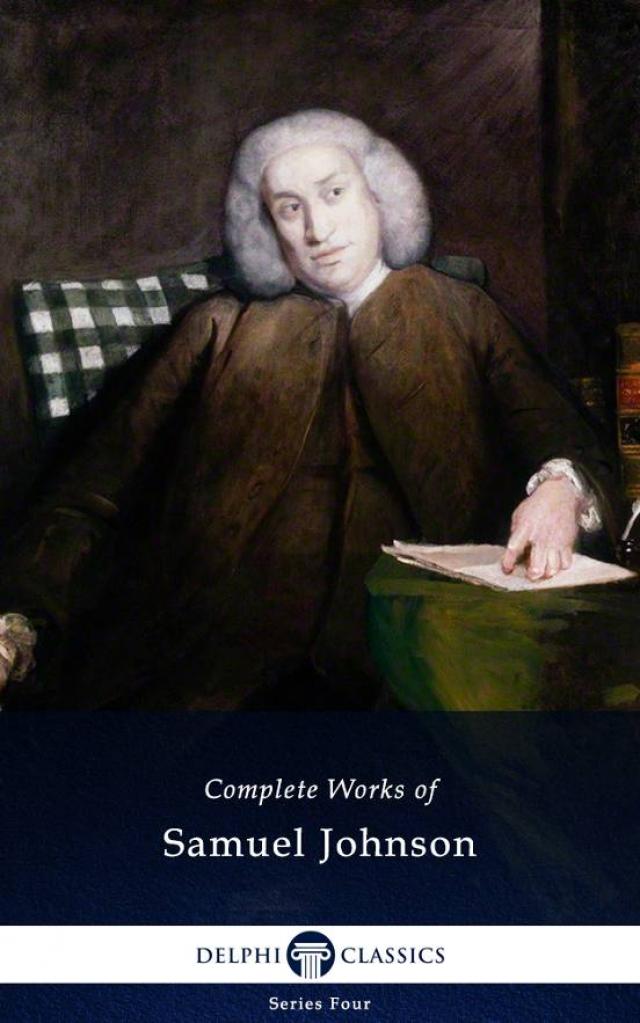
The Complete Works of
SAMUEL JOHNSON
(1709-1784)
Contents
The Essays and Pamphlets
A VOYAGE TO ABYSSINIA
MARMOR NORFOLCIENSE
A COMPLEAT VINDICATION OF THE LICENSERS OF THE STAGE
THE PLAN OF A DICTIONARY OF THE ENGLISH LANGUAGE
THE RAMBLER
THE ADVENTURER
THE IDLER
THE FALSE ALARM
THOUGHTS ON THE LATE TRANSACTIONS RESPECTING FALKLAND’S ISLANDS
THE PATRIOT
TAXATION NO TYRANNY
A JOURNEY TO THE WESTERN ISLANDS OF SCOTLAND
DEBATES IN PARLIAMENT
A CONVERSATION BETWEEN HIS MOST SACRED MAJESTY GEORGE III AND SAMUEL JOHNSON LID
MISCELLANEOUS PAMPHLETS, REVIEWS AND ESSAYS
PRAYERS AND MEDITATIONS
The Novella
THE PRINCE OF ABISSINIA: A TALE
The Dictionary
PREFACE TO A DICTIONARY OF THE ENGLISH LANGUAGE
SELECTED DICTIONARY ENTRIES
The Biographies
AN ACCOUNT OF THE LIFE OF MR RICHARD SAVAGE
THE LIVES OF THE MOST EMINENT ENGLISH POETS
THE LIVES OF EMINENT MEN
The Literary Criticism
MISCELLANEOUS OBSERVATIONS ON THE TRAGEDY OF MACBETH
PROPOSALS FOR PRINTING THE DRAMATICK WORKS OF WILLIAM SHAKESPEARE
PREFACE TO THE PLAYS OF WILLIAM SHAKESPEARE
NOTES TO SHAKESPEARE’S PLAYS
GENERAL OBSERVATIONS ON THE PLAYS OF SHAKESPEARE
The Play
IRENE
The Poems
LIST OF POEMS IN CHRONOLOGICAL ORDER
LIST OF POEMS IN ALPHABETICAL ORDER
The Criticism
DR. JOHNSON AND HIS CIRCLE by John Bailey
SAMUEL JOHNSON by Richard Claverhouse Jebb
SAMUEL JOHNSON by Leslie Stephen
STUDIES OF A BIOGRAPHER by Leslie Stephen
A POETICAL REVIEW OF THE LITERARY AND MORAL CHARACTER OF JOHNSON by John Courtenay
SAMUEL JOHNSON by Nathaniel Hawthorne
SAMUEL JOHNSON by C. E. Vaughan
ANECDOTES OF THE LATE SAMUEL JOHNSON, LL.D. by Hester Lynch Piozzi
THE REAL DR. JOHNSON by G. K. Chesterton
A REMINISCENCE OF DR. SAMUEL JOHNSON by H. P. Lovecraft
The Biographies
THE LIFE OF SAMUEL JOHNSON LL.D. by James Boswell
BOSWELL’S LIFE OF JOHNSON (ABRIDGED) by Charles Grosvenor Osgood
MACAULAY’S LIFE OF SAMUEL JOHNSON by Baron Thomas Babington Macaulay
AN ESSAY ON THE LIFE AND GENIUS OF SAMUEL JOHNSON by Arthur Murphy
The Delphi Classics Catalogue
© Delphi Classics 2013
Version 1
The Complete Works of
SAMUEL JOHNSON
By Delphi Classics, 2013
COPYRIGHT
Complete Works of Samuel Johnson
First published in the United Kingdom in 2013 by Delphi Classics.
© Delphi Classics, 2013.
All rights reserved. No part of this publication may be reproduced, stored in a retrieval system, or transmitted, in any form or by any means, without the prior permission in writing of the publisher, nor be otherwise circulated in any form other than that in which it is published.
Delphi Classics
is an imprint of
Delphi Publishing Ltd
Hastings, East Sussex
United Kingdom
Contact: sales@delphiclassics.com
www.delphiclassics.com
Parts Edition Now Available!
Love reading Samuel Johnson?
Did you know you can now purchase the Delphi Classics Parts Edition of this author and enjoy all the novels, plays, non-fiction books and other works as individual eBooks? Now, you can select and read individual novels etc. and know precisely where you are in an eBook. You will also be able to manage space better on your eReading devices.
The Parts Edition is only available direct from the Delphi Classics website.
For more information about this exciting new format and to try free Parts Edition downloads, please visit this link.
Explore Eighteenth Century literature with Delphi Classics
For the first time in digital publishing history, Delphi Classics is proud to present the complete works of these important authors.
www.delphiclassics.com
The Essays and Pamphlets
Breadmarket Street, Lichfield, Staffordshire — Johnson’s birthplace. The author’s father Michael built the house, in which he ran the family’s bookshop on the ground floor, facing on to the market square. The building now operates as a museum dedicated to the famous author.
Dr Johnson’s Birthplace by Harry Goodwin, 1876
Johnson by Sir Joshua Reynolds, c. 1769
A VOYAGE TO ABYSSINIA
By Father Jerome Lobo
Translated from the French by Samuel Johnson
After Johnson was forced to abandon his studies at Oxford in 1729 due to a lack of funds, it is believed he lived with his parents above their bookshop in Lichfield. He experienced bouts of mental anguish and physical pain during years of illness, suffering from tics and gesticulations, which are nowadays identified as symptoms of Tourette syndrome. By 1731 Johnson’s father was deeply in debt and had lost much of his standing in Lichfield and he died shortly after, having developed an inflammatory fever in December 1731.
In spite of these hardships, Johnson eventually found employment as undermaster at a school in Market Bosworth, which was run by Sir Wolstan Dixie, 4th Baronet who allowed Johnson to teach without a degree. Although Johnson was treated as a servant, he found pleasure in teaching, though at times he complained of finding it weary work. After an argument with Dixie he left the school, and by June 1732 he had once again returned home.
Johnson then spent time with his friend Edmund Hector, who was living in the home of the publisher Thomas Warren. Warren was starting his Birmingham Journal, destined to become the city’s first printed newspaper, and he enlisted Johnson’s help in writing articles. This connection with Warren grew and Johnson proposed a translation of the Portuguese Jesuit missionary Jeronimo Lobo’s account of the Abyssinians, having previously read Le Grand’s French translations and thought that a shorter version might be “useful and profitable”. Instead of writing the whole work himself, he dictated to Hector, who then took the copy to the printer and made corrections. Johnson’s A Voyage to Abyssinia was published a year later, launching Johnson’s solo career as a published author.
The original title page
CONTENTS
A VOYAGE TO ABYSSINIA.
INTRODUCTION.
THE PREFACE
PART I — THE VOYAGE TO ABYSSINIA
CHAPTER I
CHAPTER II
CHAPTER III
CHAPTER IV
CHAPTER V
CHAPTER VI
CHAPTER VII
CHAPTER VIII
PART II — A DESCRIPTION OF ABYSSINIA
CHAPTER I
CHAPTER II
CHAPTER III
CHAPTER IV
CHAPTER V
CHAPTER VI
CHAPTER VII
CHAPTER VIII
CHAPTER IX
CHAPTER X
CHAPTER XI
CHAPTER XII
CHAPTER XIII
CHAPTER XIV
CHAPTER XV
The only known surviving copy of the Birmingham Journal, dated 21 May 1733
A VOYAGE TO ABYSSINIA.
by
FATHER JEROME LOBO.
Translated from the French
by
SAMUEL JOHNSON.
CASSELL & COMPANY, Limited:
london, paris, new york & melbourne.
1887.
INTRODUCTION.
Jeronimo Lobo was born in Lisbon in the year 1593. He entered the Order of the Jesuits at the age of sixteen. After passing through the studies by which Jesuits were trained for missionary work, which included special attention to the arts of speaking and writing, Father Lobo was sent as a missionary to India at the age of twenty-eight, in the year 1621. He reached Goa, as his book tells, in 1622, and was in 1624, at the age of thirty-one, told off as one of the missionaries to be employed in the conversion of the Abyssinians. They were to be converted, from a form of Christianity peculiar to themselves, to orthodox Catholicism. The Abyssinian Emperor Segued was protector of the enterprise, of which we have here the story told.
Father Lobo was nine years in Abyssinia, from the age of thirty-one to the age of forty, and this was the adventurous time of his life. The death of the Emperor Segued put an end to the protection that had given the devoted missionaries, in the midst of dangers, a precarious hold upon their work. When he and his comrades fell into the hands of the Turks at Massowah, his vigour of body and mind, his readiness of resource, and his fidelity, marked him out as the one to be sent to the headquarters in India to secure the payment of a ransom for his companions. He obtained the ransom, and desired also to obtain from the Portuguese Viceroy in India armed force to maintain the missionaries in the position they had so far won. But the Civil power was deaf to his pleading. He removed the appeal to Lisbon, and after narrowly escaping on the way from a shipwreck, and after having been captured by pirates, he reached Lisbon, and sought still
Good Father Lobo gave up the desire of his heart, when it was proved unattainable, and returned to India six years after the breaking up of his work in Abyssinia, at the age of forty-seven. He came to be head of the Provincials of the Jesuit settlement at Goa, and after about ten more years of active duty in the East returned in 1658 to Lisbon, when he died in the religious house of St. Roque in 1678, at the age of eighty-five. A comrade of Father Lobo’s, Baltazar Tellez, said that Lobo had travelled thirty-eight thousand leagues with no other object before him but the winning of more souls to God. His years in Abyssinia stood out prominently to his mind among all the years of his long life, and he wrote an account of them in Portuguese, of which the manuscript is at Lisbon in the monastery of St. Roque, where he closed his life.
Of that manuscript, then and still unprinted (though use was made of it by Baltazar Tellez in his History of ‘Ethiopia-Coimbra,’ 1660), the Abbe Legrand, Prior of Neuville-les-Dames, and of Prevessin, published a translation into French. The Abbe Legrand had been to Lisbon as Secretary to the Abbe d’Estrees, Ambassador from France to Portugal. The negotiations were so long continued that M. Legrand was detained five years in Lisbon, and employed the time in researches among documents illustrating the Portuguese possessions in India and the East. He obtained many memoirs of great interest, and published from one of them an account of Ceylon; but of all the manuscripts he found none interested him so much as that of Father Lobo. His translation was augmented with illustrative dissertations, letters, and a memoir on the circumstances of the death of M. du Roule. It filled two volumes, or 636 pages of forty lines. This was published in 1728. It was on the 31st of October, 1728, that Samuel Johnson, aged nineteen, went to Pembroke College, Oxford, and Legrand’s ‘Voyage Historique d’Abissinie du R. P. Jerome Lobo, de la Compagnie de Jesus, Traduit du Portugais, continue et augmente de plusieurs Dissertations, Lettres et Memoires,’ was one of the new books read by Johnson during his short period of college life. In 1735, when Johnson’s age was twenty-six, and the world seemed to have shut against him every door of hope, Johnson stayed for six months at Birmingham with his old schoolfellow Hector, who was aiming at medical practice, and who lodged at the house of a bookseller. Johnson spoke with interest of Father Lobo, whose book he had read at Pembroke College. Mr. Warren, the bookseller, thought it would be worth while to print a translation. Hector joined in urging Johnson to undertake it, for a payment of five guineas. Although nearly brought to a stop midway by hypochondriac despondency, a little suggestion that the printers also were stopped, and if they had not their work had not their pay, caused Johnson to go on to the end. Legrand’s book was reduced to a fifth of its size by the omission of all that overlaid Father Lobo’s personal account of his adventures; and Johnson began work as a writer with this translation, first published at Birmingham in 1735.
H.M.
THE PREFACE
The following relation is so curious and entertaining, and the dissertations that accompany it so judicious and instructive, that the translator is confident his attempt stands in need of no apology, whatever censures may fall on the performance.
The Portuguese traveller, contrary to the general vein of his countrymen, has amused his reader with no romantic absurdities or incredible fictions; whatever he relates, whether true or not, is at least probable; and he who tells nothing exceeding the bounds of probability has a right to demand that they should believe him who cannot contradict him.
He appears by his modest and unaffected narration to have described things as he saw them, to have copied nature from the life, and to have consulted his senses, not his imagination; he meets with no basilisks that destroy with their eyes, his crocodiles devour their prey without tears, and his cataracts fall from the rock without deafening the neighbouring inhabitants.
The reader will here find no regions cursed with irremediable barrenness, or blessed with spontaneous fecundity, no perpetual gloom or unceasing sunshine; nor are the nations here described either devoid of all sense of humanity, or consummate in all private and social virtues; here are no Hottentots without religion, polity, or articulate language, no Chinese perfectly polite, and completely skilled in all sciences: he will discover, what will always be discovered by a diligent and impartial inquirer, that wherever human nature is to be found there is a mixture of vice and virtue, a contest of passion and reason, and that the Creator doth not appear partial in his distributions, but has balanced in most countries their particular inconveniences by particular favours.
In his account of the mission, where his veracity is most to be suspected, he neither exaggerates overmuch the merits of the Jesuits, if we consider the partial regard paid by the Portuguese to their countrymen, by the Jesuits to their society, and by the Papists to their church, nor aggravates the vices of the Abyssins; but if the reader will not be satisfied with a Popish account of a Popish mission, he may have recourse to the history of the church of Abyssinia, written by Dr. Geddes, in which he will find the actions and sufferings of the missionaries placed in a different light, though the same in which Mr. Le Grand, with all his zeal for the Roman church, appears to have seen them.
This learned dissertator, however valuable for his industry and erudition, is yet more to be esteemed for having dared so freely in the midst of France to declare his disapprobation of the Patriarch Oviedo’s sanguinary zeal, who was continually importuning the Portuguese to beat up their drums for missionaries, who might preach the gospel with swords in their hands, and propagate by desolation and slaughter the true worship of the God of Peace.
It is not easy to forbear reflecting with how little reason these men profess themselves the followers of Jesus, who left this great characteristic to His disciples, that they should be known by loving one another, by universal and unbounded charity and benevolence.
Let us suppose an inhabitant of some remote and superior region, yet unskilled in the ways of men, having read and considered the precepts of the gospel, and the example of our Saviour, to come down in search of the true church: if he would not inquire after it among the cruel, the insolent, and the oppressive; among those who are continually grasping at dominion over souls as well as bodies; among those who are employed in procuring to themselves impunity for the most enormous villainies, and studying methods of destroying their fellow-creatures, not for their crimes but their errors; if he would not expect to meet benevolence, engage in massacres, or to find mercy in a court of inquisition, he would not look for the true church in the Church of Rome.
Mr. Le Grand has given in one dissertation an example of great moderation, in deviating from the temper of his religion, but in the others has left proofs that learning and honesty are often too weak to oppose prejudice. He has made no scruple of preferring the testimony of Father du Bernat to the writings of all the Portuguese Jesuits, to whom he allows great zeal, but little learning, without giving any other reason than that his favourite was a Frenchman. This is writing only to Frenchmen and to Papists: a Protestant would be desirous to know why he must imagine that Father du Bernat had a cooler head or more knowledge; and why one man whose account is singular is not more likely to be mistaken than many agreeing in the same account.