

Democratic Justice, page 1


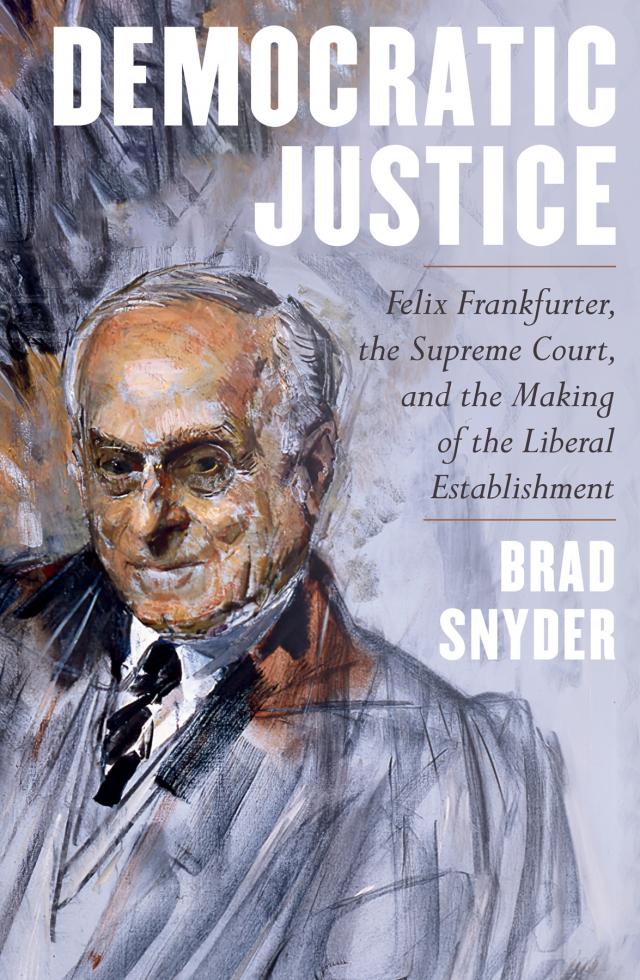
DEMOCRATIC
JUSTICE
FELIX FRANKFURTER, THE SUPREME
COURT, AND THE MAKING OF THE
LIBERAL ESTABLISHMENT
Brad Snyder
To Shelby, Lily, and Max
To Harry and Linda Snyder
To Jack and Donna Hunt
CONTENTS
INTRODUCTION: A Presidential Visit
CHAPTER 1:Miss Hogan
CHAPTER 2:A Quasi-Religious Feeling
CHAPTER 3:The Dominant Impulses of Your Nature
CHAPTER 4:The House of Truth
CHAPTER 5:To a Man, We Want Frankfurter
CHAPTER 6:Not Brandeis’s Fight, but Our Fight
CHAPTER 7:These Days We Are All Soldiers
CHAPTER 8:Personalia in Paris
CHAPTER 9:A Dangerous Man
CHAPTER 10:The Possible Gain Isn’t Worth the Cost
CHAPTER 11:The True Function of a “Liberal”
CHAPTER 12:Let Mr. Lowell Resign
CHAPTER 13:The Most Useful Lawyer in the United States
CHAPTER 14:From the Outside
CHAPTER 15:The Happy Hot Dogs
CHAPTER 16:Charming Exile
CHAPTER 17:The Most Influential Single Individual in the United States
CHAPTER 18:An Awful Shock
CHAPTER 19:Sorta Tough Ain’t It!
CHAPTER 20:The Oddest Collection of People
CHAPTER 21:The Brandeis Way
CHAPTER 22:Preaching the True Democratic Faith
CHAPTER 23:Uncle Felix and Aunt Marion
CHAPTER 24:F. F.’s Soliloquy
CHAPTER 25:A Great Enemy of Liberalism
CHAPTER 26:Race, Redemption, and Roosevelt
CHAPTER 27:The Real Architect of the Victory
CHAPTER 28:Frankfurter against Black
CHAPTER 29:My Eyes Hath Seen the Glory of the Coming of the Lord
CHAPTER 30:I Don’t Care What Color a Man Has
CHAPTER 31:The Frankfurter Cult on Trial
CHAPTER 32:The First Solid Piece of Evidence There Really Is a God
CHAPTER 33:The Wise Use of Time
CHAPTER 34:All Deliberate Speed
CHAPTER 35:Red Monday
CHAPTER 36:The Judicial Response to Little Rock
CHAPTER 37:A Health Scare
CHAPTER 38:The Political Thicket
CHAPTER 39:Father to Them All
EPILOGUE
ILLUSTRATIONS INSERT
ACKNOWLEDGMENTS
ABBREVIATIONS
NOTES
SELECTED BIBLIOGRAPHY
INDEX
DEMOCRATIC
JUSTICE
INTRODUCTION
A Presidential Visit
At 5:00 p.m. on July 26, 1962, the presidential motorcade left the back entrance of the White House for the nearly three-mile drive to Georgetown. Within minutes, President John F. Kennedy arrived at a three-story, white-brick house at 3018 Dumbarton Avenue for an “off the record” meeting with Justice Felix Frankfurter.
On April 5 of that year, the 79-year-old Supreme Court justice had collapsed at his desk and fallen to the floor in his chambers. He was carried into an ambulance and rushed to George Washington University Hospital. He had suffered a stroke and, five days later, another stroke that, like the first one, cleared itself. Doctors diagnosed it as a “cardiovascular insufficiency.” New York Times columnist James Reston wrote: “His problem is not ‘insufficiency’ but over-sufficiency. . . . His difficulty is not a shortage of anything, except maybe size, too much blood and energy, too many ideas, interests and opinions racing too fast through too small an area.”
Frankfurter had an over-sufficiency of friends, too. After his stroke, letters and telegrams poured in from cabinet members; U.S. senators; fellow justices; dozens of former Harvard law students, law clerks, and friends from around the world; and the youngest of three British children he and his wife had taken in during World War II. His closest friend, former secretary of state Dean Acheson, took charge limiting visitors and updating them on the justice’s condition. The stroke had paralyzed his left arm and leg, slowed his lightning speech “to about the normal human rate,” but left his mind mostly intact. His doctor said it was up to him whether he “lived or not,” that he had to relearn how to use certain muscles and stop thinking about his work at the Court. By mid-May, Frankfurter announced that on his doctors’ advice, he would not return to work until the Supreme Court’s next term began in October. Frankfurter’s friends, Kennedy’s national security advisor McGeorge Bundy and Washington Post publisher Phil Graham, believed that the bedridden justice would be forced to retire.
Retirement, however, was the farthest thing from Frankfurter’s mind. After his release from the hospital on July 7, he summoned Bundy to his home with an urgent message: The president needed to address the nation with several speeches. During his hospitalization, Frankfurter had encountered numerous nurses, orderlies, attendants, and doctors and discussed their views on the president and his policies. He believed that political and social change should start with Kennedy and his legislative agenda and worried about what he had heard in the hospital.
In a memorandum to the president, Bundy relayed Frankfurter’s concerns that the hospital staff was “all strongly in favor of you without knowing what you were for.” Frankfurter had some advice for the president about the problem. Bundy warned the president about Frankfurter’s “ ‘wary’ attitude toward the Administration,” described him as “a man I love,” and insisted that the justice was “a man who prefers to like people, and in his combination of wit, zest for politics, and sense of style he should be a natural talking partner and friend for you.”
Frankfurter’s wife, Marion, Bundy wrote, was a different story. She suffered from rheumatoid arthritis and for several years had rarely left her bed—by choice. She was, according to Bundy, “a deeply neurotic and selfish woman” and “a deep trial to all the Justice’s friends. But he adores her.”
After an in-person briefing from Bundy, Kennedy set off for Georgetown to call on Frankfurter. The president knew the neighborhood well. As a congressmen and senator, he had lived in Georgetown not far from Frankfurter’s residence. On the night of his inauguration, he had stopped by the home of a mutual friend and Frankfurter’s neighbor, columnist Joseph Alsop. The president was close to another member of the Georgetown set, Washington Post publisher and former Frankfurter clerk Phil Graham, who had played a key intermediary role in Lyndon Johnson’s decision to accept Kennedy’s offer of the vice presidency.
Frankfurter’s checkered history with Joe Kennedy, Sr., colored his views about the president. In 1933, Joe Sr. sought Frankfurter’s advice about whether his sons, Joe Jr. and Jack, should go straight from the Choate School to Harvard College. Frankfurter suggested that they study at the London School of Economics with Harold J. Laski because the Socialist political scientist was “the greatest teacher in the world.” Joe Sr. took Frankfurter’s advice. The two men remained cordial for a time yet parted as friends over the looming war. A supporter of Neville Chamberlain’s failed appeasement strategy, Joe Sr. resented Frankfurter’s interventionist influence on Roosevelt and blamed the justice for his ouster as U.S. ambassador to Great Britain. Frankfurter disliked Joe Sr. because of his isolationism and anti-Semitism. “Does anybody like Joe, Sr. . . .?” Frankfurter asked, “anybody, except his family?” In the fall of 1960, Frankfurter, according to Phil Graham, was “pro-Nixon almost or anyway dubitante about Kennedy because of Papa.” Knowing the justice’s reservations about him, Joe Sr.’s second son nonetheless showed respect in July 1962 by calling on Frankfurter at home.
Frankfurter was skeptical that Kennedy’s visit was “simply a courtesy call.” More likely, he thought it was “an inspection for political reasons.” For two weeks, the justice met daily with Acheson and obsessed about the details of the visit—where to receive the president (in the living room), whether Frankfurter should stand upon greeting the president (yes), and what refreshments to serve (tea). Acheson, who was as skeptical of Kennedy as Frankfurter, was there to serve as “Chief of Protocol.”
Upon the president’s arrival at Frankfurter’s home on July 26, Acheson greeted Kennedy at the door and escorted him into the living room. The justice “stood up without assistance” to shake hands with the president. The three men sat in the living room and talked politics. There were no photographers, no journalists, and only a scant mention in the next day’s newspapers.
The president complimented Frankfurter on his recovery and remarked that his own father, who had suffered a massive stroke in December 1961, was not as mobile as the justice and unable to speak. Kennedy mentioned that Bundy had shared some of Frankfurter’s ideas, but the president wanted to discuss them in person.
Frankfurter recounted his numerous conversations with the hospital staff and said “it seemed to him that there was a lack of communication between the President as the leader of American democracy and many intelligent and well-meaning people.” He believed that these people needed to be reminded and educated about what Kennedy was doing and thinking—specifically about “fundamental purposes of American democracy” and “the basic nature of our institutions.” Frankfurter suggested that Harvard historian Samuel Eliot Morison could draft a speech about democracy, Harvard legal historian Mark DeWolfe Howe could draft one about the nature of our institutions “rooted in history, philosophy, and experience,” and a Kennedy speechwriter could write one about the president’s policies and ideas.
Frankfurter suggested “building a bridge from Pennsylvania Avenue to Wall Street,” but added that any “Democratic president who was doing his job was not going to have good relations with business.” Kennedy replied that he had come to the same conclusion and wondered why Frankfurter thought so. Frankfurter believed that the solutions to the country’s domestic problems were “outside the experience of businessmen,” and therefore they viewed socioeconomic programs “with doubt, if not suspicion.” This required the president to be a “molder of American life; and a strong Democratic president was likely to mold it in ways that seemed alien, if not frightening, to businessmen.”
During his illness, Frankfurter continued, he thought about how to achieve “greatness” in the institutions of the presidency and the Supreme Court. Outstanding presidents and justices, he believed, shared a common “conception of the nature of their offices.” He mentioned Jefferson, Jackson, Lincoln, and Theodore and Franklin Roosevelt as examples, not for “guidance in modern problems” but for “how they had conceived of the nature of their office.” Kennedy agreed.
For more than forty minutes, they discussed politics and drank tea. Kennedy charmed Matilda Williams and Ellen Smith, two beloved members of Frankfurter’s household staff. He also suggested meeting Frankfurter again, perhaps sometime in August. As the president rose to leave, Frankfurter said the visit had been “a great honor” and “a great pleasure to him.” The looming question of the justice’s possible retirement, which had been rumored in the press, never came up.
Kennedy’s visit to Frankfurter’s home was reminiscent of a similarly historic meeting between a sitting president and a Supreme Court justice twenty-nine years earlier. On March 8, 1933, Frankfurter had arranged the visit of newly inaugurated President Franklin D. Roosevelt to Oliver Wendell Holmes, Jr., at the retired justice’s residence at 1720 I Street on Holmes’s ninety-second birthday. A year later, Roosevelt declared him “the wisest of all American liberals.”
The standard story about Frankfurter is that he struggled to fill the seat once held by Holmes. Scholars have portrayed Frankfurter as a judicial failure, as a liberal lawyer turned conservative justice, and as the Warren Court’s principal villain. None of these narratives rings true. Pro-government and a proponent of civil rights, Frankfurter rejected shifting labels such as liberal or conservative. A few months after his retirement, he sent a Times of London editorial to his former students teaching at Harvard Law School. He called their attention to the last paragraph: “Whether, when on the Supreme Court, [Frankfurter] was a Liberal or Conservative, or both, now matters little. He has always been a fighter for truth.”
Frankfurter made three major contributions to twentieth century America’s liberal democracy. First, he believed that the American people should seek political and socioeconomic change not from the Supreme Court but from the democratic political process. Thus, despite his wariness about the administration, he wanted to meet with Kennedy and to urge the president to address the American people about their history, system of government, and his administration’s future policies and ideas. Frankfurter understood each branch of government’s institutional role. Like Chief Justice John Marshall, whose opinions he venerated, Frankfurter believed that the Constitution was a broad outline that allowed the federal government and the states to regulate the economy and to help people through minimum-wage laws, maximum-hour laws, unemployment compensation laws, Social Security, health-care laws, and civil rights laws. Frankfurter understood that the Constitution primarily vested the power of the federal government in the people’s representatives in Congress and the White House. He viewed those two institutions, not the Supreme Court, as the engines of social change and most responsive to the popular will. Indeed, he lived to see the next president and Congress protect the rights of African Americans and women with the Civil Rights Act of 1964 and almost lived long enough to see the passage of the Voting Rights Act of 1965. These landmark civil rights laws validated Frankfurter’s overarching liberal faith in democracy.
Given his strong belief in the democratic political process, Frankfurter was extremely skeptical about judicial vetoes of state and federal legislation. The Court’s repeated use of judicial review to make social and political policy undermined any incentive the people had to seek change through their elected representatives. The Court was conservative, backward looking, and not as accountable to the people as the two elected branches. On the basis of his deep knowledge of Supreme Court history, he knew that the Warren Court was a liberal aberration, cautioned his liberal colleagues against overturning too many of the Court’s past decisions, and recognized that empowering the Court at the expense of the elected branches threatened American democracy. His last opinion, his dissent in the Tennessee reapportionment case Baker v. Carr, disagreed with the Court’s willingness to inject itself into political controversies over legislative redistricting and gerrymandering. He believed that the Court was incapable of enforcing the desegregation of the nation’s school systems and redrawing the nation’s legislative maps at the same time. He predicted that the Court would struggle to devise a manageable standard for when a legislative district was illegally gerrymandered. Indeed, Frankfurter saw Baker v. Carr as the point where the Supreme Court became too powerful and too willing, in his words, to “enter this political thicket.”
Second, Frankfurter adapted the philosophy of judicial restraint to address the most urgent constitutional problem of the twentieth century—to fulfill the promise of the Fourteenth Amendment by protecting the rights of African Americans. His record on race was far better than those of his judicial idols Holmes and Louis D. Brandeis. Despite his initial instinct to defer to the democratic political process, Frankfurter believed courts could help to protect civil rights and to prevent racial injustice.
As a lawyer, he joined the nascent American Civil Liberties Union, challenged the constitutionality of the arrest and deportation of radical immigrants during the Palmer raids, fought to save Italian anarchists Nicola Sacco and Bartolomeo Vanzetti from the electric chair, and served on the NAACP’s National Lawyers Committee. Indeed, he recommended the NAACP hire his former student Nathan Margold to write a report recommending a strategy to dismantle the Court’s racially “separate but equal” doctrine. Another former student, NAACP special counsel Charles Hamilton Houston, implemented Margold’s report by challenging the exclusion of blacks from state-sponsored law and graduate schools.
As a justice, Frankfurter believed in using judicial power to protect the rights of African Americans. He drafted a prescient concurring opinion in 1944 in Smith v. Allwright outlawing Texas’s all-white primary but withdrew it at his colleagues’ request. Four years later, he hired the Court’s first black law clerk, future secretary of transportation William T. Coleman, Jr. Frankfurter played a critical leadership role in achieving unanimity in the Court’s landmark decision in 1954 in Brown v. Board of Education outlawing racially segregated schools. He understood the Court’s institutional limitations in enforcing Brown better than many of his colleagues did, and during the Little Rock school crisis four years later, he wrote an opinion to speak to southerners who preferred to uphold the rule of law rather than to bow to racial prejudice. He consistently supported the ability of criminal defendants, black and white, to invoke their constitutional right to habeas corpus. And he wrote a majority opinion in Gomillion v. Lightfoot rejecting the Tuskegee, Alabama, city boundaries drawn to exclude black voters. To be sure, he did not always strike the right balance between liberty and security during World War II and the Cold War; his patriotism and pedantic personality sometimes got the better of his judgment and alienated his colleagues. Yet his record on race belies his critics’ claim that he was a liberal lawyer who became a conservative justice. His caution in using the Court’s power was a sign of liberal strength, not weakness.


