Complete Works of Robert Louis Stevenson, page 177


“When was this done?” asked the doctor, looking at the wound.
“More than a week ago,” replied Wicks, thinking singly of his log.
“Hey?” cried the doctor, and he raised his hand and looked the captain in the eyes.
“I don’t remember exactly,” faltered Wicks.
And at this remarkable falsehood, the suspicions of the doctor were at once quadrupled.
“By the way, which of you is called Wicks?” he asked easily.
“What’s that?” snapped the captain, falling white as paper.
“Wicks,” repeated the doctor; “which of you is he? that’s surely a plain question.”
Wicks stared upon his questioner in silence.
“Which is Brown, then?” pursued the doctor.
“What are you talking of? what do you mean by this?” cried Wicks, snatching his half-bandaged hand away, so that the blood sprinkled in the surgeon’s face.
He did not trouble to remove it. Looking straight at his victim, he pursued his questions. “Why must Brown go the same way?” he asked.
Wicks fell trembling on a locker. “Carthew’s told you,” he cried.
“No,” replied the doctor, “he has not. But he and you between you have set me thinking, and I think there’s something wrong.”
“Give me some grog,” said Wicks. “I’d rather tell than have you find out. I’m damned if it’s half as bad as what any one would think.”
And with the help of a couple of strong grogs, the tragedy of the Flying Scud was told for the first time.
It was a fortunate series of accidents that brought the story to the doctor. He understood and pitied the position of these wretched men, and came whole-heartedly to their assistance. He and Wicks and Carthew (so soon as he was recovered) held a hundred councils and prepared a policy for San Francisco. It was he who certified “Goddedaal” unfit to be moved and smuggled Carthew ashore under cloud of night; it was he who kept Wicks’s wound open that he might sign with his left hand; he who took all their Chile silver and (in the course of the first day) got it converted for them into portable gold. He used his influence in the wardroom to keep the tongues of the young officers in order, so that Carthew’s identification was kept out of the papers. And he rendered another service yet more important. He had a friend in San Francisco, a millionaire; to this man he privately presented Carthew as a young gentleman come newly into a huge estate, but troubled with Jew debts which he was trying to settle on the quiet. The millionaire came readily to help; and it was with his money that the wrecker gang was to be fought. What was his name, out of a thousand guesses? It was Douglas Longhurst.
As long as the Currency Lasses could all disappear under fresh names, it did not greatly matter if the brig were bought, or any small discrepancies should be discovered in the wrecking. The identification of one of their number had changed all that. The smallest scandal must now direct attention to the movements of Norris. It would be asked how he who had sailed in a schooner from Sydney, had turned up so shortly after in a brig out of Hong Kong; and from one question to another all his original shipmates were pretty sure to be involved. Hence arose naturally the idea of preventing danger, profiting by Carthew’s new-found wealth, and buying the brig under an alias; and it was put in hand with equal energy and caution. Carthew took lodgings alone under a false name, picked up Bellairs at random, and commissioned him to buy the wreck.
“What figure, if you please?” the lawyer asked.
“I want it bought,” replied Carthew. “I don’t mind about the price.”
“Any price is no price,” said Bellairs. “Put a name upon it.”
“Call it ten thousand pounds then, if you like!” said Carthew.
In the meanwhile, the captain had to walk the streets, appear in the consulate, be cross-examined by Lloyd’s agent, be badgered about his lost accounts, sign papers with his left hand, and repeat his lies to every skipper in San Francisco: not knowing at what moment he might run into the arms of some old friend who should hail him by the name of Wicks, or some new enemy who should be in a position to deny him that of Trent. And the latter incident did actually befall him, but was transformed by his stout countenance into an element of strength. It was in the consulate (of all untoward places) that he suddenly heard a big voice inquiring for Captain Trent. He turned with the customary sinking at his heart.
“YOU ain’t Captain Trent!” said the stranger, falling back. “Why, what’s all this? They tell me you’re passing off as Captain Trent — Captain Jacob Trent — a man I knew since I was that high.”
“O, you’re thinking of my uncle as had the bank in Cardiff,” replied Wicks, with desperate aplomb.
“I declare I never knew he had a nevvy!” said the stranger.
“Well, you see he has!” says Wicks.
“And how is the old man?” asked the other.
“Fit as a fiddle,” answered Wicks, and was opportunely summoned by the clerk.
This alert was the only one until the morning of the sale, when he was once more alarmed by his interview with Jim; and it was with some anxiety that he attended the sale, knowing only that Carthew was to be represented, but neither who was to represent him nor what were the instructions given. I suppose Captain Wicks is a good life. In spite of his personal appearance and his own known uneasiness, I suppose he is secure from apoplexy, or it must have struck him there and then, as he looked on at the stages of that insane sale and saw the old brig and her not very valuable cargo knocked down at last to a total stranger for ten thousand pounds.
It had been agreed that he was to avoid Carthew, and above all Carthew’s lodging, so that no connexion might be traced between the crew and the pseudonymous purchaser. But the hour for caution was gone by, and he caught a tram and made all speed to Mission Street.
Carthew met him in the door.
“Come away, come away from here,” said Carthew; and when they were clear of the house, “All’s up!” he added.
“O, you’ve heard of the sale, then?” said Wicks.
“The sale!” cried Carthew. “I declare I had forgotten it.” And he told of the voice in the telephone, and the maddening question: “Why did you want to buy the Flying Scud?”
This circumstance, coming on the back of the monstrous improbabilities of the sale, was enough to have shaken the reason of Immanuel Kant. The earth seemed banded together to defeat them; the stones and the boys on the street appeared to be in possession of their guilty secret. Flight was their one thought. The treasure of the Currency Lass they packed in waist-belts, expressed their chests to an imaginary address in British Columbia, and left San Francisco the same afternoon, booked for Los Angeles.
The next day they pursued their retreat by the Southern Pacific route, which Carthew followed on his way to England; but the other three branched off for Mexico.
EPILOGUE: TO WILL H. LOW.
DEAR LOW: The other day (at Manihiki of all places) I had the pleasure to meet Dodd. We sat some two hours in the neat, little, toy-like church, set with pews after the manner of Europe, and inlaid with mother-of-pearl in the style (I suppose) of the New Jerusalem. The natives, who are decidedly the most attractive inhabitants of this planet, crowded round us in the pew, and fawned upon and patted us; and here it was I put my questions, and Dodd answered me.
I first carried him back to the night in Barbizon when Carthew told his story, and asked him what was done about Bellairs. It seemed he had put the matter to his friend at once, and that Carthew took it with an inimitable lightness. “He’s poor, and I’m rich,” he had said. “I can afford to smile at him. I go somewhere else, that’s all — somewhere that’s far away and dear to get to. Persia would be found to answer, I fancy. No end of a place, Persia. Why not come with me?” And they had left the next afternoon for Constantinople, on their way to Teheran. Of the shyster, it is only known (by a newspaper paragraph) that he returned somehow to San Francisco and died in the hospital.
“Now there’s another point,” said I. “There you are off to Persia with a millionaire, and rich yourself. How come you here in the South Seas, running a trader?”
He said, with a smile, that I had not yet heard of Jim’s last bankruptcy. “I was about cleaned out once more,” he said; “and then it was that Carthew had this schooner built, and put me in as supercargo. It’s his yacht and it’s my trader; and as nearly all the expenses go to the yacht, I do pretty well. As for Jim, he’s right again: one of the best businesses, they say, in the West, fruit, cereals, and real estate; and he has a Tartar of a partner now — Nares, no less. Nares will keep him straight, Nares has a big head. They have their country-places next door at Saucelito, and I stayed with them time about, the last time I was on the coast. Jim had a paper of his own — I think he has a notion of being senator one of these days — and he wanted me to throw up the schooner and come and write his editorials. He holds strong views on the State Constitution, and so does Mamie.”
“And what became of the other three Currency Lasses after they left Carthew?” I inquired.
“Well, it seems they had a huge spree in the city of Mexico,” said Dodd; “and then Hadden and the Irishman took a turn at the gold fields in Venezuela, and Wicks went on alone to Valparaiso. There’s a Kirkup in the Chilean navy to this day, I saw the name in the papers about the Balmaceda war. Hadden soon wearied of the mines, and I met him the other day in Sydney. The last news he had from Venezuela, Mac had been knocked over in an attack on the gold train. So there’s only the three of them left, for Amalu scarcely counts. He lives on his own land in Maui, at the side of Hale-a-ka-la, where he keeps Goddedaal’s canary; and they say he sticks to his dollars, which is a wonder in a Kanaka. He had a considerable pile to start with, for not only Hemstead’s share but Carthew’s was divided equally among the other four — Mac being counted.”
“What did that make for him altogether?” I could not help asking, for I had been diverted by the number of calculations in his narrative.
“One hundred and twenty-eight pounds nineteen shillings and eleven pence halfpenny,” he replied with composure. “That’s leaving out what little he won at Van John. It’s something for a Kanaka, you know.”
And about that time we were at last obliged to yield to the solicitations of our native admirers, and go to the pastor’s house to drink green cocoanuts. The ship I was in was sailing the same night, for Dodd had been beforehand and got all the shell in the island; and though he pressed me to desert and return with him to Auckland (whither he was now bound to pick up Carthew) I was firm in my refusal.
The truth is, since I have been mixed up with Havens and Dodd in the design to publish the latter’s narrative, I seem to feel no want for Carthew’s society. Of course I am wholly modern in sentiment, and think nothing more noble than to publish people’s private affairs at so much a line. They like it, and if they don’t, they ought to. But a still small voice keeps telling me they will not like it always, and perhaps not always stand it. Memory besides supplies me with the face of a pressman (in the sacred phrase) who proved altogether too modern for one of his neighbours, and
Qui nunc it per iter tenebricosum
as it were, marshalling us our way. I am in no haste to
— nos proecedens —
be that man’s successor. Carthew has a record as “a clane shot,” and for some years Samoa will be good enough for me.
We agreed to separate, accordingly; but he took me on board in his own boat with the hard-wood fittings, and entertained me on the way with an account of his late visit to Butaritari, whither he had gone on an errand for Carthew, to see how Topelius was getting along, and, if necessary, to give him a helping hand. But Topelius was in great force, and had patronised and — well — out-manoeuvred him.
“Carthew will be pleased,” said Dodd; “for there’s no doubt they oppressed the man abominably when they were in the Currency Lass. It’s diamond cut diamond now.”
This, I think, was the most of the news I got from my friend Loudon; and I hope I was well inspired, and have put all the questions to which you would be curious to hear an answer.
But there is one more that I daresay you are burning to put to myself; and that is, what your own name is doing in this place, cropping up (as it were uncalled-for) on the stern of our poor ship? If you were not born in Arcadia, you linger in fancy on its margin; your thoughts are busied with the flutes of antiquity, with daffodils, and the classic poplar, and the footsteps of the nymphs, and the elegant and moving aridity of ancient art. Why dedicate to you a tale of a caste so modern; — full of details of our barbaric manners and unstable morals; — full of the need and the lust of money, so that there is scarce a page in which the dollars do not jingle; — full of the unrest and movement of our century, so that the reader is hurried from place to place and sea to sea, and the book is less a romance than a panorama — in the end, as blood-bespattered as an epic?
Well, you are a man interested in all problems of art, even the most vulgar; and it may amuse you to hear the genesis and growth of The Wrecker. On board the schooner Equator, almost within sight of the Johnstone Islands (if anybody knows where these are) and on a moonlit night when it was a joy to be alive, the authors were amused with several stories of the sale of wrecks. The subject tempted them; and they sat apart in the alley-way to discuss its possibilities. “What a tangle it would make,” suggested one, “if the wrong crew were aboard. But how to get the wrong crew there?”— “I have it!” cried the other; “the so-and-so affair!” For not so many months before, and not so many hundred miles from where we were then sailing, a proposition almost tantamount to that of Captain Trent had been made by a British skipper to some British castaways.
Before we turned in, the scaffolding of the tale had been put together. But the question of treatment was as usual more obscure. We had long been at once attracted and repelled by that very modern form of the police novel or mystery story, which consists in beginning your yarn anywhere but at the beginning, and finishing it anywhere but at the end; attracted by its peculiar interest when done, and the peculiar difficulties that attend its execution; repelled by that appearance of insincerity and shallowness of tone, which seems its inevitable drawback. For the mind of the reader, always bent to pick up clews, receives no impression of reality or life, rather of an airless, elaborate mechanism; and the book remains enthralling, but insignificant, like a game of chess, not a work of human art. It seemed the cause might lie partly in the abrupt attack; and that if the tale were gradually approached, some of the characters introduced (as it were) beforehand, and the book started in the tone of a novel of manners and experience briefly treated, this defect might be lessened and our mystery seem to inhere in life. The tone of the age, its movement, the mingling of races and classes in the dollar hunt, the fiery and not quite unromantic struggle for existence with its changing trades and scenery, and two types in particular, that of the American handy-man of business and that of the Yankee merchant sailor — we agreed to dwell upon at some length, and make the woof to our not very precious warp. Hence Dodd’s father, and Pinkerton, and Nares, and the Dromedary picnics, and the railway work in New South Wales — the last an unsolicited testimonial from the powers that be, for the tale was half written before I saw Carthew’s squad toil in the rainy cutting at South Clifton, or heard from the engineer of his “young swell.” After we had invented at some expense of time this method of approaching and fortifying our police novel, it occurred to us it had been invented previously by some one else, and was in fact — however painfully different the results may seem — the method of Charles Dickens in his later work.
I see you staring. Here, you will say, is a prodigious quantity of theory to our halfpenny worth of police novel; and withal not a shadow of an answer to your question.
Well, some of us like theory. After so long a piece of practice, these may be indulged for a few pages. And the answer is at hand. It was plainly desirable, from every point of view of convenience and contrast, that our hero and narrator should partly stand aside from those with whom he mingles, and be but a pressed-man in the dollar hunt. Thus it was that Loudon Dodd became a student of the plastic arts, and that our globe-trotting story came to visit Paris and look in at Barbizon. And thus it is, dear Low, that your name appears in the address of this epilogue.
For sure, if any person can here appreciate and read between the lines, it must be you — and one other, our friend. All the dominos will be transparent to your better knowledge; the statuary contract will be to you a piece of ancient history; and you will not have now heard for the first time of the dangers of Roussillon. Dead leaves from the Bas Breau, echoes from Lavenue’s and the Rue Racine, memories of a common past, let these be your bookmarkers as you read. And if you care for naught else in the story, be a little pleased to breathe once more for a moment the airs of our youth.
THE END
CATRIONA
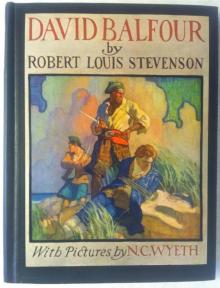
This novel is a sequel to Kidnapped (1886) and was first published in 1893. It is sometimes referred to by its alternative title: David Balfour. The novel begins where Kidnapped left off, tying up some unresolved plotlines in the original novel and continuing David’s story, including his quest for his rightful inheritance and his love affair with Catriona MacGregor, a relation of the famous Rob Roy. The first part of the story concerns David’s attempts to secure justice for James Stewart, after he is charged as an accessory in the Appin Murder (the events of which play an important part in the first novel). The second part of the novel is related to David’s relationship with Catriona and their domestic life in Holland.