Complete Works of Robert Louis Stevenson, page 119


AND SLEEPS IN THE SAME GRAVE
WITH HIS FRATERNAL ENEMY.
THE PIETY OF HIS WIFE AND ONE OLD
SERVANT RAISED THIS STONE
TO BOTH.
THE WRONG BOX
First published in 1889, The Wrong Box is the first of three co-written novels by Stevenson and his stepson, Lloyd Osbourne. The latter wrote the first draft, with Stevenson heavily revising it, adding his own unique polish, as well as the celebrity impact of his name, which helped to sell the novel.
It is a black comedy dealing with the legal arrangement known as a ‘tontine’, in which an inheritance is split between several individuals, with the sum being divided equally among the surviving inheritors as each member of the tontine dies. Eventually, the last surviving individual (or their descendants) retains the entire sum. The arrangement has provided inspiration for crime stories as diverse as Hawley Smart’s The Great Tontine (1881) and Agatha Christie’s 4.50 from Paddington (1957), where the incentive to acquire the residual amount is a convenient motive for murder!
Stevenson and Osbourne’s novel concerns two brothers, Joseph and Masterman Finsbury, who are part of a tontine containing 37 other individuals. At the beginning of the story, the tontine is nearing the end of its natural course and Joseph and Masterman are the only remaining participants. Joseph has fallen on hard times however, and his nephew Morris is determined that the tontine will renew the fortunes of his side of the family. When Joseph appears to have died unexpectedly, however, Morris takes desperate action, initiating a macabre (but darkly comic) farce.
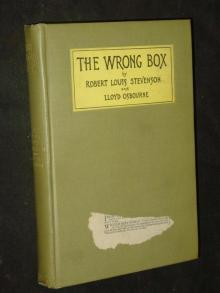
Cover of the first edition
Lloyd Osbourne (1868–1947), Stevenson’s stepson, with whom he co-wrote the novel
CONTENTS
PREFACE
CHAPTER I. In Which Morris Suspects
CHAPTER II. In Which Morris takes Action
CHAPTER III. The Lecturer at Large
CHAPTER IV. The Magistrate in the Luggage Van
CHAPTER V. Mr Gideon Forsyth and the Gigantic Box
CHAPTER VI. The Tribulations of Morris: Part the First
CHAPTER VII. In Which William Dent Pitman takes Legal Advice
CHAPTER VIII. In Which Michael Finsbury Enjoys a Holiday
CHAPTER IX. Glorious Conclusion of Michael Finsbury’s Holiday
CHAPTER X. Gideon Forsyth and the Broadwood Grand
CHAPTER XI. The Maestro Jimson
CHAPTER XII. Positively the Last Appearance of the Broadwood Grand
CHAPTER XIII. The Tribulations of Morris: Part the Second
CHAPTER XIV. William Bent Pitman Hears of Something to his Advantage
CHAPTER XV. The Return of the Great Vance
CHAPTER XVI. Final Adjustment of the Leather Business
Poster for the 1966 film adaptation, starring Michael Caine
PREFACE
‘Nothing like a little judicious levity,’ says Michael Finsbury in the text: nor can any better excuse be found for the volume in the reader’s hand. The authors can but add that one of them is old enough to be ashamed of himself, and the other young enough to learn better.
R. L. S. L. O.
CHAPTER I. In Which Morris Suspects
How very little does the amateur, dwelling at home at ease, comprehend the labours and perils of the author, and, when he smilingly skims the surface of a work of fiction, how little does he consider the hours of toil, consultation of authorities, researches in the Bodleian, correspondence with learned and illegible Germans — in one word, the vast scaffolding that was first built up and then knocked down, to while away an hour for him in a railway train! Thus I might begin this tale with a biography of Tonti — birthplace, parentage, genius probably inherited from his mother, remarkable instance of precocity, etc — and a complete treatise on the system to which he bequeathed his name. The material is all beside me in a pigeon-hole, but I scorn to appear vainglorious. Tonti is dead, and I never saw anyone who even pretended to regret him; and, as for the tontine system, a word will suffice for all the purposes of this unvarnished narrative.
A number of sprightly youths (the more the merrier) put up a certain sum of money, which is then funded in a pool under trustees; coming on for a century later, the proceeds are fluttered for a moment in the face of the last survivor, who is probably deaf, so that he cannot even hear of his success — and who is certainly dying, so that he might just as well have lost. The peculiar poetry and even humour of the scheme is now apparent, since it is one by which nobody concerned can possibly profit; but its fine, sportsmanlike character endeared it to our grandparents.
When Joseph Finsbury and his brother Masterman were little lads in white-frilled trousers, their father — a well-to-do merchant in Cheapside — caused them to join a small but rich tontine of seven-and-thirty lives. A thousand pounds was the entrance fee; and Joseph Finsbury can remember to this day the visit to the lawyer’s, where the members of the tontine — all children like himself — were assembled together, and sat in turn in the big office chair, and signed their names with the assistance of a kind old gentleman in spectacles and Wellington boots. He remembers playing with the children afterwards on the lawn at the back of the lawyer’s house, and a battle-royal that he had with a brother tontiner who had kicked his shins. The sound of war called forth the lawyer from where he was dispensing cake and wine to the assembled parents in the office, and the combatants were separated, and Joseph’s spirit (for he was the smaller of the two) commended by the gentleman in the Wellington boots, who vowed he had been just such another at the same age. Joseph wondered to himself if he had worn at that time little Wellingtons and a little bald head, and when, in bed at night, he grew tired of telling himself stories of sea-fights, he used to dress himself up as the old gentleman, and entertain other little boys and girls with cake and wine.
In the year 1840 the thirty-seven were all alive; in 1850 their number had decreased by six; in 1856 and 1857 business was more lively, for the Crimea and the Mutiny carried off no less than nine. There remained in 1870 but five of the original members, and at the date of my story, including the two Finsburys, but three.
By this time Masterman was in his seventy-third year; he had long complained of the effects of age, had long since retired from business, and now lived in absolute seclusion under the roof of his son Michael, the well-known solicitor. Joseph, on the other hand, was still up and about, and still presented but a semi-venerable figure on the streets in which he loved to wander. This was the more to be deplored because Masterman had led (even to the least particular) a model British life. Industry, regularity, respectability, and a preference for the four per cents are understood to be the very foundations of a green old age. All these Masterman had eminently displayed, and here he was, ab agendo, at seventy-three; while Joseph, barely two years younger, and in the most excellent preservation, had disgraced himself through life by idleness and eccentricity. Embarked in the leather trade, he had early wearied of business, for which he was supposed to have small parts. A taste for general information, not promptly checked, had soon begun to sap his manhood. There is no passion more debilitating to the mind, unless, perhaps, it be that itch of public speaking which it not infrequently accompanies or begets. The two were conjoined in the case of Joseph; the acute stage of this double malady, that in which the patient delivers gratuitous lectures, soon declared itself with severity, and not many years had passed over his head before he would have travelled thirty miles to address an infant school. He was no student; his reading was confined to elementary textbooks and the daily papers; he did not even fly as high as cyclopedias; life, he would say, was his volume. His lectures were not meant, he would declare, for college professors; they were addressed direct to ‘the great heart of the people’, and the heart of the people must certainly be sounder than its head, for his lucubrations were received with favour. That entitled ‘How to Live Cheerfully on Forty Pounds a Year’, created a sensation among the unemployed. ‘Education: Its Aims, Objects, Purposes, and Desirability’, gained him the respect of the shallow-minded. As for his celebrated essay on ‘Life Insurance Regarded in its Relation to the Masses’, read before the Working Men’s Mutual Improvement Society, Isle of Dogs, it was received with a ‘literal ovation’ by an unintelligent audience of both sexes, and so marked was the effect that he was next year elected honorary president of the institution, an office of less than no emolument — since the holder was expected to come down with a donation — but one which highly satisfied his self-esteem.
While Joseph was thus building himself up a reputation among the more cultivated portion of the ignorant, his domestic life was suddenly overwhelmed by orphans. The death of his younger brother Jacob saddled him with the charge of two boys, Morris and John; and in the course of the same year his family was still further swelled by the addition of a little girl, the daughter of John Henry Hazeltine, Esq., a gentleman of small property and fewer friends. He had met Joseph only once, at a lecture-hall in Holloway; but from that formative experience he returned home to make a new will, and consign his daughter and her fortune to the lecturer. Joseph had a kindly disposition; and yet it was not without reluctance that he accepted this new responsibility, advertised for a nurse, and purchased a second-hand perambulator. Morris and John he made more readily welcome; not so much because of the tie of consanguinity as because the leather business (in which he hastened to invest their fortune of thirty thousand pounds) had recently exhibited inexplicable symptoms of decline. A young but capable Scot was chosen as manager to the enterprise, and the cares of business never again afflicted Joseph Finsbury. Leaving his charges in the hands of the capable Scot (who was married), he began his extensive travels on the Continent and in Asia Minor.
With a polyglot Testament in one hand and a phrase-book in the other, he groped his way among the speakers of eleven European languages. The first of these guides is hardly applicable to the purposes of the philosophic traveller, and even the second is designed more expressly for the tourist than for the expert in life. But he pressed interpreters into his service — whenever he could get their services for nothing — and by one means and another filled many notebooks with the results of his researches.
In these wanderings he spent several years, and only returned to England when the increasing age of his charges needed his attention. The two lads had been placed in a good but economical school, where they had received a sound commercial education; which was somewhat awkward, as the leather business was by no means in a state to court enquiry. In fact, when Joseph went over his accounts preparatory to surrendering his trust, he was dismayed to discover that his brother’s fortune had not increased by his stewardship; even by making over to his two wards every penny he had in the world, there would still be a deficit of seven thousand eight hundred pounds. When these facts were communicated to the two brothers in the presence of a lawyer, Morris Finsbury threatened his uncle with all the terrors of the law, and was only prevented from taking extreme steps by the advice of the professional man. ‘You cannot get blood from a stone,’ observed the lawyer.
And Morris saw the point and came to terms with his uncle. On the one side, Joseph gave up all that he possessed, and assigned to his nephew his contingent interest in the tontine, already quite a hopeful speculation. On the other, Morris agreed to harbour his uncle and Miss Hazeltine (who had come to grief with the rest), and to pay to each of them one pound a month as pocket-money. The allowance was amply sufficient for the old man; it scarce appears how Miss Hazeltine contrived to dress upon it; but she did, and, what is more, she never complained. She was, indeed, sincerely attached to her incompetent guardian. He had never been unkind; his age spoke for him loudly; there was something appealing in his whole-souled quest of knowledge and innocent delight in the smallest mark of admiration; and, though the lawyer had warned her she was being sacrificed, Julia had refused to add to the perplexities of Uncle Joseph.
In a large, dreary house in John Street, Bloomsbury, these four dwelt together; a family in appearance, in reality a financial association. Julia and Uncle Joseph were, of course, slaves; John, a gentle man with a taste for the banjo, the music-hall, the Gaiety bar, and the sporting papers, must have been anywhere a secondary figure; and the cares and delights of empire devolved entirely upon Morris. That these are inextricably intermixed is one of the commonplaces with which the bland essayist consoles the incompetent and the obscure, but in the case of Morris the bitter must have largely outweighed the sweet. He grudged no trouble to himself, he spared none to others; he called the servants in the morning, he served out the stores with his own hand, he took soundings of the sherry, he numbered the remainder biscuits; painful scenes took place over the weekly bills, and the cook was frequently impeached, and the tradespeople came and hectored with him in the back parlour upon a question of three farthings. The superficial might have deemed him a miser; in his own eyes he was simply a man who had been defrauded; the world owed him seven thousand eight hundred pounds, and he intended that the world should pay.
But it was in his dealings with Joseph that Morris’s character particularly shone. His uncle was a rather gambling stock in which he had invested heavily; and he spared no pains in nursing the security. The old man was seen monthly by a physician, whether he was well or ill. His diet, his raiment, his occasional outings, now to Brighton, now to Bournemouth, were doled out to him like pap to infants. In bad weather he must keep the house. In good weather, by half-past nine, he must be ready in the hall; Morris would see that he had gloves and that his shoes were sound; and the pair would start for the leather business arm in arm. The way there was probably dreary enough, for there was no pretence of friendly feeling; Morris had never ceased to upbraid his guardian with his defalcation and to lament the burthen of Miss Hazeltine; and Joseph, though he was a mild enough soul, regarded his nephew with something very near akin to hatred. But the way there was nothing to the journey back; for the mere sight of the place of business, as well as every detail of its transactions, was enough to poison life for any Finsbury.
Joseph’s name was still over the door; it was he who still signed the cheques; but this was only policy on the part of Morris, and designed to discourage other members of the tontine. In reality the business was entirely his; and he found it an inheritance of sorrows. He tried to sell it, and the offers he received were quite derisory. He tried to extend it, and it was only the liabilities he succeeded in extending; to restrict it, and it was only the profits he managed to restrict. Nobody had ever made money out of that concern except the capable Scot, who retired (after his discharge) to the neighbourhood of Banff and built a castle with his profits. The memory of this fallacious Caledonian Morris would revile daily, as he sat in the private office opening his mail, with old Joseph at another table, sullenly awaiting orders, or savagely affixing signatures to he knew not what. And when the man of the heather pushed cynicism so far as to send him the announcement of his second marriage (to Davida, eldest daughter of the Revd. Alexander McCraw), it was really supposed that Morris would have had a fit.
Business hours, in the Finsbury leather trade, had been cut to the quick; even Morris’s strong sense of duty to himself was not strong enough to dally within those walls and under the shadow of that bankruptcy; and presently the manager and the clerks would draw a long breath, and compose themselves for another day of procrastination. Raw Haste, on the authority of my Lord Tennyson, is half-sister to Delay; but the Business Habits are certainly her uncles. Meanwhile, the leather merchant would lead his living investment back to John Street like a puppy dog; and, having there immured him in the hall, would depart for the day on the quest of seal rings, the only passion of his life. Joseph had more than the vanity of man, he had that of lecturers. He owned he was in fault, although more sinned against (by the capable Scot) than sinning; but had he steeped his hands in gore, he would still not deserve to be thus dragged at the chariot-wheels of a young man, to sit a captive in the halls of his own leather business, to be entertained with mortifying comments on his whole career — to have his costume examined, his collar pulled up, the presence of his mittens verified, and to be taken out and brought home in custody, like an infant with a nurse. At the thought of it his soul would swell with venom, and he would make haste to hang up his hat and coat and the detested mittens, and slink upstairs to Julia and his notebooks. The drawing-room at least was sacred from Morris; it belonged to the old man and the young girl; it was there that she made her dresses; it was there that he inked his spectacles over the registration of disconnected facts and the calculation of insignificant statistics.
Here he would sometimes lament his connection with the tontine. ‘If it were not for that,’ he cried one afternoon, ‘he would not care to keep me. I might be a free man, Julia. And I could so easily support myself by giving lectures.’
‘To be sure you could,’ said she; ‘and I think it one of the meanest things he ever did to deprive you of that amusement. There were those nice people at the Isle of Cats (wasn’t it?) who wrote and asked you so very kindly to give them an address. I did think he might have let you go to the Isle of Cats.’
‘He is a man of no intelligence,’ cried Joseph. ‘He lives here literally surrounded by the absorbing spectacle of life, and for all the good it does him, he might just as well be in his coffin. Think of his opportunities! The heart of any other young man would burn within him at the chance. The amount of information that I have it in my power to convey, if he would only listen, is a thing that beggars language, Julia.’
‘Whatever you do, my dear, you mustn’t excite yourself,’ said Julia; ‘for you know, if you look at all ill, the doctor will be sent for.’
‘That is very true,’ returned the old man humbly, ‘I will compose myself with a little study.’ He thumbed his gallery of notebooks. ‘I wonder,’ he said, ‘I wonder (since I see your hands are occupied) whether it might not interest you—’