

G-Man, page 1


VIKING
An imprint of Penguin Random House LLC
penguinrandomhouse.com
Copyright © 2022 by Beverly Gage
Penguin Random House supports copyright. Copyright fuels creativity, encourages diverse voices, promotes free speech, and creates a vibrant culture. Thank you for buying an authorized edition of this book and for complying with copyright laws by not reproducing, scanning, or distributing any part of it in any form without permission. You are supporting writers and allowing Penguin Random House to continue to publish books for every reader.
library of congress cataloging-in-publication data
Names: Gage, Beverly, author.
Title: G-man : J. Edgar Hoover and the making of the American century / Beverly Gage.
Description: New York : Viking, [2022] | Includes bibliographical references and index.
Identifiers: LCCN 2022021309 (print) | LCCN 2022021310 (ebook) | ISBN 9780670025374 (hardcover) | ISBN 9780593492611 (ebook)
Subjects: LCSH: Hoover, J. Edgar (John Edgar), 1895-1972, | United States. Federal Bureau of Investigation—Officials and employees—Biography. | Government executives—United States—Biography. | United States—History—20th century.
Classification: LCC HV7911.H66 G34 2022 (print) | LCC HV7911.H66 (ebook) | DDC 363.25092 [B]—dc23/eng/20220902
LC record available at https://lccn.loc.gov/2022021309
LC ebook record available at https://lccn.loc.gov/2022021310
Cover design: Elizabeth Yaffe
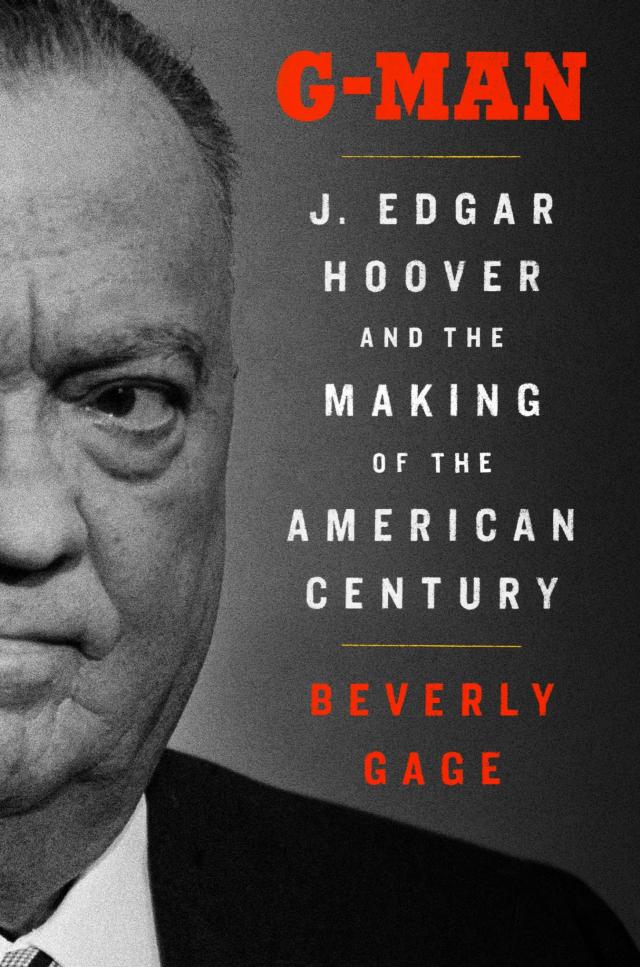
Cover photograph: Associated Press
Book design by Daniel Lagin, adapted for ebook by Molly Jeszke
pid_prh_6.0_141928374_c0_r0
For Nick
Contents
Introduction
Part I
THE FEDERAL CITY
(1895–1924)
Chapter 1: The Oldest Inhabitants (1800–1895)
Chapter 2: Little Edgar (1895–1905)
Chapter 3: The Boy Problem (1905–1909)
Chapter 4: Jump High and Leap Quick (1909–1913)
Chapter 5: Dieu Et Les Dames (1913–1917)
Chapter 6: The Great Adventure (1917–1918)
Chapter 7: The Radical Division (1919)
Chapter 8: New Elements (1920)
Chapter 9: No. 2 (1921–1924)
Part II
BUILDING THE BUREAU
(1924–1945)
Preface
Chapter 10: The New Sleuth (1924–1925)
Chapter 11: Kappa Alpha Bureau (1925–1928)
Chapter 12: Depression Days (1929–1932)
Chapter 13: Chairman of the Moral Uplift Squad (1927–1932)
Chapter 14: Government Men (1933)
Chapter 15: The Black Chamber (1934)
Chapter 16: It’s FBI Now (1934–1935)
Chapter 17: Right-Hand Man (1935–1936)
Chapter 18: Sob Sisters and Convict Lovers (1935–1938)
Chapter 19: The Gathering Storm (1936–1938)
Chapter 20: Mothers and Sons (1938–1939)
Chapter 21: Terror by Index Card (1939–1940)
Chapter 22: Henry E. Jones (1940–1941)
Chapter 23: Enemy Aliens (1941–1942)
Chapter 24: The Most Exciting Achievement Yet (1942)
Chapter 25: American Dilemmas (1942–1945)
Part III
POWER AND POLITICS
(1945–1959)
Preface
Chapter 26: Central Intelligence (1945–1946)
Chapter 27: Under Color of Law (1941–1948)
Chapter 28: The One Bulwark (1941–1946)
Chapter 29: Un-American Activities (1946–1947)
Chapter 30: Three-Ring Circus (1948–1950)
Chapter 31: J. Edgar Hoover, Churchman (1948–1950)
Chapter 32: Atomic Drama (1949–1951)
Chapter 33: Hooverism (1950–1952)
Chapter 34: Inner Conflicts (1947–1952)
Chapter 35: A Glorious Year (1953)
Chapter 36: No Sense of Decency (1953–1954)
Chapter 37: Massive Resistance (1954–1957)
Chapter 38: Master of Deceit (1956–1959)
Part IV
THE WAR AT HOME
(1960–1972)
Preface
Chapter 39: New Frontiers (1960–1961)
Chapter 40: Top Hoodlums (1957–1961)
Chapter 41: The Federal Bureau of Integration (1957–1961)
Chapter 42: Patron Saint of the Far Right (1961–1962)
Chapter 43: In Friendship (1961–1962)
Chapter 44: Decadent Thinking (1957–1962)
Chapter 45: The Most Dangerous Negro (1963)
Chapter 46: The President Is Dead (1963)
Chapter 47: The Commission (1963–1964)
Chapter 48: Freedom Summer (1964)
Chapter 49: All the Way with LBJ (1964)
Chapter 50: The Most Notorious Liar (1964–1965)
Chapter 51: White Hate (1964–1965)
Chapter 52: Hoover Knows Best (1965–1966)
Chapter 53: Commies in Colleges (1965–1967)
Chapter 54: Messiah (1968)
Chapter 55: Nixon’s the One (1968–1969)
Chapter 56: The Gospel of Nihilism (1969–1970)
Chapter 57: The Man Who Stayed Too Long (1970–1971)
Chapter 58: One of the Giants (1972)
Epilogue
Photographs
Acknowledgments
Notes
Note on Sources
Bibliography
Index
Introduction
In 1959, FBI director J. Edgar Hoover arrived at a government screening room to watch the story of his life. At the age of sixty-four, he had long ago gone thick around the middle (though FBI weight codes forbade his employees from doing the same). The press said he looked like a bulldog—squat frame, bulging wide-set eyes, fearsome jowls—but this had not always been the case. Thirty-five years earlier, when he became director of the FBI, he had been the trim, dazzling wunderkind of the administrative state, buzzing with physical energy and big ideas for reform. At the time, the Bureau of Investigation had been a law enforcement backwater, riddled with scandal and failure and controversy. In the three and a half decades that followed, Hoover rebuilt it and then rebuilt it again, according to his own priorities and in his own image.
Some found the result frightening to behold—a political surveillance force without precedent in American life. Hoover always insisted that his creation was thoroughly American. Born and bred in Washington, D.C., he believed in the power of the federal government to do great things and fight great battles on behalf of the nation’s citizens. He also believed that there were certain groups—communists and racial minorities, above all—who threatened that project. His career reflected both themes: a faith in progressive, expert-driven government and a commitment to an avenging social conservatism. His genius came in amassing enough power to promote and enforce those ideas as he saw fit.
Now he had a chance to discover what Hollywood thought of it all. The FBI Story followed the life of an organization rather than a man. But as everyone knew, Hoover was the FBI, its driving force and animating spirit. The film starred Jimmy Stewart as FBI agent Chip Hardesty, the embodiment of all that Hoover wanted his employees to be. Since taking over the Bureau in 1924, Hoover had cultivated a particular type of man as his ideal agent: tall, white, conservative, athletic, always in a dark suit and spit-shined shoes, either a lawyer or an accountant by training. In the 1930s, the newspapers had started describing this figure as a G-Man—or “Government Man”—the front-line soldier in the country’s War on Crime. As one of the federal government’s longest-serving and most prominent officials, Hoover became known as the ultimate G-Man, a political legend whose life and career were inextricable from the growth of federal bureaus and agencies and departments, and from the fraught public debate over how they were supposed to use their powers.
Colleagues liked to say Hoover was “married” to his Bureau, a policeman with neither time nor inclination for anything beyond the job. This was not quite true. If he was married to anyone, it was to Clyde Tolson, his famously loyal associate director. Tolson had joined the Bureau in the late 1920s, when Hoover was still working out his law enforcement vision. Since then, Tolson had been a model employee, but he had become something more as well. Where Hoover went, Tolson went too: not only to the office, but to the nightclub and the racetrack, on vacations and out for weeknight dinners, to family events and White House receptions. They were, in essence, a couple, though almost nobody—especially Hoover—referred to them that way.
Tolson attended the screening with Hoover. He also appeared with Hoover for a brief cameo in the film: Hoover seated at his mahogany desk, poring over serious investigative papers, with Tolson standing to his right. The rest of the film tracked Stewart’s character but the stories were all Hoover’s, the greatest hits of his three-decades-plus career. As Agent Hardesty, Stewart solved the gruesome Osage Indian murders of the mid-1920s. From there, the film broadened out into the kidnappings and gangster shoot-outs of the 1930s, the German sabotage and espionage cases of the war years, and, most recently, the FBI’s
The FBI Story director Mervyn LeRoy counted himself among Hoover’s admirers. He had allowed Hoover to review and approve the film’s script. Still, he confessed to being nervous about what the FBI director would think. If Hoover was most famous as a lawman, he was also known as a ruthless political warrior, unyielding to those who criticized him or tarnished his Bureau’s reputation. To LeRoy’s relief, Hoover looked pleased as the lights came up. “Mervyn, that’s one of the greatest jobs I’ve ever seen,” he declared after two and a half hours of watching his life story unfold. One aide thought he saw tears in Hoover’s eyes, the first time he had ever seen the indomitable FBI director show a human side.[1]
* * *
—
If Hoover had decided to step down at that moment in 1959, after thirty-five years at the FBI’s helm, we might remember him differently: as a popular and well-respected government official, often cruel and controversial but a hero to more Americans than not. Instead, he stayed on through the 1960s and emerged as one of history’s great villains, perhaps the most universally reviled American political figure of the twentieth century. His abuses and excesses, from the secret manipulations of COINTELPRO to his deep-seated racism, offer a troubling case study in unaccountable government power.
G-Man is the first major biography of Hoover to be published in nearly three decades. One of its goals is to document those abuses and then some, drawing upon recently released files to show how Hoover rose to power and then stayed there, decade after decade, using the tools of the administrative state to create a personal fiefdom unrivaled in U.S. history. But Hoover was more than a one-dimensional tyrant and backroom schemer who strong-armed the rest of the country into submission. As FBI director from 1924 until his death in 1972, he was the most influential federal appointee of the twentieth century, a confidant, counselor, and adversary to eight U.S. presidents. He also embodied conservative values ranging from anticommunism to white supremacy to a crusading and politicized interpretation of Christianity. Far from making him a public scourge, these two aspects of his life garnered him the admiration of millions of Americans, including many of the country’s leading politicians, for most of his career.[2]
Hoover’s network of supporters began at the very top, with the eight presidents—four Republicans, four Democrats—who kept him in office and then hoped that he would do their bidding. They did not always agree with his methods and ideas. But they relied on him, respected him, and, in most cases, feared him. The presidents who did the most to empower Hoover were the two great liberal titans of the twentieth century: Franklin Roosevelt and Lyndon Johnson. Hoover’s closest friend among the eight was Richard Nixon, an ally and fellow anticommunist warrior of more than three decades’ standing. Popular legend suggests that Hoover held on to power as long as he did through blackmail and intimidation—and it is true that he was skilled in such arts. But no public servant could survive for forty-eight years without support from both above and below. The truth is that Hoover stayed in office for so long because many people, from the highest reaches of government down to the grassroots, wanted him there and supported what he was doing.
After more than a decade of study, I do not count myself among Hoover’s admirers. But this book is less about judging him than about understanding him—and thus understanding ourselves and our national political past. As a biographer, I have tried to keep Hoover’s humanity in view (a consideration he did not always extend to others). I have also tried to avoid slipping into timeworn stereotypes of him as a single-minded Machiavellian operator—or, worse yet, as an unblemished national hero. Over the course of his forty-eight years as FBI director, Hoover got to know nearly everyone who mattered in Washington and helped to influence an astonishing range of national events, from the New Deal “War on Crime” on up through World War II, McCarthyism, the Rosenberg and Hiss cases, the Kennedy and King assassinations, the civil rights and anti-war struggles, and the political machinations that led to Watergate. G-Man places Hoover back where he once stood in American political history—not at the fringes, but at the center.
The pages that follow use Hoover’s story to explain the trajectories of governance, policing, race, ideology, political culture, and federal power as they evolved over the course of the twentieth century. In particular, the book situates Hoover within two political traditions now often seen to be at odds. As an appointed civil servant, Hoover championed professionalism, scientific authority, and apolitical expertise. At the same time, he saw himself as part of a vanguard force protecting key conservative principles. Today, when the Republican Party regularly denounces both federal authority and nonpartisan expertise, it can be hard to imagine these ideas fitting together. But Hoover made it work for almost half a century, a conservative state-builder throughout the heyday of American liberalism.
* * *
—
G-Man explores the full sweep of Hoover’s life and career, from his birth in 1895 to a modest civil-service family through his death in 1972 as one of the most famous and controversial political men in America. Hoover lived his entire life in Washington, D.C. His biography is also the story of his hometown as it transformed from a sleepy parochial city into a center of global power. Of the many ambitious men who descended on Washington during Hoover’s lifetime—the Wilson-era progressives, the brash New Dealers, the military-industrial architects of the early Cold War—few matched Hoover’s bureaucratic genius and political skill. When Hoover arrived at the Justice Department during World War I, the Bureau of Investigation was a tiny, obscure pseudo-agency, composed of a few dozen detectives chasing a hodgepodge of minor offenders. By the time he died in office, the FBI employed thousands of special agents and presided over investigations of federal crimes including interstate auto theft, kidnapping, bank robbery, and civil rights violations in addition to domestic “subversion” and espionage. During his lifetime, Hoover supervised countless political investigations, criminal inquiries, and counterespionage operations. He also made hundreds of speeches and published hundreds of articles on matters ranging from to law and order to communism to the virtues of the Christian family. We need not admire his agenda or applaud his methods to appreciate the sweeping nature of his influence.
G-Man shows how Hoover built the FBI into one of the most storied institutions in American government. It also seeks to restore the sense of uncertainty, experimentation, and genuine risk that went into that process. Hoover’s popular image suggests that exercising power is a simple task: press a few buttons, whisper in a few ears, twist a few arms, and presto, the world opens up. The truth is that power does not simply arrive. It has to be created, policy by policy, law by law, step by excruciating step.
For Hoover, this happened slowly. His first decade as Bureau chief mostly involved paperwork and internal reforms. Only with the New Deal and its flexing of federal muscle did the FBI begin to resemble the agency we know today. It may seem odd, given Hoover’s legendary contempt for liberals, to think of the FBI as a New Deal initiative. And yet the tools of New Deal liberalism—professionalization, centralization, administrative expansion—are what enabled his rise. Schooled as small-d democrats, Americans tend to narrate our national politics as a series of election cycles. Less often noted, but at least as important, are the stories of appointed officials like Hoover, those unelected (and sometimes unaccountable) bureaucrats who find a path to power outside of electoral processes.
Hoover’s fundamental views changed little over the course of his career—one part high-minded administration, one part narrow-minded reaction. Yet he knew how to be flexible and adapt quickly to changing circumstances. Federal jurisdiction determined which laws he was bound to enforce, but that category shifted constantly, as Congress enacted new legislation and president after president looked to the FBI to carry out new duties. Every few years, Hoover found himself forced to master a new field of law enforcement—kidnapping and bank robbery, foreign espionage, lynching, organized crime, political surveillance, civil and voting rights. Often, he had to do it in just a few months’ time and in the midst of crisis. That he managed such challenges as effectively as he did can be attributed to a surprising degree of nimbleness and creativity, traits not often associated with career bureaucrats, much less with Hoover. It can also be chalked up to self-interest. Above all, Hoover sought to protect his own autonomy and acclaim, judging each new circumstance by what it would or would not do for his career and his Bureau.


