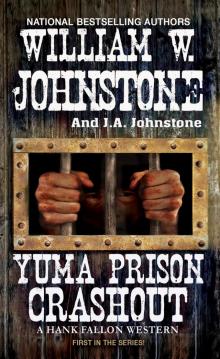
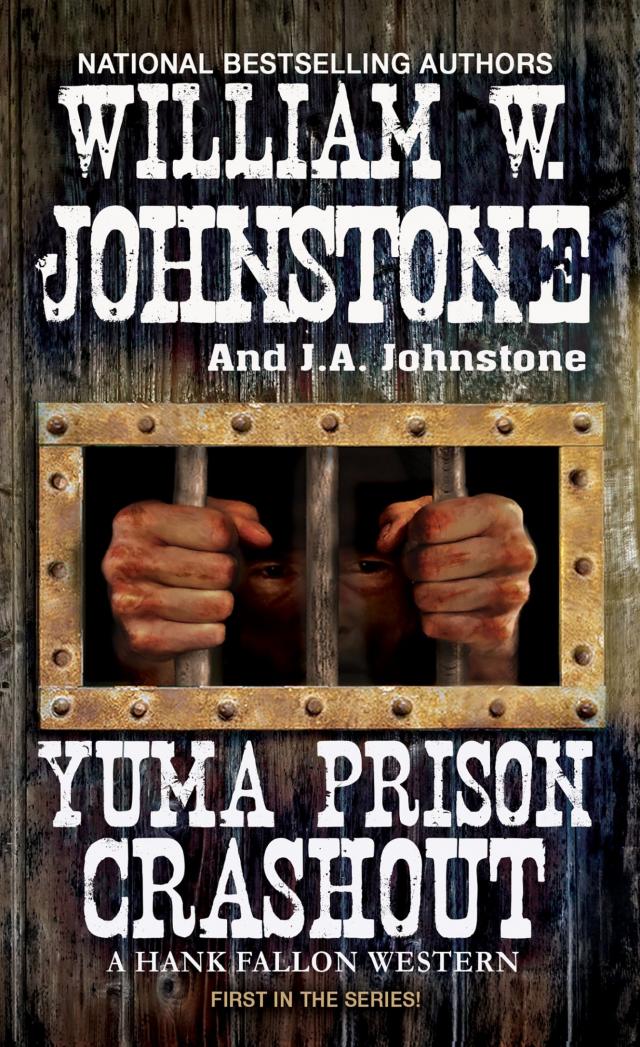
Yuma Prison Crashout, page 7


Fallon said. “So you give me the man who put me in prison. With proof.”
“Proof that will get him sent to prison. Not hearsay. Solid proof. Evidence that cannot be refuted. I am a detective.”
With a reputation that smells like a dead skunk, Fallon thought, but said merely: “Whom I’m supposed to trust.”
“Whom you have no choice but to trust.”
“For one job?”
“Well. Three jobs. Three crimes. One man is responsible for all three, you understand.”
Fallon was starting to sweat. He felt sick. He wanted to reach for that Scotch, but he made himself sit still. “What were the other two crimes?”
“You know what they were,” MacGregor said. “And you couldn’t be convicted of those because you were in prison when your wife and kid—”
“All right.” His voice thundered in the room, so sharp, so violent, MacGregor slid his chair back and spilled some of his precious Scotch whiskey.
The man recovered, slightly, though his voice faulted. “So by your declaration of ‘all right,’ you agree to the terms?”
“I want the terms in writing,” Fallon said.
“Not a chance. I am . . .” He grinned, then replaced the Scotch he had spilled from his glass.
“In writing. I walk out of here with those in my pocket, or I walk back to Joliet.”
“You can’t be serious. You can go home, your name cleared.”
“I am serious. I lost my wife and daughter. What the hell do I have to go home to?”
MacGregor sipped again and tried a different approach. “I can also arrange so that you are killed in Joliet. Not that I started that horrible riot. But I have convicts and guards who do my bidding. The riot, by the way, was unfortunate, but fortunate for me. Because of what you did, I was able to persuade officials, including Warden Cain and the governor and those on the board of parole, that . . .”
“In writing.”
MacGregor tried to stare him down again, couldn’t, and sighed, shaking his head.
“I can call your bluff. I have regular operatives in my employ. I can send one of them, as many as it takes, to help this agency earn the respect and power that the idiot Pinkerton enjoys now. While you’ll be in Joliet. With what?”
“Three hots and a cot,” Fallon said. “What else does a man need?”
For ten minutes, they stared at each other. No talking. No backing down. But one had to give, and Fallon knew that he was not bluffing. Eventually, Sean MacGregor came to the same realization.
Still, he did not speak, but he opened a drawer and pulled out paper. After dipping the pen in an inkwell, he began scribbling. He wrote. Fallon waited. Still, neither talked until MacGregor dropped the pen in its holder and slid the document toward Fallon. Then the Scot said, “Why don’t you blow it dry?”
Not responding, Fallon carefully turned the paper around with his fingers and read. He read it twice before sliding it back to MacGregor.
“You left out a number of important details. Try again. Be specific. Evidence that cannot be refuted.”
The paper was wadded up, tossed in the trash. MacGregor slid another in front of him and grabbed the pen.
“Write neatly,” Fallon said.
“Go to hell,” MacGregor responded.
Minutes later, the paper was slid again before Fallon. Again, he turned it around and read.
“You forgot to sign it. And date it.”
The man stiffened. “And I suppose you want it to be witnessed by a bloody priest, nun, schoolmarm, and Mrs. O’Leary’s cow, for Christ’s sake.”
“Just your signature. And today’s date.”
When that was done, Fallon asked for an envelope.
“Remember what I said about insolence, Fallon.”
He waved the paper off to the side, folded it evenly, stuck it into the envelope, which he folded and slid in his back pocket.
“Do we have a deal?” MacGregor asked.
“Yes.”
“Shall we shake?” He held out his hand.
“Isn’t our word good enough?”
“Very well. Allow me to bring in my son and my most reliable operatives.” MacGregor rose, moved across the dark room, and Fallon stood, watching, quickly dipping into the trash and pulling out the first draft of the “arrangement,” which he shoved into the same pocket. He walked to the window, pulled back the curtain, and stared down on the city of Chicago. It was, he decided, most impressive.
“Remember, Fallon,” MacGregor said, “screw up, fail me, and you’re back in Joliet. Violation of the terms of your parole. And anything else I might decide to add. And that riot will look like a picnic compared to what I’ll see you go through. And if you double-cross me, or try to, or even think about it . . . you’re dead. Dead, dead, dead.”
Fallon turned to see Timmons, Dan MacGregor, and Aaron Holderman back in the office. They gathered around the old man’s desk, and Fallon walked over to join them.
This time, Dan MacGregor took the lead.
“Fallon, have you ever heard of Monk Quinn?”
“I think I’ve read the name in a week- or month-old newspaper,” Fallon said.
“He’s a cold-blooded butcher. He’s also a murderer and has broken all of the Ten Commandments at least once, most of them at least twenty times.”
“All right.”
“Six years ago,” Dan MacGregor continued, and slid an old wanted dodger with Monk Quinn’s likeness sketched on it for Fallon to examine. “Quinn pulled off a giant score. Robbed a Southern Pacific train hauling two hundred thousand dollars in gold bullion.”
Fallon memorized the poster.
“You want me to find Quinn, or the gold?”
“Some of Pinkerton’s men found Quinn,” Dan MacGregor said, and Fallon looked up to catch the irritation on the older MacGregor’s face. “He has been in Yuma for the past four years.”
“And the gold?”
“That’s where Pinkerton and his fools screwed up,” the elder MacGregor bellowed. “They got the snake but not the snake’s eggs. There’s that much gold and Pinkerton can’t find it. He’s even given up. The mines in Nevada and the Southern Pacific aren’t happy. I want to make them happy . . . with me.”
Dan MacGregor hadn’t looked up during his father’s tirade. Now that the bellowing stopped, the young man said, “We believe it is buried just below the border in Mexico.”
Fallon tapped the poster. “This says Quinn led the party of six men in the holdup. What happened to the other five?”
“If you believe Quinn, he killed them below the border,” Dan MacGregor answered.
“Do you believe him?”
“It fits him to a T.”
The small Scotsman drank more whiskey and said, “The railroad has offered a twenty-five-thousand-dollar reward for the return of the bullion. Or ten percent of the amount found and returned. If you recover the gold or any part of it, I will pay you two percent.”
“Two?” Fallon grinned.
“You don’t care about gold. And you have a signed contract in your pocket that does not mention gold.”
Fallon nodded.
“The poster also says the robbery of the train was pulled off near the California border. So I assume Quinn is serving his sentence in Yuma.”
Everyone answered with a nod.
“Six years isn’t much of a sentence for robbing the railroad of that much money.”
“The pettifoggers in Arizona couldn’t convict him of that robbery,” Sean MacGregor said. “They convicted him of assault with intent to kill when a deputy sheriff around Nogales tried to arrest him.”
“So what do you want me to do? Go to Yuma and question him, see if I can’t sweet-talk him into telling me where he hid the gold? Or go to Nogales, see if I can somehow find out where he buried it on the Mexican side of the border? Or just ride across the border till I stumble across the bones of his partners that he killed? And why in hell did he bury the gold to begin with?”
“Ask him yourself,” Dan MacGregor said.
Fallon sighed. “So I am supposed to go to Yuma and question him.”
“No.” The old man grinned. “But you are to go to Yuma.”
Fallon started to catch on.
“Last year,” Dan MacGregor began, “we arranged to have one of our operatives arrive in Yuma, pretending to be a prisoner. We had the warden’s full cooperation. And our agent reported back some of what we have told you. About Mexico. About murdering his partners.”
“But Valdez wasn’t good enough,” the older MacGregor interrupted. “That’s what I get for listening to my son and hiring a greaser to be one of the American Detective Agency’s operatives.” He snorted, swore, and headed back to his bottle of Scotch, which was almost empty by now, and the man was still standing, not weaving, not slurring his words.
“What happened to Valdez?” Fallon asked. He had an idea, but he didn’t expect Dan MacGregor’s answer.
“He got bitten by a half-dozen or so rattlesnakes that found their way into Valdez’s cell while he was in solitary confinement.”
“You think I can manage any better than Valdez?” Fallon asked.
“The mistake we . . .” Dan MacGregor stopped suddenly, looked away from his father, and corrected himself. “The mistake Valdez made was trusting the warden and the guards. They knew he wasn’t a train robber. We think one of the guards tipped off Quinn. Quinn arranged, maybe with help from the guards, to have Valdez killed.”
“I’ve thought of something better for you, Fallon,” Sean MacGregor said, and drank a healthy swallow of his Scotch.
“Mr. Holderman will accompany you to Tucson, Arizona Territory. You will rob a store, a bank, or a stagecoach. That is to be left up to you. Mr. Holderman will arrest you. Trust me on one thing, Fallon. Justice in Arizona is swift. You’ll be tried, convicted, and sentenced to Yuma. The rest is up to you.”
Fallon shook his head.
“Valdez did report one thing to us before he died,” Dan MacGregor said. “Quinn’s planning to crash out of Yuma. We don’t know how. But he has some other felons with him. Most likely, he has lured them with the promise of some of that bullion he stole.”
“So I somehow join this prison break?”
“Exactly.”
Fallon nodded. He laughed. He said to himself: No wonder the American Detective Agency isn’t as well known as Pinkerton’s.
CHAPTER ELEVEN
“You mind telling me what you’re doing with my grip?” Aaron Holderman snapped the luggage shut and turned just as Harry Fallon shoved him into the seat as the train rumbled along the rails in the night.
“Sorry,” Fallon said with a smile as a few passengers looked at him and his traveling companion. “Train’s rocking more than I expected.” He held out his hand toward the detective and grinned at him, too, saying, “Slipped. That’s what happened. No hard feelings, pard.”
As Holderman took the proffered hand, Fallon sat beside him. He did not let go. He tightened the grip. Holderman grimaced.
The closest passengers were four seats back and on the opposite side of the aisle. Ahead of him, six seats up, a cavalry trooper and a drummer of farming implements snored loudly. A married couple sat ahead of them, but a two-year-old redheaded boy occupied their time. The conductor had gone on toward the smoking car.
“You think all I did in prison was wash laundry?” Fallon said in a hoarse whisper. “You want all the bones in your hand broken, or do you want to answer me?”
Tears welled in the brute’s eyes. “I’ll . . . tell.”
“Then tell.”
“Let . . . go . . . first.”
Fallon tightened the grip.
“Makin’ sure . . . you ain’t . . . got . . . no . . . gun.”
It was a lie, but Fallon had made his point. He released the hold. He didn’t like touching any part of the ruffian, anyway, and he had nothing to wipe his right hand on. “All right,” he said. Holderman began shaking his hand, trying to get the blood flowing again. Fallon figured the American Detective Agency operative was trying to find the contract, or explanation, Sean MacGregor had reluctantly written back in Chicago.
Fallon felt better. He looked better. Gone were the duds he had been given upon his release from Joliet. The American Detective Agency had bought Fallon black boots, gray-striped britches, black suspenders, a clean bib-front blue shirt, a red bandanna, gray vest, and black hat with a pinched crown. He had a change of clothes, extra pair of socks, change of underwear, and twenty-five dollars in spending money.
“So,” Fallon asked, “when do I get my gun?”
“Right before you do your job,” Holderman said. He now could rub his hand. “Not one second before.”
“A second.” Fallon smiled. “Be careful, Detective, or you might get arrested as my accomplice.”
That seemed to put the fear of God, or of Arizona law, in the fat man’s belly.
* * *
He had never been this far west, and had never seen Arizona.
When he stepped off the train in the early afternoon, he sucked in a deep breath and stepped toward the crowds.
“Huh.” Holderman spit on the dusty deck. “Figured they’d all be takin’ their siestas this time of day.”
Apparently, Aaron Holderman had never been in Arizona either.
Oh, Tucson was definitely Mexican. Dark-skinned, dark-haired men and women lined the streets, outnumbering the Americans by at least three-to-one. Fallon smelled scents of food that made his mouth water and his eyes burn. The town was practically all earth tones, adobe, the streets dusty, the buildings dusty, but the air was clean, crisp. He saw a saguaro cactus, which looked exactly like the drawings he had seen in magazines. Women in colorful dresses walked the streets. Horses of all kinds frolicked in a livery’s corral.
“Where to?” Fallon asked.
The big idiot shrugged. “I don’t know. Hotel I reckon.”
“Separate rooms,” Fallon said.
The man stared and shook his head.
“Do you really want to go to Yuma with me?”
The detective considered that.
“We’re the only two who got off the train here. So when I come to trial, no one will likely think to track down the conductor or crew or find some passengers and ask if they saw us. In fact, I can say I arrived on a stage. Or walked or rode in. Walked in after my horse was stolen. But we can’t be seen together. Right?”
Eventually, Holderman nodded.
“So . . . I’m going to walk down this boardwalk. You walk down the other side of the street. When I find a hotel I like, I’ll walk in and get a room. You wait. Then come in after I’ve walked outside. We’ll manage to have a few conversations like this. Not looking at one another. Pretending we don’t even know each other. You can leave your room unlocked, and I can sneak in, say, one in the morning. We’ll chat then.”
“No. You leave your room unlocked.”
“All right.” Fallon walked away.
As he suspected, the brute followed . . . on the same side of the street. But at least he did keep a discreet distance.
Seeing the church, Fallon got an idea. He stepped onto the street, let a burro hauling wood go by, and then walked to the gate, which he pushed open, stepping into the courtyard. A few minutes later, before he walked inside the church, he looked across the street. Aaron Holderman stood in front of a business, looking completely out of sorts.
Fallon held up a hand, spreading out his fingers and thumb. He flashed this three times. He mouthed the words, “Fifteen minutes.”
All Aaron Holderman did was blink.
Fallon went inside the church.
He saw, and smelled, the candles, and stopped to admire the crucifix and the paintings on the adobe wall. A woman with her hair covered sat on the front pew. Another knelt by the altar.
Fallon looked around until he found something that had to be where he needed to go. He moved to the back of the room and stepped into the box. He sat in the dark, waiting.
Eventually, something slid across from him. Fallon tried to figure out what he had to say.
“¿Español o Ingles?” the voice in the dark said.
“English.”
A long silence followed.
“Well.” The voice across from him was Spanish, old, but the tone did not sound impatient.
“Father,” Fallon said, “I need to ask you . . .”
“You do not ask me, my son, but to God, through Jesus, through his blessed mother.”
Fallon pressed his lips together.
“Well . . .”
He waited.
“Son, you are here to confess your sins and to ask what you must do for penance? Aren’t you?”
Maybe this wasn’t such a good idea. But at least, he had a priest who understood English.
“Father, I’m not Catholic.”
Another silence. He expected the slide to shut, or some nuns to come and drag him out and toss him into the street. Eventually, though, the priest asked, “What are you?”
Fallon had to think. “Methodist,” he answered.
This time, the priest wasted no time.
“Then say fifty Hail Marys, try to live better, and all will be forgiven.” The priest started to go.
“I need a favor. It’s a matter of life or death.”
“Perhaps,” the priest said, “you should see the local sheriff.”
“My name’s Harry Fallon. Most people call me Hank. I’m a former deputy United States marshal out of Arkansas. But for the past ten years, I’ve been in prison.”
He could hear the priest’s breathing. “Yuma is an unholy place.”
“I wasn’t in Yuma, Father, but I’m about to go there.”
The priest must have leaned forward. “You are not Catholic, but I must tell you that whatever you plan on doing, you must not do. If you wind up in Yuma, you will regret it for the rest of your life.”
“I have to go in, Father. To find a man. To get some information from him. It’s my job.”
“Your job?”
“Can I tell you? And can you not tell anyone until . . . until you have to?”
More silence. This time, Fallon thought the priest had slipped away and was seeking out some town law to get this crazy man out of his parish.