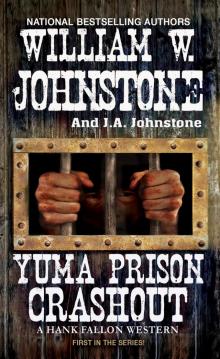
Yuma Prison Crashout, page 11


Renee liked that a lot. She even liked Ehrlander. Then she had a baby, and when Fallon held the tiny, pink-skinned six-pound loaf wrapped in swaddling cloth, Fallon felt his life change.
In the darkness of the solitary cell, Fallon could still see the baby—the baby he and Renee had made—in his arms. He feared he would drop her. No one had ever told him how to hold a baby. He didn’t know what to do. Horses? He knew about them. And dogs too. At least some dogs. But a six-pound bundle with eyes that barely opened and a set of lungs that could make Fallon’s ears split and unnerve him worse that a .44-40 slug tearing a hole through the crown of his hat.
Then, his world unraveled. He found himself charged with robbery. It could have been worse. A deputy marshal had been killed, but the solicitor said he didn’t have enough evidence to convict former deputy U.S. marshal Harry Fallon on that charge, and Judge Parker had, reluctantly, agreed. Oh, Renee stuck by Fallon all the way. So did Chris Ehrlander, his lawyer friend and mentor. Even a few deputies refused to believe that Harry Fallon would ever turn his back on the law. Rachel was too young to know what was going on, or why her father couldn’t rock her to sleep or tell her stories or let her sit on his belly and pretend that she was riding a horse.
He remembered Renee’s gasp and instant sobs when the verdict had been announced. He remembered her face, how pale, how dead it had appeared after Judge Parker, Fallon’s longtime ally, had delivered the sentence. And he remembered Chris Ehrlander and Renee, holding little Rachel in her arms while tears streamed down her face, promising that they would fight, fight, fight and not sleep until Fallon’s name had been cleared, the jury’s verdict overturned, and Parker’s sentence set aside.
Rachel was two years old when federal lawmen escorted Harry Fallon out of the dungeon that served as Fort Smith’s jail and put him on the northbound train for the federal hellhole in Joliet, Illinois.
Renee had told him that she’d wait, that she’d visit. He told her not to. He didn’t want her to have to travel to Illinois. He didn’t want to have to explain to Rachel all that had happened, and why her father was being treated like a . . . a . . . a . . . criminal.
Ten years. Ten long, inhumane, miserable years in Joliet. He had finally gotten out, with nothing to return to. Ten years, without ever seeing Renee’s face. Without ever seeing his daughter.
The photo had been taken in Van Buren when Rachel was six. Fallon had been in Joliet for four years. Renee mailed him the picture, and he had kept it with him or in his cell, looking at it when he needed to, when he had to. A few men in Joliet that he trusted had warned him not to do it, that family just meant heartaches for prisoners. They had reminded him of just how long the law had put him behind bars.
She was eight years old. Eight years old.
Eight years old. Renee would have been twenty-eight.
Too young.
To be dead.
He remembered Warden Cain summoning him to his office. He remembered hearing the words as the warden read the telegram. It was a cruel joke. Only it wasn’t a joke.
They said that Renee had killed her daughter. Distraught, the newspapers said. Heartbroken that her husband turned out to be nothing but a lowdown criminal. She couldn’t bear the shame of it all, the looks her neighbors gave her, and since the old Swiss watchmaker and repairer had died, she had no income. No way to make a living, even though Chris Ehrlander, the attorney, kept paying her rent and begging her to take a job in his office. She didn’t want pity. She abhorred charity.
She didn’t want to live.
So she had killed her daughter in her sleep. Then she had taken her husband’s revolver and shot herself in the heart.
As what the newspapers called a “lapsed” Catholic and a suicide, she was buried in Fort Smith’s potters’ field. Buried alongside the men who died in Judge Parker’s dungeon, or died at the hands of federal lawmen with no one to claim their bodies. The baby, sweet, young, pure Rachel was buried with her. Chris Ehrlander paid the expenses.
He had written a brief note to Fallon, but it had arrived after Cain read the telegram. It had arrived after Harry Fallon had died too.
He couldn’t really remember the two years that had passed since the deaths of his wife and child. He had hardened. His heart had never healed, never would heal. He had gone from an outstanding prisoner and turned into a hardcase. He acted like a man with nothing to live for. Because, Harry Fallon had figured, he had nothing to live for.
And yet sometimes he could see Renee’s face, and hear her voice, and something told him that Renee was not the type who could take her own life. Something told him that his wife had not committed suicide. But he was locked up in Joliet. Too far away to do anything.
Until Warden Cain had given him a parole. He knew he was supposed to stay in Illinois, and then Sean MacGregor had given him a way out. With a promise that Fallon’s name could be cleared. He didn’t care about the ten years of his life that had been ruined, but he could make everyone pay for Renee, for Rachel.
If he did a job or two for Sean MacGregor.
Was it worth it?
Fallon didn’t know. Did he care if he died right now? Sure. Because he had decided that someone had murdered his kid, his wife, and he wanted to make sure that son of a bitch or all of those bastards paid for it.
He tried not to think of that. He wanted to think of Rachel, of Renee, how beautiful both were. He wanted to remember how they sounded, their voices. He would try to guess at how Rachel had looked. Was she more like her mother? He sure hoped so. He wouldn’t want anyone saddled with his looks. Did she talk like a wild child from southern Missouri, or a French aristocrat? He would never know.
He blocked both his wife and his child out of his mind. He focused on the blackness. He tried to think about the job he had to do.
A sniggering voice echoed from above. “Company for you, Fulton.” Tensing, Fallon could not recognize the distorted voice until he realized that it came from above, bouncing down the shaft with the air. Footsteps moved away from the barred window at the top of the cell that allowed air to keep the prisoners confined in solitary alive. He knew who had shouted at him.
Then he heard the sound that put the fear of God into just about anyone.
An intense rattling, and he knew one thing. No Western man ever mistook the sound of a rattlesnake.
There was something else Fallon remembered. The Dark Cell had another nickname: the Snake Den.
Fallon stiffened. He did not move. He barely breathed. He heard something else, and then he knew for sure.
There were two rattlesnakes in the pitch-blackness with him.
CHAPTER SEVENTEEN
Fallon thought, Can snakes see in the dark?
The rattling, amplified in the cramped cage of iron, sounded like both snakes had been dropped in from the air hole off to Fallon’s right. They were shaking their tails in annoyance, not because they felt threatened, not because they were about to strike.
Keep telling yourself that, Hank.
He never considered himself scared of snakes. A kid exploring the woods near his house in Gads Hill got used to rattlesnakes. They didn’t bite out of aggression, except maybe when they were just coming out of that long winter’s nap or in September or October when they were about to go into hibernation. In a hot place like Yuma, rattlesnakes likely had no need to hibernate.
Fallon recalled the time that dog-and-pony circus came rolling into Van Buren. It was before he had married Renee, when they were courting, and she had wanted to go. Fallon had never cared much about circuses, and this one looked incredibly cheap, but he had paid the fifty cents admission and they had visited the man whose arms were crisscrossed with scars from snakebites.
He remembered everything so vividly.
* * *
The so-called snake doctor was willing to make side bets on a contest of bravery. He had two large jars, the bottoms filled with sand, a rattlesnake in each one.
“Put your hand against the glass, my brave friend,” the doctor had said. “If you can keep your hand against the glass when that Mojave strikes, then you’ll get your two bits back. If not, well, then I’ll be eating a steak supper tonight on your generosity.”
The muleskinner ahead of Fallon and Renee had taken the bet. The rattles sang out their warning, the snake raised its head high in anger, and, like a bullet coming out of a Colt’s barrel, struck. The wiry skinner’s bronzed hand recoiled and the man even let out a little cry.
“No shame, my good man,” the snake doctor said. “I’ve been eating steak dinners for a long, long time. But here . . . I’ll make this bet a little cheaper. Five cents. If you can keep your hand on this jar. Shouldn’t be any contest at all. Notice the snake’s head?”
Fallon and Renee had moved closer, curious, and the skinner had laughed. “Five cents? Why not fifty?”
The snake doctor had stepped back and pushed up his gray derby. “You mean double or nothing?”
“Or make it sporting,” the skinner said as he pulled out a Morgan dollar.
“Well, that’s a bit steep, sir. I mean, this snake’s blindfolded.”
Which was true. Renee had looked at Fallon, hoping he could explain, but Fallon had shrugged. A black band was wrapped across the snake’s eyes.
Fallon had whispered to Renee, “That’s how that doc has gotten bitten so many times. Putting blindfolds on rattlesnakes’ eyes.”
She had elbowed and shushed him.
“That a real blindfold?” the skinner asked, suddenly skeptical.
As proof, the snake doctor moved his hand up and down in front of the jar. The snake appeared not to notice.
“But a dollar?” the scarred man said. “That’s a lot of money. Fifty cents, perhaps?”
The skinner had laughed. “Where’s your sporting blood, mister?”
So the bet was confirmed at a dollar. The skinner put his hand against the glass, and grinned. The snake rattled. The head turned. The skinner’s face paled.
“I promise you, sir, that this Mojave rattler cannot see.”
The snake struck, its head bouncing off the glass, and the rattler coiled up again, threatening another strike, but the skinner’s hand was high over his head. The skinner looked at the hand in disbelief, then at the doc, and then his hand went for a knife sheathed in his boot top.
“Leave it be,” Fallon had said, and pushed back his jacket to reveal the six-point star on his vest.
“That ain’t no real blindfold,” the skinner protested.
“Take off the lid, then,” Fallon had said. “Take the blindfold off. Let’s see.”
The skinner had stopped his curse, tipped his hat at Renee, and stormed out of the tent. He left his money by the jar.
“I swear on a stack of Bibles, Marshal,” the snake doctor said, “that the snake is blindfolded. He cannot see a thing.”
* * *
Now, Fallon exhaled and slowly sat up. His hands raised to grab hold of the iron bars and, even slower, pulled himself to his feet. The rattlers still sang their warnings a good distance from him. He started inching his way from the nerve-numbing whirring, and he remembered what the snake doctor had told him all those years ago.
The snake in the second jar was indeed blindfolded, but snakes, the old doc had learned or at least made a good guess, didn’t see very well to begin with. Their secret sense, as cold-blooded critters, was detecting heat. Heat from warm-blooded animals like rats and rabbits and human beings. The Mojave had detected the heat from the muleskinner’s hand. That’s why the ugly-looking blindfolded serpent had struck.
He could see nothing, and would be as blind as those snakes until dawn began to creep in through the hole in the ceiling. The problem was: those rattlesnakes could detect his heat, and he couldn’t sense their coldness. He could only hear their warning.
He inched his way, feeling, trying to remember the layout of the ten-by-ten cell when he could see.
That snake doctor from the Amazing Sebastian J.C.C. Culpepper’s Traveling Exposition of Amazing Wonders and Freaks of Nature had told Fallon something else about rattlesnakes.
“There are different species of genera Crotalus and Sistrurus, part of the subfamily called Crotalinae. Eleven, all told, in our United States and territories, and I have been bitten by six of those. The timber, diamondbacks—both Eastern and Western—and, well, let’s just say that the meanest and the deadliest is this baby here that I have to blindfold every few days. Yes, Marshal, you never, ever want to be bitten by a Mojave rattlesnake.”
Fallon couldn’t see, of course, if the snakes the guards, most likely, had dropped into his cell were Mojaves of that muted green coloring or just your everyday Western diamondback variety. Right now, Fallon didn’t really care. He just wanted to get through this night without looking like the arms of that snake doctor, Horatio K. Jakes, from the Amazing Sebastian J.C.C. Culpepper’s Traveling Exposition of Amazing Wonders and Freaks of Nature.
The rattling stopped. Fallon drew in a deep breath. He imagined the snakes crawling across the hard floor, separating, slithering down the opposite walls, and hoping to catch Fallon in a venomous crossfire. A breeze reached him, and he raised his hands, finding the iron bars. He gripped as hard as he could, and pulled himself up.
Grimacing, drawing in a deep breath, he managed to swing his legs up, and then bent his knees and braced them against the hard bars. His muscles already strained. This, he decided, would be the most uncomfortable night he ever spent. But being struck repeatedly by a couple of rattlesnakes would feel worse than strained muscles and chaffed hands.
* * *
Every few minutes, Fallon unbent his knees and allowed his legs to dangle a foot or foot and a half off the cold, hard floor. He moved his hands to the other bar, just to keep his muscles from locking up. Mostly, he ground his teeth and breathed regularly, straining, aching, but refusing to drop to the ground.
He half-expected the brutal guard named Allan—Fallon had recognized the voice when the demon announced the present he was dropping into the cell—to return, to step on Fallon’s fingers until they broke, and send Fallon to join the reptiles waiting for him somewhere on the dark floor.
But Fallon was alone. He peered up into the darkness but saw nothing. It was like looking up a chimney. You saw only blackness.
He had no conception of how long he had hung from the bars, but gray light filtered down the shaft. Dawn came quickly to this desert, but not in the Snake Den. Yet there was just enough sunlight making its way into the Dark Cell for Fallon to find the two snakes. One lay still near the door. The other, awake, slid this way and that along the wall’s edge. Fallon kept his bleary eyes locked on the snake, which had to be a good two feet long. He couldn’t tell if it was a Mojave or any other species. Hell, he had never even known rattlers came in various kinds until that dog-and-pony show back in Arkansas.
As he slowly lowered his legs again, Fallon held his breath. The snake slithered. Fallon waited. He wondered if a snake would understand what it was passing under if it sensed heat of a mammal above him. He gnawed on his lower lip. His throat turned dryer than the sand in his cell. And Fallon released his hold on the bars.
He dropped, slamming his right boot heel onto the rattlesnake’s head. His knees buckled from the impact, from the pain of the night’s torment, and he almost toppled over. His left hand, however, reached out and slammed against the wall, and his fingers clasped on a bar. His right arm swung wildly and Harry Fallon kept his balance. The snake’s tail whipped frantically. Maybe it was dead. Fallon couldn’t tell. He remembered his father telling him at least a dozen times: “A snake don’t die till sundown. Don’t never get close to one. Known many a man to die from gettin’ bit by a dead rattler.”
Fallon turned, grabbed the tail just below the rattles with his right hand. He didn’t count how many. He slid his boot carefully a couple of inches below the snake’s triangular head, gripping it with his left hand.
Groaning, he made himself stand, then stepped and swung, releasing the snake’s head with his right hand but holding the tail with his left. The head smashed against the iron bars, and Fallon dropped the snake. It twitched from nerves, but Fallon saw the tear in the serpent’s head and neck. It was dead.
The other rattlesnake, however, was awake.
Fallon moved in a wide circle. The light sneaking down the shaft began to fade. It would be black again soon as the sun moved away from the hole in the ceiling. He picked up the dead snake and tossed it against the wall, watching it land near the living reptile, which reacted quickly, coming into a coil, and letting its tail sing another warning.
Fallon moved faster than the rattler, faster than he had ever moved. He pinned the snake’s head with his boot, crushing, driving, twisting against the iron floor as Fallon held his breath. Finally, he dispatched the snake against the metal just as he had killed the first one.
His heartbeat slowly steadied. He checked his hands and fingers to make sure no fang had punctured his skin. He thought about removing his prison shoes and prison socks to make sure he had not been bitten there either.
Darkness descended again as voices and footsteps sounded down the caliche tunnel that led to the Dark Cell, and Harry Fallon heard the grinding of the key in the lock of the outer door.
CHAPTER EIGHTEEN
When the outside door opened, the sunlight caused Fallon’s eyes to squeeze even tighter. He heard footsteps, and as he sat against the far wall of the cell, legs stretched out in front of him, hands holding the snakes on either side of his body, he made out the guard named Allan’s laughter.