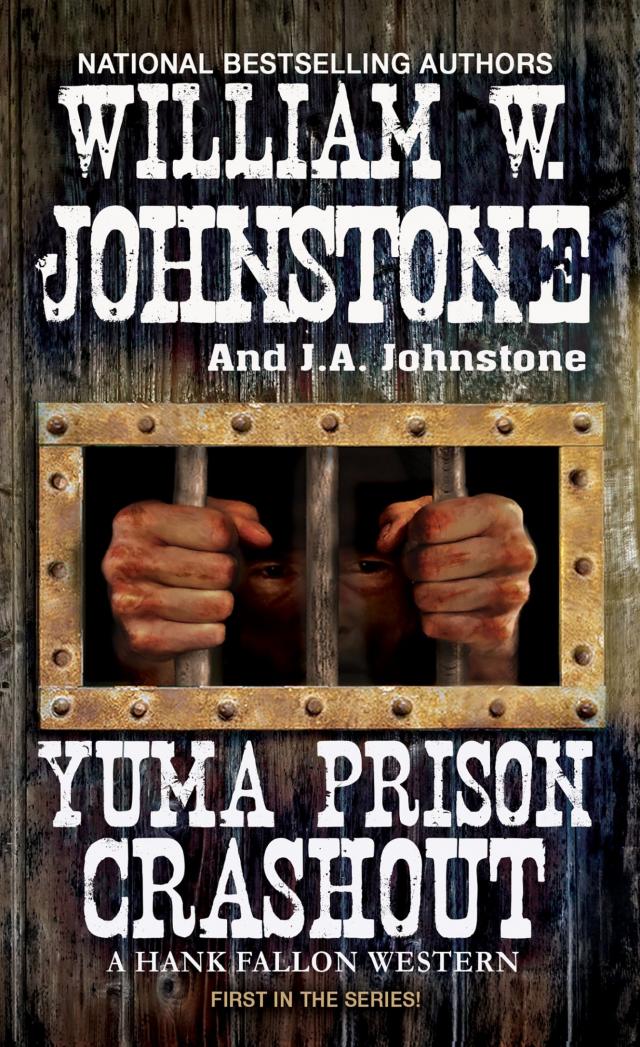
Yuma Prison Crashout, page 13


Fallon smiled. The grin hurt his face, and he rubbed his jaw. “How long has Pinky been here?” he asked once his jaw stopped hurting for the time being.
The old man shook his head. “Pinky’s been here so long he don’t remember. Feels like that, anyhow.” The rail-thin man straightened. “The first of July,” he said as his eyes brightened, “in the Year of Our Lord Eighteen Hundred and Seventy-six.”
Fallon remembered that year. He had started riding with Judge Parker in 1876. Fifteen years ago.
“That’s when ol’ Pinky came here. Yep, ol’ Pinky and six others.” His head bobbed with satisfaction. “Pinky helped build this place.”
Fallon nodded. “You did a damned fine job.”
The main guard tower had been built atop of the water supply, just beyond the whitewashed wall, in the northeast corner. Fallon could see the guard with the rifle, staring at the yard, enjoying the shade the roof provided. The guard had a rifle in his arms, and Fallon remembered the guard sitting in the booth in front of the sally port when Fallon first arrived at Yuma. He, too, was armed with a repeater, a .44-40 Winchester.
There were other towers, including one that must have been connected to the main one by a small walkway. The guard in that corner tower carried a Sharps rifle with a long brass telescopic scope. A man like that with a gun like that could see and shoot for a far distance. He saw the other corner posts atop the whitewashed walls, and even a few guards walking along the tops of the walls. More guards here than there had been at Joliet.
Moving to the wall nearest him, Fallon studied the southeast guard tower across the compound. Moving to the wall closest him, he studied the guard there. And the gun. This was a little different. The guard didn’t have a Winchester or a Sharps. It was something else.
Finally, Fallon realized what it was.
“Gatling gun,” he said to himself, but Pinky had heard.
“Not exactly,” Pinky said. “It’s what they call a Lowell battery gun. Better, we’re told, than ’em ol’ Gatlin’s.”
Fallon laughed. He had read all about the Lowell in some military journal that wound up in the Joliet library. The Lowell, if he remembered correctly, could fire six hundred rounds in a minute. Accuracy almost perfect up to one thousand feet. With a horizontal sweep of ninety feet.
If there was a blind spot at Yuma Territorial Prison, Harry Fallon couldn’t find it.
He lifted his boot to scrape the heel on the wall.
“It ain’t adobe,” Pinky told him.
Fallon lowered his foot and looked at the old man.
“Solid rock,” the prisoner who had helped build this prison said. “At least on the foundation. After that, it’s adobe bricks all the way up.”
Fallon looked up. Eighteen feet high, he guessed. Nothing to grip.
“How thick?” he asked.
“Close to eight down here,” Pinky said. “Up top . . .” The old-timer shrugged. “Five or around there.”
He heard the lonesome whistle of a train, and watched the black smoke rising above the high adobe wall off to the west. He could even hear the clickety-clack of the iron wheels on iron rails. The tracks of the Southern Pacific ran close to the outer walls, but Fallon knew that already. His escorts from Tucson had led him off the train, into a wagon, and just around the corner to the prison.
“So don’t get no notions ’bout gettin’ out of Yuma, sonny,” Pinky said. “We built it good.”
Fallon chuckled. “Yeah, you did a fine job, Pinky.”
“Too fine.” Pinky let out a sigh. “Ol’ Pinky did too fine a job buildin’ this prison.” The old man pointed at the smoke as the train moved toward the nearby Colorado River. “I think they put the tracks this close just to torture everyone in here.”
Fallon rubbed his jaw. “Allan does enough torturing,” he said.
Pinky laughed. “Ain’t that the truth!”
“How about the guards?” Fallon asked.
“What about ’em?” Pinky said with a good bit of suspicion. “You’ve met the worst of the lot.”
Meaning, Fallon figured, the man with the staff and the iron fists, Allan.
“How much money do they make?”
“Good wages,” Pinky said. “Seventy-five a month. Lots of folks want the job just for that reason. Jobs that pay that kind of money ain’t common in this patch of Hades.”
“So bribing them’s not much of an option.”
Pinky shrugged. “Depends on the guard. Most of ’em be honest. Then you get the bad apples. Thing is, you can’t trust the bad apples.”
Like Allan, Fallon knew.
“All right. What else can you show me that I need to know about Yuma?”
They walked around the compound.
The hospital was new, five, six, no more than seven years old. Fallon knew the superintendent was trying to get funds from the territorial government to build cells for the women prisoners, and there was talk about adding a library for inmates one of these years.
Fallon figured, from what he had determined from Superintendent Gruber, that if the territory turned funds over to Gruber for women’s cells and a library, well, they might get another cell dug into the caliche hill and maybe a few newspapers and a Bible for prisoners to read in the hospital. The rest of the money would line Gruber’s pockets.
The breeze blew off the Colorado River, up over what the residents of Yuma called Prison Hill, and over the whitewashed walls.
Pinky laughed. “The story goes that the breeze from the river is always cool. Makes life almost pleasant here in prison.”
Fallon looked at the old man. “That wind’s cool?” he asked sarcastically.
“That’s the story,” Pinky said. “You’ve seen enough?”
“For now,” Fallon replied. “I’m hungry.”
“Good. So am I. Let’s eat. Then we’ll have to report for work detail. After that, I’m sure Allan will figure out where you’re bunking for the next two years.”
“What work?” Fallon asked.
Pinky shrugged. “Cooking. Digging at the quarry. The good ones might get out to make shoes or canes, stuff like that.”
“What do you do?” Fallon asked.
“Me?” Pinky grinned. “I try to stay alive. In Yuma, that can be a hard, hard job.”
CHAPTER TWENTY
The guard opened the door to the cell, and grinned at Fallon. “Welcome home,” Allan said as his smile turned into a sneer.
Fallon stopped at the iron-barred door. “No snakes?” he said.
“I wouldn’t say that,” Allan answered. “Get in.”
Fallon slid through the narrow opening and stepped to his right as Pinky followed. The door slammed shut, and Allan locked the door, laughed, and walked away.
The first thing Fallon did was crush a black widow with the toe of his boot. It was, he figured, better than a couple of rattlesnakes.
The slop bucket in the corner was filled to the point that one more bowel or bladder movement would have the contents seeping over the top. Narrow bunks crisscrossed the room in pairs, and Pinky had already taken the top one nearest the door. A cell this size could hold two prisoners in what no one would call comfortable but at least they’d be tolerable. This one had beds for six. Two bunks were empty, however.
He saw a few beetles—no cockroaches like they had to feed the rats at Joliet—but no more spiders. He didn’t see any scorpions either.
“Here’s your bunk, Fulton,” Pinky said, and pointed to the bedding to Fallon’s right. Bed? Well, there was one sheet over some straw on the floor. Bedbugs? Fallon figured he’d learn if he had any of those paying rent when he woke up the next morning.
Pinky and the two other top bunks at least had a mattress, which might have been stuffed with straw but at least the canvas would keep the straw from spreading, or being covered with human excrement.
“Boys,” Pinky said, “meet the fresh fish, our new bunkie.”
No one paid any attention.
“He’s the fish who tried to make Allan eat the rattlers he tossed into the Dark Cell last night.”
Now, the men—all but one—raised their heads.
Pinky made the introductions.
“Hank Fulton, this be the Preacher.”
Preacher Lang needed no introduction. Fallon had seen the wanted posters on him in Arkansas, in Kansas, in Texas. He must have been captured in Arizona while Fallon was serving his sentence in Joliet. The long dark hair was gone, cropped short, but the mustache and beard remained thick, brown with some white streaks showing up. His nose was long and crooked, and a deep scar ran from his left eyebrow and across his cheek to the ear. His eyes were blacker than Miss Adler’s hair, though probably not as black as Preacher Lang’s soul.
If you believed the wanted posters Fallon had seen many years ago, Preacher Lang—first name unknown—had killed twelve women and fifteen men. Fallon wondered who was worse, and who was crazier, the Preacher . . . or the Deacon from Joliet? Well, the Deacon was now dead so . . .
“He’s doin’ fifteen years for manslaughter.”
“Woman-slaughter,” said the Mexican in the bottom bunk next to Fallon.
“She was no woman,” the Preacher said. “She was a demon, a sorceress, the left hand of Satan.”
“Left?” the Mexican asked, and laughed.
“Yes. For I am the right. The right hand of our God Jehovah. The right hand of Lucifer as well.”
Preacher Lang, Fallon decided, was as crazy as all those wanted posters said.
“New Mexico Territory wants the Preacher too,” Pinky said. “So does six or seven other states. But Arizona got him first, and they ain’t doin’ no extraditin’ till he finishes his sentence here.”
“That’ll be the day,” Preacher Lang said.
“Shut up!” the Mexican said.
Preacher Lang let out a muffled chuckle, nodded at Fallon, and lowered his head while lifting the Bible he held with long fingers, the nails unsightly and desperately needing a trim.
Pinky looked down at the Mexican, who grinned and made a mocking wave of his right hand at Fallon. “Señor, I am Yaqui Mendoza. At your service. For a price that you might not be able to afford.” He read no book. He just sank his head on the clasped hands and stared at the ceiling. Fallon glanced to see what held the man’s fascination, but saw only the brownish dirt and stone.
“Mendoza has only thirty days left,” Pinky said. “Then he gets out.”
“Lucky.”
The fourth man laughed. Mendoza cursed and turned his head away from the ceiling. “You laugh again, señor, and you will awaken to find a tarantula in your mouth tonight.”
“Is that supposed to scare me, Mex?” The man laughed again.
“He gets out,” Pinky explained, “when they hang him for killing two men in Flagstaff.”
“They were not men,” Mendoza said. “They were pigs.”
Fallon waited for Pinky to introduce the last of the inmates, but instead the old man nodded at the bunk and said, “Might as well lie down and rest. You gots to be sore after the beatin’ you took, and I doubt if you slept real good last night in the Dark Cell.”
Fallon waited, and studied the last man.
“No need to get to know me, boy,” the man said in a rich Southern drawl. “They hang me in six days.”
* * *
Pinky and the Mexican snored. The Preacher talked fire and brimstone in his sleep. The doomed man whose name Fallon did not know twisted and turned and kicked, raining straw and dust down toward the floor. Somewhere beyond the walls, coyotes sang.
A train whistle blew in the night, and Fallon agreed. The railroad must have laid its tracks close to the prison walls to torture the inmates.
* * *
He heard the footsteps and smelled the cigar smoke before the door to the cell rattled and swung open. Fallon felt the coolness of the desert night reach him. A man coughed and said, “Up, Fulton. The boss man wants to see you.”
Fallon opened his eyes and sat up. He knew Pinky and the other inmates were awake, even though the Preacher pretended to be snoring. He knew none would say a word, or even lift their heads off what passed for pillows. Fallon saw the lantern that Allan held at his side.
It had to be two in the morning. Fallon did not think Superintendent Gruber wanted to see anyone at this hour.
“Either you come, bucko, or I drag you out. Fact is, I’d rather drag you. So give me a reason.”
Fallon pulled on his shoes and found his hat. He rose, dodging the other bunks and arms, and careful not to come close to the slop bucket, slid through the open door, which slammed shut and was locked by the guard named Allan.
“This way,” Allan said, and nodded.
The superintendent’s home was, naturally, outside the whitewashed walls, through the sally port and close to the Colorado River. Fallon had seen that on his way inside the Hell Hole. Allan was leading him the opposite direction, to the south wall. Back to the Snake Den? Fallon wondered, but the guard behind him with the lantern grunted, “Right.” Fallon moved east, between the wall and the line of other rock-walled cells. Fallon glanced at the guard towers. He saw no signs of movement, no glows from cigarettes. There could be guards up there, watching, but Fallon didn’t think so. Allan had likely arranged that both guards take a break for a spell.
Yellow light shone through the cell at the end of this block. Fallon walked, listening, staring at the shadows that danced on the ground just outside of the cell with light. On the far wall stood the hill of caliche.
Something else was coming out of that cell at the end of the block. Music. Fallon tried to remember when he had heard music inside a prison except during Sunday church services or when visitors were brought in to serenade some of the less vicious convicts on Easter, Christmas, or Thanksgiving. No one was singing, though over the wind Fallon thought he heard someone humming inside the cell.
Allan said, “Stop.”
Fallon stood in front of the light-filled cell. Not only light, but music—bells and tines—playing some tune from a cylinder music box. The song slowed, died, but the light kept flaring. The door to the cell opened.
“Inside, Fulton,” Allan ordered.
Fallon saw the figure of a man in prison clothes bending over a table, fumbling with the cylinder while puffing on a fat cigar. Fallon saw the greasy black hair, long, past the shirt’s collar. His shoes were not what any of the other prisoners wore, but fancy, hand-tooled black boots, gleaming from wax, with long mule-ear pulls that were inlaid with red and gold crosses. The man gave up on the box and turned around. He removed the cigar and studied Fallon up and down, and then he spoke to Allan.
“Wait here. This won’t take long.”
Behind Fallon, the guard grunted.
The prisoner asked, “Do you know who I am?”
CHAPTER TWENTY-ONE
Monk Quinn almost looked like a Mexican with that long dark hair and a face bronzed a deep brown, yet his accent revealed more than a touch of Ireland and his eyes were a deep, dark green, practically jade in color. His shirt and pants were Yuma Territorial Prison regulation, only his, like many other inmates Fallon had seen, featured gray and white stripes rather than yellow and black. As far as Fallon could tell, there was no rhyme or reason as to who got what color. It was probably just random.
“You’re the Boss Man,” Fallon said, and hooked his thumb back at Allan. “At least, that’s what he calls you.”
The man had no reaction. Slowly, he removed his cigar and pitched it into the slop bucket in the corner. His bucket, from the looks of things, got emptied on a regular basis. “I’m Moses Quinn,” the man said. He pointed at Fallon and grinned. “Call me Monk. And you’re the man who isn’t afraid of rattlesnakes.”
Fallon wet his lips, trying to figure out why he was here. Sure, he wanted to get in close with Quinn. That’s why he had come to Yuma, but this seemed to be happening too fast, and he couldn’t figure out why he would be brought to Quinn’s cell in the middle of the night after being in Yuma for all of two days.
“How do you figure I’m not afraid of snakes?” he asked.
“You killed two.”
Quinn, Fallon thought, looked sort of like a serpent himself. Long, lean, his hair slicked with grease, and he even spoke with a lisp.
With a shrug, Fallon said, “It seemed like the thing to do.”
“It was. Otherwise you’d be with the Killing Sawbones getting patched up or, more than likely, you’d be on your way beyond these walls”—his smile even reminded Fallon of a serpent—“to spend eternity in a shabby box in the hard ground with a bunch of rocks piled over your hole to keep the coyotes from getting at you.”
“Maybe I got lucky.”
“Maybe. But to kill two rattlesnakes in the Snake Den tells me that you know how to handle yourself with snakes.”
Suddenly, Fallon knew. Monk Quinn was scared of rattlesnakes. From what all Fallon had learned about the hardcase, Monk Quinn feared nothing, but that was a façade. Now Fallon knew how to play this game, this cat-and-mouse session.
“When a body gets sent to Yuma Territorial Prison,” Fallon said, “he has to do a few things like staying alive. I’ve killed snakes before. I’ll kill them again. I’m not afraid of rattlesnakes.”
“Nor am I,” Quinn sang out, too loudly, too boastful. Yes, this man was frightened to death of rattlesnakes, and the desert around here—and into Mexico—was filled with rattlers. Fallon had to guess that Monk Quinn had deposited that stolen gold in a den of rattlesnakes. Which was a pretty safe place to leave a fortune.
“There’s nothing to fear as long as you respect them, and know that they can kill you if you don’t kill them first.”
“Like most people I know,” Quinn said.
“I killed those two snakes,” Fallon said, “because I want to get out of the Hell Hole.”
“Don’t we all?” Quinn turned back to the music box. “But how did you manage it? In the dark? In the Snake Den?”