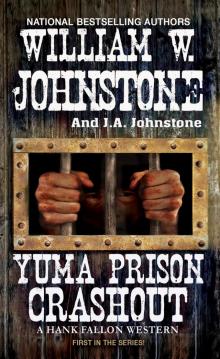
Yuma Prison Crashout, page 23


“¿Hablas Español?” the Rurale officer asked.
“Sí,” Yaqui Mendoza answered.
The officer sighed. “Bueno.” He grinned. He asked a question.
Mendoza translated. “He asks if we come from the north.”
“Tell him yes,” Quinn said. “Tell him we are meeting friends in Valle Verde.”
Spanish resumed. Mendoza said, “He asks about the buzzards in the air near what would be the farm of Luis and Maria de la Rosa.”
“Tell him we have seen no buzzards.”
Mendoza grinned and turned to the Rurale. He answered.
The lieutenant frowned. He spoke in rapid Spanish, and pointed at the faint outline of the carrion birds that could just be made out in the blue sky.
“Oh,” Quinn said. “Those. Tell him the ugly birds are waiting for him.”
As soon as Yaqui Mendoza had finished, Monk Quinn blew the soldier out of the saddle.
That’s when Fallon slipped from his horse, using the bay as a shield. He thought about pulling the revolver from out of his shirt, but knew better. There was nothing he could do. He wrapped the reins to the bay around his right hand and pulled hard on the lead rope that held the four mules. He looked back at Gloria Adler, and saw she was shielding herself with her horse.
Guns roared. Fallon saw Allan working the Winchester, shooting from the saddle, his face masked by the white smoke rising all around him.
Horses screamed. Fallon knelt, the water of the stream soaking his pants. He watched the slaughter.
Four horses were down. Two others galloped away, but Captain Allan’s gun roared twice and those horses somersaulted and lay still. Bile crept into Fallon’s throat. The captain was killing all of the horses, although Mendoza had shot the one in the middle of the stream, and it lay atop the dead body of the young lieutenant.
Killing the horses, Fallon knew, so they would not ride back to the village.
He spit the taste of gall out of his mouth.
Two soldiers had managed to get out of their saddles and find their weapons just before bullets from Allan’s Winchester killed their horses. One tried to work the bolt on his rifle, but two bullets from Morgan Maynard’s gun dropped him to his knees and the rifle, unfired, fell into the wet sand. The man made the sign of the cross and fell facedown in the shallow water.
The other man fired a shot, but he rushed it, and Yaqui Mendoza put two rounds into his chest, twisting him to his knees and turning him around. A geyser of blood erupted from the center of his back, and the man fell on his face just a few yards from the other man.
A white horse splashed into the water. It was the scout, and he had drawn his revolver and put the reins into his teeth. His gun belched flame and smoke, but Monk Quinn casually drew his revolver and put a bullet between the man’s eyes. The gun flew out of his hand and splashed in the water while he flipped over the back of the horse and landed in the stream. The horse kept galloping, but Quinn turned, using his other arm as a resting spot for his gun. The revolver blasted again, and the magnificent white horse screamed and fell into the water. Monk Quinn rode closer to it, ignoring the gunfire all around him, cocked his pistol, and shot the horse in the head. It shuddered and its bloody head sank beneath the frothy water.
Two others, their horses shot down, were running toward the bluff. Morgan Maynard spurred his mount and ran them down, shooting one in the back, and knocking the other into the dirt with his horse. He wheeled the horse around, but did not fire the pistol. He rode up and made his horse rear. The Mexican looked up and screamed as the hooves came down, crushing him. Maynard pulled hard on the reins. The horse reared again, came down. And again. And again.
Then Maynard cocked his revolver and shot the first man in the back of the head.
By then, the others were dead, or dying. Fallon rose and leaned against the saddle for support. He looked at Gloria, who was slowly standing, her face paling at the sight of this carnage, this slaughter, this massacre. Still in the saddle on the banks of the stream, Doc Fowler was desperately trying to get the bottle of liquor out of his pocket.
Preacher Lang had crossed the stream and was kneeling by a mortally wounded Rurale, who did not appear to be out of his middle teens.
“I don’t know how to pray in Mex, boy,” the killer said. “But I know that our Lord knows how to speak all languages. And so does this Remington.” He laid the barrel of the derringer on the boy’s nose and pulled the trigger. Then, Preacher Lang laughed.
“That should take care of the Rurales,” Monk Quinn said. He waved the men over. “Cross the stream. Now.”
When they had gathered on the other bank, Monk Quinn was on the ground. He found a kepi and tossed it to Fallon.
“See if this one will fit you, Fallon. You can’t ride around in the desert without protecting your head. And this one will even protect your neck too.”
Fallon reluctantly put the hat on. To his disgust, it fit perfectly.
“How about that?” Monk Quinn laughed. “I will deduct the price of the hat from your share of my gold.” He turned. “Doctor Fowler, what on earth are you doing?”
“I thought . . .” The doctor had dismounted and was trying desperately to untie the grip behind his cantle. “I thought . . . I should . . . these men . . .”
“Are beyond need of our services, but that’s most commendable. Here.” He reached into his saddlebag and withdrew a small bottle of gin. “Maybe this will help you live up to your Hippocratic oath.”
The bottle was flipped. Doc Fowler dropped it, but the glass did not break and the cork did not pop out. He bent quickly, snatched it up, and drank greedily.
“You . . .” Gloria Adler said, staring with malevolent eyes at Monk Quinn. “You . . .” She looked at Mendoza with eyes just as hateful. “You butchered that family back there. To bring out these poor soldiers. So you could kill them too.”
“Yes, my sweet little thing,” Quinn said, and he climbed back into the saddle. “That is exactly what I have done. And now there is nothing standing between me and my gold. Vamanos.”
CHAPTER THIRTY-SIX
They traveled hard and fast. The country turned rougher, drier, more brutal, and the kepi did its job, even though Fallon detested wearing it. The doctor kept drinking. No one spoke, and the coats of the horses soon slickened and shone with sweat.
In the heat of the day, they rested in what passed for shade.
“How far . . . ?” Preacher Lang paused to pour water into his parched throat from the canteen. “How far . . . to Valle Verde?”
“If we ride hard,” Monk Quinn said, “tomorrow.”
“Ride hard?” Lang drank again. “What in heaven’s name do you think we’ve been doin’?”
“You are soft,” Quinn said. “We have rested enough. We must move.”
“Don’t be a fool, Quinn!” Morgan Maynard shouted. “It’s stupid to push these horses at this time of day. It’s too hot. Nobody rides through the desert when the sun’s like this.”
“Exactly,” Quinn said. “So no one will see us. Vamanos.”
* * *
That night, they made camp in an arroyo, more dip than a canyon, nothing more than a depression, but it dropped them below the skyline. No one would see them unless they fell on top of them.
“Loosen your saddles,” Quinn said. “Do not take them off.”
“These horses are almost played out,” Maynard countered.
“And if someone by chance happens upon us, Indians or Rurales or scalp hunters? Do you want to take time to saddle your horse? Then, by all means, take off the saddle. Roll yourself in your blankets. Why don’t you even light a fire and make it a big one? No wonder you were in Yuma. You must have been easy to catch.”
“You were in Yuma, too, Quinn,” the gunman said icily.
“Yes. But only after I killed one of the lawdogs who tried to arrest me.” He laughed.
Morgan Maynard did not unsaddle his horse.
They ate jerky and hardtack, which they washed down with hot water from their canteens. They did not take off their boots. They did not roll out their bedrolls. They leaned against the sandy wall of the arroyo and listened to the coyotes yip and howl. The wind blew across the arroyo. The air turned cold.
Gloria Adler came from her horse and sat next to Fallon.
They sat in silence until Fallon asked, “How’s Fowler?”
“Passed out,” she said. “Sweating.”
“Too much liquor,” he said. “Dehydrated. He needs water.”
Her response was a haggard cough.
“You could use some water too,” he said.
“I had some.”
“Not enough.”
“Do you know how far it is to Valle Verde?” she asked.
“Just what Quinn told Maynard. Be there tomorrow, if we ride hard.”
She turned to him, and he saw her face. It was a hard face, filled with years of hatred, abuse, and injustice.
“This is my first trip to Mexico,” he said.
“And your last,” she said.
He shrugged. “Maybe. Maybe not.” Fallon found his canteen. The cork popped out.
“I would save your water,” she told him. “We will not be at Valle Verde tomorrow. Maybe the day after, if God watches over us. Maybe two days. And there is no water between here and Valley Verde.”
He looked at the canteen, his throat turning more parched the longer he stared at the opening. The cork was returned, and he slammed it in tighter with the palm of his hand.
“He wants to kill us,” Gloria said. “Kill us in the desert.”
Fallon shook his head. “No. He needs the mules to pack out that bullion. He just wants to wear us out. Break us a little. Once he has the gold, then he can kill us.”
She studied him, and must have decided that he knew what he was saying. She looked over at the sleeping doctor. She started to spit, but then swallowed it instead.
“Why did he bring Fowler?” she asked.
His eyes found her again. Fowler, she had called him, this time. Not . . . Jerome.
“Snakes,” Fallon answered.
Again, she looked at him.
Fallon explained. “He’s scared to death of rattlesnakes. Doc’s grip is filled with remedies and medicines. I’m not sure they all work, but that’s most of what he’s carrying—other than the booze he needs to get through each day.”
Her head shook. “That seems like a lot of medicine for what few we have with us.”
He nodded. “Could be.” He crossed his legs at the ankles. “Or it could be a lot of snakes.”
They listened to the coyotes howling now, their voices echoing across the desert, to be answered by others. It felt as though coyotes surrounded them.
“A pit,” Gloria Adler said softly, thinking out loud.
“That would be my guess,” Fallon said. “Drop the bullion into a snake den. No one would go exploring down there. It’s like he has his own guards, only he doesn’t have to pay them anything.”
She said, “Quinn needs us to get the gold out.”
Again, Fallon nodded. “He’s too scared of the snakes to do that himself.”
“That’s why he brought you along.”
He leaned his head back and laughed. “Because of nothing but luck. I happened to kill two rattlesnakes in the Dark Cell in Yuma. He decided that I must be some kind of snake charmer. A witch doctor. Something along those lines. I’m not exactly sure. He . . .” Fallon chuckled again.
It had been his job, his assignment for the American Detective Agency, to sidle up to Monk Quinn, get on his good side, get picked to take part in the crashout from Yuma Territorial Prison. And he had done it, done exactly what he was supposed to do, but not out of any skill, not because he was some exceptional undercover operative or detective. Because he had lucked his way out and managed to kill two rattlesnakes. Because all those years in Joliet had taught him how to be tough, hard, uncompromising.
Inhuman. Devoid of feeling.
“Fallon,” she whispered.
He started to look at her, but made himself focus on the night sky, so clear, so peaceful, so very far from this desert floor and these people with him.
“Hank,” he said. “The name’s Harry. Most folks call me Hank.”
“Hank.” She tested the word. He heard Renee’s voice and he closed his eyes, still refusing to look at her. If he looked at her, he thought, he might become human again. At least whole. But for the job he had to do, if he let himself feel again, feel anything, that might get him—and Gloria Adler—killed.
The silence stretched on. Gloria, though, did not turn away from him. He heard her voice again.
“I wish I’d known you . . . a long time ago,” she said.
He closed his eyes and let out a heavy sigh. Finally, his lips parted and through his parched throat and cracked lips he spoke to her.
“A long time ago,” he said softly, “I was a different man.”
To himself, he thought, A long time ago, I was at least a man. A human being. And not an animal.
* * *
When the sun appeared to be at about the ten-o’clock position and Quinn stopped to rest the horses, Fallon swung out of the saddle. He removed the kepi, wiped his head with his sleeve, and used the cotton cloth that protected his neck to wipe his face. Most people were drinking water, guzzling it, but Fallon made himself take only a quick sip. More than he had swallowed he poured into his kepi, and this he held under the horse’s nose. The bay drank thirstily, and when the water was gone, Fallon donned the cap again and returned the canteen.
He bent to his knees and found a pebble, didn’t like that one, tossed it away, and discovered another. He put it in his mouth, and picked up two more. These he brought to Gloria Adler.
She stared at the one he held between thumb and forefinger.
“Put it under your tongue,” he told her. “It’ll help make saliva. Keep your mouth wet. Moisture. You’ll need it.”
She took it, and when her fingers made contact with his skin, he felt an electrical spark. He tried to ignore that. She had the pebble, and her chapped lips parted as she stuck the piece of rock into her mouth. She said nothing. Speaking exhausted what little energy anyone had.
Fallon smiled, or tried to, and moved to the doctor.
“Doc?” His voice sounded raw, like the rattle of death in a dying man.
The doctor, his face an odd color, stared. He blinked. Maybe the doctor did not even recognize him. Fallon held up the pebble.
“Put this in your mouth.”
“Is it a pill?” Fowler asked.
“Something like that, Doc. Just don’t swallow it. Leave it in your mouth. It’ll help with spit. Keep your throat moist. Keep you alive.”
“Who cares to live?” The doc let out a raspy cough, but he did take the pebble. He put it in his mouth and made a face.
“It doesn’t taste like bourbon.” This time, Doc Fowler managed to laugh just slightly, but that laugh, that joke, brought a bit of life back into his face.
“Kind of like gin, Doc,” Fallon said. He patted the man’s thigh, pulled the kepi down, and walked back to his horse.
“How”—Preacher Lang rasped—“much farther . . . till . . . Valle . . . Verde?”
“Tomorrow,” Monk Quinn said, “if we ride hard.”
“You said . . .” Preacher weaved in the saddle, but grabbed the horn and somehow managed to stay on the back of the horse. “Said . . . said . . . that . . . yes- . . . yes- . . . yesterday.”
Quinn was already riding. “The sun’s getting to you, Preacher. You don’t know what you’re saying. Let’s go. Vamanos. Vamanos. That gold’s waiting for us all.”
* * *
Through his cotton shirt, the sun seemed to bake the. 38-caliber Colt Lightning so much that his right side burned from the metal. Yet as he looked around, Fallon realized the other men must have been in worse condition than he was. The pebble in his mouth helped, and, he had to admit, so did the dead Rurale’s kepi that he now wore. His bay horse was holding out better than at least Preacher Lang’s and Morgan Maynard’s mounts. Lang appeared about ready to fall out of the saddle. Doctor Fowler looked even worse.
Across the desert, Fallon saw nothing that resembled a town, or even a village. Certainly nothing that would have made him suspect they were riding into a place called Valle Verde, or Green Valley. The only colors Fallon saw were shades of tan and brown and white and beige. Even the sky no longer looked blue, just white, and hot, and ugly.
When they camped that night, they were still in the desert. Lang’s canteen was empty; Morgan Maynard had only a few drops left. Doc Fowler had consumed the last of his liquor and was trembling underneath his bedroll.
“This is . . . crazy . . .” Preacher Lang said, half-delirious. “We can’t . . . go on . . . like . . . this . . .”
Monk Quinn was checking on the pack mules tied to the picket line. He walked back into camp and nodded at Fallon.
“You know mules, my friend. You have taken good care of them.”
Fallon shrugged. “I’m from Missouri,” he said. “We know mules.”
The killer walked over and kicked Preacher Lang’s boots. “Fear not, Reverend. You have made it. You have reached Valle Verde.”
Lifting his weary head, Lang looked at the endless desert. He coughed, and his eyes finally found and focused again on Monk Quinn.
“You have . . . to be . . . kidding . . . me,” he said.
“It is true.” Quinn squatted beside the preacher and tipped back his hat. “I am kidding you!”
He laughed at the look that appeared on Lang’s face, but then leaned and patted the man on his thigh.
“No, this is not Valle Verde. I play a joke on you. But we are close, and this I swear on the soul of my father, whoever he was. We are two miles or so from the valley, and the gold is just two miles beyond that.”
Suspicious eyes glared.
“Ask him.” Monk Quinn pointed at Yaqui Mendoza. “He knows this country better than anyone.”
The brute shrugged. “Es verdad,” he said. “Two miles. Maybe three. It is not much of a valley, but it has been used by travelers since ancient times. More of a canyon than a valley. And often a slaughterhouse.”