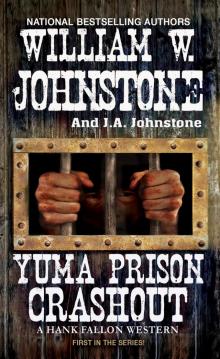
Yuma Prison Crashout, page 14


“Killing snakes,” Fallon said, “is my specialty.”
“Take him away,” Quinn said without looking back at Fallon.
Fallon turned to go, but Quinn called out to him, still looking at the music box. “Is Hank Fulton your real name?”
“It’s a name,” Fallon said with his hand on the flatiron-barred door.
“Ever been in Arizona before?”
“First time.” That wasn’t a lie either.
Quinn was sitting now, so Fallon stepped through the door, and let Allan close the door and lock it.
“Lights go out in ten minutes, Monk,” the guard told the prisoner. “They’ll be back from the breaks by then.” Meaning, Fallon guessed, the sentries at the two closest guard towers.
As Fallon started back down the corridor toward the cell he shared with other men, Quinn called out his name once more from inside the cell he had to himself. Fallon stopped but did not turn back.
“You want to see how men get out of Yuma? Be near the sally port around noon on Thursday. Sleep well, amigo. And watch for snakes.”
* * *
Thursday, Fallon thought. Three days from now. Was that an invitation to take part in Quinn’s crashout? Or was it an invitation to get shot dead?
He was thinking about that at breakfast the next morning, and all through his work detail at making adobe bricks for prison repairs. He thought about it over supper, and considered it till he made himself sleep in his bunk. Yet something had changed. The slop bucket was emptied and the cell cleaned and fumigated. He even found all the beddings replaced for all of Fallon’s cell mates. That, Fallon thought, could have been due to the upcoming execution of the man in the cell whose name Fallon still had not learned. But Fallon’s photograph had also been returned, so, no, this had to be Monk Quinn’s doings, because Monk Quinn truly was the boss man inside Yuma’s walls.
The next morning, Fallon figured he would be back making more adobe bricks, but this time he was sent to the caliche hills with a pickax. To his surprise, he found Moses Quinn sitting in a chair in the shade. Two other inmates held shovels, but none was digging.
One man had his back to Fallon. The other had his foot on the spade while he rolled a cigarette.
Fallon stopped. The guard assigned to this duty, Allan, did not order the men to begin work. Moses Quinn nodded at Fallon and pointed at the man with the smoke.
“This is Percy Marshall,” Quinn said.
He knew the type. The kid had long, stringy blond hair, and his face was pitted with pockmarks. His eyes were dead; he was slender, pale, with yellowed teeth and jaundiced eyes. Fallon did not know what crime Percy Marshall had committed to be sent to Yuma, but he had seen this type for years in Arkansas and the Indian Nations. He was a punk. A young punk.
“Percy,” Quinn said without taking his eyes off Fallon. “I’d like you to meet Hank . . . Fallon. Isn’t that right, Morgan?”
Fallon. So Quinn knew, and as the other inmate, the only one wearing yellow-and-black stripes like Fallon turned, Harry Fallon knew how Quinn had learned Fallon’s real name.
Morgan Maynard grinned his crooked smile and pushed back the sorry cap on his head.
“Hank,” the gunfighter said. “Been a long time, Hank. Or should I say, Deputy Marshal Hank . . . I mean, Harry . . . Fallon.”
Morgan Maynard had aged some. His hair, once long and flowing and black, was close-cropped like all of the convicts in prison except Pinky and Moses Quinn. His face bore stretch marks, wrinkles, and blotches from bad sunburns over the years. Two fingers on his left hand were missing, and there was a hole in the top of the lobe of the right ear, which was blackened by gunpowder. All of these, Fallon knew, were occupational hazards for a hired gun like Morgan Maynard.
Fallon had arrested him for murder in 1878. Maynard had been acquitted—the witnesses, most likely, had either been intimidated or bought off, but Judge Parker had made it clear to Maynard that he had best leave the judge’s territory at a high lope. Apparently, Morgan Maynard had taken that advice and wound up in Arizona Territory, where he had not been able to frighten or pay witnesses to forget that someone got goaded into a gunfight he couldn’t possibly win, or had been shot in the back.
“Here,” Fallon said, “I’m called Hank Fulton.”
“I call you a lawdog.” This came from Percy Marshall.
Fallon did not even glance at the kid. He said, “I don’t recall inviting you into this conversation . . . punk.”
The punk dropped his cigarette and grabbed the handle of his spade.
“You come at me with that shovel, boy,” Fallon said, still not taking his eyes off Maynard, “and they’ll use it to bury you.”
“Marshall,” Quinn said. “Make yourself another smoke.” He looked at Fallon. “You are Fallon?”
“It’s the name I was born with.”
“Federal marshal.” Quinn cackled. “Interesting. Last man the government sent was a detective. Not a Pinkerton, but some small-time operative. Too bad, Fallon. You know snakes. But, well . . .”
“Listen to me, Quinn,” Fallon said. He could tell Moses Quinn did not like being interrupted, but he kept right on talking. “Here, my name is Fulton. You got that. It’s Hank Fulton. You tell your ugly, slow as Easter gunman here, that too. Because if I hear anyone calling me Fallon, I’ll be killing your bigmouthed blowhard.”
Maynard laughed a hollow laugh, and Moses Quinn grinned.
“Morgan Maynard had quite the reputation riding with the cowboys down in Tombstone, Fallon. He’s fast too. Greased-lightning fast.”
Fallon shook his head. “Ask him who put that hole in his ear back in ’78.”
Maynard stiffened and stepped toward Fallon, who brought up the pickax.
“Fallon,” the gunman said icily.
“You call me that again and I’ll kill you,” Fallon said.
“Why?” Quinn asked, suddenly curious.
“You got ears outside these walls,” Fallon said. “Your boy remembers a deputy marshal from years back. Why don’t you find out what happened to Marshal Harry Fallon? And then you sons of bitches can leave Hank Fulton alone. Now . . .” He turned to face Allan. “Are we digging? Or what?”
* * *
That night, the guard named Allan unlocked the door to the cell and said, “Get up.” He didn’t use any name, not Fulton, not Fallon, but Fallon rolled out of his bunk, pulled on his shoes, found his cap, and walked into the night.
“Keep your voice low,” Allan said. “And remember this: You can see snakes in the dark. I can see you. One false move, and your body will look like a sieve. Got that?”
Fallon didn’t answer.
He knew the way to Quinn’s cell, but this time there was no light shining in the darkness. “Stop,” Allan whispered, and Fallon obeyed.
No music sounded from inside Monk Quinn’s cell, but the man had to be standing against the hard stones next to the iron door. Fallon heard the whisper.
“Holdups do not seem to suit you . . . ummm . . . Hank Fulton. A bank in the Indian Nations. A store in Tucson. You were much more successful as a lawman. Why the change in careers?”
“You know how long most marshals in Judge Parker’s court live?”
Quinn laughed.
“Was it worth it?”
“What are you in for?” Fallon asked.
“Robbery,” Quinn answered. “But they only caught me. I have money waiting for me beyond these walls.”
“Was it worth it?” Fallon asked.
“If I can get out to spend it.” Quinn chuckled.
“You were paroled,” Quinn said, changing the subject. “Yet you are in Arizona Territory. How come?”
“It’s a long way from Joliet. I don’t want to go back.”
“I’ve never been in Joliet.”
“Ain’t no place to be.”
“Nor is Yuma.” Quinn let out a long breath. “Two years in Yuma. Maybe you’re out in eighteen months. After ten years in Joliet, I would think you can do eighteen months or even the full twenty-four with no problem.”
“Except I have a much bigger problem thanks to your pal Maynard. He lets the warden know my real name, I serve my time here, and then they extradite me back to Illinois to finish my sentence there. And like I’ve said, Joliet ain’t no place to be.”
A long silence held till the guard Allan spoke. “Best hurry, Quinn.”
“Very well. I told you a few days ago that if you want to see how to get out of Yuma, you should be near the sally port tomorrow afternoon, when you’ve finished your work detail and before supper. Make sure you’re there.”
Fallon said, “All right.”
“Let’s go.” Allan prodded Fallon’s back with the curved edge of the staff. As Fallon turned, Quinn called out his name, the Fulton name.
“One thing to remember, though. If I were you, I wouldn’t leave the way these men will be leaving. I have a better way in mind.”
CHAPTER TWENTY-TWO
The footsteps of Fallon and Allan made little sound as they walked near the whitewashed wall.
“You were a lawman,” Allan whispered.
“Five years,” Fallon said.
“Nothin’ sickens me more than a lawman gone bad.”
Fallon reached the end of the block of cells and turned left to head to his own new home.
“Felt the same way when I wore a badge,” Fallon said. “But after a month in Joliet, my tune changed.”
“How so?”
“These days, nothing sickens me more than a prison guard who violates his oath.”
He expected to feel Allan’s staff to slam against one of his shoulders, but the guard merely said, “You try to live off seventy-five bucks a month.”
Fallon caught his breath. “That’s more than I made as a deputy.”
“You didn’t have to deal with the scum of the earth like I do.”
“I do now,” Fallon said, and this time he felt the staff.
It didn’t come down hard. Instead, Allan must have reached the long rod forward. In the darkness, Fallon didn’t see it, and the crooked hook caught his left leg. Allan pulled hard, and Fallon hit the hard earth with a thud. The shinbone ached so fiercely that for a moment Fallon thought it might be broken, yet he rolled over and tried to sit up, but now the staff was against his throat. Allan was right, Fallon thought. He must be able to see in the dark.
“I don’t like you, Fallon,” the guard said, but lowered the staff. “When we get out, I’m going to kill you.”
When we get out . . .
Fallon felt the heavy staff pull away from his throat. He rubbed his shin, tested his leg, and realized that he would likely just have a bad bruise on his leg, and some cuts and scrapes from the fall.
“Get up.”
When we get out . . . So Allan was in on this jailbreak too. He had to be. The prisoners would likely need an inside man, and Allan already had been bought off. When we get out . . . So Monk Quinn had decided to bring Fallon into the crashout too. But when? And what was tomorrow supposed to be about?
A match flared in Allan’s hand, and Fallon came to his feet and watched the guard move to the cell. He leaned the staff against the wall and found the key. Fallon limped over and saw the burning match, the features of the brutish guard, and the cell door as it started to swing open.
Then Allan looked inside the cell, and the match dropped and went out.
In the darkness, Fallon heard the guard’s muffled curse.
Fallon stood still. The cell door squeaked. Another match flared, and Allan held the match toward the door. He cursed again, backed up, and turned to Fallon.
“Stay where you are!”
Fallon froze.
The guard turned toward the closest tower and yelled, “Sergeant of the guard! Cell number twenty-four! Sergeant of the guard! Cell number twenty-four! All guards to cell number twenty-four! All guards to cell number twenty-four!”
The match went out again, but darkness lasted but a few seconds. A spotlight swept down from two of the guard towers, bathing Fallon and Allan and the open cell door in yellow light.
That told Fallon something else about the prison. Over breakfast, he had heard some inmate mention something called the Dynamo. He had paid no attention, but now he recalled reading an article in a magazine in Joliet. Most of it had been like reading Greek, but he remembered the principles about rotating wire coils, and magnetic fields, and the rotation somehow converting into power. Dynamo. A Dynamo generator. Yuma Territorial Prison might be in the middle of nowhere, but it had electrical power. Now Fallon remembered the wires that were strung overhead. He had thought that they might be telegraph lines, but that made little sense. Telegraph lines outside the prison maybe. But inside? No. The prison had electrical lights, and those lights were bright. Fallon shielded his eyes and stood still.
Footsteps pounded and Fallon saw guards racing from the sally port. He lowered his hands, then decided to raise them high over his head. He was a prisoner in stripes, and outside of his cell in the middle of the night. But other prisoners slowly left his cell too.
Pinky . . . Preacher Lang . . . Yaqui Mendoza all stepped away from Allan, who stood in front of the cell door. They lined up beside Fallon, their hands reaching skyward, too, as the armed guards quickly formed a semicircle around them, covering them with their .44-40 Winchesters, cocked and ready.
One man had not come out of the cell. The man who was awaiting his execution.
From other cells, shouts, grunts, and curses rang into the eerie light.
“What the hell is goin’ on?” “Can’t a man get any sleep?” “It’s supposed to be lights out!” “Escape? Did somebody crash out?”
The sergeant of the guard, a tall man with a well-groomed mustache, came jogging over. The sergeant stopped in front of Allan, whose head nodded inside the cell. The sergeant looked, sighed, and cursed.
“What happened, Captain?” the guard asked.
“Just found him, Dickinson,” Allan answered.
Pinky stood next to Fallon, who whispered, “What happened?”
“Roach hung hisself,” the old man said.
Which is what Fallon figured had happened. The nearest guard pointing his rifle at the inmates in cell number twenty-four said, “Shut up. No talking.”
Fallon wet his lips. He ignored the guard and yelled at Dickinson and Allan, “He might still be alive!”
“Shut up!” the guard with the Winchester said.
“At least check on him!” Fallon yelled.
Two other guards adjusted their aim on Fallon’s head. The sergeant and the captain stared at each other. None looked inside the cell where the condemned man named Roach—Fallon had just learned his name—likely still hung from the bars at the top of the cell.
“Should we wake Mr. Gruber?” Dickinson asked.
An electrical alarm rang out in the night.
“I’m sure he’s awake now, Sergeant!” Allan yelled over the deafening racket.
* * *
Mr. Gruber, superintendent of Yuma Territorial Prison, stood with a black Prince Albert over his plaid nightshirt. He wore bedroom slippers—probably not wise in a land filled with scorpions, centipedes, and rattlesnakes—and looked as if he had just been pulled out of bed.
Two other guards stood at his side. The alarm had been turned off, but the spotlights still shone down, bathing this part of the prison in light. The guards kept their Winchesters trained on the surviving residents of cell number twenty-four. No one had set foot into that cell to check on inmate Roach.
“What were you doing here, Captain Allan?” Gruber asked the guard again.
“I make it a habit,” the captain lied, “to enter the prison at night, making sure no one has found a way out, that there is no contraband, nothing . . . peculiar . . . happening with our residents.”
“Commendable,” Gruber said, “but dangerous.”
“Comes with the job, sir.”
“In the future, Captain, you will let the guards know when you are doing one of these secret missions. And I would like to know it too. You could have been killed by accident.”
“I’ll remember that, sir.”
Fallon sighed, and held back from shouting. The hanged man had to be dead by now. If he wasn’t, he might as well be.
“So what made you check this particular cell?” Gruber asked.
There was no denying the fact that Captain Allan thought fast on his feet. “The new convict, Ha—” Allan stopped himself. He had almost said Harry Fallon. “Hank Fulton. Yes. Fulton. He has been put here. I always make a habit of keeping a special eye on the fresh fish, sir. So as I came around here, I heard something. I struck a match and looked inside. It was the convict, Roach. His boot must have banged against one of the bunks. I opened the cell, and, as Fal—Fulton was starting to sit up in his bunk, I ordered him out. Then I sang out for assistance.”
Gruber turned and studied Fallon. “He was the only one awake?” the warden asked without looking away from Fallon.
“It appeared so, sir.” He quickly added, “Just waking up, sir. Likely he heard the same noise that I did.”
“I see.”
Gruber walked over beside the guards with their rifles still aimed at the inmates outside.
“You just woke up?” Gruber asked Fallon.
“I was awakened by something,” Fallon said. That wasn’t a lie, but sort of a fabrication of the truth.
“And you heard nothing?”
“No, sir.”
Gruber considered that, and asked, “Did Roach give you any indication that he planned to take his own life?”
Fallon shook his head. “Warden, he never even told me his name.”
“Louis Roach,” Gruber said. “He was supposed to be transferred to Cochise County in two days to be executed there for murder. Instead, Cochise County will be saved the expense of a burial—although I am sure the gallows have already been built—and we will get to bury this man at the prison’s expense.”
Gruber sighed, shook his head, and looked at Fallon long and hard before he turned to the Mexican.
“You heard nothing?”