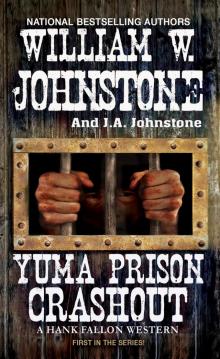
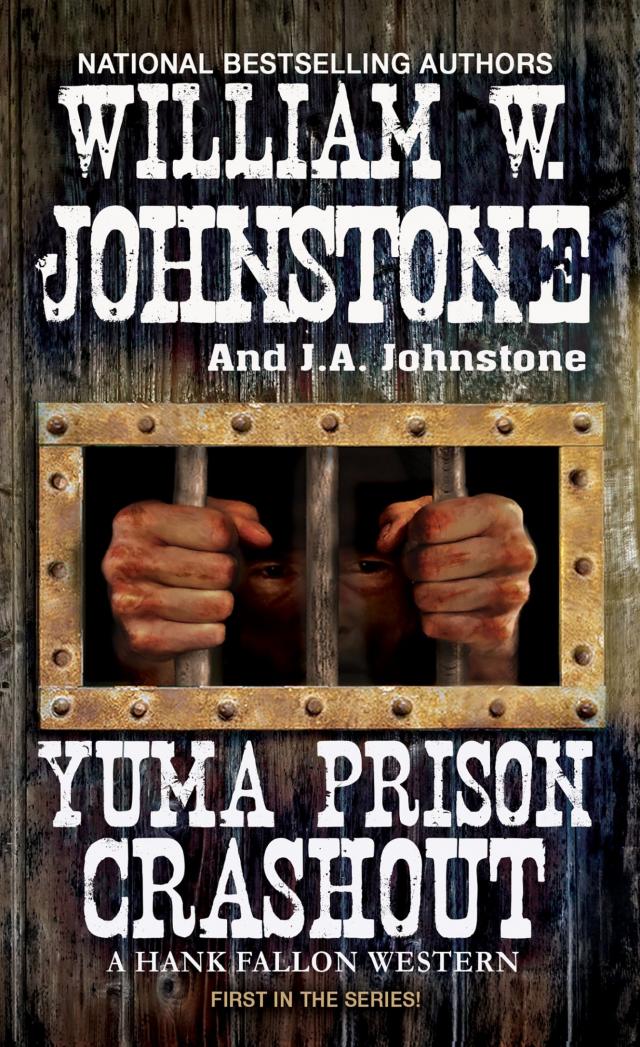
Yuma Prison Crashout, page 10


Miguel Perez had no questions for the witness.
The railroaders testified. They were a lot more honest than Primm. Well, they didn’t stretch the truth and when they didn’t know the answer to one of the questions, they said they did not know. When they had not seen something, they admitted that they had not seen it. But they did identify Hank Fulton as the man who had attempted to rob the strongbox at Primm’s Dry Goods and Sundries on the southwestern edge of Tucson.
Aaron Holderman took the stand. He said he had been on the trail of this Hank Fulton since Albuquerque. That Hank Fulton was a scoundrel known far and wide. Perez did not bother to object. And that, sure, while there were no charges against Hank Fulton in New Mexico or Arizona territories, that he, Aaron Holderman, special detective for the American Detective Agency out of Chicago, Illinois, knew if he would just keep his eye on the miscreant, he would catch Fallon red-handed.
“Fallon?” the judge asked. “Who’s Fallon?”
“Umm. Fulton. Fallon’s another felon I’ve got my eye on. Sorry, Your Honor.”
The judge sighed.
“And,” the prosecutor asked for his final question, “did you catch this Hank Fulton red-handed?”
“Yes, sir.” The prosecutor had coached Holderman very well. “Caught him before he could do harm to any more good citizens. Of course”—he nodded at the railroaders—“I had some mighty fine help. Good lads. Couldn’t have brought this bad man to justice if not for their able assistance.”
The territory rested its case. Miguel Perez asked Fallon if he wanted to testify, that he did not have to, that he probably shouldn’t, but he could if it was his desire.
Fallon shrugged. “Why bother?” he said.
“Indeed,” Perez said.
The defense rested.
The judge found another piece of candy. “You have forgone a trial by jury and left this in my hands. The charges are kidnapping, but I find no evidence of kidnapping. That charge is dismissed. Attempting to hold a man in a cheap pine box that has been painted a cherry color and being sold as cherrywood is a preposterous place to hold a kidnapped victim. The charge of assault is also dismissed. You fired a weapon yourself, Mr. Primm, and if I believe what I have heard, you fired it at an unarmed man. You got what you deserved, and I don’t mean the one percent per diem you charge.”
The judge stared at Fallon, who began to wonder if he might get off and walk out and have to find another way to land in Yuma.
“But there is also the charge of robbery. Robbery with a loaded firearm. And you did threaten Primm with bodily harm.” He found the gavel. “So you leave me little recourse under the laws of our nation and the territory of Arizona. It is, therefore, that I sentence you, Hank Fulton, to the territorial prison in Yuma for a sentence of six months for attempted robbery, and I tack on a sentence of eighteen months in the same prison, to be served consecutively, for the destruction of a damned fine keg of Pennsylvania bourbon.”
The gavel slammed.
“Next case.”
CHAPTER FIFTEEN
If Yuma wasn’t the end of the earth, it was close to it.
Gone were the sloping hills, the saguaro cacti, the junipers, and the distant, rugged mountains. The country was flat, sandy, with a few scrubs popping up here and there, though few and far between. The Colorado River ran wide and blue; California lay on the other side, but it looked no greener, no wetter, and no less desolate. The sun shown with brutality, and the wind either blistered you with its heat or scarred you with sand.
The town of Yuma looked much like the desert itself, flat, wide, unimpressive, and almost uninhabitable. Few buildings topped one story. Adobe walls needed patching or simply to be rebuilt. There were few stone buildings, and nothing made completely of wood. A few tents served as roofs for itinerant businesses. More people lived in miserable jacales than adobes. No dogs trotted down the streets. No chickens pecked for food. Even the people appeared motionless. It was too hot to move.
Yet amid all this Spartan landscape rose one of the most impressive, yet terrifying, structures in the American Southwest. The high walls dwarfed the buildings of the town, and the brown color offered a wide contrast to the paleness of the desert that surrounded it. The massive, thick iron gate swung open as the wagon stopped outside.
Two lawmen shoved Harry Fallon, alias Hank Fulton, out of the back and into the sand. The first thing Fallon saw was a scorpion that looked ready to sting before it scurried underneath a cactus. The second thing Fallon spotted, when he lifted his head, was the words chiseled into the adobe above the iron-barred gate:
YUMA TERRITORIAL PRISON
“You’re home, Fulton,” one of the lawmen said. “Ain’t it what you always dreamed of?”
* * *
They made him bathe first, in scalding water with lye soap that felt like shaved iron. The barber cut his hair, almost shaving it down to his skull, and the striped uniform he was given felt worse than the clothes he had been forced to wear at Joliet. But the colors were different: yellow and black stripes instead of black and white. They gave him a hat to wear, to protect him from the sun, but the piece of wool had no brim and the wool just made the top of his head hotter. His extra clothes consisted of two handkerchiefs, another pair of socks, trousers, and a jacket. Fallon didn’t think in a furnace like Yuma he would ever need a jacket. They also gave him two towels, though one seemed to have more holes than cotton.
They also gave him a number: 1776. Patriotic, Fallon figured.
Fallon’s next stop was the warden’s office. There were no windows. Adobe was supposed to be cool, but Collin Gruber, superintendent of Yuma Territorial Prison, sat at his desk sweating. He studied the paper, handed one of the lawmen who had escorted Fallon from Tucson a receipt, and said:
“Two years. Robber of a mercantile? Oh my, what a hard-nosed lawbreaker they’ve sent me this time. We shall not have any trouble with you, will we, Mr. Fulton?”
Before he could answer, he felt a blow to his kidneys. He collapsed against the desk, tried to catch his breath.
“Answer the boss man,” the rough voice behind him said.
He didn’t reply quick enough. Another blow bounced off his head, knocking the woolen cap onto the floor.
“Now, you piece of filth. Answer the boss man.”
“No . . .” Fallon managed “. . . trouble.”
He put his hands on the top of the desk to help himself stand. As he was rising, a stick came up rapidly, catching his arms just below the wrists, forcing him to lose his hold on the desk, and he went to the floor again. Hard.
“You keep your hands off the boss man’s desk, you piece of filth.”
Fallon rolled over. Sweat dripped into his eyes, burning them and making it harder to see, but he could make out the guard before him. He held a stick, but not a billy club or nightstick. It was more like a pole, four feet long. No, it was a staff—like something an artist would have put in Moses’s hands in a painting of the Ten Commandments, challenging the pharaoh or parting the Red Sea. The man even looked like Moses, with a wild mane of gray hair and a darker, thick, long mustache and beard.
The man raised the staff as though to bring it down against Fallon’s skull, but a shadow covered him, and Fallon saw a man wearing a striped woolen uniform kneeling beside him, taking him under the right shoulder and lifting him to his feet.
“Easy, there, tenderfoot. Easy. Let ol’ Pinky help you up. There. There. You’ll be fine. Just fine. Here. I’ll get your cap.”
Fallon felt himself leaning against Gruber’s desk, so he pulled away and somehow managed to keep his feet while the prisoner named Pinky bent to grab the woolen cap.
Pinky was a small, frail man. His hair was long, white, and flowing, and a few days of stubble brightened his face. He looked to be more bones than flesh, and his fingers were the longest Fallon could ever remember seeing on a man. The man’s back was to the guard with the staff, and the staff was up again, but this time the figure straight out of the Old Testament had changed the direction. He was going to crush the puny old-timer with the wooden rod.
Fallon’s mouth opened, but the voice that sounded was not his:
“Mr. Allan, please mind your manners.”
The guard stopped, frowned somewhere underneath the beard, and lowered the long piece of wood, butting it on the floor as the frail inmate turned and looked at the warden. Not speaking, Pinky rose and placed the woolen cap in Fallon’s left hand.
Fallon’s escorts took their receipt and left Fallon standing in the sweltering room. The warden handed an envelope to the big, brutal guard named Allan and said, “Make sure that none of this is contraband, Allan.” He gave a waxy smile at Fallon.
“Mr. Fulton, this is Pinky. He’s a friend to us and a friend to his fellow inmates. If you have a question, you go to Pinky. Don’t ask a guard. Don’t ask a guard anything. Don’t even look at a guard. Don’t speak to a guard. Don’t touch a guard. If you need to see me about anything, ask Pinky. If you need to find the privy, ask Pinky. If you need to find the library for prisoners, ask Pinky. If you need to empty your bladder or bowels, ask Pinky. Do this, and your sentence will breeze by. Make one mistake, and Mr. Allan will introduce you to pain you have never even imagined.”
Still smiling like a snake-oil salesman, Gruber looked back at the big, burly, biblical Allan. “Well?”
The guard sniggered and tossed a badge on the warden’s desk.
“It says,” Allan sniggered, “Deputy U.S. Marshal.”
“My, oh my.” Gruber fingered the badge and cocked his head. “Why would a deputy marshal resort to robbing a tiny store in Tucson?” The badge spun in an arc and landed in a trash can in the corner of the office. “But I’m afraid, Mister . . .” He had to glance at the paper before him. “Mr. Fulton. Yes, yes, Fulton. So why would you have a marshal’s badge. Did you forget which side of the law you were on?”
“I was hungry,” Fallon said.
“Well, you shall not go hungry here, Mr. Fulton. You have beans and potatoes every day. With bread too. For supper. Gruel for breakfast. More beans and potatoes for your dinner, sometimes even with a bit of meat.” He looked back at the guard. “Anything else, Mr. Allan?”
The man held the old photograph in his massive fingers. He stared, grinned, and waved the small print under Fallon’s nose. “I don’t think you can have this, you piece of filth. No. Not at all. Looking at a petticoat that looks this good, why, it would give you some real bad thoughts. Not good. No, not good at all. Now, me, now I could have an image of this fine thing. And give that kid a few years and, well, maybe I wouldn’t even have to give her any years at all before . . .”
Fallon hit him. He moved so fast, the big guard had not even looked away from the photo of Fallon’s wife and daughter. No one had expected it. From the corner of his eye, Fallon saw the warden putting both hands on the desktop as though trying to push himself out of his seat. Fallon didn’t even look at Pinky, the skinny little trusty. He saw only the face of Moses. He felt nothing but blinding fury.
Allan had a couple of inches and sixty pounds on Fallon, but none of that mattered. The man’s bearded face turned with the punches, this way, and that, then drove back against the adobe wall. The staff rattled on the floor. The man could not even move, never even brought his arms or hands up to defend himself. Fallon punched, and punched, and punched. All he saw was the photo, slipping out of Allan’s fingers and drifting away, toward Pinky. He thought he saw the trusty catch the old print. Then he went to work on Allan’s stomach and ribs.
Something rang in his ears. For a moment, he thought it was the sound of blood, rushing to his head. Then he realized that it was a whistle. The superintendent of Yuma was blowing a whistle. Gruber remained in his seat, but Pinky was moving. He quickly pulled open the door.
Gruber’s voice reached Fallon. The man was screaming in terror, but Fallon did not understand the words. All he understood was the sound of his fists driving the behemoth Allan to his knees. Blood spurted from the man’s nostrils, and his lips.
A moment later, Fallon knew he was on the ground, and his head was throbbing. He didn’t see Allan anymore, or Pinky, or Gruber. He saw flashes of white and red and lavender, and felt his head throbbing. Excited curses and shouts bounced in his eardrums. Someone kicked him in his side, and he gasped for air.
At last, as he lay on the hot floor, he managed to make out Gruber’s now sharp voice.
“Stay where you are, Allan. You brought that on yourself and . . .” The warden—superintendent, whatever he wanted to call himself, even God—chuckled. “And I must say, I really enjoyed it. A big man like you, getting the hell beat out of you by a man who robs a puny little store, and doesn’t even get out of the business before he gets caught. You’re a fine guard, Allan. Sit there. Sit there and quit bleeding on my dust.”
Gruber sighed, and his voice went back to the placating, sarcastic tone he had been using earlier. “But, well, we can’t allow this, Mr. Fulton. No, sir, we cannot allow our residents acting like this, beating up a big man like Ezekiel Allan. I’m afraid I’ll have to put my foot down, before my strongest guard decides to shove that long stick of his up your . . . throw the bastard in the Dark Cell, gentlemen.”
Fallon felt himself being lifted up.
The warden spoke again as Fallon was dragged out of the superintendent’s office.
“And if you ever try a stunt like that again, we’ll bury you just beyond the walls, my boy.”
CHAPTER SIXTEEN
It felt much cooler in the Dark Cell. Cooler than anywhere Fallon had felt in a long, long time. He lay still on the floor, his head propped up against the iron wall. He raised his hand over his head, turned it this way and that, and brought it down to a few inches above his eyes. At least, he thought he had. He couldn’t see a damned thing.
Blackness. A blackness of which he had never experienced. Darker than he remembered one night with his father back in Gads Hill. A new moon, and his father had blown out a candle as they walked home together, and Fallon remembered coming to an abrupt stop, sucking in a deep breath, and feeling terrified of the instant darkness. His father had chuckled, but put a reassuring hand on the boy’s shoulder. Fallon could not have been older than seven or eight.
“There’s nothing to fear in the dark, Hank,” he could remember his father saying. “Remember that. Dark’s just dark. That’s all it is.”
But this was a different kind of darkness.
Not only was the blackness so permanently deep, there was no sound. He knew he remained in prison. He had opened his eyes outside to see the chambers on either side of him as they dragged him to this cell. He remembered them opening another barred door, and then he saw the emptiness, the murkiness that soon turned into a gloom. When the door had been shut behind the guards, that darkness turned into an awful gloom.
They called this the Dark Cell. It had been dug into the caliche hill, a ten-by-ten-foot solitary cell in which they had put in an iron cage. Light—and precious air—came from the ventilation hole in the ceiling.
There was no light, of course, at night. There was only darkness now.
Yet when he lowered his arm, and tucked his hands underneath his head, he did not feel the gloom. When a man closed his eyes, it did not matter if it was day or night. He could see, or at least imagine, what he wanted to see.
This time, Harry Fallon saw Renee. And he saw Rachel.
His wife’s family, her grandparents, at least, had left France for America. New Orleans, first, followed by Memphis, and then St. Louis. Renee DeSmet had left St. Louis for Fort Smith to work for a watchmaker. The watchmaker, a Swiss man whose name Fallon never could remember, was getting old, and his eyes kept failing him, and his hands trembled. So he told Renee what to do.
Fallon watched the process once. The man sitting in a chair in his shop, hands on his knees, listening, and Renee, black-haired with stunningly blue eyes, at the table, holding the tools like surgical instruments. The man would say something, often in French, and she would bend closer or look through the magnifying lens. Fallon had never seen anything like it.
Nor had he ever seen a woman like Renee DeSmet.
They roomed in a boardinghouse in Van Buren, just down the road and river from Fort Smith. Rents were cheaper in Van Buren, and the town did not have all the drunken railroaders, the drunken deputy marshals, the commotion and bustle, and the hangings like Fort Smith. It was, for the most part, fairly peaceful.
Her room was three down from Fallon’s. The widow Rita Talley ran the boardinghouse, and served decent food—an extra fifteen cents for boarders, or twenty-five cents for guests—that usually consisted of chicken and dumplings or fried catfish. Her tea was especially sweet. She did wonderful things with onions and carrots.
Since they both worked in Fort Smith, he volunteered to escort Renee to the watchmaker’s shop. For a month, they did this, barely speaking to each other for the first four days. She didn’t like his gun, but he loved everything about her.
By the second month, she had grown used to him. After the third month, they were engaged. Six weeks later, they moved out of the boardinghouse into a rented room still in Van Buren but closer to Fort Smith.
He had been riding for Judge Isaac Parker’s court for a little more than a year and a half.
Renee didn’t care much for the life of a federal lawman. Waiting for her husband to come back home, worrying every day that he walked out the door if she would see him alive again. But the job paid well. A nice salary. Even expenses. And when court was in session, Fallon got to spend a good bit of time in Van Buren and Fort Smith. He got to take his wife out to supper, or swing by the watchmaker’s shop and marvel over how she managed to do the old Swiss man’s work for him.
Those long, dull hours in the courtroom made Fallon a little more interested in the other side of the legal system. He watched the attorneys—those for the federal court and those defending the men brought before Judge Parker. One evening, Fallon found himself waiting outside the courthouse when Judge Parker stepped out. They walked to the corner where the omnibus stopped and they talked. Parker suggested that Fallon read law, maybe pass the state bar and get an appointment. A lawyer could go anywhere. So could a lawman, but a lawyer had a better chance of living to see his fortieth birthday. Parker even suggested a pretty decent lawyer who could help Fallon study, so Fallon began spending a lot of time in the office and home of Chris Ehrlander.