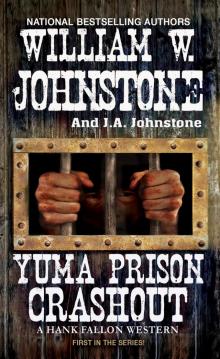
Yuma Prison Crashout, page 19


“No,” Allan said. “Keep singing. Now they’ll especially hear you back in the prison.”
Monk Quinn laughed. “Sing away, pretty lady.”
She sang. She had the voice of a chorus of angels.
Percy Marshall found a .38-caliber Colt Lightning. Naturally, he had no bullets for his gun either.
Pinky, apparently, had no gun. He kept working the pick, grunting with each swing.
Marshall stifled a cough and turned the bag over. Only dust fell out, reflecting the light from the lanterns.
“You and him have the only ammunition?” Marshall pointed at Captain Allan. “You trust a prison guard more than you trust us?”
“I don’t trust any of you more than I’d trust a dead snake.” Quinn shrugged, cocked his head, and smiled as Gloria Adler sang. “I don’t even trust her, but damn, what a voice.” He turned to face Captain Allan, and Quinn smiled. “No, I don’t trust him. But I need him. And, well, he knows as well as I do that I can shoot faster and straighter than he could in a month of Sundays.”
The wind kicked up again, not as wild and hard, but strong and steady.
“We can’t fight off those guards with empty weapons, Quinn,” Morgan Maynard said.
“You’ll find your bullets when we get to the horses,” Quinn said, and spun the revolver on his finger before sliding it into the holster that was slick with grease for a faster draw and to keep the barrel clean.
“Horses?” Mendoza asked.
“Well, I don’t think these two mules will get us to all that gold.” Quinn patted the rump of the nearest mule.
Mendoza looked around. “Where are the horses?”
“Not here.”
“They’re not here?” Percy Marshall asked.
“Keep your voices down, gentlemen,” Quinn said. “As I’ve already said. Sound travels far. The hooves of a bunch of horses riding south would attract the attention of Scott, Mitchell, and all those other idiots back at the prison.”
“How far away are the horses?” Mendoza asked.
“Five miles.”
“Five miles?” Maynard exploded.
Quinn brought a finger to his lips. “Shhhhhhhhh. Remember . . .” he whispered mockingly. “Sound . . .”
“Over this wind?” Maynard said.
The gunman stiffened. Allan had jammed his spine with the barrel of the rifle he held. “Be smart, Maynard,” the guard said. “Which way is the wind blowing, you damned fool?”
Maynard said nothing. The wind kept blowing. Fallon could just make out Gloria’s voice and the unsteady, uneven sounds of Pinky’s pickax striking sunbaked, rock-hard dirt that covered this part of Prison Hill.
“We can’t walk five miles,” Marshall said. “That won’t give us enough time.”
“We’re not walking. And we’re not burying anybody.” He nodded at the wagon. “Keep the lanterns going, but turn them down. The coffins can stay where they are. Fallon, you go first.”
“Where?”
The killer drew the .44 and waved to the edge of the hill that overlooked the Colorado River.
“To the river,” Quinn ordered. “That way if a rattlesnake is out hunting, it will strike you first.”
“Are the horses at the river?” Marshall asked.
“Tell them, Captain,” Quinn ordered, suddenly annoyed.
“Boy,” Captain Allan said, “you’ve been in prison long enough to know that the Colorado River isn’t five miles from those damned ugly walls I’ve been staring at forever.”
“But . . .”
“If my fellow guards or some fisherman or some ship’s captain found a bunch of horses staked this close to prison, we wouldn’t be walking. We’d be deader than McMahon and his idiots. They’re five miles downstream. At a place I know, and held by a man I trust. That’s where we’re going.”
“I can’t swim,” Marshall said.
“You don’t have to. There’s a flatboat in the rocks. Hidden and covered with brush. We float downstream. The current’s running fast so we’ll make good time. Then we find our horses and ride to Mexico.”
“All of us?” Doc Fowler had spoken.
“Well, Doctor Fowler,” Quinn said. “I’m sure you wouldn’t like being left alone with no one to care for you, to tuck you in after you’ve passed out blind drunk. And, as I’ve said, that fine-looking woman will help keep us all in line.”
“Why do we need him?” Maynard pointed at Fallon.
“We need him,” Quinn said. “But if you don’t like his company, you’re free to go.”
“And the doctor?” the kid Marshall asked.
“In case someone gets sick,” Quinn said.
“And him?” Mendoza pointed at Pinky.
“We never could have gotten as far as we have without a good trusty. And we needed our fine, strong, fearless captain too. Boys, boys, boys. We are really still too close to the walls of Yuma to be debating anything. Let’s get down to the banks of the river. Shall we?”
* * *
They walked to the edge, away from the light of the lanterns, away from the empty coffins and the sleeping mules. Fallon tried to figure out how far down they had to climb to the banks. He sought out a trail, but in the darkness, that proved hard.
“There’s a trail down to where the boats dock by Gruber’s home,” Quinn said, his voice laced with sarcasm. “Maybe you’d like to use that one.”
“This’ll do,” Fallon said. “Watch your footing. Go slow.”
“Not too slow,” Quinn urged.
Fallon sat down and slid over loose rocks but mostly dirt a few feet. He stopped at a ridge, and found a switchback just wide enough that even the biggest of this bunch—Yaqui Mendoza—could make it with ease. Fallon couldn’t tell how far the switchback went though.
At least the ridge above blocked the wind. It felt calm here. But just as dangerous.
He moved away and, hugging the wall, slid along the path. The guard came down next, followed by Gloria Adler, Pinky, and Doc Fowler, who almost toppled over but somehow righted himself.
Fallon breathed again. He whispered to Captain Allan. “Better watch the doc and the girl. It might not be a fatal drop from here, but it’ll bang them up a bit.”
“I’d prefer it killed them,” Allan said. His breath stank of gin. “More of that money for us.”
“And if they scream on their way down . . .”
Allan shrugged, considered the suggestion, and swore. He moved back toward the doctor, the old convict, and the woman, but stopped and looked back at Fallon.
“You try something, I kill you.”
“All I’m trying,” Fallon said to the shadow a few feet before him, “is to get down this hill in one piece.”
When the switchback ended, Fallon waited till the others had made it. No one was missing; even Pinky had made it. Fallon wiped his hands on his trousers. He could hear the river now, even see its outline in the darkness. At least the stars shone, and the sliver of the moon. Not much light, but enough to make out a path.
“Keep close to the wall,” he said. “The sides are nothing but loose stones. Step on one, and you’re likely bouncing your way down.”
He started again, sweating now, despite the coolness. He cursed for allowing himself to be hornswoggled into this stupid plan by Sean MacGregor of the American Detective Agency. His boot knocked a stone and it rattled as it bounced its way down.
Five minutes later, he had reached the end.
Allan came down a moment later, gasping for breath. He stepped toward Fallon and asked, “Is this it?”
“Not quite.” Fallon nodded below.
The captain of the prison guards swore.
Quinn moved past the others, knocking stones into the darkness. He moved between Allan and the wall and said, his voice seething, “What is it?”
“We either jump,” Fallon said, “or we climb back up and try another way down.”
The killer whirled and shoved the .44’s barrel underneath Allan’s chin. “This is what you do? You don’t bother to figure out how we get down in the middle of the night? Do you really think that’s worth even one bar of gold?”
“If you’re going to kill him, I’d do it now,” Fallon said. He pointed downstream. A ship was heading up the river.
The killer swore and holstered his gun. “Jump,” he told Fallon. “Now.”
Fallon never hesitated. He leaped into the darkness, feeling the wind and the back of the rocky wall rush past him. He hit, his knees buckled, pushed upward, and he tumbled down sand and stones. Instantly he came to his feet. He cupped one hand over his mouth and said, “Twenty feet or thereabouts. Just get enough distance away from the wall.”
Allan landed, and almost took Fallon down a few feet with him. The guard sat up, shaking his head.
“You all right?” Fallon asked. He could care less.
“I’m alive. And I still got my rifle and Colts.”
“Good for you. Get down to that rock. Keep one eye on the boat coming upstream and the other eye on the path that leads to Gruber’s place. If the ship’s stopping, someone will be waiting for it up there.”
“You don’t give me no orders, Marshal.”
There was no time to argue. From above, Monk Quinn said, “Here comes the girl.”
Gloria Adler landed gracefully—at least from what Fallon could tell in the dark. He picked her up and pointed to a rocky partition. “Get down there. Hide.”
She ran, but Allan had found his feet, and he grabbed her by the arm and jerked her hard. She fell in the dirt and cried out in pain.
“We’ll hide till the ship passes.”
“Better hope it ain’t stayin’ overnight,” Captain Allan said. “Because if that’s the case, we’re all going back to the Snake Den for a mighty long time.”
CHAPTER THIRTY
He remembered steamboats, side-wheelers and stern-wheelers, chugging up and down the Arkansas River. Larger ones, of course, he had watched whenever his job as deputy marshal took him to Jefferson City and the state prison there in Missouri. When he was just in his teens, he had ridden out of Gads Hill, Missouri, with a couple of boyhood pals just to soak their boots in the Mississippi River. They had watched in awe two stern-wheelers churning in practically utter silence downstream, bound for New Orleans or some other foreign place that the kids had dreamed of seeing. Later, he had dipped his boots again in the river—with his new bride by his side, giggling as she did the same—in St. Louis. That had been on their honeymoon.
Fallon tried to block that memory from his mind. He focused on the steamboat coming up the Colorado River. All those times, all those years, all those boats, big and small, that he had watched with awe and amazement . . . and he never realized just how infernally slow they were.
Little wonder people preferred trains these days.
The boat’s lights reflected off the water. He could make out the voices of passengers and crewmembers wandering on the various decks. He saw the red glows of men with their cigars. The sound of the steam organ glided across the night.
Fallon turned to look up at Prison Hill. He could see the lights near the decking and the stairs and trail that led to the docking point for boats. In Missouri’s state penitentiary, he remembered some of the guards saying that, when the intimidating structure had first been built, the only way prisoners could be brought to the penitentiary was by boat.
No one could be seen at the top of the hill. The good news was that the superintendent, most likely, was still in the doctor’s office in Yuma—and Gruber had no wife, no children, no family, just a Mexican maid who cleaned house and cooked for him. She’d be in Yuma, too, either home with her own family or in some church praying for her employer.
“This is what you do, Captain Allan?” Monk Quinn whispered in the darkness. “This is your idea of planning?”
“I checked the schedule in the Yuma Clarion,” Allan said. “There’s no steamboats scheduled to dock tonight. Not even tomorrow. Hell, we haven’t had a boat stop here in two weeks.”
Quinn spit.
“If that boat stops, we’re doomed,” Quinn said. “Deader than McMahon and his party. You understand that, Allan?”
“It won’t stop,” Allan answered. Fallon could almost taste the big guard’s fear.
“If it does, you’ll be the first to die.”
“It’s not stopping,” Allan said, but Fallon could detect the captain’s mouth moving as if in silent prayer.
The boat kept creeping in the river.
“Keep quiet,” Monk Quinn said as he turned toward the men and one woman with him. “Not a sound. Don’t move. Don’t even breathe.”
“Just pray, brothers and sisters,” Preacher Lang said. “Just pray.”
“Shut up.”
“A silent prayer,” Lang said, and chuckled.
Monk Quinn swore.
Fallon inched over to Quinn. “She won’t stop,” he whispered.
“You better hope not.”
“She won’t.” Fallon pointed. “She’s still in the middle of the river. If she were docking, she’d have to be turning by now.”
Quinn remained silent for a full minute, watching the steamboat continue its course. He nodded, let out a sigh of relief, and turned to Fallon. “We still have to wait till she’s gone.”
Fallon shook his head. “Why?”
“They’ll see us.”
Fallon shrugged. “Maybe. But it’s not like they’ll be hollering or shooting off Roman candles. They’ll think we’re fishing from the banks, or a bunch of drunks holding a gathering.”
“Maybe,” Preacher Lang said, “a gathering at the river. A good ol’ head-dunkin’ baptismal service.” He laughed again.
Allan voiced his objection. “And if some of the guards are up there taking in the show to watch the boat pass?”
“You put the fear of God in your boys, Captain,” Fallon said. “They’re all in the prison, worried sick that something will go wrong tonight what with the Dynamo not working, a warden shot, and four prisoners dead.”
“I say we wait,” Allan argued.
“We wait,” Fallon said, “and chances are we get caught. If one of your guards came down to watch a damned steamboat pass, he would have noticed that the lanterns were burning at the cemetery but that he couldn’t see any shadows, anything, anyone actually digging one grave. We’d be seeing torches burning and hearing whistles and dogs barking.”
“He’s right,” Monk Quinn said. The killer looked at the captain of the guards. “Where did you hide the raft?”
* * *
They moved down the riverbank, not bothering to crouch or duck or stay hidden. Allan led the way toward the hiding place, and Monk Quinn hurried along beside him. Suddenly, Quinn stopped. He sucked in a deep breath. Fallon stopped, too, uncertain, trying to figure out why the leader had stopped. There was nothing on the top of Prison Hill. Nothing looked strange on the passing steamboat. Ahead, Allan stopped and turned.
“What’s the matter?” the crooked guard asked.
Quinn whispered the answer, but that was directed at Fallon.
“Is that a snake?”
Fallon moved closer, inching his way along. A rattlesnake would be singing its warning now, but there were other snakes in the desert, Fallon figured. He came along Quinn’s side.
“Where?”
Quinn just pointed a finger. A cloud passed over the moon, but only briefly, and then Fallon studied the ground. It took a while for him to spot what the killer feared was a rattlesnake.
He said, “No. It’s a stick, Quinn. A dried out cactus spine.”
“You tell anyone,” Quinn said, “and I’ll kill you.”
Fallon said, “I’ve been fooled by sticks, even shadows too.”
“Fooled. But not scared.”
“We best get going, Quinn.”
* * *
They kept close to the hill until they came to the flatboat. The convicts pulled away the brush that Allan had piled up against the boat, and then they hauled it toward the river. Monk Quinn kept his rifle aimed at the top of Prison Hill. Captain Allan kept his pointed at the riverboat, which was now past the docking point at Yuma and steaming into the night.
Fallon could smell the smoke from the ship’s twin stacks. Now, he could only make out the silhouette of the boat. Yaqui Mendoza carried an anchor. Pinky, Doc Fowler, and Gloria Adler brought the oars.
“An anchor?” Morgan Maynard said, and laughed while shaking his head.
“Quinn said to bring one,” Captain Allan said. “And you’ll find a couple of torches leaning over yonder. Dipped in pitch. All we should have to do is light a match to them.”
“Well,” Quinn said. “Let’s not light that yet, but definitely let’s put those aboard our U.S.S. Constitution. Old Ironsides.” He laughed.
Moses Quinn lowered his rifle, no longer worried about someone seeing them on the river’s edge. “Anchors come in handy,” he said.
“Yeah,” Percy Marshall said, and coughed. “In a desert. Real handy.”
Preacher Lang bowed his head and said, “‘Which hope we have as an anchor of the soul, both sure and stedfast, and which entereth into that within the veil.’ Hebrews. Chapter six. Alas, I cannot remember the verse.”
“Nineteen,” Monk Quinn said.
“Amen, Brother Monk. Amen.” Preacher Lang laughed, and said, “‘They that go down to the sea in ships, that do business in great waters; These see the works of the Lord, and his wonders in the deep.’ Psalms, Brother Monk, and I need no assistance this time. Twenty-three and twenty-four.”
“Just get the damned flatboat in the river and let’s get out of here,” Quinn said.
Flatboat. Well, that was one name for it. Raft was another. But what it looked like, in the darkness, was a bunch of leftover boards from a sawmill or a woodworker’s shop laced together and topped with planks to form a deck. The oars were, at least, real oars.
Yaqui Mendoza lowered the anchor onto the edge of the raft. Fallon wet his lips. There was no rope attached to the anchor, and Quinn did not appear to notice. Or if he noticed, he did not care.
“Maybe,” Maynard said, “it would be faster if we walked those five miles.”
“I can’t swim,” Percy Marshall said.