Delphi Collected Works of Ouida, page 789


On Longstreet’s left, two squadrons of Virginian Cavalry were drawn up, waiting the order to advance, and passionately impatient of delay as regiment after regiment were sent up to the attack and were lost in the whirling cloud of dust and smoke, and they were kept motionless, in reserve. At their head was Bertie Winton, unconscious that, on a hill to the right, with a group of Federal commanders, his father was looking down on that struggle in the Shenandoah. Bertie was little altered, save that on his face there was a sterner look, and in his eyes a keener and less listless glance; but the old languid grace, the old lazy gentleness, were there still. They were part of his nature, and nothing could kill them in him. In the five years that had gone by, none whom he had known in Europe had ever heard a word of him or from him; he had cut away all the moorings that bound him to his old life, and had sought to build up his ruined fortunes, like the penniless soldier that he was, by his sword alone. So far he had succeeded: he had made his name famous throughout the States as a bold and unerring cavalry leader, and had won the personal friendship and esteem of the Chiefs of the Southern Confederacy. The five years had been filled with incessant adventures, with ever present peril, with the din of falling citadels, with the rush of headlong charges, with daring raids in starless autumn nights, with bivouacs in trackless Western forests, with desert-thirst in parching summer heats, with winters of such frozen roofless misery as he had never even dreamed — five years of ceaseless danger, of frequent suffering, of habitual renunciation; but five years of life — real, vivid, unselfish — and Bertie was a better man for them. What he had done at the head of Eight Hundred was but a sample of whatever he did whenever duty called, or opportunity offered, in the service of the South; and no man was better known or better trusted in all Lee’s divisions than Bertie Winton, who sat now at the head of his regiment, waiting Longstreet’s orders. An aide galloped up before long.
“The General desires you to charge and break the enemy’s square to the left, Colonel.”
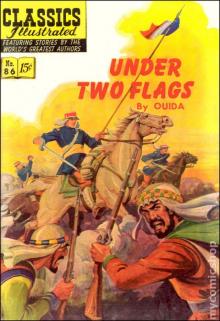
Bertie bowed with the old Pall Mall grace, turned, and gave the word to advance. Like greyhounds loosed from leash, the squadrons thundered down the slope, and swept across the plain in magnificent order, charging full gallop, riding straight down on the bristling steel and levelled rifles of the enemy’s kneeling square. They advanced in superb condition, in matchless order, coming on with the force of a whirlwind across the plain; midway they were met by a tremendous volley poured direct upon them; half their saddles were emptied; the riderless chargers tore, snorting, bleeding, terrified, out of the ranks; the line was broken; the Virginians wavered, halted, all but recoiled; it was one of those critical moments when hesitation is destruction. Bertie saw the danger, and, with a shout to the men to come on, he spurred his horse through the raking volley of shot, while a shot struck his sombrero, leaving his head bare, and urging the animal straight at the Federal front, lifted him in the air as he would have done before a fence, and landed him in the midst of the square, down on the points of the levelled bayonets. With their fierce war-cheer ringing out above the sullen uproar of the firing, his troopers followed him to a man, charged the enemy’s line, broke through the packed mass opposed to them, cut their way through into the centre, and hewed their enemies down as mowers hew the grass. Longstreet’s work was done for him; the Federal square was broken, never again to rally.
But the victory was bought with a price; as his horse fell, pierced and transfixed by the crossed steel of the bayonets, a dozen rifles covered the Confederate leader; their shots rang out, and Bertie Winton reeled from his saddle and sank down beneath the press as his own Southerners charged above him in the rush of the onward attack. On an eminence to the right, through his race-glass, his father watched the engagement, his eyes seldom withdrawn from the Virginian cavalry, where, for aught he knew, one of his own blood and name might be — memories of Salamanca and Quatre Bras, of Moodkee and Ferozeshah, stirring in him, while the fire of his dead youth thrilled through his veins with the tramp of the opposing divisions, and he roused like a war-horse at the scent of the battle as the white shroud of the smoke rolled up to his feet, and the thunder of the musketry echoed through the valley. Through his glass, he saw the order given to the troopers held in reserve; he saw the magnificent advance of that charge in the morning light; he saw the volley poured in upon them; and he saw them under that shock reel, stagger, waver, and recoil. The old soldier knew well the critical danger of that ominous moment of panic and of confusion; then, as the Confederate Colonel rode out alone and put his horse at that leap on to the line of steel, into the bristling square, a cry loud as the Virginian battle-shout broke from him. For when the charger rose in the air, and the sun shone full on the uncovered head of the Southern leader, he knew the fair English features that no skies could bronze, and the fair English hair that blew in the hot wind. He looked once more upon the man he had denied and had disowned; and, as Bertie Winton reeled and fell, his father, all unarmed and non-combatant as he was, drove the spurs into his horse’s flanks, and dashing down the steep hill-side, rode over the heaps of slain, and through the pools of gore, into the thick of the strife.
With his charger dead under him, beaten down upon one knee, his sword-arm shivered by a bullet, while the blood poured from his side where another shot had lodged, Bertie knew that his last hour had come, as the impetus of the charge broke above him — as a great wave may sweep over the head of a drowning man — and left him in the centre of the foe. Kneeling there, while the air was red before his sight that was fast growing blind from the loss of blood, and the earth seemed to reel and rock under him, he still fought to desperation, his sabre in his left hand; he knew he could not hold out more than a second longer, but while he had strength he kept at bay.
His life was not worth a moment’s purchase, — when, with a shout that rang over the field, the old Lion rode down through the carnage to his rescue, his white hair floating in the wind, his azure eyes flashing with war-fire, his holster-pistol levelled; spurred his horse through the struggle, trampled aside all that opposed him, dashed untouched through the cross-fire of the bullets, shot through the brain the man whose rifle covered his son who had reeled down insensible, and stooping, raised the senseless body, lifted him up by sheer manual strength to the level of his saddle-bow, laid him across his holsters, holding him up with his right hand, and, while the Federals fell asunder in sheer amazement at the sudden onslaught, and admiration of the old man’s daring, plunged the rowels into his horse, and, breaking through the reeking slaughter of the battle-field, rode back, thus laden with his prisoner, through the incessant fire of the cannonade up the heights to the Federal lines.
“If you were to lie dying at my feet!” — his father remembered those words, that had been spoken five years before in the fury of a deadly passion, as Bertie lay stretched before him in his tent, the blood flowing from the deep shot-wound in his side, his eyes closed, his face livid, and about his lips a faint and ghastly foam.
Had he saved him too late? had he too late repented?
His heart had yearned to him when, in the morning light, he had looked once more upon the face of his son, as the Virginian Horse had swept on to the shock of the charge; and all of wrath, of bitterness, of hatred, of dark, implacable, unforgiving vengeance, were quenched and gone for ever from his soul as he stooped over him where he lay at his feet, stricken and senseless in all the glory of his manhood. He only knew that he loved the man — he only knew that he would have died for him, or died with him.
Bertie stirred faintly, with a heavy sigh, and his left hand moved towards his breast. Old Sir Lion bent over him, while his voice shook terribly, like a woman’s.
“Bertie! My God! don’t you know me?”
He opened his eyes and looked wearily and dreamily around; he did not know what had passed, nor where he was; but a faint light of wonder, of pleasure, of recognition, came into his eyes, and he smiled — a smile that was very gentle and very wistful.
“I am glad of that — before I die! Let us part friends — now. They will tell you I have — redeemed — the name.”
The words died slowly and with difficulty on his lips, and as his father’s hand closed upon his in a strong grasp of tenderness and reconciliation, his lids closed, his head fell back, and a deep-drawn, labored sigh quivered through all his frame; and Lion Winton, bowing down his grand white crest, wept with the passion of a woman. For he knew not whether the son he loved was living or dead — he knew not whether he was not at the last too late.
Three months further on, Lady Ida Deloraine sat in her warm bright nest among the exotics, gazing out upon the sunny lawns and the green woodlands of Northamptonshire. Highest names and proudest titles had been pressed on her through the five years that had gone, but her loveliness had been unwon, and was but something more thoughtful, more brilliant, more exquisite still than of old. The beautiful warmth that had never come there through all these years was in her cheeks now, and the nameless lustre was in her eyes, which all those who had wooed her had never wakened in their antelope brilliancy, as she sat looking outward at the sunlight; for in her hands lay a camellia, withered, colorless, and yellow, and eyes gazed down upon the marvellous beauty of her face which had remembered it in the hush of Virginian forests, in the rush of headlong charges, in the glare of bivouac fires, in the silence of night-pickets, and in the din of falling cities.
And Bertie’s voice, as he bent over her, was on her ear.
“That flower has been on my heart night and day; and since we parted I have never done that which would have been insult to your memory. I have tried to lead a better and a purer life; I have striven to redeem my name and my honor; I have done all I could to wash out the vice and the vileness of my past. Through all the years we have been severed I have had no thought, no hope, except to die more worthy of you; but now — oh, my God! — if you knew how I love you, if you knew how my love alone saved me — —”
His words broke down in the great passion that had been his redemption; and as she lifted her eyes upward to his own, soft with tears that had gathered but did not fall, and lustrous with the light that had never come there save for him, he bowed his head over her, and, as his lips met hers, he knew that the redeemed life he laid at her feet was dearer to her than lives, more stainless, but less nobly won.
OUR WAGER.
OR, HOW THE MAJOR LOST AND WON.
I. INTRODUCES MAJOR TELFER OF THE 50TH DASHAWAY HUSSARS.
The softest of lounging-chairs, an unexceptionable hubble-bubble bought at Benares, the last Bell’s Life, the morning papers, chocolate milled to a T, and a breakfast worthy of Francatelli, — what sensible man can ask more to make him comfortable? All these was my chum, Hamilton Telfer, Major (50th Dashaway Hussars), enjoying, and yet he was in a frame of mind anything but mild and genial.
“The deuce take the whole sex!” said he, stroking his moustache savagely. “They’re at the bottom of all the mischief going. The idea of my father at seventy-five, with hair as white as that poodle’s, making such a fool of himself, when here am I, at six-and-thirty, unmarried; it’s abominable, it’s disgusting. A girl of twenty, taking in an old man of his age, for the sake of his money — —”
“But are you sure, Telfer,” said I, “that the affair’s really on the tapis?”
“Sure! Yes,” said the Major, with immeasurable disgust. “I never saw her till last night, but the governor wrote no end of rhapsodies about her, and as I came upon them he was taking leave of her, holding her hand in his, and saying, ‘I may write to you, may I not?’ and the young hypocrite lifted her eyes so bewitchingly, ‘Oh yes, I shall long so much to hear from you!’ She colored when she saw me — well she might! If she thinks she’ll make a fool of my father, and reign paramount at Torwood, give me a mother-in-law sixteen years younger than myself, and fill the house and cumber the estates with a lot of wretched little brats, she’ll find herself mistaken, for I’ll prevent it, if I live.”
“Don’t be too sure of that,” said I. “From what I know of Violet Tressillian, she’s not the sort of girl to lure her quarry in vain.”
“Of course she’ll try hard,” answered Telfer. “She comes of a race that always were poor and proud; she’s an orphan, and hasn’t a sou, and to catch a man like my father worth 15,000l. a year, with the surety of a good dower and jointure house whenever he die, is one of the best things that could chance to her; but I’ll be shot if she ever shall manage it.”
“Nous verrons. I bet you my roan filly Calceolaria against your colt Jockeyclub that before Christmas is out Violet Tressillian will be Violet Telfer.”
“Done!” cried the Major, stirring his chocolate fiercely. “You’ll lose, Vane; Calceolaria will come to my stables as sure as this mouthpiece is made of amber. Whenever this scheming little actress changes her name, it sha’n’t be to the same cognomen as mine. I say, it’s getting deuced warm — one must begin to go somewhere. What do you say to going abroad till the 12th? I’ve got three months’ leave — that will give me one away, and two on the moor. Will you go?”
“Yes, if you like; town’s emptying gradually, and it is confoundedly hot. Where shall it be? — Naples — Paris — —”
“Paris in July! Heaven forbid! Why, it would be worse than London in November. By Jove! I’ll tell you where: let’s go to Essellau.”
“And where may that be? Somewhere in the Arctic regions, I hope, for I’ve spent half my worldly possessions already in sherry and seltzer and iced punch, and if I go where it’s warmer still, I shall be utterly beggared.”
“Essellau is in Swabia, as you ought to know by this, you Goth. It’s Marc von Edenburgh’s place, and a very jolly place, too, I can tell you; the sport’s first-rate there, and the pig-sticking really splendid. He’s just written to ask me to go, and take any fellows I like, as he’s got some English people — some friends of his mother’s. (A drawback that — I wonder who they are.) Will you come, Vane? I can promise you some fun, if only at the trente-et-quarante tables in Pipesandbeersbad.”
“Oh yes, I’ll come,” said I. “I hope the English won’t be some horrid snobs he’s picked up at some of the balls, who’ll be scraping acquaintance with us when we come back.”
“No fear,” said Telfer; “Marc’s as English as you or I, and knows the good breed when he sees them. He’d keep as clear of the Smith, Brown, and Robinson style as we should. It’s settled, then, you’ll come. All right! I wish I could settle that confounded Violet, too, first. I hope nothing will happen while I’m in Essellau. I don’t think it can. The Tressillian leaves town to-day with the Carterets, and the governor must stick here till parliament closes, and it’s sure to be late this year.”
With which consolatory reflection the Major rose, stretched himself, yawned, sighed, stroked his moustache, fitted on his lavender gloves, and rang to order his tilbury round.
Telfer was an only son, and when he heard it reported that his father intended to give him a belle-mère in a young lady as attractive as she was poor, who, if she caught him, would probably make a fool of the old gentleman in the widest sense of the word, he naturally swore very heartily, and anything but relished the idea. Hamilton Telfer, senior, had certainly been a good deal with Violet that season, and Violet, a girl poor as a rat and beautiful as Semele, talked to him, and sang to him, and rode with him more than she did with any of us; so people talked and talked, and said the old member would get caught, and the Major, when he heard it, waxed fiercely wroth at the folly his parent had fallen into while he’d been off the scene down at Dover with his troop, but, like a wise man, said nothing, knowing, both by experience and observation, that opposition in such affairs is like a patent Vesta among hayricks. Telfer was a particular chum of mine: we’d lounged about town, and shot on the moors, and campaigned in India together, and I don’t believe there was a better soldier, a cooler head, a quicker eye, or a steadier hand in the service than he was. He was six-and-thirty now, and had seen life pretty well, I can tell you, for there was not a get-at-able corner of the globe that he hadn’t looked at through his eye-glass. Tall and muscular, with a stern, handsome face, with the prospect of Torwood (where there’s some of the best shooting in England, I give you my word), and 15,000l. a year, Telfer was a great card in the matrimonial line, but hadn’t let himself be played as yet, for the petty trickery the women used in trying to get him dealt to them disgusted him, and small wonder. Men liked him cordially, women thought him cold and sarcastic; and he was much more genial, I admit, at mess, or at lansquenet, or in the smoking-room of the U. S., than he was in boudoirs and ball-rooms, as the mere knowledge that mammas and their darlings were trying to hook him made him get on his stilts at once.
“I don’t feel easy in my mind about the governor,” said he, as we drove along to the South-Eastern Station a few days after on our way to Essellau. “As I was bidding him good-bye this morning, Soames brought him a letter in a woman’s hand. Heaven knows he may have a score of fair correspondents for anything I care, but if I thought it was the Tressillian, devil take her — —”