

Tomb World, page 6
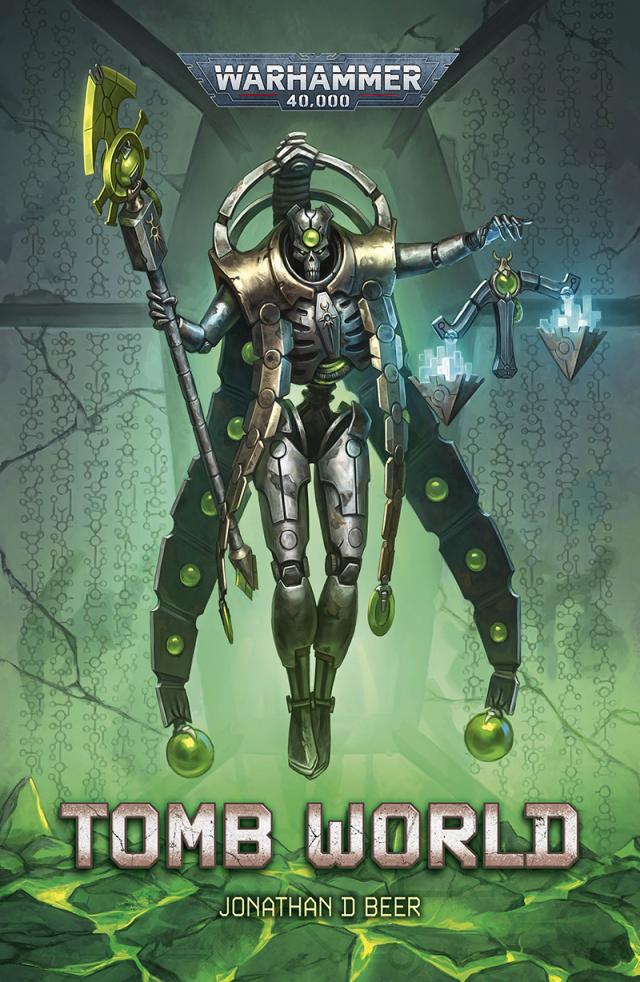


In the days since her release Khemet has been plagued by a cold, abstract kind of anger. She had believed that her fury arose from the shame of her debilitated condition, a manifestation of her frustration and corrupted neural pathways. And while that undoubtedly is the case, now that Khemet has access to her most recent memories and can recall at will the betrayal that cast her into the labyrinth, she has a far more potent and justified cause for her rage.
The injustice of Anrakyr’s actions is a hot coal in her core. She is a praetorian, an agent of the Silent King. No one, not even a phaeron, may elevate himself above the servants of the Triarch. The Traveller violated the gravest laws of the necrontyr when he placed himself in judgement over her. What is more, he has compounded his crime by robbing Khemet of her rod of covenant, her staff of office that marks her as a praetorian of the Triarch.
In her isolation, Khemet has found a new kind of solace from the persistent flaws and failures of her cognition – imagining the forms her vengeance will take when she next meets the Traveller.
‘Khemet. Your presence is desired by Lord Hekasun.’
The interstitial message arrives fully formed, as though Kamoteph walks beside her.
‘I told you to leave my mind, cryptek.’ She snarls the words, grateful for a target against which to turn her attention.
‘I assure you, praetorian, I have made no unsolicited entrance to your thoughts. The interstices are merely the simplest means of contacting you while continuing with my work.’
Khemet chooses to hold on to her anger in the face of Kamoteph’s conciliation.
‘Does Lord Hekasun give any consideration to my desires?’ This, she knows, is simply contrarian pique. She has been planning to force an audience with the commander of the Senusret for several days, the first step on her imagined path that will lead her to Anrakyr.
Khemet has not paused in her wandering at Kamoteph’s contact. As she turns a corner, stone giving way to more stone, she finds her way blocked. Mandulis stands across the passageway’s width. Much like their first encounter he is armed, and says nothing.
‘I am afraid not,’ says Kamoteph into her mind.
That Hekasun chooses to insult her by dispatching his vargard to usher her to him is telling of what is to come, though she takes some pleasure in recalling Mandulis’ destruction at her hands. A warden who has been defeated by his ward is not a potent form of intimidation.
‘Very well,’ she says aloud.
Mandulis turns on his heel and sets off. He does not wait for Khemet, but after a moment’s petulant hesitation she follows.
She waits for anything further from Kamoteph, but he is silent. She is glad; despite his protestations to the contrary, she does not trust that the cryptek will honour his promise to leave her thoughts alone.
As she walks, the digits of her intact hand begin to drum against the metal of her thigh, a manifestation of her trepidation at returning to the company of other necrons. It is only for a moment, her fingers producing a handful of dull notes that barely go beyond her. But it is enough for Mandulis to notice; Khemet sees the vargard tilt his head slightly towards the sound.
‘You are Lord Hekasun’s vargard,’ she says, as cover for her dismay at showing her impairment to another. ‘Were you always in his service?’
He does not answer.
‘How many times have you been destroyed?’ she tries instead.
He does not answer.
‘Do you even know?’
He halts abruptly, turning so that his copper oculars can fix upon Khemet’s.
When the C’tan crafted the slave-bodies for their deceived servants, they made their faces cruel. Heavy brows sit above deep sockets, lit by bitter oculars that stare out of the darkness. The sharp planes of their faces draw down into sneering, lipless mouths. The necron visage is cold, callous, spiteful.
Mandulis’ face is all this and more. His necrodermis is flawless, but there is an unmistakable air of time-worn malice in his stare. This is a warrior who has endured much, and who remembers every slight and scorn.
The vargard, his point made, resumes his marching pace. Khemet nods to herself, struck by a surprising pang of regret for her mockery. Reanimation is the greatest gift that biotransference bestowed, but it is not faultless. Every body-death, every mind’s pass through the reanimation circuitry of tomb worlds and ships degrades that mind further. Serfs and nobles alike are slowly worn away, a little less of themselves restored to their newly crafted bodies.
Mandulis, she suspects, is evidence of this. His silence is not a choice. His brain and body have been rebuilt so many times, with flaw compounding upon flaw, he has lost the ability to speak.
The vargard leads her into a part of the ship she has yet to explore, further forward within the ship’s narrow superstructure. The Senusret is a Dirge-class warship, a slight and swift grade of vessel most often found escorting its greater brethren. Now, however, it sails alone.
Khemet has been aboard many such ships, and would have had no difficulty finding her way to its command deck unescorted. That familiarity is her undoing. As she turns a corner her perceptual centres fail. With a lurch akin to vertigo a wave of memory crashes over her, laying every time she has walked through a hallway such as this upon her senses one atop the other, until the signals of her inputs are all but swamped and she cannot tell where memory ends and the now begins.
She looks around at the pattern of marbling within the stone. The glyphs carved within their columns. They are all alike, all the hundreds of times she has stood in this spot. Her vision blurs, unable to distinguish between what she is seeing and what she has seen.
Khemet stumbles, her equilibrium lost. As she staggers, the tip of her foot strikes the wall, leaving a short, shallow scar across its smooth surface.
In an instant the vertigo passes. The violence of its departure leaves her even further off balance, until she realises how she had broken the spell.
The scratch she made in the wall is new. This is the only version of this corridor that is marked this way. She has changed it. She has acted upon the world, rather than reliving what she has already done. This is the dividing line that she needs, the means of fixing her broken perceptions in the moment.
Khemet stares at the faint scuff as the last of the overlapping memories recede to their vaults. It is only then, when she feels she is back on firm ground, that she glances up.
Mandulis has not paused in his stolid, inexorable march, and is a dozen paces ahead of her. If he noticed her stumble, he gives no sign of it.
She sets off once again, now barely seeing the corridor and the shades of darkness in the noctilith, all her attention turned inwards. After several paces she reaches out and lets her hand brush along the cold, unyielding surface at intervals. Occasionally she digs the tips of her fingers in, faintly scarring the stone, marking the world. Feeding her mind a pulse of fresh sensation to keep her chained to the now.
The corridor opens abruptly into a squared archway, a pair of warriors flanking the entrance. They stand at either side with spears bared and crossed to block her path. At Mandulis’ approach they sharply withdraw their blades, adhering to the protocols of authority without thought.
The command deck of a necron vessel is a multi-tiered affair. Crew stations project from the blackstone walls, and are sunk into geometric depressions. Each station is an arrangement of sharp-edged consoles, illuminated by the unhealthy jade glow of information passing across their faces. In ages past, each cluster of consoles would have been attended by a collection of serfs, honoured far above the standing of their birth to serve aboard a voidship.
At the rear of the deck is a throne, raised by a series of stepped platforms to place the vessel’s commander far above their thralls. The arrangement of the deck’s levels, which to an uneducated eye seems random, is in fact a mathematically perfect disposition to ensure the occupier of the ship’s throne has an uninterrupted view of each serf and their station.
Of course, such architectural considerations had been rendered unnecessary by biotransference. A necron lord receives thousands of sendings per second from every part of their ship’s systems. They can cast their consciousness directly into the head of any warrior to see what they see and take charge of their limbs. Visual surveillance of a crew slaved to a commander’s will is an anachronism.
Yet it does not stop some from adhering to the old ways. As Khemet enters she observes a cohort of lychguard making their slow rounds along the walkways between the crews, oculars sweeping over vacant serfs. The warriors are largely idle, staring with blank incomprehension at controls that do not require them. The only real activity is undertaken by a few apprenteks scattered amongst the serfs, slender creatures marked out by their bracelets and necklaces of attainment tiles.
Khemet’s arrival goes unnoticed, or at least unremarked, by both the crew and the few knots of nobles that litter the deck. There are a dozen necrons of various ranks clustered at the foot of the throne’s pyramid. The vents of their central reactors glow in shades of jade, copper, sapphire and amaranth. They, like the lychguard, clearly have no role in the function of the Senusret, serving merely to clutter the deck.
It is clear which of the nobles is in command. He sits atop the throne, occasionally deigning to give his attention when a group of sycophants request it. This is a familiar scene for Khemet. Few necron lords, whatever their true rank and standing, would be without a train of subordinates to reinforce their status, and Hekasun is evidently no exception.
She watches Hekasun, as Mandulis abandons her and drifts loyally to his master’s side. Kamoteph has told her that he was present for her release from the labyrinth, but Khemet does not recall him. He is a broad figure, as powerful and well sculpted as any of the necrontyr nobility beneath him. A pair of sickle-bladed swords hang on either side of his stone seat, close at hand, but that means little. Every noble, regardless of their rank and function, carries the skill and knowledge of necrontyr warcraft in their minds.
Khemet has hovered on the periphery for too long – her hesitation will be noticed if she lingers any longer.
As Khemet enters their midst, the press of figures parts as though she carries a contagion. She halts at the foot of the throne’s ziggurat. She suddenly feels the absence of her rod of covenant. So many times has she stood as she now stands, at the centre of a hostile court and beneath the gaze of an arrogant lordling, but bearing the sigil to which all must heed.
‘You asked for me,’ she says after a long pause. All audible conversation has paused at her approach.
Hekasun stares down at her. ‘I did not ask for you,’ he replies. ‘I summoned you.’
After so many days of Kamoteph’s blandishments and cajoling, Hekasun’s honest aggression is surprisingly refreshing.
‘It pleases me to see you restored, praetorian. On our last meeting you were in a far more… inchoate state.’
‘For what purpose was I summoned?’ she asks. She will not indulge his petty impulse to perform for his cronies.
Hekasun’s gaze sharpens. ‘Kamoteph. I think you explain it best.’
The cryptek shuffles forwards. He has been standing silently at the base of the throne’s pyramid, proximate to but clearly separate from the fawning nobles. He plants himself before Khemet, leaning heavily on his staff, and waits until she shifts her attention from his lord to the cryptek. If he regrets his role in Hekasun’s pageantry, he gives no sign of it.
‘Praetorian Khemet,’ he begins, in a sonorous tone. ‘By the judgement of Overlord Anrakyr, to whom this court is pledged, you are duatekh. Condemned. Your existence is forfeit.’
Evidently Kamoteph has been commanded to demean her before Hekasun’s cadre of lesser lords. Khemet’s extant hand clenches into a fist.
‘But our overlord is merciful. He would see you serve once more.’
Again, the Traveller sets himself above Khemet. Above even the Silent King. Khemet’s thoughts of retribution stir, awakening her combat protocols. The flames of her core-flux shift in response, burning hotter and harder.
‘You have been released into the custody of my lord Hekasun,’ Kamoteph continues. ‘He holds your leash. If you perform as you are required, my lord is empowered to consider you redeemed. If he judges otherwise, you will return to the labyrinth.’
She can feel her self-control slipping. No force in the universe would compel Khemet to return to that prison, and the mere threat of it is enough to send sparks racing along her neural net.
It takes all of her restraint to remain still. ‘What would you have me do?’
Hekasun rises from his throne, an image of imperious command.
‘You lost the Traveller a world, praetorian. Now, you will win him one.’
Realisation dawns like a shattering crystal, each shard knife-edged with perfect clarity. This is the answer to her question to Kamoteph, to why she has been freed from the labyrinth.
As a praetorian, Khemet is empowered to override the command precepts of a tomb world. She has done it before. She gifted the world of Menouthis to the Traveller, and there have been others, those isolated and forgotten worlds that Anrakyr’s host came upon in their tireless campaign. Entire stellar systems, like the Lazar crownworld, have awoken from the Great Sleep to find that they serve an entirely different master, their dynastic lords displaced and their loyalties remapped to the Traveller and his generals.
‘Do you understand the task you are charged to perform, duatekh?’ Hekasun demands from his dais.
Khemet understands that she has been freed merely to serve as a tool of theft, with as little honour or nobility of purpose.
‘I do.’
CHAPTER 6
Her humbling delivered, Hekasun returns to conversation with his court, beckoning several up the steps of his throne so they can praise his commanding display. Kamoteph gives Khemet the briefest of bows, a fractional dip of his head, before retiring to his place in the shadows.
For a time she observes, feeling the pulse and rhythm of the deck. The lychguard pace, alert for hints of disobedience that are impossible for the vacant warriors they oversee. Kamoteph’s mentees work, though in truth there is little a crew is required to do aboard a necron craft.
Khemet goes purposefully ignored. This in itself is not unfamiliar; few would purposefully attract the attention of a praetorian, and so she is used to a degree of studious inattention.
There is so much that she does not yet know. The Traveller has tasked Hekasun to wake a slumbering world, but she does not know which world, or from which dynasty they will be stealing. When questioned, the Senusret’s autonomous spirit is unhelpful – the ship is indeed decelerating, but it will not share its destination with her.
Their objective is not the only mystery. During her idleness she examines the medley of necron nobility Hekasun has chosen to accompany him on this mission, and she is left even more confused.
It was not simply the great dynasts who formed the aristocracy of the necrontyr. Nobility was a station to which one was born, not a rank awarded through distinguished service or merit. How the scions of the dynasties employed themselves had varied greatly in accordance with the size of their house, the scale of their dominion, and their personal proclivities. The sons and daughters of phaerons and overlords were raised to rule, but the lesser houses were as destined to serve as the commoners, albeit in significantly greater comfort.
A creeping realisation settles upon Khemet. The glyphs engraved upon the courtiers’ bodies display allegiances to a motley assortment of lesser houses, and some that even Khemet does not know. These are not the lords of the Traveller’s legions. These are not his nemesors, or admirals, or the wisest of his counsellors. No, these are the disowned. The assemblage of nobility is made up of those who have been cut loose from their dynasties. They are the dispossessed, the embarrassments, the burdens their overlords could not afford and were happy to lose. They are the members of houses who were content to render them up to the Traveller as hostages.
She looks up at Hekasun. An overblown lordling commanding a single vessel, with a court of second-rate hostages for companions and a bent-backed cryptek for a vizier.
It is becoming apparent to Khemet that this mission does not rank highly among the Traveller’s priorities.
‘Absurd, are they not?’
None of Hekasun’s lackeys have yet approached her, either out of fear of Hekasun’s judgement or – she hopes – fear of her. The first necron to do so is a deathmark, who appears with the silent tread of her profession from around the corner of a pillar.
‘None of them have commanded so much as a parade, and yet they preen as though they are about to break the heavens themselves.’
Khemet had not noticed the deathmark as she had entered, but that is hardly surprising. Those Khemet has known are as fleet of foot and subtle of manner as any necron can be.
‘Hail, praetorian.’
‘Greetings, assassin,’ Khemet replies.
She speaks the title with no great venom. Though there are many in her order who consider any use of those who bear the deathmark to be a grave violation of the codes of war, Khemet is more open-minded. She has never and will never sanction their sly ways in conflicts between dynasties, but the necrons have loathsome and treacherous foes. The concealed blade has its purpose, and Khemet has never baulked at deploying the deathmarks to sever the head of an Unclean army when that is the swiftest path to victory.
‘I am Ahnuret,’ she says, stepping from the shadows.
‘Khemet.’


