

Tomb World, page 4


Aeldari.
This world is guarded by four other praetorians, peers in whom Khemet has a trust that can only come from millions of years of shared duty. She receives terse notifications from each of them, alerted as she has been by the vault’s spirit. They stride into dimensional doorways at points scattered across the globe, and emerge an instant later from a shimmering emerald portal less than six khet from the besieged library.
Khemet herself sets off with a measured stride, giving her body’s actuators a moment to test themselves and ensure optimal function after her idleness. From her position on the tomb’s western terrace, it will be swifter for her to approach from the exterior of the complex, and tactically advantageous to engage the aeldari from the rear.
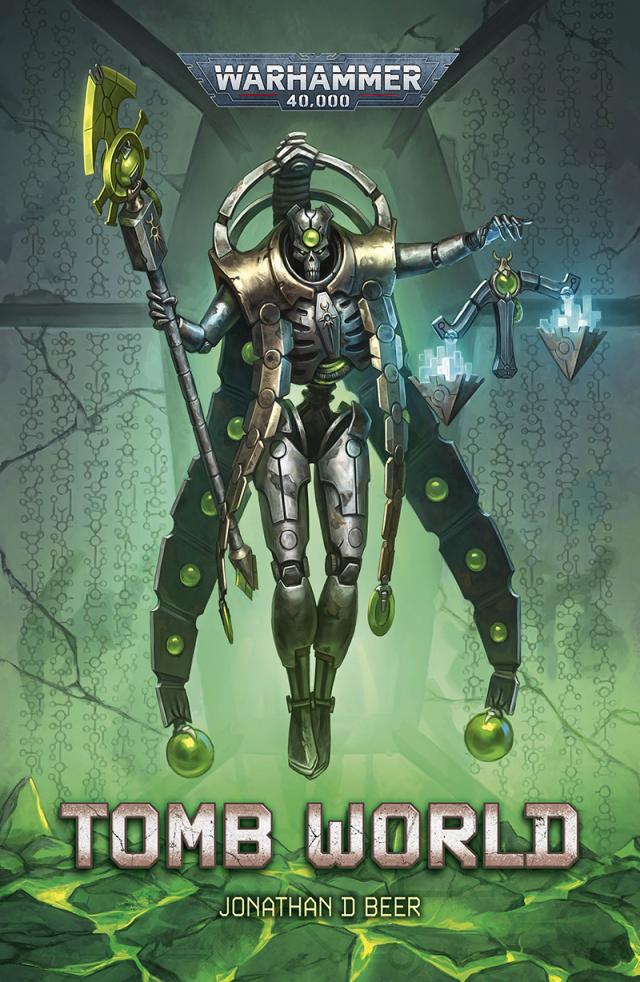
With a flourish, she recalls her rod of covenant from its pocket dimension. The stave enters reality in a burst of jade energy and settles comfortably in her waiting hand. Its bladed head is sculpted in evocation of the ankh of the Triarch, the same symbol that burns upon her metal chest and proclaims her allegiance, above all else, to her absent king.
After centuries of inactivity, the promise of a pitched battle ignites a gratifying fire in her central reactor. Periods of rest can be useful, but Khemet lives for her duty.
The gravity displacement pack that forms the upper portion of her torso flares into life, carrying Khemet up into the sky and towards her enemy.
Khemet surfaces as though from beneath an ocean’s waves. Error codes still dance in her sight, and are slow to subside.
‘Such weakness.’
When Khemet realises the comment is directed at her, anger burns away much of the turmoil. She looks over at him, still sitting upon the room’s sole chair, as though he requires the carved stone’s respite from a day’s exertions. As though every stick of furnishing were not alien to him and to the necron existence.
‘You dare speak to me of weakness? You, whose flaws extend to mastery of your own form?’
Kamoteph rises, and despite his stoop he seems to tower over Khemet, his presence outstripping his dimensions.
‘My flaws are my own, praetorian. But I expected more from you. The labyrinth was a harsh domain, no doubt, but you are a disappointment. The Silent King’s favoured servants should not be so fragile.’
With the gates thrown open, this comes easily. In a great cascade, an avalanche of renewed emotion, Khemet sees the figure whom she has served all the years of her long life.
She stands in silence, illuminated by the light of a poisonous star and the unyielding gaze of an imperious monarch.
Every praetorian in the galaxy stands beside her. They are arrayed across the decks of thousands of ark-craft in serried ranks, unconcerned by the chill of the void. They bask in the presence of their lord, but mourn the reason they have been brought together.
Szarekh, the Silent King. The deceived sovereign and conquering saviour of an empire.
He looks down from his dais, bathed in the baleful glare of their home star, the virulent orb that laid its curse in the bones of every necrontyr. At his back, suspended like jewels in the azure rays, are the vessels of his armada, the craft of the honoured millions who will accompany their king into his self-imposed exile.
The greatest jewel of all is the Song of Oblivion, pre-eminent among the vessels sent forth by the necrontyr. It was from the throne of its majesty that the Silent King cast down the gods and shackled them to his will, slaves to those they had enslaved. Now the mighty ship will carry him into the lightless expanse beyond the galaxy’s edge, an eternal penance for his failure to perceive the lies of the C’tan.
Khemet looks up, aching in whatever facsimile of a soul the treachery of biotransference left her. The fault did not lie solely with her king. Khemet, as with all the praetorians of the Triarch, are the appointed guardians of the empire’s spirit. She, as much as any other, bears the shame of accepting the star gods’ honeyed words while blind to the hunger in their eyes.
Szarekh says nothing, for he is the Silent King. But Khemet needs no words, no parting oaths or gestures. That he has taken this brief moment with them, a final conclave between a master and his most devoted servants, is all the acknowledgement she requires.
His dais completes its long, slow drift across the face of their formation. Szarekh halts, fewer than a hundred khet from Khemet’s ghost ark. For the briefest moment, Khemet thinks that he will break the tradition of millennia and raise a hand in farewell. Or, perhaps, he will violate the ancient taboo and speak some parting word, a last order that would sustain Khemet through the ages to come.
He does not.
With the briefest flare of light her king steps through a dimensional doorway, departing to take the helm of his palanquin for the voyage to come.
None move to follow him. For the praetorians there can be only one duty. As long as their monarch is absent from his realm, they will guard it. While the rest of the Silent King’s subjects march in lockstep into their stasis vaults, they will stand as sentinels over the tomb worlds. They will defend a sleeping empire against the grasping claws of the Unclean, and chronicle all that passes in the domain the necrons have abandoned, but not relinquished.
For inherent in the purpose of the Great Sleep is the promise of awakening – that the necrons will once more bestride the galaxy. Khemet clings to the hope bound up with that promise – that the hour of their rising will also be the hour in which their all-conquering king is returned to them. When he is returned to her.
The engines that will propel the master of an empire into exile blaze into life, their brilliance fit to eclipse the cancerous sun. Slowly, but with growing speed, the fleet turn their prows to the emptiness and depart.
Khemet watches until the last glimmers are swallowed by the darkness of the void.
‘Remarkable.’
The word escapes Kamoteph, and Khemet crashes back to the now.
The cryptek has seen all that she recalls. Intruded upon a moment of the gravest sanctity, and after his scorn and mockery. None outside the praetorian’s order were present to witness the Silent King’s departure, and now that most solemn memory has been tainted.
Kamoteph backs away, staff gripped suddenly tight, as if that could ward off her rage.
Khemet has no weapon to level, and so can only express her fury as a fist raised and poised to strike.
‘Withdraw your creatures from my head, and end your voyeurism of my thoughts.’
Kamoteph backs away awkwardly, his canoptek pets scuttling from beneath his feet. ‘You still need my aid.’
‘Then you will give it without prising open my brain.’
The cryptek nods, dropping his long chin in submission.
The faintest sensation, like a stream of sand, trickles down the nape of her skull and along her arm. A knot of grey, no larger than a fingernail, forms on the back of her clenched fist. Kamoteph extends a hand and sweeps it over Khemet’s, and the nanoscarabs are gone.
There is no matching sensation for Kamoteph’s retreat from her thoughts, but when she runs a diagnostic she finds her interstitial nodes untouched by outside influence.
‘Now get out.’ Khemet points towards the far wall.
She has learnt enough of Kamoteph in the few days she has been free to know that it is not in him to endure her dismissal without comment, so she is unsurprised when he pauses at the threshold.
‘Your progress pleases me, praetorian. You may yet serve your purpose.’
CHAPTER 4
‘Why have you freed me?’
This is the question Khemet asks each time Kamoteph comes to her.
Khemet has been given the freedom to roam the Senusret by Hekasun, though she has yet to encounter him or be invited to his presence. She has not sought out that audience, though she knows she should.
After the first flush of pleasure in her returning sense of self, her recovery has stalled. So much of her cognitive processing is taken up with the effort of containing all she now recollects, Khemet finds herself slow-witted. Worse, she is distracted, robbed of the purity of focus her cursed metal existence should bring.
The reason is not complicated. Her time in the labyrinth was spent drifting between her memories, retaining what little sanity she had left by reliving all that she has said and done in the course of her age-long existence. That path into her engrammatic vaults is well-worn, and too easy to slip into. It is not merely a temptation, but a compulsion, to escape the constant trials of the now by disappearing into the triumphs and tragedies of the then.
But to give in to such compulsion is an intolerable weakness. Thus, Khemet has taken to roaming the ship in search of other stimuli.
She has quickly exhausted the novelties it can offer. She has walked its dark halls, and stood among its crypts. She finds a measure of peace by looking through viewports at the passing starlight. She has observed the chained fragment of a star god whose immense power is siphoned to drive the Senusret through the void, but she finds little interest or satisfaction in its torment.
Kamoteph seeks her out in these places, or in her quarters. Though he has become more cautious in his handling of her, the cryptek continues to urge her always to confront her fear and reach into her memories, in spite of the risk she feels lurking among them. He is fixated upon restoring her, awakening the parts of Khemet that still remain out of reach. While she is just as eager to be free of the unbearable weakness that plagues her, his interest plainly goes beyond altruism.
‘Why did you free me?’ she asks. He has found her in one of the practice halls near the rear of the Senusret, one of many such spaces whose function was rendered unnecessary by the C’tan’s treachery. No necron, regardless of their station, has any need to practice the forms of war. Khemet had been using the empty space to test her capacity for stillness, but the cryptek’s arrival sets her to pacing about the hall.
‘We were bade to release you by the overlord,’ Kamoteph replies.
‘Which overlord?’
‘Do you not recall?’
The urge to lash out boils up, and Khemet forces it back down. ‘I have cautioned you before, cryptek, to be wary of mocking me.’
He inclines his head. Khemet has learnt that a pretence of submission is Kamoteph’s habitual response to reproach. ‘Speak to me,’ he says, ‘of Lord Anrakyr.’
He is called the Traveller.
The ceaseless crusader, the phaeron so driven by a vision of necron supremacy that he gave up his claim to his own crownworld so that he might raise an empire from its torpor.
The wandering vagrant, who plunders the strength of the worlds he stirs from the Great Sleep before their time.
‘He is an overlord,’ she replies, after the momentary shock of successful recall subsides.
‘Not merely an overlord,’ corrects Kamoteph. ‘Our lord, to whose service we are pledged.’
‘I serve only the Silent King and the Triarch.’ The words are automatic, not heartfelt as they should be. But Khemet has no heart, and while the bonds of fealty are hard-coded in her, they are unmoored from the experience of time and deed.
‘That,’ says Kamoteph carefully, ‘is not entirely true.’
This time, he is prepared for the violence of her reaction. As Khemet strides towards him, hands clenching in the absence of a weapon, Kamoteph retreats into the swarm of canoptek constructs that have accompanied him. They do not attack her but they foul her steps, requiring that she either stamp them into shrapnel or halt her approach.
‘I bid you think,’ he says quickly. ‘I do not question your devotion to our king, from whom all light and power flows.’ The cryptek touches the ankh of the Triarch emblazoned in his chestplate. The same glyph marks the necrodermis of every necron in existence, placed there at the moment of biotransference to mark them all as subjects of their king.
‘But you were alone for so much of the Great Sleep. Millions of years, a lone sentinel against the Unclean.’
In spite of all that he has done for her, Khemet resents Kamoteph’s intrusion into her thoughts. He has seen all that she has remembered, every war and judgement and condemnation. Khemet has never shared that kind of intimacy with anyone, not even her fellow praetorians, with whom – despite what Kamoteph says – she shared the long years of the Sleep.
‘It is only to be expected that as your isolation ended, as the dynasties awoke, you sought out… direction.’
She remembers. She is ashamed, but she remembers. For so long, Khemet’s duty was her own, to enact as she saw fit. She stood watch over silent tombs, battled the ravening encroachments of the Unclean, without any guiding hand.
And then she found the Traveller.
Khemet has heard of him long before his fleet enters the blighted skies above Menouthis. In recent centuries Khemet has been constantly at work, racing between the stars to shepherd the early awakenings of isolated tomb vaults, near-forgotten fringeworlds, and gilded crownworlds. For many thousands of necron nobles, Khemet’s faceplate has been the first they have seen in sixty million years.
In the course of her fleeting passage she has encountered the signs of the Traveller’s passage. Tomb worlds that had been overrun by the Unclean for millennia, now scourged of life for their sins. Newly risen coreworlds, their overlords in a state of outrage that they had been roused only to have whole flotillas and legions claimed as a tithe by the one who had woken them. Others of her order who have been drawn into his orbit, who serve as outriders of his coming and custodians of the noble courts he stirs from their age-long rest.
Khemet’s scythecraft detects the coming of its greater brethren as they enter the solar system, giving her time to rise from the depths of Menouthis’ vaults to greet him. The Traveller’s fleet now drifts in orbit, a hundred pinpricks of light even with her oculars tuned to their maximum magnification.
She stands at the tomb’s great gate, staring up into the ink-black night. It is sheer happenstance that her presence coincides with his coming, but it is a fortuitous conjunction. Her curiosity has been piqued by rumour, and this way he has brought himself to her, rather than requiring Khemet to seek him out.
She is not kept waiting. A new speck appears in the firmament and grows quickly into the familiar stooping crescent of a Night Scythe. The scout craft is chased by a fiery tail as it drops through the atmosphere, joined seconds later by a long, bellowing roar of displaced air. Its descent is fast and steep until it is only a dozen khet from the sea of sand, and then it pulls up in a lazy glimmering arc that brazenly defies gravity’s grip.
The scythecraft comes to rest before her, unleashing a brief hurricane of gritty particles that batter at Khemet’s immobile form. The craft is a study in restrained decadence, the swept wings chased with metagold to pick out the glyphs of its master. Its godsteel hull sighs as it shrugs away the heat of atmospheric entry, vitrifying the sand to glass beneath its bulk.
A blaze of light and energy makes Khemet’s oculars dim, as the wormhole in the Night Scythe’s hull forms a bridge between its orbiting flagship and the desert floor. From the jade beam comes the familiar sound of metal feet marching in lockstep on hard-packed sand.
At the head of a phalanx of warriors strides their overlord, a vision of necron majesty. For all their duplicity, the C’tan had honoured the caste structure of the necrontyr when they fashioned their cages of living metal, giving the grandest and most powerful forms to the phaerons and their heirs.
The overlord towers over Khemet, his body literally built to a grander scale than even that of the Silent King’s most favoured servants. His breadth and stature are emphasised by the crest that rises transverse from his head, a crown that Khemet might consider disloyal if it were anything more than a simple bronze crescent. Her concerns are allayed by the ankh of the Triarch, the brand of allegiance that unites the grandest warlord with the lowest warrior, proudly emblazoned at the centre of his chestplate, alight with the same cerulean glow that is barely contained within his thoracic cage. A skirt of heavy bronze plates sweeps the sand at his feet, and a warscythe’s butt hisses through the black grains as he approaches her.
‘Well met, praetorian,’ says Anrakyr, called the Traveller by admiring allies and embittered foes alike.
Khemet lifts her rod of covenant in both hands, holding her badge of office before her. She does not bow; a praetorian bows only to the Triarch.
‘Hail, lord. I am Khemet. Welcome to Menouthis.’
He acknowledges her with a single arm pressed against his chestplate, observing the rite of greeting with microscopic accuracy.
An honour guard of two-score Immortals follow in the overlord’s wake, their double-barrelled gauss blasters held in tireless arms. Khemet considers the immaculate warriors. Anrakyr has brought too few to pose a threat to the massed legions of the tomb world, but sufficient to demonstrate the calibre of the legions he could call upon. A well-judged bodyguard for a first meeting with an unknown dynasty.
Khemet, for her part, stands alone before the gates of Menouthis. The glyph upon her chestplate and crowning her staff are all the defence she requires, even from a phaeron.
Anrakyr inclines his head quizzically. ‘I had expected to be received by a delegation of the nomarch, or another of the Zathanor Dynasty. Not, of course, that the presence of one of the Triarch’s honoured emissaries is ever a disappointment.’ He possesses a kingly voice, strong and mellifluous, well suited for the giving of compliments and the issuing of commands.
‘Nomarch Benekhir did not awaken, lord. She and her court have succumbed to engrammatic decay.’ Khemet is blunt; there is little point attempting to conceal the broken state of the tomb world’s rulers.
The Traveller is sanguine, though he pauses for a moment to give Khemet’s words their due gravity. ‘The entire court?’


