

Tomb World, page 12


‘When you have a moment, my lord, there are distribution orders that require your attention.’
‘Later, Cadfan, later.’ The ablutorial door swings shut, effectively punctuating his dismissal.
Gerand Cadfan settles into the time-filling activities of a lifelong bureaucrat. The mentioned distribution orders are shuffled together, neatly arrayed beside the logisticator’s seal and ink. A pair of dataslates are deactivated and tidied into a drawer of the desk. A thick-based glass is filled with purified water from a decanter on a side table in anticipation of Farroll’s thirst.
There is a small sound, a swift whine noticeable only by its softness. Cadfan turns, curious, then starts at the heavy thud that travels through the wooden door.
‘My lord?’
No angered shout greets his weak question. He waits, caution battling with duty, but he does not wait long.
The logisticator primus’ private hygenium is as subtly rendered as the rest of his sanctum. Blue and white tiles, each marked with the Imperial aquila in the opposite colour, line the floor, and light in a hundred colours beams from a glassaic window. The ablutorial is behind a screen, elegantly maintaining the dignity of the space.
Farroll is on the floor, eyes rolled back in their sockets, blood sheeting from his nose.
The devoted aide rushes in, dropping to his master’s side, ignoring the pain that flares through his knees from the impact with the tiled floor. Protocol is abandoned as he cradles the old man’s head. He knew he should have insisted Farroll step back, delegate more. And now all of Cadfan’s fears have come to pass.
Something clicks on the tiles, near at hand. Gerand Cadfan turns, tears in his eyes, to look into the barrel of a long, bulky weapon, held in metal hands.
The weapon’s tip emits the softest glow. It is the last thing Cadfan sees.
The body strikes the tiles with a second thump, meat rippling from the impact within its cloth coverings.
Ahnuret struggles to contain her disgust. There is no outward sign of her revulsion – she is not burdened by the involuntary physical responses of the biological forms she abhors. It is a purely intellectual burden, a horror and repugnance that skips in cycles through her mind.
It is not merely the humans themselves. They are the loci of her disgust, but just as bad is the sensation of organic particles in the air. The minute and myriad fragments of the Unclean existence. The specks and flakes of life’s detritus, wafting on currents to settle on her sacred necrodermis.
With an almighty effort, Ahnuret masters herself. Her sacrifice in exposing herself to this filth is in service of a purpose.
The human who had followed its master into the chamber is not dead, though it is only a matter of time. Crimson leaks from where its skull struck the tiled floor, its synaptic pathways burnt to ash by Ahnuret’s weapon. The deathmark almost turns aside from the sight, but she forces herself to look for what she knows the body will possess.
She is meant to stage the scene to present the appearance of murder followed by suicide, a means of concealing her role and that of her people. For this, she requires one of the humans’ own weapons.
The servant is indeed armed with a short-barrelled pistol, holstered at its waist and half-concealed beneath a fold of cloth. Ahnuret sees that the sidearm’s grip is too small for her to hold. With a minor effort, she reshapes the necrodermis of her hand, reducing her digits to compare with that of the human who lies brain-dead at her feet. She reaches down to pluck the weapon from the body.
A flake of skin, a single mote in the light that shines through the window, lands upon her outstretched hand.
She freezes. Ahnuret’s mind locks, overtaken by horror and fury. The curse thrashes within its cage, demanding to be released, demanding that she scour this taint from her body, from her world, from her universe.
A knock of flesh against wood echoes through the ablutorial.
‘Logisticator Primus? Are you all right? This is Captain Nasan. Your alert band was activated.’
Danger breaks the recursive cycle. Ahnuret looks down at the elderly human at her feet. It has a thick ring on an index finger, a golden band crowned with a large ruby-red stone. With its final seconds of life, as Ahnuret’s synaptic disintegrator shredded its mind, the Unclean evidently triggered some kind of warning. Ahnuret can sense it, now that she is alive to it – an electromagnetic burst of alarm blaring from an emitter concealed within the ring.
She has lingered too long, trapped by her horrified paralysis. Any hope of portraying the murder as the work of an enraged servant is lost. All that matters is that she not be discovered.
Ahnuret opens a hyperspace oubliette and flees into its depths.
A moment later, the guards come in with lasguns drawn. For an instant, Captain Nasan thinks that she sees something from the corner of her eye, twinkling in the air. But when she lifts her gaze there is nothing. Then her eye is drawn to the bodies on the floor, and all else is forgotten.
Gweldyn Pyrch holds up his seal of office, hung about his neck on a slim cord. The enforcers at the checkpoint inspect it, then wave him through.
Dust and refuse billow down the street as Pyrch ducks under the barrier. The dust carries the smell of fyceline and blood, to which Pyrch would, on any other day, be entirely immune.
But this is not an ordinary day. The last vestiges of the riots are still burning in the farthest precincts of the billet-city, and the stillness of the morning is due only to the enforcers and seconded Astra Militarum units at each corner. Thankfully, the office of the chief verispexor – Pyrch’s office – is sited far from the Administratum palace, and thus was spared the worst of the fighting that spontaneously erupted around its gates in the wake of the logisticator primus’ death.
Bodies fill the city’s mortuaria, awaiting collection by relatives who fear to associate themselves with the men and women who surged towards the palace grounds when the news first reached the streets. Whether a spontaneous outburst of collective mourning, or an opportunist expression of anger and dismay at the state of the food supply to the city, it matters little. The guards, afraid and alert after their chief protectee died while under their care, reacted as they did, and now hundreds are dead, with many thousands more filling the city’s hospitals and gaols.
Pyrch yawns as he pushes open the main door of the mortuarium. He spent much of the night watching the crowds run from the enforcers in their armoured vehicles from the window of his hab. It was a poor way to prepare for this day’s work.
His assistant is waiting for him in the building’s foyer, fidgeting with a chartboard clutched in both hands.
‘Are they ready for me?’ he asks before Ahmose can speak.
‘On the slabs, sir.’ Antim Ahmose is young, capable, and all too aware of his skills. And, Pyrch thinks, far too casual in his reference to the body of the billet-city’s esteemed governor.
‘Go and find out when I can access the scene. And see if you can’t find me something to eat while you are about it.’ Pyrch, despite his station, lacked a servant of his own, and the refectory where he typically broke his fast had been closed during his short walk to the mortuarium.
Ahmose chastened, Pyrch briskly trots up the marble stairs of the main vestibule, through another checkpoint, and on into the suite of laboratoria that make up the top floors of the building.
As Ahmose said, Logisticator Primus Farroll and his aide lie on separate metal slabs in Pyrch’s preferred examination room, bodies covered by black cloth. It is simple enough to tell them apart even with their faces covered. Farroll is willow-thin and tall, whereas his servant is built like a grox, broad-shouldered and squat.
Pyrch is, oddly, looking forward to the next few hours. His task is simple to give, yet he suspects it will be difficult to achieve. Whatever killed both men must be explained, to quell the panic in the streets with the counterseptic light of truth, and, more importantly, provide answers to the host of senior officials, enforcers, and the alarmed staff of the lord-militant, who are all demanding to know whether it was simply Farroll’s declining health or some malign actor that ended his life and that of his aide.
Pyrch removes his overcoat and gloves, tossing both onto a stool in one corner. He crosses to the counter that runs along one wall of the room, its surface polished to a sheen of silver. He turns on a tap and begins to scrub up, a holdover from his years as residential chirurgeon to one of the many Astra Militarum barracks sited in and around Verongyl.
He is washing the last of the caustic cleaning fluid from his forearms when a sound, a click of metal against metal, makes Pyrch turn.
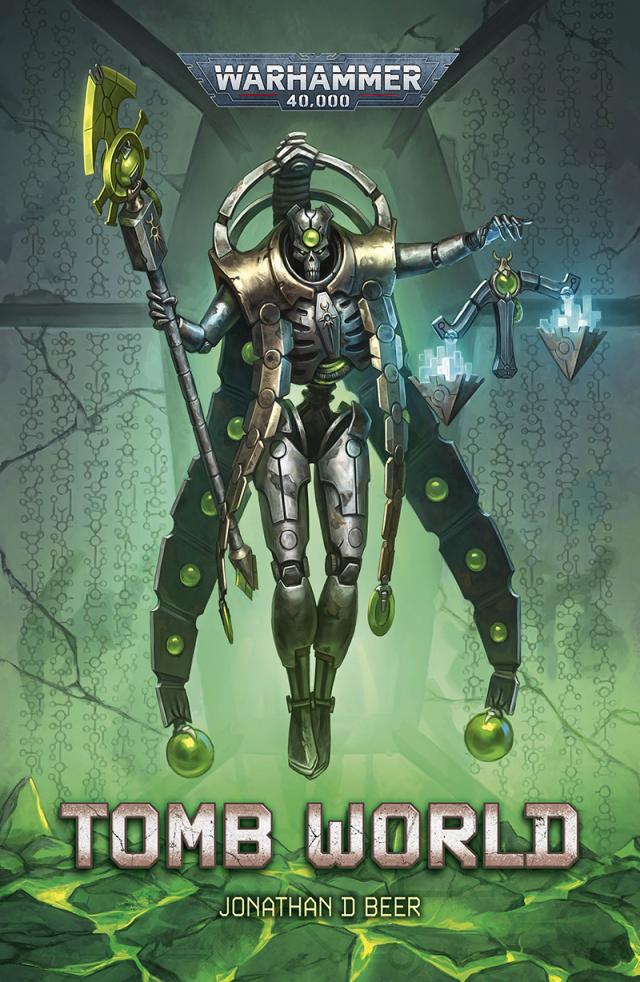
A skeleton looms above him. It is monstrous in its scale, inhuman in its resemblance to humanity’s basic form. It is skeletal, yet its limbs are broad and bulky in mimicry of musculature. The joints in its arms and legs and shoulders move and roll as Pyrch would expect. The chest cage is what fascinates him most, more even than the one great eye at the centre of its skull. A sickening glow emanates from between the metal ribs. It is hunched over beneath the laboratory’s low ceiling, and from its right arm hangs a curtain of some kind of tiles.
The creature holds an enormous staff in one hand, topped by two translucent blades that gleam with a sickening light. Insectoid things lurk around its legs, and clamber along its shoulders like pets.
It is, unquestionably, the most horrific sight Pyrch has ever witnessed.
‘Sir, I could not raise the palace. There is something corrupting the building’s vox-relay.’ Ahmose pushes open the exam room’s door with one hand, still gripping his chartboard with the other.
With shocking speed the creature sweeps its staff around. The monstrous head, bladed and alive with energy, passes through Ahmose’s torso without the slightest pause. The two halves of Pyrch’s assistant strike the tiled floor in a welter of gore.
Pyrch releases a noise. It is not a scream but a moan, a low groan that emerges from the centre of his being, soul-deep and unrestrained. It is the sound of a beast, a cattle animal confronted by something it cannot comprehend.
‘Well, that is unfortunate.’ The creature speaks, its voice an electronic growl of Gothic syllables. It turns back to Pyrch. Its face, or what passes for one, radiates malice. Flecks of Ahmose’s blood hiss from the blade of the thing’s enormous staff. ‘You will have to do something about that later.’
Pyrch takes a single step back, mouth agape. The creature reaches out a hand, fingers curled towards Pyrch, and the beetles that walk across its body leap.
They fly at him, a nightmare of razor-edged legs and snapping jaws. More are coming, emerging from nothingness, a tide of iridescent bodies falling from a shimmering surface that hangs from the skeleton’s metal body.
Now Pyrch screams.
They are every size, from hounds and felids to vermin and fleas. Carapaces gleam in the sharp light of the examination ward, viridian and opal and gold enclosing skittering black metal bodies. Pinions click and clatter across the metal floor, a staccato riot of sound that swallows the sound of Pyrch’s cries.
He tumbles back against the cabinet, falling away from the tide of metal monstrosities that are hurling themselves onto his body. The largest grip his wrists and ankles, hard enough to restrain but not so tight as to break bones or sever flesh. The lesser beasts are on him, climbing up his legs. They are shockingly heavy for their size, lumps of animated metal that tug at his flesh.
A thousand pinpricks track their way up the skin of his chest, crawling beneath the fabric of his shirt. They are on his neck, his face. They are in his eyes, his ears, his nose. They crawl inside his open mouth, clinging to the soft tissue of his cheeks. Something stabs at the back of his throat and Pyrch tastes blood, copper over the vile tang of alien metal.
The creatures are inside him, swarming through his flesh. He is still screaming, but the screams are suffocated by the weight of insects on his tongue.
Something pinches, seizing not flesh but nerves and brain stem. There is a struggle, fleeting and entirely one-sided. Pyrch falls silent.
Slowly, reluctantly, the tide of scarabs recedes. They climb out of his open mouth, and track their way down his body. Thousands of shallow nicks and cuts cover the skin of his chest and arms where their needle-sharp limbs have pierced him. The pain is agonising, but Pyrch does not cry or whimper. The one scarab that remains, jaws locked tight around the top of his spinal column, is firmly in command.
Pyrch sags as the canid-sized scarabs release his arms and legs. Their jaws have left red welts around his wrists. He knows that he will need to conceal them until they heal, lest they give rise to questions that might compromise his new allegiance.
Pyrch looks up and into his master’s enormous green eye. The change is instantaneous. What had been inhuman is now beatific. Noble. Commanding. Pyrch can see his reflection in that gaze, and he is overcome with revulsion for what he sees. His place is on his knees, head bowed in supplication. His duty is to serve. He is servile, born and bred only to offer his meagre labours to those who are as gods to him.
Pyrch drops in an instant, overwhelmed by shame for daring to meet his master’s eye. From his knees he raises his hands above his head, palms up and open, in echo of a gesture he somehow knows is older than the genetic history of his species.
In the back of his mind, held in place by alien chains, Pyrch screams and screams and screams.
‘There,’ his master says. ‘Now we understand each other.’
Kamoteph the Crooked leans back, settling himself against the autopsy table. He places his staff across his knees and adjusts the fall of tiles that drape from his arm. The wave of scarabs gather about his legs, while some clamber up his body and along his spine.
‘So, my new friend. Let us discuss the two bodies you are about to inspect, and what it is you are going to find.’
The smoke wakes Thestri. It coils around the edges of the dorm’s doorway, insidious fingers of grey fumes.
It takes some time for him to stir. He had taken the noctis shift to let Semmi, his watch-partner, get some rest. There should have been four of them crewing the tower, but the Officio reassigned Halwyn and Sadryn four months ago and never bothered to replace them.
But despite his bone-deep weariness and empty belly, the rasp of hot air in his throat finally forces Thestri into waking.
He coughs, hawks saliva, and spits over the edge of the bunk in the vague direction of the dorm’s spittoon. He opens his eyes, which are immediately stung by the streamers of grey smoke that have gathered among the room’s metal rafters.
The smoke smells sweet. Cloyingly sweet.
Thestri bolts upright, sleep banished by a jolt of adrenaline that sets his heart thundering. Shaking, he rolls off his bunk. He lands badly, pain shooting up his ankle. He ignores it, lunging for the dormitory’s door, not bothering to even pull on his overalls.
‘Semmi?’ He tries to shout, but the word emerges as a bark, barely carrying the length of the corridor. The hallway is half-hidden by the smoke, boiling through the exterior hatch. The metal door swings open in clear violation of Officio regulations.
He and Semmi have one responsibility. The cane fields are a tinderbox in the summer months. The tight rows of stalks trap the heat, setting the stage for lightning strikes all across the plains of Orymous Secundus. Thestri and his watch-partner have reported three fires in as many weeks, bringing their sector’s response teams charging in with suppressant foam and brush-cutters. He and Semmi have earned a minor commendation from the local Logisticarum overseer; their vigilance has kept the losses from each blaze within the allowable margin.
A wall of heat hits Thestri as he hauls the hatch open, a dry, choking heat that seems to suck the air from his lungs.
Thestri dives into the darkening corridor, finding the steps to the watch-station’s tower by memory. He takes the stairs three at a time, each leap setting off a tremor that shivers through the metal frame. His twisted ankle protests with each step, but he ignores it, hauling himself up the switchback stairs.
Thestri reaches the summit, and grabs for the hatch handle. He gropes at open air; the metal plate is hanging off its hinges, partly wedged in the doorway. He clambers over the obstacle, but catches his foot and lands on his hands and knees.
He lands in blood. Red smears his hands as they slide through the gore. Thestri’s chin hits the deck and he feels his teeth crack.
Dazed, he pushes himself up. He doesn’t understand what he is seeing. Hunks of flesh and flecks of bone coat the watchtower’s floor. Its windows are shattered. The vox-unit used to call in strike sightings has been carved into ruin. Enormous slashes, cutting deep through the console’s frame and into the sanctified workings within. Sparks and yet more smoke are spitting from its ruined interior.
His bare foot knocks against something, and Thestri looks down. Semmi is staring up at him, eyes wide in their sockets. His head rolls over, cut free from his body.
Thestri vomits.
When he can finally straighten up, he knows what he will see.
From horizon to horizon, the cane fields are burning.
‘Faster! We’re nearly there.’
Taron Gethisme and his family run, run as if their lives depend upon their haste.
They head towards the sanctuary of a pool of yellow light, a single box-lumen caged behind wire mesh. The lumen marks the entrance to the civic shelter for their hab-district. Taron can see it, six blocks away, a tiny puddle of light at the base of the broad rockcrete bastion at the end of the road. It hunkers low to the ground, half the height of the rows of hab-blocks that line the road, but he knows that the bastion delves deep into the foundations of the city. If he can get his family to that light, Taron tells himself, they will be safe.
Beneath the pounding of his feet and the air sawing in his chest, Taron hears the sound of metal scraping against stone, and he knows the daemon has found them.


