

Tomb World, page 2
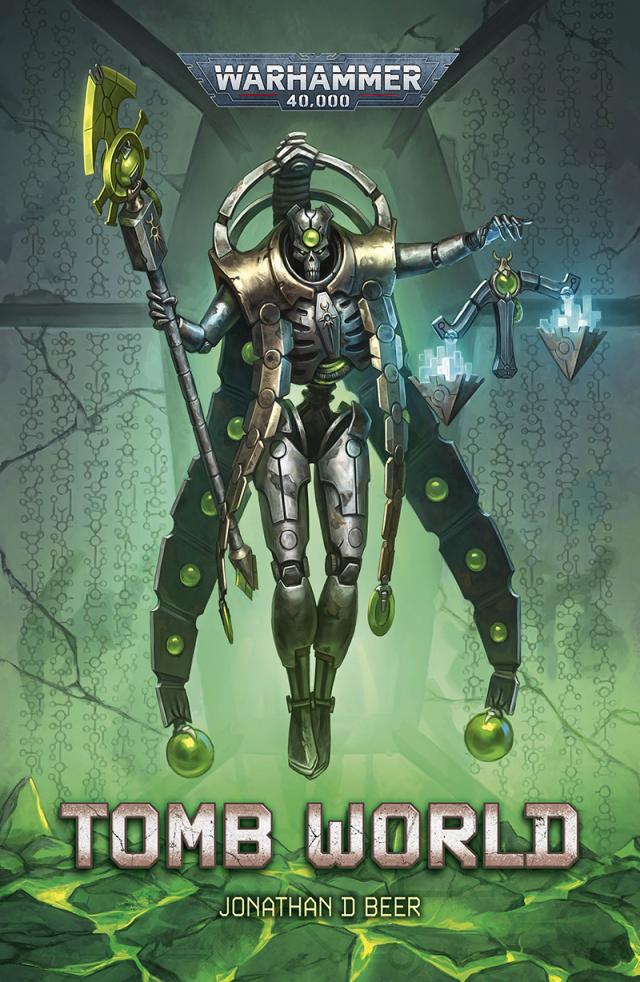


Her name is Khemet. She is a necron. She possesses strength, or can steal it from others. All else is still a swarm of sparks, shorting and colliding and corrupting any focus she might grasp.
And while her body is partly restored, she is far from whole.
A viridian beam glances from her shoulder, ripping away some of her stolen necrodermis. The other warriors advance, gauss flayers levelled, undaunted by her consumption of their kinsman.
Khemet turns and hurls herself into their midst.
‘If this continues, she will tear the ship apart.’
Hekasun speaks mildly, affecting disinterest. But Kamoteph can hear the concern behind the words.
‘It is entirely possible, lord.’
They observe Khemet’s rampage through the eyes of the Senusret. The sensors that line the ship’s corridors show them her progress, and her brutal encounter with the first squad of warriors sent to contain her.
Neither show the least concern for the eviscerated serfs. Such disinterest is the birthright of necron nobility, but they also know that the warriors are not truly lost. At the moment of their death, the Senusret’s reanimation circuits capture their engrams and spirit them away. In ordinary circumstances the reanimation protocols would also capture their broken bodies, stealing them from the battlefield for molecular deconstruction and repurposing, the same minds implanted into the same, reforged bodies. This is the great strength of the necrons – destruction is rarely absolute.
‘Then again,’ says Kamoteph thoughtfully, ‘perhaps not.’
He is watching the creature he has summoned. As Khemet consumes each warrior, her stance changes. She rises from her bestial crouch. Her movements become less feral and more fluid, displaying the surety of a warrior. She still lashes out, batting aside any weapon that swings towards her, but with strikes that show directed anger, not untethered madness.
Eventually she can take no more. The wasted remains of six warriors litter the corridor’s floor and Khemet stands restored. Except, he sees, for her right hand, which has stubbornly refused to regenerate. Her arm ends in two jagged spars of metal where a wrist articulator should be.
Her hand’s absence is a curiosity Kamoteph intends to explore, if he is given the chance.
When Khemet realises that she can drain no more metal from her victims, she pauses. It is only for a second, but Kamoteph sees it clearly. She halts, considering what she will do next. She too notices the absence of her hand, staring down at the truncated wrist. Then she takes off, plucking a gauss flayer from the deck as she goes.
‘I believe I can end this, my lord,’ says the cryptek.
Whatever she may have been when she emerged, Khemet persists, her instincts and identity buried beneath the scars of the labyrinth. Thus, it is a matter of freeing herself from wherever she resides – no different, in many ways, to liberating her physical form.
‘I demand it,’ says Hekasun imperiously. ‘Your folly unleashed her, so you must cage her once more.’
‘As you say, sire. But I shall require the use of your vargard.’
Behind his lord, Mandulis hefts his warscythe.
Her body has shaped itself into a vessel of power. Her limbs are strong and her torso is heavy, far bulkier than that of the warriors she has slain. There is potential in that weight of metal and mechanism, but she has no time to explore it. While her body is mostly restored, Khemet’s mind is still far from whole.
Her missing hand is a nagging, gnawing pain. Not a physical pain – Khemet has been unaffected by the dozen incidental wounds the warriors inflicted in their death throes – but there is a deeper hurt, a scar that is etched across her circuits. She knows not why it is lost, or how. Whenever she turns her focus to the question a bitter flash of regret and loss and white-hot hate blows up with a hurricane’s force, threatening to corrupt her fragile sanity. Like so much else, her hand’s loss and its meaning are locked away behind mental firebreaks to preserve what stability she can muster.
Her passage through the dark corridors has become less frenzied, though no less swift or violent. At every junction there are more warriors to bar her way. Where she can, she batters them aside, but the threat of their gauss flayers sends her plunging down other paths when she finds them waiting for her.
There are no halls or chambers, no greater spaces, just a maze of narrow tunnels. At intervals she passes what appear to be lintels, stone arches that stand proud from the walls as if to suggest entrances to other spaces, but they are blocked by the same black stone.
She is being herded. She has recovered enough of herself to know this, the way a prey creature senses the approaching hunter. At the junctions she is directed one way or another in accordance with some will. Part of Khemet rages at the arrogance, but her newborn intellect is content to go where she is being sent, if only in the hope of learning more of her hunter, and herself.
Finally, the warren ends. There is only one hallway left, opening onto a larger chamber. Sharp lines of viridian light pulse through the walls, seeming to beckon her onwards.
Khemet could stop here. Turn and run back into the maze, confront the cohorts of warriors that have dictated her path. But there are no answers that way.
She enters, passing beneath a slab of rock that seems to reflect no light. Beyond is an open space, high-ceilinged and occluded by shadow. There are no furnishings, no seats or consoles or glyphs to indicate the chamber’s function.
those are the trappings of life there is no life here there is only stasis
One wall is dominated by a vast window, a sharply angled rhombus of transparent crystal set into the stone. There are pinpricks of light moving beyond the window.
Stars. We are in the void.
From where she draws these concepts – the mighty spheres of crushing gravity and fusion that are stars; the immensity of the emptiness between them that is the void – she does not know.
The starlight is not what claims her attention. A single necron is waiting for her, standing unwavering in the centre of the chamber. This, she sees, is a true warrior. The others, the thin, slow and bitter creatures she has killed and run from were thralls, stamped from the same press in their multitudes. The construct facing her is a soldier, a killer, hulking and clearly lethal. His eyes and the smoky outgassing of his ribcage too mark him out from those others, alight as they are with fuliginous copper rather than poisoned emerald. He holds an immense warscythe in both hands. A weapon wielded by kings, and those who would protect them.
The warrior offers no words, and nor does she. For whatever reason, the power that directed her here desires to see them fight, and in her ignorance and fury she will oblige.
They come together in a shower of jade sparks. The slender flayer cannot match the warscythe’s weight, particularly as Khemet is hindered by her absent hand. A single swing of the scythe would carve her long barrel in two if she met the blade directly, so she does not. Khemet catches the first massive cut with a counterstrike that hits the flat of the warscythe and deflects its passage. The warscythe slashes past her head, captive energies humming within. She thrusts in turn, driving the warrior back, using the flayer’s length as a spear to deny him the warscythe’s advantage.
They are fast, she and the warrior, and strong. Each meeting of blades shivers up her arm, absorbed by kinetic buffers and muscle-fibre bundles. Her body was built for this, built for combat, built for war.
Built to execute.
She wields a weapon of surpassing craft, and ends thousands in blasts of viridian fire, scouring them from existence. She sees necrons forced to their knees by their own bodyguards, presented for her to end. This is her function, her reason for being. Khemet is an executioner.
The memory boils up from the cauldron within her, and the loss of focus almost ends her. The warscythe catches the flayer and hammers it aside, and only a desperate roll beneath its backswing prevents Khemet from being cut in half.
The warrior presses, swinging the great blade in huge arcs that Khemet can only weave between. She backs away but the wall is close behind her, impassive and unyielding. She can flee no more, so must attack or die.
Khemet lets the next swing pass her, close enough that the tip of the warscythe drags its way through the surface of her chest, and then she strikes. She stabs forwards, the gauss flayer held by its pistol grip. The knife-blade barrel slides into a gap between two ribs and Khemet fires. A flash of gauss erupts from the weapon’s end, and the warrior’s core bursts in a gout of orange fire.
He sags to his knees, dead instantly. As the warrior slumps to the deck his body fragments, segmenting into prismatic blocks that dissolve into finer and finer particles. What strikes the floor is a cloud of sand that melts away to nothingness. In seconds there is no trace of the warrior she has fought, merely an empty chamber and Khemet, no wiser.
She spins, expecting a blade in the back. But there is no other, only the open viewport to the stars beyond the transparent crystal.
The protocols of combat that took control of her recede as quickly as they came. This is something else she has learnt about herself. She possesses wells of not merely knowledge but skill, experience, ability – whole partitions of her being that can devote themselves to a task with singular focus. It is only in fighting that she has found them. One part of herself rose up to become dominant, quieting the rest, letting something like calm come over her.
But that clarity is slipping. There is still too much she does not understand about herself, about the place – the voidcraft – upon which she has awoken. Without the locus of combat the kaleidoscope of memories and questions returns in full force, crashing through the ordered thoughts like a breaking wave. Khemet clutches at her head, a bodily act of self-preservation that is entirely involuntary.
After what feels like seconds, but could be hours, the warrior returns. He comes not from the open archway but through the stone of the wall to her left, the spiteful eyes and cruel faceplate emerging first from the solid matter. Khemet finds herself oddly unsurprised – this, she knows, is something they can do. Necrons mastered the art of manipulating reality long before her birth.
birth we were born we lived we are not this we are not these monsters
The growl of actuators in her neck is loud as Khemet shakes her head, clearing the aberrant thought, pushing down that frightened nub of self back into its vault.
It is the same warrior she has just fought, identical in every detail. His metal is pristine, unblemished, showing no trace of the wound her gauss flayer inflicted.
The calm returns. This is a test. For whatever reason, the unseen hand that brought her to this place requires that she remain, so it presents an opponent against whom she will be tested, again and again.
Without knowing why, without knowing who she is or how she fights so proficiently, Khemet hefts her gauss flayer and attacks once more.
Kamoteph has never found the exertions of warriors particularly engaging, either as spectacle or a technical exercise. Even so, he watches Khemet and Mandulis duel, not to appreciate the artistry of their violence but to observe the storm-racked disorder of Khemet’s thoughts.
He is several decks away, fingers interlaced in the second alignment of Ahtekh, but his mind is with Khemet as she parries Mandulis’ every blow. He has steadily threaded his consciousness into hers, using the Senusret’s interstitial network as a bridge. He sits, silent and unseen, amid the appalling chaos of her broken mind.
Four times Mandulis has entered the chamber, and four times he has been destroyed. When he attacks, Khemet counters his strength with a speed that cannot be equalled. When he allows her to attack, she dictates the combat so thoroughly that she dances around his massive swings. During their third engagement the greater weight and reach of his warscythe almost tells, battering aside the slender gauss flayer, but she abandons the weapon, and with a great heave rips his skull and spinal column from his body. As his corpse sparks into death, Khemet plucks Mandulis’ weapon from his body, preventing it from phasing away.
The decision to switch weapons – to make a conscious judgement, weighing multiple options – reassures Kamoteph that there is some rational, thinking part of Khemet that can be saved.
Finally, he determines that he has seen enough, and begins to act.
During each duel the great discordance of Khemet’s mind calms, displaced by the protocols of combat that are deep-seated in her being. In that calm Kamoteph can search, in much the same manner as he sifted the labyrinth. With care and subtlety he finds and assembles the fractured algorithms and logic gates, dredges for what snatches of identity he can grasp, and steadily begins to piece together Khemet’s sense of self.
His aid swiftly tells. He cannot improve on the tranquillity she achieves during combat, but in the interim periods, the scant moments it takes for the Senusret to seat the vargard’s consciousness into a new body, Khemet retains more of her battle-calm. The clashing discord of memories is still there, still waiting to draw her into their depths, but Khemet’s conscious mind is lifted above them, observing rather than being swept up in their thrashing cacophony.
It is slow but steady work, difficult but far less taxing than extracting Khemet’s body from the labyrinth. But when the seventh Mandulis is slain, the scales tip.
‘Get out!’
Kamoteph is shocked, so much so that he almost loses his footing within Khemet’s mind. He had not imagined that she would be capable of perceiving his presence. He imagined himself an invisible hand, working without her knowledge. It would have been better, he thinks, had she attributed her recovery to her own resilience.
He ignores her demand. Khemet’s grafted ego is far from stable, and it requires considerable effort on his part to maintain.
When the eighth copy of Mandulis dies, Khemet tries again to dislodge Kamoteph.
‘I see you. I will give you nothing.’ It is less an interstitial sending and more a grunt of will given words.
After some thought, he replies. ‘I do not intend to take anything.’
When the ninth dies, Khemet speaks to him clearly. ‘Show yourself.’
Finally, the guiding hand emerges.
This one is no fighter. He leans heavily on a blade-topped staff. His segmented vertebrae are deeply curved, and the metal of his shoulders and cervical spine has grown up and around his skull, forming a crooked hunch that bends him almost to Khemet’s waist. A single outsized ocular dominates his faceplate, which draws down into a pronounced mandibular crest.
A curtain of small tiles hangs from the arm that holds his staff, like the pinions of a moulting bird. Khemet is certain she knows the symbolism of the shards of metal and ceramic that clatter gently as the creature moves, but she cannot form the connection.
With him comes a host of scuttling metal constructs. They follow in the creature’s wake, a tide of scarabs and scorpions, wyrms and arachnids. Several ride upon the creature’s shoulders, clattering across his arms and along the curved length of his spine. The largest stands to the height of Khemet’s waist, a beetle with an iridescent black shell and wickedly curved mandibles. They are vaguely threatening as a collective, moving with a disconcerting unity of purpose.
The one who brought Khemet to this place enters alongside the tenth copy of her slain opponent. The hulking warrior towers above the creature, though his gaze does not leave Khemet. He is clearly restrained, leashed by a greater power. Khemet does not move, nor does she lower her stolen warscythe.
‘I am Kamoteph.’ The bent-backed creature speaks, a deep growl accented by the metallic tones of his vocaliser. He gestures behind him. ‘This is Mandulis.’
The warrior does not respond to his name, and Khemet is equally impassive. Their duels have been hard-fought and bitter. And, of course, she has dismembered him in nine different ways since first they met.
‘I thought you should know the name of your assailant,’ continues Kamoteph. There is a mocking edge to his voice, but Khemet cannot tell at whom it is aimed.
She still says nothing. In truth, she is unsure whether she can speak. Though she has felt the burden of madness lifting, she can feel it waiting, lurking. What spills from her vocaliser could be the nonsensical gibberings of the damned.
‘And you are Khemet,’ says the hunchback.
‘I know.’ Her vocaliser makes a cracked, metallic wheeze. These are the first words she has spoken for… some time. She cannot say how long, and she does not wish to try.
‘What do you remember?’
Far too little. Her memory is still a jumble of conflicted images and sensations, ill-defined and out of sequence.
‘What are you?’ she challenges instead.
‘I am a cryptek.’ The title means nothing, though he speaks it with clear pride. When Khemet does not react, he explains. ‘A worker of the arcane. A technomancer, by vocation.’
‘Magic.’ The word occurs to her suddenly, prefigured with glyphs of distaste and mistrust.
Kamoteph scowls. ‘My “magic” pulled you from the labyrinth.’
A spike of alarm runs through Khemet’s core. Now she has a word to put to that feeling of absolute dread. The cause of the abyssal emptiness in her mind, in which her memories swirl and collide and seep away.
‘The labyrinth,’ she repeats.
‘Your prison. A most cruel form of punishment, even by the standards of our lords and masters.’
‘Why was I imprisoned?’
Kamoteph takes a few cautious steps towards her. ‘Can you not recall?’
Khemet tries. She truly does, but she cannot endure venturing into the scalding swirl of memory. There is the flickering sensation of a blow to her chest, the shock of her hand being cut from her arm, and a blaze of rage that falls away into oblivion.


