

Tomb World, page 11


Vanda can afford to be philosophical about their cargo. By dint of seniority over the other engines of Sixteen-Red, Queen of the North is the lead locomotive, and thus Vanda, as engine-captain, is spared the worst of the stench. Further back, aboard Veredictum and Honour of Orymous, Vanda knows that it is unbearable. Almost every enginseer assigned to Sixteen-Red has requested and received augmetic olfactory sensors, allowing them to at least be blind to the miasma that penetrates their clothes, hair, and skin with every mile of the northern passage.
Loaded with the manure of millions, Conveyor Sixteen-Red charges on through the night.
The door at the rear of the cabin swings open with a clang. ‘Coming up on the hour, third echelon,’ says Matejo Azahan.
Vanda blinks, her half-slumber abruptly banished. On the far side of the control cabin, wedged between the wall and the brass frame of a cogitator, Second Echelon Nikas Radomen rolls his eyes.
Vanda glances at the chrono. ‘You do it.’ She is comfortable atop the breaker box, and the vox-horn is wired into the cabin’s centre console.
Matejo takes her laziness as an honour, a show of trust in him. He is a recent addition to the Queen’s crew, the single bar of first echelon newly tattooed over his right eyebrow. Vanda thinks he will work out, if he can shed his youthful desire to please all those around him.
The young man primly lifts the vox-horn and thumbs the activation stud. ‘Conveyor Sixteen-Red, this is the hourly vox-check. All engines, report your condition.’
There is a pause, then a loud crackle of static. ‘By the Throne, boy, it’s the noctis shift. Would it kill you to pull that stick out of your arse for just a minute?’
Vanda does not hide her chuckle. Matejo blushes, but finds the sternness within him. ‘Report your condition, Honour.’
‘This is Honour of Orymous, at oh-three-hundred hours,’ says Hirve Donisas, third echelon of the Honour, in a bored monotone. ‘All readouts are green. Coolant temperature nominal. Hydraulic pressure nominal. She’s running like a dream, even with the nightmare of shit we’re hauling.’
‘Noted, Honour.’ Matejo does indeed diligently key Hirve’s report into the cogitator console. ‘Veredictum?’
The rearmost engine of Sixteen-Red does not respond.
‘Veredictum, come in.’
He waits another few seconds, then holds out the vox-horn in mute appeal.
With a heavy sigh, Vanda tips herself forwards from her seat and crosses to the vox-unit. She takes the horn from Matejo’s outstretched hand.
‘Come in, Veredictum.’
Again, silence.
Vanda scowls. With her free hand she reaches forwards to one of the control panels and flicks a switch. A tiny pict screen, no larger than Vanda’s palm, hums into life. It shows nothing until she turns a dial, clicking through until she finds the feed for Veredictum’s cabin picter.
There is no one on the footplate. No one, indeed, in Veredictum’s control cabin at all.
She thumbs the vox again. ‘Damn it, Alwyn, if you don’t return to your post in the next three seconds I’m going to have to record this in the route log.’
The seconds tick by, and Alwyn Handr does not appear.
‘Throne of Terra,’ Vanda mutters. She clicks the dial through the other pict feeds aboard the locomotive. One returns only static and the other, the feed from the interior of the engine’s reactor furnace, is occluded, showing only a thin smear of light between blackness.
‘Hirve, go and check on him.’
She is not panicking, not yet. It is strange that all three of Veredictum’s on-duty crew have absconded, but there are reasons why all three would abandon their posts.
None of them are good, though.
Vanda’s gaze shifts to the hatch to her right. There are twenty indentured serfs at work within the furnace of each engine. They are criminals, saved from the horrors of Servitude Imperpituis only to endure a more immediately lethal fate. Few last more than two or three years; the radioactive overspill from the engine’s reactors turns their bones to powder and their organs to liquid. Their lives, more than the radiological material that fires the furnace, are the fuel on which Queen of the North runs.
It is rare for the serfs to rebel, enfeebled and chained as they are to the machine they serve, but it is the fear of every engine-captain.
‘Don’t make me, Vanda,’ Hirve Donisas says over the vox.
‘Do it, and take your goad.’
Enginseers work unarmed, aside from shock goads intended to keep the serfs in line when necessary. She can hear Hirve turn serious. ‘All right. I’ll call in from Veredictum.’
More than a mile of shit-streaked silo cars separate Honour of Orymous from Veredictum, and it is a perilous walk along the exterior gantries. It will take him time, Vanda tells herself.
The minutes pass slowly.
‘Should we report this?’ asks Matejo.
‘We’re due a check-in with the terminal in eighteen minutes. I’ll tell them then.’ Vanda doesn’t want to report Handr. Dereliction of duty would mean the loss of his captaincy, and he has been driving for almost as long as Vanda.
The chrono continues to spin. Vanda clicks back to Veredictum’s cabin pict feed, waiting for Hirve’s lean form to appear at the open door.
The chrono’s needle ticks round to twenty past. Hirve has yet to appear.
‘Hirve?’ she asks into the vox-horn, hoping that his name will summon the fellow engine-driver to appear. Beside her, Nikas looks as worried as Vanda feels.
An impact like the fall of a trip-hammer, or the chime of a monstrous bell, shivers through the Queen’s superstructure.
‘What in the name of Terra was that?’ All three drivers spin to the rear of the cabin, Vanda’s grip tight on the vox-horn.
The rear of the engine holds the crew quarters. The Queen has bunks for two, along with a tiny galley and ablutorial, and then the hatch leading to the conveyor’s exterior. The door through which Matejo has come is closed, but the latch is not locked shut.
Another strike, softer but still heavy. Then another.
‘Hirve?’ Vanda asks. The rhythmic stamp of metal on metal draws closer. They are footsteps, unmistakably, although too far apart and far too heavy to be any of her crew.
An unnatural, superstitious fear takes hold in Vanda’s belly. The tales of monsters and aliens she had learnt as a child come back in a rush. They had always given her nightmares, even though every story ended with the mighty legions of Orymous crushing the Imperium’s enemies. Her father had been too good a storyteller, painting Vanda’s dreams with vivid images of green-skinned barbarians and cruel, dancing aliens.
But it is none of these horrors that appears at the cabin’s door.
The metal flies open, hurled back on hinges that squeal suddenly. Vanda screams in fright at the sound, but the cry dies in her throat at the sight of the thing that threw open the door.
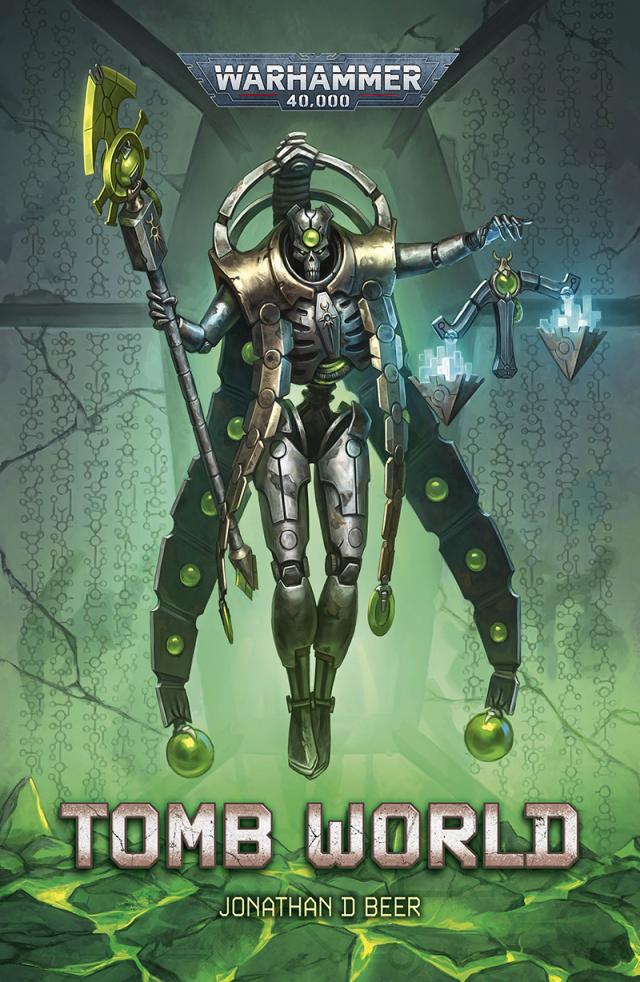
An enormous creature looms above her. A metal skeleton, hideously broad, peers into the cabin. It has a face, an inhuman metal face, with a green orb embedded in the centre of its head.
The hatch is too low and too narrow for the creature to enter. It bends on thick legs, the action sickeningly human, and curls metal digits around the hatch bulkhead. It pushes and the metal crumples, torn like tin. It stoops, a broad shoulder tearing through an overhead storage unit. A weapon, its blade as long as Vanda’s leg, is held in one hand. The curved sword glows with sickly radiance, painting the cabin’s black walls a vile green.
Vanda Gerig feels the vox-horn slide from her hands.
The engine’s shock goads are locked in a slim cabinet just beside the rear hatch. Matejo Azahan lunges for the armoury strongbox, forgetting that he has not been entrusted with the code. This act of bravery, as noble as it is pointless, brings him closer to the metal monster, and for this he dies first.
Khemet kills quickly, efficiently. After the first human hurls himself on her blade none of the others find their courage. One attempts to throw herself out of the locomotive’s cabin, but Khemet is much, much faster. The woman dies with Khemet’s staff in her spine. She hauls the body back inside, to slide off into a wet pile on the blood-slick floor.
She has worked her way along the conveyor’s length, and is now well practised in disabling the engine vehicles that pull it along. With a single cut she carves the furnace hatch from its hinges, and finds the expected rad-wasted creatures within. She looks upon their deaths as a mercy.
Khemet can barely stand inside the furnace’s interior, but that does not matter. She links her mind with the slim obsidian plate affixed to her waist, which awakens with a familiar glow of energies. From its jade surface comes first one scarab, then another, then a flood. A skittering swarm of Kamoteph’s chosen constructs pour like a waterfall from the dimension gate, and then they set to work.
The constructs tear through the machine that the humans consider ancient, but which to a necron is hopelessly primitive. The scarabs do not commit mindless carnage, but targeted destruction. Fail-safe systems are slashed first, then the locomotive’s vox-systems and cogitators. Finally, the immense pistons that drive the pneumatics of the braking lines are pierced by hundreds of bladed mandibles.
With a shriek of venting hydraulics, Queen of the North screams as it is carved apart from within.
When their work is done the scarabs return to Khemet, spilling from the rents they have made in the engine housing and disappearing back into the green plane of the dimension gate. They will be back at Kamoteph’s side in moments. Khemet briefly envies them their rapid return to the tomb world’s depths. Her own journey will take several days of marching through the desolate hinterland, and several more of trudging along the ocean bed to the complex’s closest entrance.
Khemet crosses to the open step of the locomotive. The landscape races by, heedless of the deaths and the destruction she has wrought. She takes no pride in the murder of the hulking machine or its crew. It was a task, unchallenging save for the need to avoid the humans’ crude means of internal surveillance. The pride is found in the end, not the means.
Khemet steps into open air, and the anti-gravity emitters in her torso lift her into the night sky.
Unrestrained, Queen of the North charges on.
When Conveyor Sixteen-Red misses its hourly vox-check with the railhead authorities, protocol is followed. An archaeopter is dispatched with a cargo of rapid-response enginseers. It takes the crimson ornithopter forty-six minutes to intercept the stricken conveyor, but only four for the Mechanicus adepts to assess the damage as catastrophic and irreparable.
They remain calm, for they are adherents of the Machine God and thus aspire to be above petty emotionality. Furthermore, a protocol exists for this contingency. Conveyor Sixteen-Red can be diverted to a run-off track – two hundred miles of long, slow incline into the foothills of the Prandalii Mountains.
The adepts report the situation to their overseers, who in turn alert the signal operators on the outskirts of the railhead.
There is no response from the signal operators. Remote-access protocols fail to reach the cogitators that control the rail switches. A second scrambled archaeopter reports murder at the switching station and carnage among the sanctified mechanisms.
At the railhead, clarions scream and workers run. Evacuations of this scale have been planned, but never put into action. Tens of thousands of serfs clamber aboard carriages on the secondary rails, and are borne away along the slim tracks that bring cargoes in from the agri-fields. The officials and adepts who manage the terminal flee in groundcars and flyers, all shouting into vox-casters to demand answers that do not come.
An hour after the last labourer has fled the network of rails and depots and silos, Queen of the North arrives.
A hundred thousand tons of iron, brass, and human ordure crash through the flimsy buffers, though no obstacle in the world would have been equal to the assault. The conveyor thunders through the brick-and-rockcrete warehouses and offices, rips the foundations from gantry cranes, shatters the bodies of carriages and flatbeds and other conveyors.
Thanks only to the grace of the God-Emperor and the work of the rapid-response team, none of the locomotives’ fission reactors explode. But they do tear, layers of armour peeling away beneath the succession of impacts to expose the broken heart of Queen of the North. Fissile material, rad-laden liquid and human waste spill across ten miles of gravel, a toxic tide of black water that infects all that it touches.
It spills through the open mouths of warehouses, polluting the sixteen billion bricks of starch and slab that were waiting to be delivered to the hungering mouths of Orymous.
Major General Heinzen Flener spears the last morsel of verdikine on his plate, mops it through the remainder of an extravagantly rich sauce, and stuffs it into his mouth.
‘This business up north… Is it causing any trouble with supply?’
The rest of the table’s diners studiously ignore the man’s poor manners, along with his absurd question. It has been twenty-one days since disaster struck the primary railhead for the northern agri-fields, and the effects are only beginning to be felt across the entire continent.
News of the derailment was impossible to contain, spreading through the unofficial channels of whisper and rumour like wildfire. Its progress could be tracked by the outbreaks of civil unrest that spread from city to city, as the civilian populace worked out for themselves what the adjudicators and metriculators of the lord-militant’s office were concluding – every citizen’s daily ration must be cut in half, for at least the next three months.
‘Well?’ barks Flener.
Flener is recently arrived on Orymous, along with two hundred and thirty thousand soldiers of the God-Emperor’s Astra Militarum. His division will be a part of the Beathen Crusade, an undertaking that has been seven years in the making. Millions of men and women have been brought to Orymous, to wait and to train for the day when they will be unleashed against the Imperium’s enemies.
But until that time, they must be fed, sheltered, and policed by the ceaseless labours of the Officio Logisticarum.
‘I am afraid so, general,’ replies Logisticator Primus Farroll evenly. ‘The situation is quite grave.’
Farroll is effortlessly tactful in the face of Flener’s ignorance. He was a native of Orymous, and of the city of Verongyl he now governs. A graduate of its principal scholam, over the course of eighty years Farroll worked his way through the rungs of the billet-city’s bureaucracy, and for the past twelve has sat at its very top. In the feudal hierarchy of most Imperial bodies, merit is not necessarily what determines elevation through their stratified ranks. Fortunately for Verongyl and for Orymous, Farroll has been an exception.
‘Open your stores, then,’ offers Flener casually. ‘Surely you have reserves.’
‘Indeed we do, general, and indeed we have. But there are over a billion Imperial souls on Orymous, without counting the valiant warriors of the God-Emperor we host. Even in times of plenty, we exist on thin margins. Disruption on this scale cannot easily be absorbed.’
At the far end of the room, silent and passive, Gerand Cadfan watches and listens. He is aide senioris to the logisticator primus, and Cadfan fears that the old man will not survive this crisis. He is long overdue to temporarily demit from his office to undergo greatly needed medicae and rejuvenat treatments, but the Sixteen-Red disaster has ended any hope of that. Farroll has worked until the small hours for every day since the planet’s infosphere blossomed into mayhem. The last thing he needs is to waste time entertaining oafish fools like Flener, but the demands of his office are not conditional upon good health and fair days.
‘At least we are in no danger of going hungry!’ said Flener cheerfully, as the palace’s waiting staff sweep in to remove the wreckage of the party’s meat course and replace it with the first of the desserts.
The arrival of artfully worked sucrose breaks up the conversation, and Flener’s crass display is brushed aside. As the diners devolve into their pairs, arguing or debating depending on familiarity and institutional friction, Farroll quietly taps a napkin to his lips.
‘If you will all excuse me.’
Cadfan is behind him instantly, easing the logisticator’s chair back with noiseless grace. Farroll, brow sweating, lifts himself by the seat’s gilded arms, and with the aid of a silver-pommelled cane starts with some haste towards the dining hall’s rear.
No one passes comment on his sudden departure. Farroll’s ill health is an open secret among the city’s upper echelons, and none of the new arrivals – not even Flener – are rude enough to ask where their host is going.
Cadfan follows the logisticator at a discreet distance as he leaves through the rear of the dining room. Farroll is as sensitive about his delicate bowels as he is famous for them, and Cadfan had been on the receiving end of his vicious tongue often enough to learn to give his master his privacy.
They pass through two further receiving halls, each as large and as grand as the dining chamber where Farroll’s guests are seated. The logisticator is an ascetic man by nature, but the palace and its many antiquities and decorations were in place long before Farroll took up his position, and will endure long after. Paintings, sculptures, and various historic documents lie in stasis fields, ensuring that this is the case.
It is fortunately only a short walk to Farroll’s office, and through it to his private ablutorial.





