

Tomb World, page 3
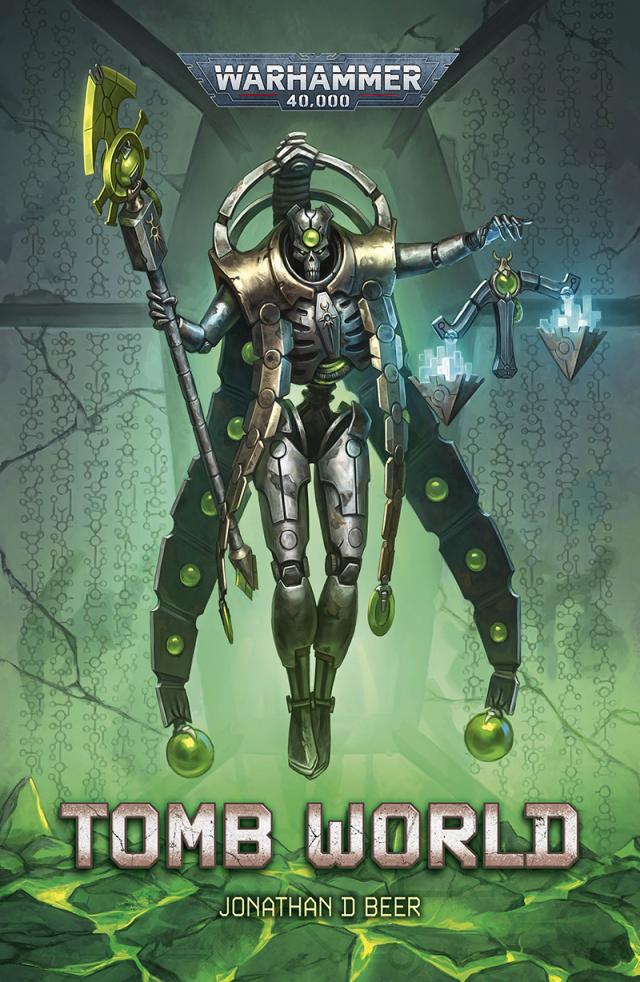


Kamoteph sees her struggling. ‘I can aid you.’
Khemet snarls in reply, a harsh grunt of electronic noise. ‘I need no aid.’
‘I can restore what you have lost.’
‘I have lost nothing.’ But that is not true. There is an absence. She looks down at her truncated arm. It is not the hand that is missing, but what it is meant to hold. Something of immense value, and authority. A symbol, of something greater and more terrible than herself.
‘What am I?’
The words escape her, utterly shameful but impossible to stop.
The question seems to please Kamoteph, who takes another step forwards. His staff strikes the stone like the report of a herald’s trumpet. ‘You are a praetorian.’
Embers of pride rise within her, but unmoored from any context.
‘I do not know what that means.’
‘If you will refrain from slaying any more of our servants, I will help you remember.’ Behind him, Mandulis is a statue, his warscythe held utterly still.
After an age of hesitation, Khemet lowers her blade.
CHAPTER 3
Lord Hekasun does not relish the times when he must venture into Kamoteph’s lair. He much prefers the martial austerity of the Senusret’s command deck, his natural place aboard the vessel. But there are times when he must lower himself to secrecy, and thus he must go where no others will tread.
Kamoteph’s laboratory is in the prow of the ship, at the very centre of the two sweeping wings that project forward of its hull. Hekasun knows he is growing nearer by the increasing presence of scarabs and other canoptek beasts. The creatures are a common sight on any necron craft or world, their scuttling activity a background noise that Hekasun has long since learnt to ignore. But the profusion and variety of the constructs that Kamoteph surrounds himself with goes beyond function, straying into the macabre.
They are the cryptek’s vocation. Every follower of Kamoteph’s creed has one, a passion – insofar as the C’tan left their deceived followers the capacity for passion – that they explore with the diligence and patience of the immortal. Kamoteph is a technomancer, which as far as Hekasun’s limited understanding goes concerns the use and function of the canoptek constructs that serve and maintain necron technology.
The green light of power pulsing through the Senusret’s walls reflects from their carapaces as Hekasun walks into their midst. Scarabs and beetles of every size and description cling to the floor, walls and ceiling, parting for him if they might impede his progress towards their master.
It does not occur to Hekasun that they would not part if he were unwelcome into their master’s midst.
It seems to Hekasun that the ship’s illumination grows dimmer as he enters the cryptek’s domain. The decks are lit more and more by the sickly glow that emanates from the constructs’ eyes. Dozens of jade-green circles, each cluster unequal in number and placement, stare at him as he passes.
Hekasun finds Kamoteph at one of the many workstations in his lair, his hunchbacked body bent over a spyder that he has opened and spread across the metal bench.
‘My lord.’
Kamoteph, as is proper, abandons his work the moment Hekasun enters.
The cryptek leans heavily on his staff and walks with a pronounced limp, in abject defiance of the god-given strength in his limbs. Hekasun has encountered many such unfortunates. Though they had walked – or been hurled – through the furnaces of biotransference and emerged clad in powerful frames of living metal, their minds have stubbornly clung to the frailties of their consumed bodies. Some are cognitively enfeebled, unable to accept the full potential of their new mental faculties, whereas others cannot shed the physical infirmities that had plagued their former selves.
Kamoteph is one of the latter breed. Hekasun pities him, so far as he is able. But the cryptek has proved his value to the noble many times, in spite of his psychosomatic impediment. That, after all, is how they have come to this situation.
‘Have I erred in trusting you, Kamoteph?’
Hekasun offers no preamble, and Kamoteph is unfazed by his blunt challenge.
‘My assurance remains, lord. Khemet will achieve all we require of her. I ask that you extend your trust a while longer.’
‘You ask for too much, cryptek. She is half feral.’
Kamoteph does not reply immediately. He shuffles away towards another workbench and another half-built construct, finding an excuse to retreat from Hekasun’s presence in his lair.
‘There is time before we reach Qeretesh,’ he says. ‘I had anticipated that Khemet would bear the scars of her imprisonment. The labyrinth’s damage can be undone.’
‘If there is anything of the praetorian left in her.’
‘That is what I shall determine. I have seen inside her mind, lord, and shall see deeper in the course of rebuilding her.’
The lure of power Kamoteph offers is a naked attempt to divert Hekasun’s misgivings. The secrets of the praetorian order are a prize indeed, but Hekasun is not so easily put off.
‘Have you considered what it is you seek to rebuild? The servants of the Silent King are not known to be biddable.’
Kamoteph nods. ‘That is true, lord, at least in my limited experience.’
Hekasun allows the silence to stretch out between them.
‘What do you ask of me, o lord?’ Kamoteph asks finally.
Hekasun resents the need to speak his commands so plainly. ‘Restrain her. Bind her. In the course of remaking her, insert the means to destroy her. My destiny will not be impeded by the whims of an honour-bound relic.’
Kamoteph bows low.
‘As you command.’
Khemet drifts.
No. Drifting implies movement, and there is no movement. There is nothing. There is no direction, no orientation. There is no light, and no darkness. There is only absence.
Khemet fights. She flails, lashing out against the nothingness, groping blindly for something, anything, that is tangible. But if her limbs respond she does not feel them move. They have been shorn from her, her mind ripped from her body. There is nothing left of her but a displaced intellect, cast into the void.
‘There is no value in dwelling on that,’ says Kamoteph.
And yet it is all Khemet can think of. Whenever she strains to recall, whenever she attempts any exercise of thought more complex than determining the arc of a sword’s swing, her mind finds the labyrinth’s boundless desolation.
Kamoteph sits on a stone chair, his staff resting across his knees. Around him, a dozen scarabs click and scuttle in idleness. She has learnt that he is never without them, canoptek constructs of various design and function. Some, the size of her clenched fist, he allows to clamber along and across his body. He appears indifferent to their presence, but since Khemet acquiesced to his offer of aid she has never seen him without them.
Khemet paces. The cryptek has given up attempting to have her adopt a meditative pose. She cannot endure stillness. Even a second’s immobility sparks a riot of error codes and frantic action, limbs lashing out in spasmodic terror.
She has been assigned quarters, and the room shows the evidence of these outbursts. A pair of Nikah Dynasty tapestries, ancient beyond measure, are torn rags strewn across the floor. The walls are scarred by metal hands that have ripped at their surfaces, clawing sensation from the stone. Anything Khemet can do to force a connection with the present, to feel the inputs of her body, she has done.
‘Think. Remember.’
For six days Kamoteph has sat with her, slowly rebuilding her conscious and subconscious minds. He has released a swarm of nanoscarabs into her skull to reforge the billions of crystal synapses, reset the shorting logic engines, and rebuild accumulators worn down by a century of abuse.
that is no mind it is a cage a prison a mockery of a thinking soul
The renewal of her cognitive processes, Kamoteph has said, is only half of the task. His microscopic constructs can repair the frame, the scaffolding along which her thoughts can run, but Khemet must populate it with her sense of self, her identity. And thus, Kamoteph demands that she reach into the black well of memory, summoning the storm that threatens her sanity.
‘What is a praetorian?’
This is the question he repeats, never offering answers. He claims to be at work, using his occult powers to suppress the worst of her mind’s outbursts so she can search its depths. Khemet does not enjoy the connection Kamoteph has forged between them, nor the knowledge that his miniscule pets are at work within her head.
In truth, she does not enjoy anything. Khemet has emerged from the labyrinth to find an existence that is harsh and joyless. She occupies a body designed to excel only in destruction, to take pleasure from nothing. The closest she has come to joy was the peace she found in hacking Mandulis apart in the observation port.
The vargard – an elite warrior elevated to the responsibility of guardianship over a noble, she now recalls – is stationed beyond the walls of her quarters, a precaution against a relapse into madness that Khemet finds at once insulting and insufficient.
‘What is a praetorian?’ Kamoteph asks, persistent as only a machine can be.
‘I do not know.’
Evidently the cryptek’s patience is running thin. He lifts his staff and slams its end against the stone floor.
‘Then use your imagination! By the dead, if you cannot remember the least detail of your existence then at least consult your lexicon and contemplate what the title implies.’
She looks up sharply from her aimless pacing. ‘Do not mock me.’
‘Why not?’ The hunchbacked creature leans towards her. ‘You are nothing. You possess no power, no authority. I have no need to fear you.’
She crosses the chamber with swift strides to loom over the crooked figure. ‘You have every reason to fear me, cryptek.’
The threat unlocks something. The swell of potential violence within her unbars a gate, picks at a loose thread, parts the clouds. All these and more are inadequate to describe the shock of realisation, of clarity blazing like a sunburst through her discordant thoughts.
Primed by Kamoteph’s relentless pestering, Khemet opens herself to the memories that pour forth.
The Unclean come, and Khemet throws them back.
Across the expanse of time and space, Khemet fights. She has been a warrior for countless aeons, a defender of the only empire worthy of the name.
She has faced all that the relentless hostility of the galaxy has to offer. The upstart species, mere millennia from the comfort of their primordial pools. The ancient enemies, the Old Ones and the aeldari and the enslavers. The C’tan, the truest foe of all necrons. It matters not; Khemet has slain them all.
The memories of all the fighting Khemet has faced rush over her. The duels she has fought. The battles directed. The wars waged, and campaigns won.
She staggers, overcome by the volume of all that she now remembers. The engrammatic vault from which they came now lies open to her. The temptation to delve into it, to relive the triumphs she has won, to revel in the feelings of indomitable strength, is overwhelming.
Satisfaction glows in the cryptek’s oversized ocular. ‘At last.’
Irritation at Kamoteph’s intrusion stops her from plunging back into the ocean of memory. She steps away from him, fighting another twitching outburst that gathers in objection at her restraint.
He leans back in his chair. ‘But tell me, is that all that a praetorian is? A fighter? A pugilist with little thought to honour and duty?’
‘No.’
The expression of physical power is not her purpose. She can feel – she knows – that it is merely a means, a necessity of her function. She must be formidable, not merely to the enemies of the necrons but to the necrons themselves. She possesses the strength to match the power of any lord or phaeron so she can wield the authority granted to her. To permit her to execute her judgements as she sees fit.
With an emerald blast of energy, she ends the life of High Adjudicator Ferenzik.
The metal body, devoid of its torso, topples backwards to be caught by a swarm of canoptek scarabs. The swarm immediately lifts these remnants and hauls them away, a paragon of industrial efficiency. Later, the constructs will disassemble the body and repurpose its necrodermis for the needs of those who are still functional.
They are brought before her screaming, or raving, or silent and immobile. Khemet has been at work for three days, bringing peace to the broken house of the Zathanor Dynasty. They failed to endure the rigours of the Great Sleep, and so death is the only mercy they can receive. As a praetorian, this is her most solemn duty, and Khemet bends to her task with patient diligence.
This rush is tinged with more complex emotions, and an immensity of knowledge.
Khemet is, at her centre, an executioner. The realisation does not bring shame, but pride. She is entrusted to enact the ultimate sanction against those who fail to uphold the honour of the Infinite Empire. Those who fail the many tests the galaxy presents, or succumb to the many temptations that power brings.
The honour codes of the necrontyr unfold within her. They have their own partition within her mental architecture, accorded such prime importance that their expression and interpretation are hard-coded upon her being, much the same as the techniques of swordwork and the stratagems of war. These are the tenets upon which her existence is based, that she exists to enforce.
we are the necrontyr we are not these hollow things these necrons we were a great people we were betrayed
Kamoteph is watching her. If he is aware of the occasional eruptions that emanate from her suppressed hindbrain, he makes no sign of it. Khemet, to her dismay, is growing numb to them, dismissing them as swiftly as they occur.
No, it is not that she is dismissing them, but rather that they are swept up in the tidal wave that crashes over her.
For many hours, they are both silent. The release of so much data is overwhelming. Khemet can feel her mind’s engines working, striving to process and index all that she has seen and done. It is a task that will takes years, decades, even if she were to sit in perfect stillness and devote the entirety of her energies to its undertaking.
‘When did you awaken, Kamoteph?’ She breaks the silence without warning. This is the first idle question Khemet has asked, and she can see the wariness come over the cryptek.
‘A little more than seven centuries ago,’ he replies.
‘Early.’
‘Not as early as some.’ There is resentment there, but Khemet does not care to probe it now.
‘I did not sleep,’ she says instead.
Kamoteph nods, but she is not speaking to him. She is barely conscious that she is speaking at all.
‘I… have endured. Persisted. For millions of years. For as close to an eternity as one can name.’ The pressure of so much existence piles up within her.
‘How did you do it?’ the cryptek asks.
Khemet stands motionless, watching Ghenenekh’s twinned suns chase one another across the sky.
She has decelerated her chronosense to its minimum, speeding her perception of time to permit weeks to pass as minutes, and years as hours. Her body’s other senses are still alert for intrusion, and her chronosense will crash back to normalcy should the tomb world’s innumerable canoptek constructs detect the slightest anomaly. But to any outward observer, Khemet is no different to the dozens of stone statues that line the tomb’s esplanade.
She has done this many times across the aeons of her immortal life. When she has explored all possible means of diversion, all the sundry ways her mind can be kept active and engaged, Khemet has sought refuge from the creeping passage of time by stepping out of its path.
Khemet considers it a form of sleep, the closest any praetorian can come to true respite. Not for Khemet and her peers the long, long embrace of the tomb. No, it is their duty, their penance, to forgo the oblivion of the Great Sleep and stand as sentinels over slumbering billions. The younger races of the galaxy will rise and fall, but through the tireless vigilance of Khemet and her order would the necrons awaken once more, and reclaim the stars that were theirs by right of ancient conquest.
Khemet stands motionless, watching suns chase themselves across the sky.
Alerts suddenly wail. In pursuing the memory she has relived it, settling into the same immobility she adopted on Ghenenekh, and at countless other times throughout the millions of years of her existence.
She can feel Kamoteph moving, acting, directing her consciousness to push ahead, to look beyond the memory to another. Part of her fights him, reflexively. But then she feels the shape of where he is sending her, and Khemet reaches for it hungrily.
She moves for the first time in seven centuries. An accumulated rind of calcified stone shatters as her limbs flex. The grey dust of Ghenenekh is scorched to ash as the exhaust vents of her core reactor burn with revived strength.
Her chronosense has returned in an instant to its baseline. Such a sudden lurch in her perception requires even Khemet to pause, allowing her mind’s processing centres to reconfigure themselves.
For a moment – truly just a moment, now – Khemet wonders what has awoken her. But then her cognitive train works through its buffer, and she understands.
There are intruders in the south library.
Canoptek wraiths have already engaged them. The tomb vault’s autonomous spirit has pulsed a warning that triggered her preset alerts, and is now feeding Khemet a stream of data across its interstitial network. In her mind’s eye, she sees a ferocious battle of particle casters and razor-edged metal. Lithe bodies clad in sculpted plates of psychically sensitive armour vault and caper, dodging the snapping mandibles and blazing transdimensional beamers of the tomb’s automated defenders, lashing out in turn with energised blades and arcane weaponry.


