

Tomb World, page 27
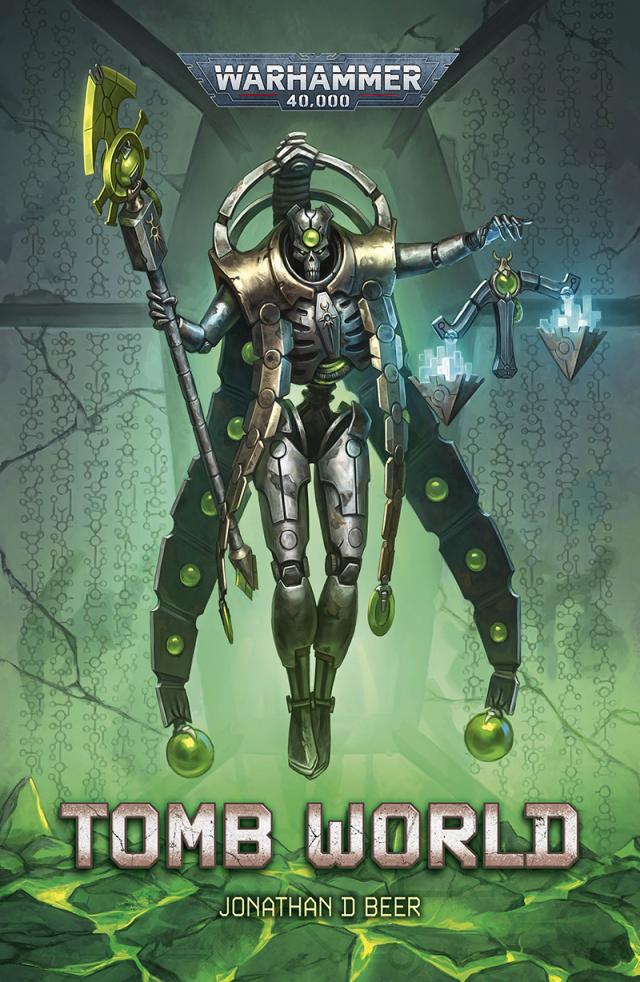


‘What is more,’ she says, lifting her rod of covenant, ‘it is my duty to pass judgement upon you.’
Hekasun does not flinch. He stares down his death, fury burning in the copper flames that crackle from his broken core.
‘I judge you, Hekasun, to be the rightful claimant of Qeretesh, and inheritor of all that the Zathanor hold.’
Khemet lowers her weapon.
As Hekasun gawks at her, shock not yet displacing hate, Khemet reaches across the interstices and offers him all she took from Kamoteph. The command protocols for the world, for every one of its warriors, are passed to Hekasun in an instant. That is the power of a praetorian: to make and break the might of lords and nobles.
‘Rule here, and rule well. Take this place that I have given you. Make Qeretesh a bastion of our people. Prove to me that you are deserving of this honour.’
Hekasun has stared in disbelieving silence, but finally his arrogance breaks through his surprise. ‘I have nothing to prove to you.’
Khemet looms over his legless form. ‘You have everything to prove to me, Hekasun. All that I give, I can take away. If you squander this gift I will return, and I will tear down your little kingdom and bury you within its rubble. I am your arbiter, Hekasun. You will not disappoint me.’
She leaves Hekasun where he has fallen, a final indignity to ensure her lesson is truly heeded. If he has any parting words, Khemet does not hear them. He will either learn from this moment, or he will not.
As she leaves the ruined command deck, Khemet kicks aside the canoptek wreckage of Kamoteph’s creations. She ignores the broken body of their master. She is surprised to find she bears no extraordinary malice towards Kamoteph. The cryptek played his hand, and acted on the self-interest that plagues his kind. Were it not for Khemet’s intervention, he would have undoubtedly succeeded in his treachery. In all likelihood, he would have been a more effective nomarch of Qeretesh than Hekasun will prove to be, for all that Khemet has warned him of her vigilance.
But that was not his fate, nor his role. For all his venality, Hekasun is the rightful heir to the Zathanor by the ancient codes of the necrontyr. And Khemet, for all her doubts, is their protector and enforcer. She is their praetorian.
EPILOGUE
To the Imperium of Man, Orymous has ceased to exist.
Every vessel sent to investigate its fate fails to return. The benighted creatures that can look into the realm behind reality see only a lacuna. No soul-fires burn, no astropathic missives emerge. There is only emptiness.
Nothing moves across the face of the world. There are no bodies, no human refuse to pollute the atmosphere with their degradation. All have been sundered to atoms, disintegrated by the voracious, tireless carpet of constructs that have scoured an entire planet bare.
The cities remain, silent mausoleums haunted by dust and dry winds. The world’s returned masters have no need of the coarse materials used in their construction, and so they are content to let them endure, for as long as they may. The works of humanity will all crumble, in time.
Beneath the world, metal figures march, and sleep, and wait.
ABOUT THE AUTHOR
Jonathan D Beer is a science fiction and alternative history writer. Equally obsessed with the 19th century and the 41st millennium, he lives with his wife and assorted cats in the untamed wilderness of Edinburgh, Scotland. He is the author of the Warhammer 40,000 novel Dominion Genesis, and has also written the Warhammer Crime stories ‘Old Instincts’, ‘Service’ and ‘Chains’, as well as the novel The King of the Spoil.
An extract from The Infinite and the Divine.
Before the being called the Emperor revealed Himself, before the rise of the aeldari, before the necrontyr traded their flesh for immortal metal, the world was born in violence.
And despite everything that would happen, this violence was more terrible than any the world later witnessed. For sweeping battlefronts are nothing compared to the torture of geologic change, and no warhead – no matter how large – can equal a billion years of volcanic upheaval.
It was a nameless world, for no one yet lived there to name it.
Ice sheets tall as a battle cruiser expanded and retreated. Tectonic plates ground continents together, their collision pushing up mountain ridges like teeth in the gums of a child. In the world’s great ocean, an undersea volcano spewed white-hot magma into the darkness of the oceanic floor, gradually building an island. Then another. The oceanic plate moved across the hotspot, carrying the created islands north-west as the volcanic boil continued to vent itself into the cold, black water. A long archipelago formed, like the dot-dash of an ancient code running across the jewelled blue of the sea.
The first civilisations rose around these islands, in a manner of speaking.
Microorganisms ruled the warm waters, their battle for survival as worthy as any that would come after. But their struggles, their triumphs and their cannibalisms went unremarked – even by the organisms themselves. Sentience was an unneeded complication.
Then came the great city-builders. Colonies of coral polyps that erected great funnel towers, branching architectural lattices in green and magenta, cities full of life and activity.
And like every great civilisation, they built upon the skeletons of those that had come before. Layer upon layer, each generation withering and ossifying, so the living stood unthinking upon a vast necropolis of their predecessors.
Perhaps the fish that weaved through these great reefs were the first sentient beings on the world. They had little emotion other than fear, pain and hunger, yet their arrival presaged a new era – no longer was life there a march of unfeeling organisms that existed in order to exist. They could now perceive.
When the great lizards emerged from the water, the struggle became one of legs and muscle and hearts beating blood fast through strong chambers. And though these great lizards were little more intelligent than the fish, they felt. They felt the pleasure of hot blood on their tongues, the agony of a festering wound, and maternal protectiveness. They died in great numbers, rotting corpses ground and crushed by geological processes into the diamonds and crude oil that other beings would, in time, murder each other to possess.
And a few, just a few, would enter a state of deathless preservation. Trapped in silt and unable to fully decay, the calcium of their bones replaced atom by atom with rock until they were but stone skeletons. Immortal in form, yet with nothing of their bodies remaining. A mockery of the vital living creatures they once were.
Life on the nameless world continued this way for billions of years, unheeded by the rest of the galaxy.
Then one night, a saurian scavenger sniffed the wind, sensing something had changed. Pointing her long snout towards the sky, she took in a sight that had never been encountered there before.
New stars burned in the rainbow smear of the sky. Points of light that clustered together with unnatural regularity. Lights that glowed with balefires, green as the island canopies, and moved across the sky as clouds did.
To the scavenger’s rudimentary brain, strange visual information like this could only be a hallucination brought on by consuming one of the island’s poisonous plants. Her body triggered a purge reflex, vomiting egg yolk and root plants before she darted for the twisted labyrinth of ground trees.
As the scavenger watched, judging the threat, the lights descended. The creatures were large, with great sickle wings swept forward and bodies so black they barely stood out against the night.
Like any who survived on the island, the scavenger knew a predator when she saw one.
Cold emerald light spilled from the creatures’ bellies, and the scavenger detected the foreign scent of sand baked into glass.
Two-legged creatures stepped out of the emanation, feet shattering the plate of fused beach. Starlight glinted off their bodies like sun on the sea, and their eyes burned the same green as the lights on the flying predators.
The world would be nameless no longer.
Aeldari World of Cepharil, Eastern Fringe
Ten Thousand Years Before the Great Awakening
Ancient stories, passed from the lips of spirit-singer to spirit-singer, held that anyone who touched the stone would burn.
Thy hand shall curl and turn black
Thy back-teeth glow white-hot
Thy bones crack like fire-logs
For I have drunk from elder suns
The songs held that the gemstone was a meteorite. Wandering, semi-sentient. Absorbing the energy of each star it passed. During the War in Heaven, it was said that warriors had used it to channel the gods themselves.
Trazyn, however, had learned long ago not to believe the absurdities of aeldari folklore. Ancient though their race was, they were still given to the follies of an organic brain.
Trazyn had travelled the galaxy for so long he’d forgotten what year he’d started. Collecting. Studying. Ordering the cultures of the cosmos.
And one thing he’d learned was that every society thought their mountain was special. That it was more sacred than the mountain worshipped by their neighbouring tribe. That it was the one true axis of the universe.
Even when informed that their sacred ridge was merely the random connection of tectonic plates, or their blessed sword a very old but relatively common alien relic – a revelation they universally did not appreciate, he found – they clung to their stories.
Which is not to say there were not gods in the firmament, of course. Trazyn knew there were, because he had helped kill them. But he’d also found that most of what societies took to be gods were inventions of their own, charmingly fanciful, imaginations.
But though he did not believe the gem channelled ancient gods, that did not mean it wasn’t worth having – or worth the aeldari protecting.
Indeed, the sounds of a siege echoed through the bone halls.
Trazyn allowed a portion of his consciousness to stray, if only to monitor the situation. Part of his mind worked the problem at hand, the other looked through the oculars of his lychguard captain.
Through the being’s eyes, Trazyn saw that his lychguard phalanx still held the gates of the temple. Those in the front rank had locked their dispersion shields in a wall, each raising their hyperphase sword like the hammer of a cocked pistol. Behind them, those in the second rank held their warscythes as spears, thrusting them over the shoulders of their comrades so the entire formation bristled with humming blades.
Perfectly uniform, Trazyn noticed. And perfectly still.
Exodite bodies littered the steps before them – feather-adorned mesh armour split with surgical-straight lines, limbs and heads detached. His olfactory sensors identified particles of cooked muscle in the air.
Another attack was massing. In the garden plaza before the temple, where five dirt streets converged, aeldari Exodites flitted between decorative plants and idols carved from massive bones.
In the distance, he could see the lumbering form of a great lizard, long necked and powerful, with twin prism cannons slung on its humped back. Trazyn marked it as a target for the two Doom Scythes flying a support pattern overhead.
Shuriken rounds swept in, rattling the necron shields like sleet on a windowpane. One disc sailed into the ocular cavity of a lychguard and lodged there, bisecting the grim fire of his eye. The warrior did not react. Did not break formation. With a shriek of protesting metal, the living alloy of his skull forced the monomolecular disc free and it fluttered to the steps like a falling leaf.
Trazyn looked at the pattern of it through the captain’s vision. Circular, with double spiral channels. A common aeldari design, not worth acquiring.
He sensed a change in the air and looked up to see the first Doom Scythe streaking down in an attack run. At the last moment the great lizard heard it, rotating around its serpentine head to stare at the incoming comet.
A beam of white-hot energy lanced from the Doom Scythe’s fuselage, tracing a line of flame through the lush undergrowth. It passed through the creature’s long neck and the top third of it fell like a cut tree branch. The great body staggered, heeled, stayed upright. Then the next Doom Scythe lanced it through the midsection and set off the payload on its prism cannons. Cascading detonations tore the creature apart, the purple energy blast throwing the weapons crew hundreds of cubits away.
Pity, Trazyn thought as he watched the carcass burn. I wanted one of those.
But he had no time for such side projects. Conch shell horns sounded across the rainforest-girdled spires of the city, and already he could see more great lizards lumbering towards the temple. One rotated a twin-barrelled shuriken cannon towards the sky and began spitting fire at the retreating Scythes. Though they were primitive, once the Exodites marshalled their numbers his small acquisition force would be overwhelmed.
Cepharil was awakening to defend its World Spirit.
Trazyn left the lychguard captain’s body, rejoined his consciousness, and focused on the task at hand.
Before him stretched a long wraithbone corridor, likely salvaged from whatever craftworld these fundamentalists had used to begin their self-imposed exile. Bas-relief carvings depicting the society’s exodus, fashioned from the bones of the great lizards, decorated the walls.
Trazyn had been scrying for traps, detecting pressure plates and a huge mechanical fulcrum hidden in the masonry. Beyond that waited the cyclopean gates of the inner chamber.
He finished his calculations and saw the way through.
Trazyn picked up his empathic obliterator and strode into the corridor.
Eyeholes in the bas-reliefs coughed, sending clouds of bone darts clattering off his necrodermis. Trazyn snatched one out of the air and analysed the tip: an exotic poison derived from a local marine invertebrate, unique to this world.
He slipped it into a dimensional pocket and continued forward, sensing a stone shift and sink beneath him.
A piece of masonry, hammer-shaped and weighing six tons, swept down at him like a pendulum. Trazyn waved at it without stopping, the stasis projection from his palm emitter halting its progress mid-swing. He passed it without a glance, its surface vibrating with potential energy.
Finally, the gate. Tall as a monolith, it was decorated with exquisite carvings of aeldari gods. A vertical strip of runes laid out a poem-riddle so fiendish, it would stop even the wisest if they did not know the obscure lore of the–
‘Tailliac sawein numm,’ intoned Trazyn, turning sideways so he could slip through the gates as they ground open.
Normally, he would have put some effort into it. Solved it by thought, then performed a textual analysis. Trazyn enjoyed riddles. They revealed so much about the cultures that shaped them. But a noemic notice from his lychguards suggested that the Exodites were pressing harder than anticipated. No time for amusing diversions.
He hadn’t paused to process the meaning of the runes, just fed them through his lexigraphic database and cross-referenced double meanings, inferences and mythological connotations. Even now, he could not have explained what the answer to the riddle was, or what it meant. It was merely a linguistic equation, a problem with an answer.
An answer that had brought him into the presence of the World Spirit.
The chamber swept up around him like a cavernous grotto, its upper reaches lost in the echoing vaults of the ceiling. His metal feet sounded off a causeway, its wraithbone marbled with veins of gold. Filigreed balustrades on either side mimicked the corals of the ocean depths, for Cepharil was a world of warm seas and lush archipelagos. On either side of the walkway, pools of liquid platinum cast watery light across the walls.
‘Now,’ he muttered to himself. ‘Where are you, my lovely?’
Before him rose the World Spirit.
It curved ahead, inlayed into the vaulted surface of the far wall. It too was made of bone, but rather than the old, inert wraithbone of the walls and ceiling this sprouted alive from the floor, branching like a fan of tree roots that had grown up instead of down.
No, Trazyn corrected, that was not quite accurate. His oculars stripped away the outer layers of the World Spirit, refocusing on the veins of energy that ran through the psychoactive material. Arcane power pulsed to and fro in a circulatory system, racing through arteries and nerves as it travelled to the highest forks of the network and back to the floor. Not roots, then – antlers. Yes, that was it, a great set of antlers, large as a mountain, the points of its forks curving away from the wall. Here and there it sprouted buds, fuzzy with new growth.
Exquisite.
Stepping closer, Trazyn appraised the object. The substance was not wraithbone, he noted, at least not entirely. This was a hybrid, a substitute, grown from the skeletons of the great lizards and interwoven with the psycho-plastic wraithbone salvaged from their crashed ship. A gene-sequence scry failed to find where one substance began and the other ended, no points where the ancient craftsman had fused or grafted the two materials together. This was a seamless blend, nurtured and shaped over millions of years, wraithbone woven between the molecules of reactive, but lower quality, dinosaurid remains. A masterwork by one of the finest bonesingers in the galaxy, an act of artistry and devotion that was at once temple, mausoleum and metropolis. A place for the souls of his slain aeldari ancestors to be at rest, united and safeguarded from the hungry gods of the aether.
Trazyn carried towards it on tireless legs, craning his hunched neck to see where the highest forks disappeared in the darkness of the vault. Once, his own kind had been able to accomplish works such as this. But the process of biotransference, the blighted gift that had moved their consciousness to deathless metal bodies, had also burned away nearly all artistry. His kind were no longer artisans or poets. Those few that retained the knack found their powers diminished. Now they forged rather than created. A work that took this much care, this much love, was beyond them.


