

Tomb World, page 10
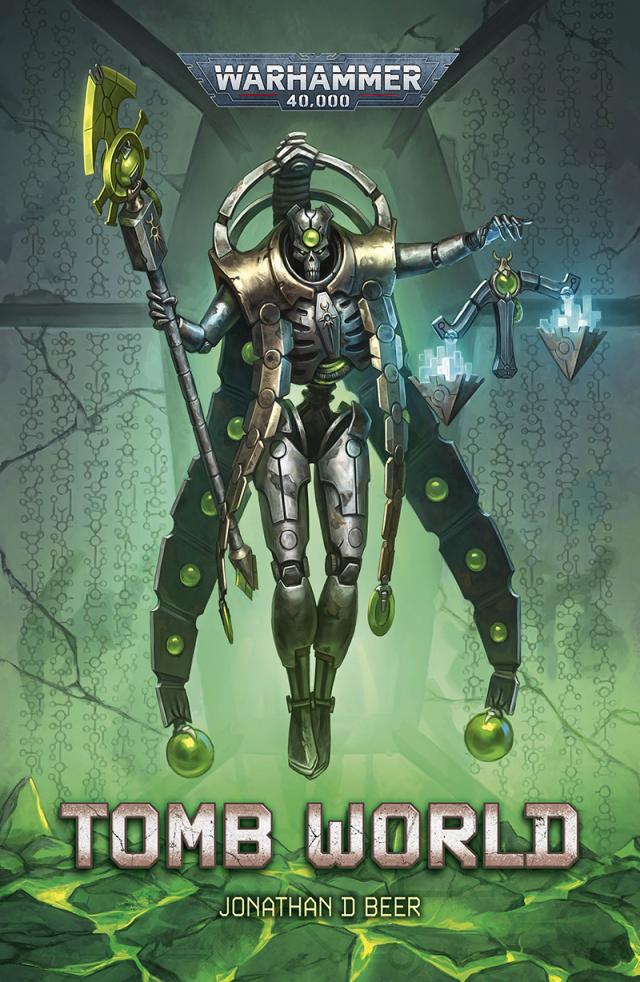


She allows herself the moment’s indulgence and then, as she must, Khemet reaches into the interstices.
A shadow envelops her, vast and total. It swallows her, consumes her, draws her down into the place where darkness is born, permanent and absolute.
Or so the tomb world’s spirit would have her believe.
Khemet has entered its domain, and it is fighting back. She is stripped of form, reduced to a mind persisting in the darkness. This is the reality of Qeretesh, its experience of existence – alone in the void, forever.
Khemet is undaunted by the black depths, because she has been here before. This is not the first tomb world she has confronted. She is ready for the bleak loneliness that tries to swallow her being.
More vitally, Khemet has faced oblivion. Within the tesseract labyrinth there was not simply darkness, but true absence, where even all-consuming shadow would have been a blessed relief. For all that Qeretesh has persisted for uncountable millennia, it cannot conjure true emptiness. The weight of the planet around it is too real for the tomb world’s spirit to imagine anything greater.
Khemet reaches out, projecting herself through the interstices. Her will meets the tomb world’s. Opposing visions, opposing mindscapes meet, but only one can assert itself.
A light, harsh and cold, pierces the darkness. Khemet knows that if she turns the light will still be behind her, forever out of sight. It is her duty to go forth from the light, but she cannot bask in it, no matter her desire to feel it upon her face.
The darkness retreats, the tomb world’s power faltering in the face of her overwhelming mandate.
As the black recedes she discovers Hekasun ahead of her, insofar as distance can apply to this place.
In his reality, the impossible landscape is a throne room, a mosaic floor stretching away to infinity. At the centre of that floor is a crown, sitting upon a stone pillar, as one might display a bauble or antiquity. Hekasun is reaching for it, striving for it, bending all of himself to the task. But no matter how hard he strives, he can come no closer to it.
The noble appears to her as a figure made of golden light, reaching with outstretched fingers to grasp the circlet he so desperately seeks. But the darkness fights him, denies him, closing about his golden hand to rebuff each lunge. The walls and ceiling of his imagined chamber are shrouded in shadow, and close in by the moment. Hekasun lacks the knowledge he needs to defeat the tomb world, and so is attempting to push the world’s spirit aside with pure force.
It is only now, seeing Hekasun laid bare to his essence, that Khemet understands the lord to whom she has been leashed. Whatever Hekasun may pretend, he does not seek to claim Qeretesh in the name of the Traveller. That may be the mandate under which he has come, but Hekasun desires the crown for himself. He wants to rule.
Khemet dismisses Hekasun, erasing him from her mindscape. His desires and pride are irrelevant to her.
In her sight, the crown is instead a sceptre, a simple rod of metagold shaped into the ankh of the Triarch. It seems to float before her, its face and edges made sharp by the azure light behind her.
This, the tomb world cannot deny. It was built by those who bear the sigil of the Silent King upon their bodies, who owe their existence to his will, and to his folly. Qeretesh is unable to resist her. It was made to obey that sigil.
Khemet reaches out and plucks the sceptre from the darkness.
Khemet rises from the illusion in time to weave aside from a scarab’s attack. The battle has not abated in the moments of her vision. Warriors are still being pulled down by a tide of chittering bodies, and sliced apart by streams of energy.
With a wave of her hand, and a wide-cast command across the interstices, she ends the wasteful exercise.
The Qeretesh constructs freeze, all motion halted in the same instant. Wraiths and spyders stand rampant, bladed limbs halted in the act of plunging into reactor cores. Several are destroyed as scythe swings cleave through suddenly inanimate objects. Gauss blasts shatter others, until Hekasun issues a silent order to his warriors to still their wrath. Kamoteph’s own canoptek creatures continue to rend their peers to scrap for a few moments more, until the cryptek calls them to heel.
Hekasun unbends from his rigid pose, sagging all at once as though he had endured the rigours of a foot race. With one hand against a knee, the noble looks up into the twilight depths of the chamber.
‘It is done. I claim the succession of the Zathanor. I am the master of this place. I am the master of this world.’ Each declaration echoes in the sudden silence, rising into the chamber’s darkest reaches.
As one, the lords and warriors that Hekasun brought to Qeretesh bow before him.
‘No, you are not,’ Khemet says softly.
Hekasun turns with a crackle of servos, triumph banished by fury. ‘You deny my victory.’
Khemet meets his gaze. ‘This is not your doing, Hekasun, but mine.’ The lord’s anger turns to confusion. Khemet can almost see his mind at work. He searches his command precepts for what he believes he now possesses, and discovers that he does not.
‘Insolent wretch! You are duatekh. Give me what is mine!’
The petulance of his demand only confirms that Khemet has chosen the right course.
‘Speak that word again, Hekasun, and I shall erase you from existence.’ She walks towards him, raising her rod of covenant to bring its sigil-topped head into Hekasun’s sight. ‘I am a praetorian. Power over this world is not yours to claim, but mine to bestow.’
Hekasun’s core-flux is incandescent, burning with the heat of hatred. At an unspoken command Mandulis and his lychguard leave Hekasun and encircle her, holding a ring of gauss blasters ready to rend her body to atoms. A fleeting memory of green blades and a ghostly moan rise out of her vaults, but she pushes it aside.
‘Destroy me, and you have nothing.’ Mandulis and his warriors halt, as she knew they would. ‘I am a servant of the Silent King. My existence is inviolate. If you break the gravest law of our people, you will dishonour yourself and condemn your cadre to an eternity beneath the rock of this world.’
Khemet steps towards Mandulis, but looks past his baleful gaze towards his master. ‘Without me, Qeretesh will not obey you. No lights will shine. No warriors will wake. No doors will open. You will be consigned to shadow and silence, to blindly walk the halls of the world you were sent to claim.’
Hekasun glares at Khemet. But she knows his mind. His intention was to use her, as he said, as the key to open Qeretesh to his control, and then he would have destroyed her. The arrogance is astonishing, yet not at all surprising.
‘But,’ says Khemet, ‘I will grant you a portion of the power you seek. We will use it, together, to claim this world, and rid it of the pestilence that infects its surface. And when that is done it will be my judgement, Hekasun, that will determine whether you inherit Qeretesh in the name of your absent master. You shall prove yourself to me.’
For all Hekasun’s venality, Khemet knows that this is the path she must take. This world must be woken, and the humans purged from its soil. It is not Khemet’s role to claim power for herself. She is an arbiter, charged to instil it in others. Or strip it away.
Hekasun lowers his sickle blades. At least he has the wisdom to know when he is beaten. ‘I accept your terms, praetorian.’
Khemet nods.
One by one, the lights of Qeretesh flicker into life.
CHAPTER 10
They assemble at the roof of the world, in a grand chamber beneath the planet’s polar cap.
Two days have passed since Khemet took possession of Qeretesh. In that time Hekasun and his court have fled from her sight, seeking to escape the shame of capitulating to the one whom they had sought to use. Khemet, naturally, has monitored their progress as they have gallivanted around the tomb world, moving from gate to gate and from vaulted chamber to high hall to survey their new holdings. The coreworld’s treasuries have been opened, and its arsenals of monoliths and seraptek constructs and voidcraft inspected. The first of its many stasis vaults, with its legions of coffins, crawl with Kamoteph and Ptah’s apprenteks as they catalogue how many warriors and nobles have survived the Great Sleep.
Khemet has left them to their amusement. She has been studying and planning what is to come.
The senses of the tomb complex extend throughout the roots of the world, and its autonomous spirit, now that it has been brought to heel, has been most obedient. The breadth of data it has provided Khemet is enormous, and she has immersed herself in all it can tell. She has learnt much about her enemy, but now Hekasun’s marauding and Khemet’s study must end. They have a world to win.
The Zathanor, as Khemet well knows, were not a grand dynasty. Their holdings were never extensive nor rich. It is highly probable that had Khemet not ended their line, another house would have engulfed them in time. Nevertheless, a tomb world is a vast construction, veining through the bedrock of a planet. If Khemet so desires, she can walk from one pole of this world to the other without ever leaving its halls, though the tomb world’s spirit has spoken to her of areas that have suffered decay and collapse during the millions of years of its slumber.
Khemet has chosen this place at the very top of the complex for their conference as it sits closest to the world’s surface. Barely fifty khet of ice and rock cover the chamber’s blackstone roof. Though there are many routes that could take them from Qeretesh’s depths to stand beneath its sky, this antechamber is the nearest. Though she has no desire yet to march forth, she felt the symbolism appropriate. Khemet and her people will emerge, and take war to the humans.
Hekasun enters the chamber via an eternity gate, stepping from the electric blaze of energy trailed by Kamoteph and Mandulis. She sees that Hekasun has adorned himself with a diadem he has found in the course of his pillaging, a band of metagold that has merged with the necrodermis of his skull. A gem – a vast and flawless ruby – is mounted at its centre, surrounded by an artfully arranged collection of minor jewels.
Khemet considers this vanity. There is only one necron deserving of a crown, and he is far from here.
‘Do not presume to summon me,’ Hekasun says by way of greeting. ‘What is it you require?’
‘I have considered the disposition of this world and its occupants,’ Khemet replies. She stands at a broad holographic plate, lit by a chrysoprase orb projected from its surface. She holds a small plate in one hand, with which she can manipulate the image of Qeretesh before her.
Hekasun and his company draw closer. The forbidding countenance of the necron visage is only heightened by the pallid light of the projector, sharpening the angles of their metal skulls and deepening the shadows around their oculars.
‘Speak,’ commands the would-be lord of Qeretesh, one hand toying with the gem embedded in his forehead.
Khemet puts the control plate down carefully. She has anticipated that Hekasun would resist the change in their interactions that she has made.
‘I remind you, lord, that I am a praetorian of the Triarch. Think well on how you speak. I do not expect you to be humble, or abase yourself before me. I do not desire or seek that – you are a lord of the necrontyr, and I would have you act as one. But I also expect you to recall this – I am judging you. Consider this should you feel the urge to issue further commands to me.’
He takes her reprimand well. Hekasun’s core-flux brightens as he processes his indignation, as does that of his vargard. Mandulis may be mute, but his fury on behalf of his chastened lord is clear to see.
Hekasun’s hand strays to the diadem fused to his brow, clicking each digit against its jewel in turn. ‘Very well. Please, praetorian. Share your analysis.’
Khemet is willing to overlook his sarcasm for now; she has shaped enough nobles to her will to know that they must be bent, not broken.
‘Put simply, if we force an encounter with the humans before we are prepared, we will lose.’
Hekasun pauses in his idle tinkering. ‘I had not imagined a praetorian could be a coward.’
He speaks the insult quickly, without consideration for the reasoning that brought her to this verdict. Khemet revises her previous judgement – some degree of breaking may be necessary.
‘I have brought more worlds to heel than you have walked upon. Tell me, Lord Hekasun, have you fought the humans?’
Hekasun meets her ocular, but there is a new wariness in his gaze. ‘They are weak.’
‘Individually. But their strength is in their multitude. A single human war machine is trivial, but they will bring tens of thousands. A single human warrior is nothing, but they will call upon millions.’
‘We have millions of our own,’ says Kamoteph. The cryptek has been as wary of Khemet as his master since their arrival on Qeretesh. She has yet to decide whether Kamoteph was aware of Hekasun’s intention to destroy her. In either case, she suspects that her decision to withhold the full power of the tomb world’s command from Hekasun surprised him. If so, that is his error to bear, along with whatever consequences Hekasun chooses to mete out.
‘Indeed, technomancer, indeed.’ Hekasun looks up and around, as though seeing through the rock to the many legions of the tomb world that he can now call upon.
‘Our forces will take years to awaken,’ Khemet replies. ‘And in that time, if we are rash, the humans will detect our presence beneath their feet. The seismic disturbance of troop movements and power generation will make it unavoidable.’
Hekasun glances briefly to his cryptek, who gives the slightest gesture of agreement.
Khemet continues. ‘And thus they will bring a weight of fire and a weight of numbers down upon us that will choke our tombs before our armies can march forth.’
‘My armies, praetorian. Mine.’ Hekasun aims for imperious, but achieves petulance.
‘We cannot meet them in open battle until we are ready,’ she repeats. If they are to achieve their goal, and win this world for the Traveller as Hekasun has been commanded, then he must be made to grasp this point. If he chooses to indulge his new pride and begins rousing Qeretesh’s legions prematurely, the same disaster that befell the Lazar crownworld will occur here.
‘What, then? If we cannot take war to the humans, in what way do you propose to cleanse my world?’
Khemet extends one hand up, pointing far into the hall’s dark upper vaults, to where Ahnuret has been watching their conversation from a distant balcony.
‘Her way.’
If the deathmark is alarmed by their sudden attention, she shows no sign. The assassin has dogged Khemet’s steps these past days, haunting the highest places of the tomb complex as Khemet has worked. For what purpose she has attached herself to Khemet’s shadow, she still does not know.
Hekasun and Kamoteph follow Khemet’s gesture, and understanding begins to dawn.
It will be a quiet war. A hidden war. A war that will break the humans long before the legions begin to march, fought far from the places that will become battlefields.
It will be a war waged from the shadows.
ACT 2
CHAPTER 1
Queen of the North is flying tonight.
The mile markers emerge from the darkness and disappear in a flash of grey rockcrete, a little more than once a minute. The cabin rocks gently as the locomotive follows the subtle undulations of the track. The hiss-thud of labouring pistons beats a tattoo that is as familiar to Vanda as the thump of her own heart.
Enginseer Third Echelon Vanda Gerig’s eyes are half closed. She is sitting on the top of the breaker box, a tiny ledge of metal just deep enough to let her take the weight off her aching feet. She is as comfortable as it is possible to be while on duty. The box is located at the perfect confluence of the heat of the engine’s reactor furnace and the cool air rushing along the locomotive’s flank. She has recently eaten. There is little for her to do except monitor the coolant temperature dials and listen to the rhythm of her machine.
And, most importantly, she cannot smell the conveyor’s cargo.
The three engines of Conveyor Sixteen-Red have been on the same route for thirty-two years, and Vanda has been with them for every year and every mile. First south, laden with bricks of starch and slab collected from the agri-fields and the great tangle of processing plants, as foul and dangerous as any manufactorum on the planet. Half the bricks offloaded at the equatorial voidports, to go up on the lifters to feed the masses aboard the orbital plates, to be replaced by troops, tanks, and whatever goods the Munitorum sees fit to bring down to Orymous.
Then west, far to the west, through the belt of coastal billet-cities before turning north for the brutal sprawl of Verongyl. The entire stage takes eleven days, with pauses to unload and load at each city. Vanda hates that leg, hates the stop-start pace and the strain it puts on the Queen and the other locomotives. It takes the conveyor six hours to heave its way from a standstill to its running speed, engines roaring against the immensity of their carriages. It takes eight to gradually throttle back, the universal law of inertia doing far more of the work than the brakes. This was the first lesson she had been taught, before Vanda had even stepped aboard the Queen. A hundred thousand tons of metal and freight do not stop on a whim.
The final phase of the route takes Vanda back into the north. It is a long haul, but a simple one. No breaks, no pauses, just an uncomplicated exercise in mechanical effort to climb up the curve of the world to return to the agri-fields, loaded with the foulest of cargos.
On their westward run, each billet-city disgorges a bounty of cylindrical silos. Every silo is triple-sealed and welded shut, and yet their contents inevitably leak out. Human waste, the collected run-off of the cities’ sewer systems, is hauled away by Conveyor Sixteen-Red to be used as fertiliser for the agri-fields. In her more philosophical moments, Vanda considers it fitting – she and the Queen deliver the bounty of Orymous’ great plantations to the soldiers and civilians who are packed like cattle into the billet-cities, and return what becomes of that fare to the fields to sustain them.





