The Last Gasp, page 1


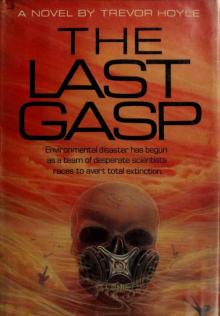
The Last Gasp
About the Author
Trevor Hoyle doesn’t divide his time between Lancashire, where he was born and still resides, and anywhere else, though he has lived in Mallorca. He had tremendous fun in advertising and television before becoming a full-time author of novels, short stories and radio drama some forty-odd years ago. He hasn’t spent half his writing career working on this novel, it just seems so.
Also Available in Ebook
The Relatively Constant Copywriter
Rule of Night
The Man Who Travelled on Motorways
K.I.D.S.
Earthcult
Vail
Blind Needle
Mirrorman
Down the Figure 7
The ‘Q’ Series (a science fiction trilogy)
1: Seeking the Mythical Future
2: Through the Eye of Time
3: The Gods Look Down
Title
Trevor Hoyle
Copyright
First published in Great Britain in 1983 by Random House
This edition published in Great Britain in 2016 by
Jo Fletcher Books
an imprint of
Quercus Editions Ltd
Carmelite House
50 Victoria Embankment
London EC4Y 0DZ
An Hachette UK company
Copyright © 2015 Trevor Hoyle
The moral right of Trevor Hoyle to be
identified as the author of this work has been
asserted in accordance with the Copyright,
Designs and Patents Act, 1988.
All rights reserved. No part of this publication
may be reproduced or transmitted in any form
or by any means, electronic or mechanical,
including photocopy, recording, or any
information storage and retrieval system,
without permission in writing from the publisher.
A CIP catalogue record for this book is available
from the British Library
PB ISBN 978 1 84866 455 5
EBOOK ISBN 978 1 84866 456 2
This book is a work of fiction. Names, characters,
businesses, organizations, places and events are
either the product of the author’s imagination
or used fictitiously. Any resemblance to
actual persons, living or dead, events or
locales is entirely coincidental.
Typeset by CC Book Production
Dedication
In memory of my beautiful sister Julie.
May she at last have found the peace she sought,
on her final journey.
Epigraphs
‘. . . Let us strike the keynote, Coketown, before pursuing our tune.
It was a town of red brick, or of brick that would have been red if the smoke and ashes had allowed it; but as matters stood it was a town of unnatural red and black like the painted face of a savage. It was a town of machinery and tall chimneys, out of which interminable serpents of smoke trailed themselves for ever and ever, and never got uncoiled. It had a black canal in it, and a river that ran purple with ill-smelling dye, and vast piles of buildings full of windows where there was a rattling and a trembling all day long, and where the pistons of the steam engine worked monotonously up and down like the head of an elephant in a state of melancholy madness. It contained several large streets all very like one another, and many small streets still more like one another, inhabited by people equally like one another, who all went in and out at the same hours, with the same sound upon the same pavements, to do the same work, and to whom every day was the same as yesterday and tomorrow, and every year the counterpart of the last and the next’
HARD TIMES by Charles Dickens
‘Half of all the energy consumed by man in the past two thousand years has been consumed in the last one hundred’
FUTURE SHOCK by Alvin Toffler
‘If the present growth trends in world population, industrial pollution, food production and resources depletion continue unchanged, the limits to growth on this planet will be reached sometime within the next one hundred years’
THE LIMITS TO GROWTH by Donella H. Meadows
‘All progress is based upon a universal innate desire on the part of every organism to live beyond its income’
Edmund Burke
Contents
2016
1
2
3
4
5
6
2021
1
2
3
4
5
6
7
2025
1
2
3
4
5
6
7
8
2030
1
2
3
4
5
6
7
2036
1
2
3
4
5
6
2042
1
2
3
Epitaph: 2052
1
AFTERWORD
ACKNOWLEDGEMENTS
SOURCES
2016
1
1
The mystery man arrived just before the five-month Antarctic night set in. Two days later and he would never have been found.
Like a mole from its burrow, Gavin Chase emerged that morning from the prefabricated bunker eight feet below ground. Ten years ago the bunker had been on the surface. Now, shored up with buckled iron ribs and creaking timbers, it was gradually sinking deeper and deeper into the ice with the warming summer temperatures. Soon it would be necessary to abandon and build anew.
It was still dark. The spread of stars was etched into the firmament with hard, diamond-like precision. Above the icebound continent of five million square miles – nearly twice the area of Australia – the insulating troposphere was so shallow, half that of the equator, that the marine biologist felt as if he were directly exposed to the vacuous cold of outer space. Welcome to the Antarctic winter: cold enough to turn gasoline into jelly and make steel as brittle as porcelain.
Chase stepped carefully from the slatted wooden ramp that led below. He was a bulky, shuffling figure in outsize red rubber boots, swaddled in waffle-weave thermal underwear and navy-issue fatigues, all zipped up inside an orange parka. Protecting his vulnerable hands, felt gloves inside thick mittens were thrust into gauntlets that extended to his elbows. A thin strip from eyebrows to the bridge of his nose was the only part of him open to the elements. He moved across the wind-scoured surface of packed snow to the weather-instrument tower, eyes probing the darkness.
Yesterday the temperature had fallen to -46.8°C. Once it dropped past -51°C there would be no more scuba diving till next summer. But he hoped there was time for at least one more dive. There were specimens of planktonic algae he wanted to collect, in particular a subspecies known as silicoflagellates, which abounded beneath the pack ice of the Weddell Sea, here on the western rim of the Antarctic Plateau. Amazing really – that there should be such an abundance of microscopic life teeming below when up above it was as bleak and sterile as the moon.
It was an odd phenomenon. While surface temperatures stayed very low, sea temperatures underneath the ice were rising. One of the positive results for him was that the diving window had been extended: even this late in the season there were patches of open water in the pack ice, whereas a few years ago it would have been a solid mass. Impenetrable.
With slow, calculated movements he gripped the metal ladder and hauled his six-foot frame twenty feet up to the first platform. Young and fit as he was, honed to a lean 160 pounds after nearly six months at Halley Bay Station, Chase knew that every calorie of energy had to be budgeted for with a miser’s caution. Inactive, the body used up about one hundred watts of power, which went up tenfold with physical activity. The trick was to keep on the go without overtaxing yourself. That way you kept warm, generating your own heat – but there was another trap if you weren’t careful. At these extreme latitudes the oxygen was low, the equivalent of living at ten thousand feet on the side of a mountain. With less oxygenated blood reaching the body’s tissues any exertion required double the effort and energy expenditure. Too much exertion and you could black out – as quickly as a light snapping off – and that would be that.
Chase knelt down and brushed away the thick coating of frost from the gauges.
Windspeed was up to twenty-two knots, he noted with a frown, then he relaxed slightly and grinned when he saw that the red needle of the temperature gauge was still a few degrees short of sixty. Good. That meant one more day, possibly even two. Nick wouldn’t like it, but he’d have to persuade him; he couldn’t dive without a backup.
With only two weeks left to serve at the station, Chase was keen to gather as many marine samples as possible before boarding the C-130 for the 1,850-mile flight across the Pole to the American base at McMurdo Sound, then the 2,400-mile haul back to Christchurch, New Zealand.
And a week after that he would be home!
He straightened up and gazed out over the featureless wasteland towards the heart of the polar interior. His breath plumed the air like smoke. On the barely discernible line of the horizon a very faint smudge of crimson indicated the advent of the sun. They would see it for a couple of hours today – a flattened reddish ball resting on the rim of their world – and then it would be dark once more. Soon it would be night until September.
The five-month long night aside, there was another, more urgent reason Chase was glad to be leaving. During the winter months the Antarctic lost nearly half its ozone cover, the earth’s protective shield against ultraviolet radiation from the sun. The decline had first been spotted in the early seventies, when atmospheric analysis had revealed the culprit to be CFCs, the chlorofluorocarbons used in aerosol sprays and other products. By the mid-nineties, ozone levels above the South Pole had fallen by forty per cent, and the Nimbus 7 satellite confirmed it: a gaping hole in the stratosphere of thousands of square miles, as big as the USA.
Twenty years on, the hole was not just still there; it was growing. Come September, anyone at Halley Bay foolish enough to spend a few hours exposed to direct sunlight ran the risk of developing melanoma. And Chase was quite certain he could do without a dose of skin cancer, thanks very much.
Directly below him elongated slivers of deep purple shadow edged out from the weather gantry and radio mast – the ‘bird’s nest’ as it was called by everyone on the station. The shadows crept slowly across the smooth humps that were the only visible sign of the warren of living quarters and labs and the thirty-six men beneath.
The arc of red tipped the rim of the world.
Chase held his breath. An Antarctic sunrise was awesome, no matter how many times you witnessed the miracle.
From dingy grey to misty pearl and then to blinding white: the landscape was illuminated like a film set. Chase shielded his eyes against the reflected glare. Even though the horizontal rays were weak, the albedo effect of the white blanket of snow and ice threw back every photon of light in a fierce hazy dazzle that seared the eyeballs. Under certain conditions this caused a whiteout, land and sky melting together with no horizon to align the senses, all contours and topographical features lost in a blank white dream.
Chase watched and marvelled, and then he focused . . .
Something was moving out there on the ice. Hell, no, must be mistaken. He was gazing towards the Pole. Nothing could be coming from that direction, from the barren heart of all that emptiness.
In the next instant he was scrambling down the ladder, rubber boots slithering on the ice-coated rungs. In his haste he forgot about the thinness of the atmosphere, about energy budgets. He hadn’t gone more than a dozen yards before his chest was heaving. Sweat ran from his armpits: always a danger signal, because damp clothing quickly lost its insulation properties and you could end up freezing in your own perspiration.
Steady now, idiot, take it easy. Whatever was out there – if anything was out there – it had survived until now. Steadying himself, he sucked in long deep gulps of air. He’d look bloody foolish if he were found dead within fifty feet of the entry ramp.
A little over ten minutes later, pacing himself, he came in sight of the object he’d seen. It was a sled. The team of eight dogs was, quite literally, on its last legs, too exhausted to do anything except sag in their harness straps and pant weakly.
Chase leaned over the sled and pulled back the stiffened canvas sheet. It cracked like breaking timber. A shapeless mound of ice-encrusted furs concealed the body of a man. His head was sunk deep in a cavity of fur. He was heavily bearded and blackened by the sun. Dark goggles, the old-fashioned type, with tiny circular lenses, covered the eye-sockets.
Dead – must be, Chase reckoned and then saw the blistered lips move. Bloody impossible. The man had come out of nowhere, appeared from a thousand miles of icy wilderness and – incredibly – he was alive.
2
The wedge of light sliced through the darkness as if the blackness itself were a tangible substance. Wielding the heavy battery of arc lamps, Chase swam deeper. He was the searcher, Nick the collector. Above them the lid of ice, forty feet thick, sealed them in a freezing watery tomb, save for a single tiny aperture that was their entry and exit point. It was very easy to feel trapped and claustrophobic.
No wonder Nick had grumbled and cursed. ‘For Christ’s sake, are you a masochist or what, Gav? No, I get it, a bloody sadist, that’s what you are. Nick Power thinks the tour’s over, no more work to be done, so I’ll show the bastard. Make him suffer.’
Except that Chase didn’t think of it as suffering. He rather enjoyed it, as a matter of fact. When diving like this he felt suspended, a tiny fragment of warm life, on top of the world (top, bottom – in an astronomical context they were interchangeable), with everyone and everything else beneath him.
All the continents, oceans, cities and the whole of mankind were way down there.
At a hundred and thirty feet he swung the battery of lamps around. Nick hadn’t a clue what to look for; he merely followed the wedge of light and swooped when Chase gave the signal. It could look a bit ridiculous, grabbing at nothing, and Chase grinned behind the full-facemask at Nick’s apparently pointless pantomime. They were after microscopic plants, the silicoflagellates, and it was more good luck than fine judgement if they happened to snare the ones Chase wanted.
He chose what looked a likely spot, just above the ocean floor and hoped for the best.
Nick turned towards him, his faceplate flashing like a silver coin in the milky light. The net trailed after him, a long swirling cocoon. He’d closed the neck, Chase saw, and was gesturing upwards. He’d obviously had enough. Probably the cold was starting to seep through his insulated suit – he could feel a creeping numbness in his own feet. If you ignored it – and you could, it wasn’t painful – you felt fine, at least until you got back to the surface and began to thaw out. Then you were wracked with the most excruciating agony and, eventually, if not treated promptly, you’d find all your toes had dropped off.
Chase gave a thumbs-up in the cone of light, indicating they were done, but Nick continued gesturing, his movements sluggish, dreamlike. What was the daft clown playing at?
Chase kicked with his flippered feet and swam nearer to see Nick’s panicked eyes bulging at him through the faceplate. He gestured frantically over his shoulder towards his double cylinders . . . something was the matter with his air supply.
It was difficult, trying to manoeuvre the awkward battery of lights with one hand while he spun Nick around with the other. The blackness surrounding them was total, just a speck of light in countless cubic miles of inky black water.
The first cylinder was empty; its gauge registered zero. The second cylinder should have kicked in automatically, but it hadn’t, and Chase saw why at once: the exposed brass feed-pipe was flecked with ice and the valve had frozen. Nick was eking out his existence on what little oxygen remained in the first tank.
They were below 130 feet, and if they were to avoid the bends, that meant an ascent lasting several minutes – much too long for Nick to survive. And Chase couldn’t feed him from his own mouthpiece: air supply and mask were an integral unit, and if you removed your mask in these waters, the cold would strike needles into your skull and kill you with the shock.
For several seconds Chase’s mind was locked in paralysis. Nick had only a few gasps of air left; even if he managed to get him to the surface alive, the lack of oxygen would cause irreparable brain damage. It was an unwelcome reminder that the Antarctic was an implacable enemy: relax your guard for even one instant and it would exact the full penalty. Negligence was death.
Heat.
You fought cold with heat. The only source available was the battery of lamps. Chase grasped Nick by the shoulder, using the leverage to force the cowled arc light against the brass feed-pipe. If he didn’t get direct contact, the water would dissipate what little heat there was.
Together they floated in darkness, the muted thump-and-gurgle of Chase’s air supply the only sound. Everything became topsy-turvy; they were no longer at the top of the world but the bottom, the immense weight of the planet pressing down on them. So that must mean the thick slab of ice was beneath them, and beyond that the tenuous troposphere, and then nothing but bottomless space . . .