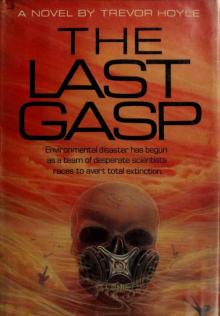
The Last Gasp, page 10


‘I have been informed of that,’ Malankovitch said. He cleared his throat. ‘Most upsetting.’ He reached out to a side table and picked up a sheet of paper. Boris could see that it had the Hydro-Meteorological Service logo at the top, but nothing more.
‘You’ve been in touch, I understand, with someone at the Scripps Institution of Oceanography in California. A person called Theo Detrick.’
‘Not correct,’ Boris said.
‘No?’ Malankovitch kept his eyes lowered, his sallow face expressionless.
‘No. I did try to contact him by email but got no reply.’
‘For what purpose?’
‘I was hoping he’d be attending the conference in Geneva so we could meet up.’
‘And will you be meeting him there?’
‘I have just explained,’ Boris said patiently, ‘that I haven’t had a reply, so I don’t know if Dr Detrick will be there or not.’
‘The email contains personal news and friendly salutations.’
‘So it does.’ That Malankovitch and his henchmen read his emails and other communications came as no surprise to Boris, but nonetheless it infuriated him. This gang was nothing more than a pack of arrogant mafia goons lining their own pockets, and doing it by using the talents of those like him and other dedicated scientists seeking to pursue knowledge and enlightenment.
‘I’ve visited and worked with Dr Detrick in the past. I consider him a friend as well as a colleague. He would think it “strange and perplexing” if my message wasn’t couched in personal terms; in fact he’d find it rather insulting.’
Malankovitch blinked a number of times, frowning into the middle distance. He slowly nodded. ‘I see. Yes, ah, well, that would explain it. I understand.’
‘Good. Glad you do. Now you know. Anything else?’
Boris loaded the terse phrases with several shades of meaning: condescending, impatient, intimidating, challenging, even a hint of bullying. As if to say I am Professor Boris Vladimir Stanovnik, one of this country’s leading experts in marine microbiology, and you, Yuri Malankovitch, whatever status you might have attained, and however much loot you might have plundered, and whoever you think you are, will always remain the incompetent, shifty, snivelling lab orderly with poor complexion and bad breath.
The glow of vengeful satisfaction Boris felt didn’t last long. This evening, having supper with Nina as they watched the news together, the bitter taste left by Malankovitch’s final words as he was leaving the gated compound to the north of Moscow hadn’t faded.
Fixing his odd-coloured eyes on Boris for the first time, Malankovitch had said, in a voice empty of expression, ‘Have a pleasant stay in Geneva, Professor. Don’t forget to bring back a present for your wife.’
His meaning had been all too clear. While Boris was free to leave the country to attend the conference, he should never forget for one moment that Nina remained behind in Mother Russia. Shades of the old Soviet regime. What was the time-honoured phrase? The more things change, the more they stay the same?
2
From his seat one over from the window, Theo Detrick looked out at the huge circular cowling of the GE90, bathed in diamond-bright sunlight. As part of his research, Theo had made a special study of commercial aero engines. The GE90 on this Delta Boeing 772 long-haul was the largest and most powerful engine so far in aviation history, producing 130,000 pounds-force thrust. The engine was slightly ahead of him, so he couldn’t see the gaping turbofan mouth gulping in rarefied air 35,000 feet above Greenland. But he knew that every minute of the flight this one engine consumed more than one hundred pounds of oxygen, which, times two, meant the aircraft burned up eighty-six tons of oxygen every time it crossed the Atlantic.
He couldn’t begin to guess at the number of flights on the transatlantic route. And God knew how many other private, commercial and military aircraft were flying every hour of the day and night. Add them all together and it amounted to a global oxygen loss of millions of tons every twenty-four hours.
And that in itself was only a tiny proportion. Man was greedily consuming more and more oxygen in his industrial plants, his power stations, his home furnaces, his automobiles – every form of combustion was destroying oxygen in quantities that the natural cycle of the biosphere wasn’t designed to cope with, nor able to replenish.
There was also – and this was a thought never far away from Theo’s mind these days – the world population of 7.2 billion human beings, each one needing seven pounds of oxygen every day to stay alive. By the year 2030, at the current rate of growth, there would be an estimated eleven billion people inhabiting the planet; the question was, would there be any air left for them to breathe?
And those cretins in Washington couldn’t see – refused to admit – there was a problem. Were they mad, or was he?
In the window seat next to his, Cheryl leaned forward, blocking his view. Resisting the impulse to touch her hand, Theo asked instead, ‘You’re not regretting this, are you?’
‘Not so far,’ Cheryl answered briefly. She spared him a cool glance and turned away, a shaft of pure sunlight gilding her razored cap of hair and snub-nosed profile.
He had no right to expect anything more. All those years of absence and neglect couldn’t be simply wiped away by the promise of a week in Geneva. He remembered his resolve not to rush her into a kind of false father/daughter intimacy that would embarrass them both. No, if any real affection was still there it would have to evolve naturally, unforced, at its own pace. It came as a shock that for years he had experienced not a twinge of guilt, only now to discover that it was his strongest emotion.
He said diffidently, ‘This trip will be useful to you. You’ll meet other marine biologists and people with different views, be able to get involved in seminars and debates—’ Then he hastily reconsidered and thought it wise to add, ‘Of course, for you, I want it mainly to be a vacation.’
Still not looking at him, Cheryl said, ‘I thought maybe you’d invited me along to take notes. Work comes first, doesn’t it? And second. And third.’
‘Yes, my work is important to me,’ Theo acknowledged soberly. ‘But it is also important to me that you are involved – that you believe in what I am doing – I hope—’ He was fumbling for the words and making a mess of it. He looked down at his hands, gnarled mahogany. ‘I wanted you to be with me because . . .’
The truth was he didn’t know himself what the reason was. He suspected it had something to do with a need to find understanding. Sympathy. Affection? One person in all the world who might believe in him.
Cheryl shook her head, looking out of the window. ‘You don’t have to explain. If I wanted reasons I’d have asked for them. I’m here. Let’s leave it at that.’
Theo found a smile. ‘If nothing else, you’re an independent young woman.’ He meant it as a compliment, but it was a day when he could say nothing right.
‘Yes,’ Cheryl said. ‘I’ve had plenty of practise.’
Theo shifted uncomfortably, his broad torso hampered by the narrow seat, and wisely decided to abandon this pretence at conversation.
In the battered briefcase between his legs rested the paper he was to read at the conference. It was a summation of all his years of research and thought, worked on and sweated over during the past three weeks until he had pared it down to eleven double-spaced typed pages. More a predictive document than a list of facts and figures, he had given it the title ‘Back to the Precambrian’: a reference to the period more than 2.5 billion years ago, when the atmosphere was composed of hydrogen, methane and ammonia and no free oxygen; a time to which he believed the earth was returning.
Theo dozed while Cheryl stayed awake and watched a movie.
She felt confused and vulnerable. It was a massive understatement to say it had been a shock when her father turned up unannounced at Scripps less than a week ago. That shock turned into bewilderment when he produced two airline tickets and hotel reservations. She couldn’t actually remember accepting his invitation, or even having time to regret it. As fate would have it, she had ten days before the Melville sailed on its next research voyage, this time to Guadalupe Island off Mexico. There had been no obstacle, no real reason why she shouldn’t go. And, she argued to herself, it would be valuable and stimulating to attend a convention with such high-profile delegates, most of them leaders in their field. So here she was.
Travelling with the spin of the earth, they saw dusk come upon them with the dramatic abruptness of a thundercloud. After passing over the northernmost tip of Scotland, the aircraft began to lose altitude in preparation for the long descent into European airspace. To one fitfully dozing passenger the muffled shriek of engines sounded like the howl of a greedy machine sucking the breath from his lungs.
3
It was Chase’s first visit to Geneva and his preconceptions that it would be clean, somewhat austere, and filled with the all-purpose breed of European technocrat seemed depressingly close to the mark.
He and Nick were booked into the Inter-Continental, a fifteen-minute drive from Cointrin Airport, which conveniently enough was also the conference centre. In the wide carpeted lobby a laser display board gave the conference itinerary, with details and locations of the various speakers and their subjects.
Chase paused to scan the board. His spirits sank. This was heavy stuff.
GLOBAL ENVIRONMENTAL MONITORING:
Dr J. N. Ryman
HAZARDS OF TOXIC WASTE:
Professor I. V. Okita
DEMOGRAPHIC PATTERNS IN THE 21ST CENTURY:
Professor D. S. Smith
THE CARBON DIOXIDE CONUNDRUM:
Dr P. Straube
GLOBAL WARMING – FACT OR FICTION?:
Lord Derker of Hollingworth
Nick said, ‘Who in hell is Lord Derker? Is he one of ours?’
‘I guess he must be a Member of the House of Lords.’ Chase shook his head. ‘Though what he knows about global warming, real or otherwise, is double bollocks wrapped in tissue paper.’
OZONE – A VANISHING PROBLEM?:
Professor C. Hewlett
WHERE IS SCIENCE TAKING US?:
Dr E. B. Salem
Where indeed? The list was long and Chase didn’t come to the name he was looking for until near the end.
MICRO-ORGANISMS AND CLIMATE:
Professor B. V. Stanovnik
Suitably noncommittal, Chase reckoned, for a paper from a Russian scientist. He saw that Stanovnik was down to speak on the Tuesday morning, three days from now. Perhaps he’d get the opportunity to have a word with him before then. Sir Fred had mentioned that he spoke good English, which was fortunate. Chase didn’t relish the idea of conversing via an interpreter. It might easily lead to misinterpretation.
The hotel – ‘Holiday Inn with Hiltonian pretensions’, according to Nick – was bustling and frenetic. After unpacking and cleaning up they kept to Nick’s plan and headed for the main bar. Chase felt ill at ease alongside the conservatively suited conference crowd sporting plastic name tags on their lapels. The atmosphere was one of forced conviviality, with everyone busily consuming pre-dinner drinks.
‘Oh, Christ, no . . .’ Nick sucked in a breath and lowered his head.
‘What’s up?’
Nick swivelled his head as a signal and stared hard. Through the bar-dwellers Chase glimpsed a narrow bald head and close-set eyes like raisins in dough. In his usual tweed jacket and grey cords Professor Ivor Banting was talking to a large bull-necked man with shorn greying hair.
‘Has he spotted us?’ Nick asked tremulously. ‘I had to put up with the bastard at Halley Bay and I’ll be damned if I’m going to here.’
‘Last person I expected to see,’ Chase said, turning to face the other way. ‘Would you have said Banting the Terrible was all that interested in the future of the environment?’
Nick was scathing. ‘He bloody well isn’t. A week in Geneva at somebody else’s expense, though? A fucking freeloader . . .’
Chase looked down on him with a flinty grin. ‘Unlike present company, you mean?’
‘He’s an arse-licker,’ Nick insisted. ‘Why do you suppose he was so accommodating to the Yanks in taking the Russkie?’
‘You tell me.’
‘Because they’ve got the funds to underwrite big research projects, dummy. Banting keeps in with the guys with the bucks. He couldn’t give a damn who they are and what the project is providing they’re willing to cough up—’ He glanced furtively over his shoulder. ‘He hasn’t seen us, has he?’
‘What makes you think he’s all that keen to meet us anyway?’ Chase said. ‘Could be he’s as anxious to avoid—’
Unfortunately he wasn’t; the next moment Professor Banting had excused himself and was beginning to push his way towards them through the crowd.
Nick swore under his breath and threw back his drink in one quick gulp.
After they’d shaken hands – Nick with barely concealed bad grace – Banting gestured around, saying with a knowledgeable air, ‘Some excellent people here. I’m looking forward to it, aren’t you? Have you seen the agenda?’
Chase said he had. ‘Anyone you’d recommend?’
‘Straube and Ryman, and Colin Hewlett’s paper should be worth hearing – I was his tutor at Loughborough, you know. And Stanovnik and Professor Okita; all first-rate chaps. I’ve been to the last two conferences, in Iceland and Miami, and this looks like the best so far.’
‘What’s that?’ Nick said, peering intently at Banting’s lapel badge. Unlike all the others, his ID was mounted in a thin silver frame, in the bottom corner of which was the tiny embossed emblem of a silver conch shell.
‘I’m a sponsored delegate,’ Banting explained. ‘The JEG Corporation. They’re very much concerned with environmental matters.’
‘American?’
‘International,’ Banting said. ‘Their interests are worldwide – electronics, chemicals, lumber, transportation, aerospace. A very large organisation with dozens of subsidiaries.’
Nick’s expression remained deadpan, which was eloquent enough in itself.
Chase said, ‘So you reckon Stanovnik will be worth listening to?’
‘It’s always useful to find out what the Russians are up to,’ Banting said. He gestured towards the bar. ‘That’s the chap I was with a moment ago. Decent type, quite friendly, not a grump like most of his colleagues.’
‘That was Stanovnik?’ Chase said, craning to see, but the big Russian had gone. Apparently random events and disconnected factors, somehow drawn together. He had the feeling that he was on the edge of something. He was intrigued, and also strangely excited. Half-listening to Banting, he nodded abstractedly, and heard Nick utter a low groan of deep anguish.
Chase had just accepted Banting’s invitation for the three of them to dine together, a sort of British Antarctic Expedition reunion. Shit and Corruption.
4
In common with the seventeen hundred other people in the hall, Chase hadn’t a clue what the rumpus was about.
Scheduled to start at 3 p.m. – it was now ten past – on the Sunday afternoon, this first session was billed in the programme as ‘Welcome to the Sixth International Conference’, followed by a ‘Symposium of Views’: a cosy get-together, he had imagined, to ease everyone as painlessly as possible into the rigours of the week ahead. Like everyone else he hadn’t been prepared for the commotion by the steps leading up to the platform.
What the hell was going on? A protest?
If so then the protestors were an unlikely pair – a stocky, tanned, white-haired man and a girl who might have been a student in a grey parka with faded denims tucked into knee-high boots. It was the girl who was doing all the talking while the man was standing there holding a dilapidated briefcase under his arm, his expression calm, resigned, a little weary.
Several officials had closed ranks while others were scurrying around gesticulating to one another. The girl, attractive and obviously incensed, was by turns raging at and then pleading with a harassed-looking official. Above them the conference chairman, a Norwegian, waited unhappily at the microphone, uncertain whether to ignore the commotion and carry on regardless, or hang on in the hope that it might, like a summer thunderstorm, quickly blow over.
‘And I thought this was going to be dull,’ Nick said, enjoying the spectacle, straining his curly head to get a better view. ‘Who are they?’
Chase shook his head. ‘No idea. But the girl sounds American.’
They watched as the officials escorted the man and the girl along the aisle and through a side door, the girl arguing as fiercely as ever. The auditorium, silent and rapt till now, droned with speculation like a beehive disturbed by an intruder.
Nick grinned delightedly. ‘I hope the next act is as good,’ he said, but his face fell when the Norwegian began to speak in that unrhythmic swaying singsong that either grated or sent people to sleep.
It sent Nick to sleep.
5
The official held up his hands, palms outwards, and said, ‘The governing committee is not required to give a reason, mademoiselle. It is their decision alone. You understand?’ He gave a weak smile.
Cheryl, now icily calm, said, ‘I see. The fact that my father has flown halfway round the world to be here doesn’t matter a damn to your committee. They can decide, just like that, and we don’t have the right to ask why or to receive an apology or even a reply? That’s how you run things here, is it?’
‘I am sorry, Mademoiselle. The decision is not mine.’
‘You won’t even give us a reason.’ She looked towards her father, who so far had shown neither anger nor disappointment – no emotion at all, in fact.
‘As I have said, it is not required. The rules of the conference state that all papers must receive prior approval—’
‘But the paper was accepted!’
‘No, not so in this instance, mademoiselle. It was provisionally agreed that Dr Detrick would be allowed to address the conference, subject to his paper being cleared by the committee. The committee has now seen the paper and made its decision.’ Again the half-shrug, the tepid smile.
‘You’ve been in touch, I understand, with someone at the Scripps Institution of Oceanography in California. A person called Theo Detrick.’
‘Not correct,’ Boris said.
‘No?’ Malankovitch kept his eyes lowered, his sallow face expressionless.
‘No. I did try to contact him by email but got no reply.’
‘For what purpose?’
‘I was hoping he’d be attending the conference in Geneva so we could meet up.’
‘And will you be meeting him there?’
‘I have just explained,’ Boris said patiently, ‘that I haven’t had a reply, so I don’t know if Dr Detrick will be there or not.’
‘The email contains personal news and friendly salutations.’
‘So it does.’ That Malankovitch and his henchmen read his emails and other communications came as no surprise to Boris, but nonetheless it infuriated him. This gang was nothing more than a pack of arrogant mafia goons lining their own pockets, and doing it by using the talents of those like him and other dedicated scientists seeking to pursue knowledge and enlightenment.
‘I’ve visited and worked with Dr Detrick in the past. I consider him a friend as well as a colleague. He would think it “strange and perplexing” if my message wasn’t couched in personal terms; in fact he’d find it rather insulting.’
Malankovitch blinked a number of times, frowning into the middle distance. He slowly nodded. ‘I see. Yes, ah, well, that would explain it. I understand.’
‘Good. Glad you do. Now you know. Anything else?’
Boris loaded the terse phrases with several shades of meaning: condescending, impatient, intimidating, challenging, even a hint of bullying. As if to say I am Professor Boris Vladimir Stanovnik, one of this country’s leading experts in marine microbiology, and you, Yuri Malankovitch, whatever status you might have attained, and however much loot you might have plundered, and whoever you think you are, will always remain the incompetent, shifty, snivelling lab orderly with poor complexion and bad breath.
The glow of vengeful satisfaction Boris felt didn’t last long. This evening, having supper with Nina as they watched the news together, the bitter taste left by Malankovitch’s final words as he was leaving the gated compound to the north of Moscow hadn’t faded.
Fixing his odd-coloured eyes on Boris for the first time, Malankovitch had said, in a voice empty of expression, ‘Have a pleasant stay in Geneva, Professor. Don’t forget to bring back a present for your wife.’
His meaning had been all too clear. While Boris was free to leave the country to attend the conference, he should never forget for one moment that Nina remained behind in Mother Russia. Shades of the old Soviet regime. What was the time-honoured phrase? The more things change, the more they stay the same?
2
From his seat one over from the window, Theo Detrick looked out at the huge circular cowling of the GE90, bathed in diamond-bright sunlight. As part of his research, Theo had made a special study of commercial aero engines. The GE90 on this Delta Boeing 772 long-haul was the largest and most powerful engine so far in aviation history, producing 130,000 pounds-force thrust. The engine was slightly ahead of him, so he couldn’t see the gaping turbofan mouth gulping in rarefied air 35,000 feet above Greenland. But he knew that every minute of the flight this one engine consumed more than one hundred pounds of oxygen, which, times two, meant the aircraft burned up eighty-six tons of oxygen every time it crossed the Atlantic.
He couldn’t begin to guess at the number of flights on the transatlantic route. And God knew how many other private, commercial and military aircraft were flying every hour of the day and night. Add them all together and it amounted to a global oxygen loss of millions of tons every twenty-four hours.
And that in itself was only a tiny proportion. Man was greedily consuming more and more oxygen in his industrial plants, his power stations, his home furnaces, his automobiles – every form of combustion was destroying oxygen in quantities that the natural cycle of the biosphere wasn’t designed to cope with, nor able to replenish.
There was also – and this was a thought never far away from Theo’s mind these days – the world population of 7.2 billion human beings, each one needing seven pounds of oxygen every day to stay alive. By the year 2030, at the current rate of growth, there would be an estimated eleven billion people inhabiting the planet; the question was, would there be any air left for them to breathe?
And those cretins in Washington couldn’t see – refused to admit – there was a problem. Were they mad, or was he?
In the window seat next to his, Cheryl leaned forward, blocking his view. Resisting the impulse to touch her hand, Theo asked instead, ‘You’re not regretting this, are you?’
‘Not so far,’ Cheryl answered briefly. She spared him a cool glance and turned away, a shaft of pure sunlight gilding her razored cap of hair and snub-nosed profile.
He had no right to expect anything more. All those years of absence and neglect couldn’t be simply wiped away by the promise of a week in Geneva. He remembered his resolve not to rush her into a kind of false father/daughter intimacy that would embarrass them both. No, if any real affection was still there it would have to evolve naturally, unforced, at its own pace. It came as a shock that for years he had experienced not a twinge of guilt, only now to discover that it was his strongest emotion.
He said diffidently, ‘This trip will be useful to you. You’ll meet other marine biologists and people with different views, be able to get involved in seminars and debates—’ Then he hastily reconsidered and thought it wise to add, ‘Of course, for you, I want it mainly to be a vacation.’
Still not looking at him, Cheryl said, ‘I thought maybe you’d invited me along to take notes. Work comes first, doesn’t it? And second. And third.’
‘Yes, my work is important to me,’ Theo acknowledged soberly. ‘But it is also important to me that you are involved – that you believe in what I am doing – I hope—’ He was fumbling for the words and making a mess of it. He looked down at his hands, gnarled mahogany. ‘I wanted you to be with me because . . .’
The truth was he didn’t know himself what the reason was. He suspected it had something to do with a need to find understanding. Sympathy. Affection? One person in all the world who might believe in him.
Cheryl shook her head, looking out of the window. ‘You don’t have to explain. If I wanted reasons I’d have asked for them. I’m here. Let’s leave it at that.’
Theo found a smile. ‘If nothing else, you’re an independent young woman.’ He meant it as a compliment, but it was a day when he could say nothing right.
‘Yes,’ Cheryl said. ‘I’ve had plenty of practise.’
Theo shifted uncomfortably, his broad torso hampered by the narrow seat, and wisely decided to abandon this pretence at conversation.
In the battered briefcase between his legs rested the paper he was to read at the conference. It was a summation of all his years of research and thought, worked on and sweated over during the past three weeks until he had pared it down to eleven double-spaced typed pages. More a predictive document than a list of facts and figures, he had given it the title ‘Back to the Precambrian’: a reference to the period more than 2.5 billion years ago, when the atmosphere was composed of hydrogen, methane and ammonia and no free oxygen; a time to which he believed the earth was returning.
Theo dozed while Cheryl stayed awake and watched a movie.
She felt confused and vulnerable. It was a massive understatement to say it had been a shock when her father turned up unannounced at Scripps less than a week ago. That shock turned into bewilderment when he produced two airline tickets and hotel reservations. She couldn’t actually remember accepting his invitation, or even having time to regret it. As fate would have it, she had ten days before the Melville sailed on its next research voyage, this time to Guadalupe Island off Mexico. There had been no obstacle, no real reason why she shouldn’t go. And, she argued to herself, it would be valuable and stimulating to attend a convention with such high-profile delegates, most of them leaders in their field. So here she was.
Travelling with the spin of the earth, they saw dusk come upon them with the dramatic abruptness of a thundercloud. After passing over the northernmost tip of Scotland, the aircraft began to lose altitude in preparation for the long descent into European airspace. To one fitfully dozing passenger the muffled shriek of engines sounded like the howl of a greedy machine sucking the breath from his lungs.
3
It was Chase’s first visit to Geneva and his preconceptions that it would be clean, somewhat austere, and filled with the all-purpose breed of European technocrat seemed depressingly close to the mark.
He and Nick were booked into the Inter-Continental, a fifteen-minute drive from Cointrin Airport, which conveniently enough was also the conference centre. In the wide carpeted lobby a laser display board gave the conference itinerary, with details and locations of the various speakers and their subjects.
Chase paused to scan the board. His spirits sank. This was heavy stuff.
GLOBAL ENVIRONMENTAL MONITORING:
Dr J. N. Ryman
HAZARDS OF TOXIC WASTE:
Professor I. V. Okita
DEMOGRAPHIC PATTERNS IN THE 21ST CENTURY:
Professor D. S. Smith
THE CARBON DIOXIDE CONUNDRUM:
Dr P. Straube
GLOBAL WARMING – FACT OR FICTION?:
Lord Derker of Hollingworth
Nick said, ‘Who in hell is Lord Derker? Is he one of ours?’
‘I guess he must be a Member of the House of Lords.’ Chase shook his head. ‘Though what he knows about global warming, real or otherwise, is double bollocks wrapped in tissue paper.’
OZONE – A VANISHING PROBLEM?:
Professor C. Hewlett
WHERE IS SCIENCE TAKING US?:
Dr E. B. Salem
Where indeed? The list was long and Chase didn’t come to the name he was looking for until near the end.
MICRO-ORGANISMS AND CLIMATE:
Professor B. V. Stanovnik
Suitably noncommittal, Chase reckoned, for a paper from a Russian scientist. He saw that Stanovnik was down to speak on the Tuesday morning, three days from now. Perhaps he’d get the opportunity to have a word with him before then. Sir Fred had mentioned that he spoke good English, which was fortunate. Chase didn’t relish the idea of conversing via an interpreter. It might easily lead to misinterpretation.
The hotel – ‘Holiday Inn with Hiltonian pretensions’, according to Nick – was bustling and frenetic. After unpacking and cleaning up they kept to Nick’s plan and headed for the main bar. Chase felt ill at ease alongside the conservatively suited conference crowd sporting plastic name tags on their lapels. The atmosphere was one of forced conviviality, with everyone busily consuming pre-dinner drinks.
‘Oh, Christ, no . . .’ Nick sucked in a breath and lowered his head.
‘What’s up?’
Nick swivelled his head as a signal and stared hard. Through the bar-dwellers Chase glimpsed a narrow bald head and close-set eyes like raisins in dough. In his usual tweed jacket and grey cords Professor Ivor Banting was talking to a large bull-necked man with shorn greying hair.
‘Has he spotted us?’ Nick asked tremulously. ‘I had to put up with the bastard at Halley Bay and I’ll be damned if I’m going to here.’
‘Last person I expected to see,’ Chase said, turning to face the other way. ‘Would you have said Banting the Terrible was all that interested in the future of the environment?’
Nick was scathing. ‘He bloody well isn’t. A week in Geneva at somebody else’s expense, though? A fucking freeloader . . .’
Chase looked down on him with a flinty grin. ‘Unlike present company, you mean?’
‘He’s an arse-licker,’ Nick insisted. ‘Why do you suppose he was so accommodating to the Yanks in taking the Russkie?’
‘You tell me.’
‘Because they’ve got the funds to underwrite big research projects, dummy. Banting keeps in with the guys with the bucks. He couldn’t give a damn who they are and what the project is providing they’re willing to cough up—’ He glanced furtively over his shoulder. ‘He hasn’t seen us, has he?’
‘What makes you think he’s all that keen to meet us anyway?’ Chase said. ‘Could be he’s as anxious to avoid—’
Unfortunately he wasn’t; the next moment Professor Banting had excused himself and was beginning to push his way towards them through the crowd.
Nick swore under his breath and threw back his drink in one quick gulp.
After they’d shaken hands – Nick with barely concealed bad grace – Banting gestured around, saying with a knowledgeable air, ‘Some excellent people here. I’m looking forward to it, aren’t you? Have you seen the agenda?’
Chase said he had. ‘Anyone you’d recommend?’
‘Straube and Ryman, and Colin Hewlett’s paper should be worth hearing – I was his tutor at Loughborough, you know. And Stanovnik and Professor Okita; all first-rate chaps. I’ve been to the last two conferences, in Iceland and Miami, and this looks like the best so far.’
‘What’s that?’ Nick said, peering intently at Banting’s lapel badge. Unlike all the others, his ID was mounted in a thin silver frame, in the bottom corner of which was the tiny embossed emblem of a silver conch shell.
‘I’m a sponsored delegate,’ Banting explained. ‘The JEG Corporation. They’re very much concerned with environmental matters.’
‘American?’
‘International,’ Banting said. ‘Their interests are worldwide – electronics, chemicals, lumber, transportation, aerospace. A very large organisation with dozens of subsidiaries.’
Nick’s expression remained deadpan, which was eloquent enough in itself.
Chase said, ‘So you reckon Stanovnik will be worth listening to?’
‘It’s always useful to find out what the Russians are up to,’ Banting said. He gestured towards the bar. ‘That’s the chap I was with a moment ago. Decent type, quite friendly, not a grump like most of his colleagues.’
‘That was Stanovnik?’ Chase said, craning to see, but the big Russian had gone. Apparently random events and disconnected factors, somehow drawn together. He had the feeling that he was on the edge of something. He was intrigued, and also strangely excited. Half-listening to Banting, he nodded abstractedly, and heard Nick utter a low groan of deep anguish.
Chase had just accepted Banting’s invitation for the three of them to dine together, a sort of British Antarctic Expedition reunion. Shit and Corruption.
4
In common with the seventeen hundred other people in the hall, Chase hadn’t a clue what the rumpus was about.
Scheduled to start at 3 p.m. – it was now ten past – on the Sunday afternoon, this first session was billed in the programme as ‘Welcome to the Sixth International Conference’, followed by a ‘Symposium of Views’: a cosy get-together, he had imagined, to ease everyone as painlessly as possible into the rigours of the week ahead. Like everyone else he hadn’t been prepared for the commotion by the steps leading up to the platform.
What the hell was going on? A protest?
If so then the protestors were an unlikely pair – a stocky, tanned, white-haired man and a girl who might have been a student in a grey parka with faded denims tucked into knee-high boots. It was the girl who was doing all the talking while the man was standing there holding a dilapidated briefcase under his arm, his expression calm, resigned, a little weary.
Several officials had closed ranks while others were scurrying around gesticulating to one another. The girl, attractive and obviously incensed, was by turns raging at and then pleading with a harassed-looking official. Above them the conference chairman, a Norwegian, waited unhappily at the microphone, uncertain whether to ignore the commotion and carry on regardless, or hang on in the hope that it might, like a summer thunderstorm, quickly blow over.
‘And I thought this was going to be dull,’ Nick said, enjoying the spectacle, straining his curly head to get a better view. ‘Who are they?’
Chase shook his head. ‘No idea. But the girl sounds American.’
They watched as the officials escorted the man and the girl along the aisle and through a side door, the girl arguing as fiercely as ever. The auditorium, silent and rapt till now, droned with speculation like a beehive disturbed by an intruder.
Nick grinned delightedly. ‘I hope the next act is as good,’ he said, but his face fell when the Norwegian began to speak in that unrhythmic swaying singsong that either grated or sent people to sleep.
It sent Nick to sleep.
5
The official held up his hands, palms outwards, and said, ‘The governing committee is not required to give a reason, mademoiselle. It is their decision alone. You understand?’ He gave a weak smile.
Cheryl, now icily calm, said, ‘I see. The fact that my father has flown halfway round the world to be here doesn’t matter a damn to your committee. They can decide, just like that, and we don’t have the right to ask why or to receive an apology or even a reply? That’s how you run things here, is it?’
‘I am sorry, Mademoiselle. The decision is not mine.’
‘You won’t even give us a reason.’ She looked towards her father, who so far had shown neither anger nor disappointment – no emotion at all, in fact.
‘As I have said, it is not required. The rules of the conference state that all papers must receive prior approval—’
‘But the paper was accepted!’
‘No, not so in this instance, mademoiselle. It was provisionally agreed that Dr Detrick would be allowed to address the conference, subject to his paper being cleared by the committee. The committee has now seen the paper and made its decision.’ Again the half-shrug, the tepid smile.