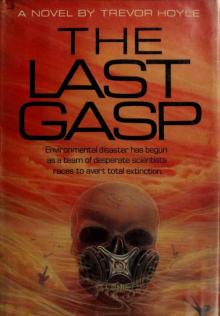
The Last Gasp, page 26


THE PRIPET RIVER NEAR CHERNOBYL RAYON HAS NEVER BEEN SO HIGH DURING 96 YEARS OF OBSERVATION.
FLOODING HAS ALSO BEEN REPORTED ALONG THE VOLGA AND YENISEI RIVERS DUE TO THE MELTING OF THE SNOWPACK. THIS IS THOUGHT TO BE RELATED TO AN EARLY START TO NAVIGATION ON THE OB AND YENISEI RIVERS FOLLOWING LAST WINTER.
‘Looks like the floods have it today,’ Janis observed. ‘Do you want some more coffee?’
‘No,’ Binch said. ‘Thanks.’ He riffled through the rest of the pile, his round face set in a pugnacious expression, as if the man in the moon were scowling.
Poland . . . serious flooding . . . river Warta 1.5 metres above danger level.
France . . . wettest spring and summer on record.
India . . . snow and hailstorms . . . 1500 people and 4000 cattle dead.
Indonesia . . . torrential rain brings floods . . . seventy people reported killed by landslides.
Egypt . . . 500,000 people threatened . . . flooding of Upper Nile Delta . . . potentially worst disaster ever.
It suddenly occurred to Binch that he was acting just as Brad Zittel had: looking for signs of catastrophe and finding them – as of course you would if you surveyed the world at large.
And it wasn’t as if any of this hadn’t been predicted. The gradual warming of the atmosphere had been known for a couple of centuries or more. Over the past hundred years it had been measured at around half a degree centigrade. All those billions of tons of carbon dioxide pouring into the atmosphere, plus the widespread use of CFCs – one molecule of which trapped 10,000 times more heat inside the ‘greenhouse’ than a molecule of CO2. If the heating went on unchecked and global temperatures rose by a further two to three degrees, as was likely, conditions would revert to what they had been millions of years ago, long before the appearance of mankind.
And this, Binch thought, looking at the reports spread before him, was just what you’d expect to find: widespread flooding. Water expanded as it heated up. With the steady reduction of the polar icecaps releasing even more water, sea-levels would rise between eight inches and four-and-a-half feet, depending on melt-rate. An average increase of eight inches didn’t sound much – until you realised that a rise of only one foot would erode the Gulf and Atlantic coastal areas, wiping out New Orleans, Atlantic City, New York and Boston. He’d seen one gloomy forecast that predicted a rise by the end of the twenty-first century of twenty-six feet . . .
If he was starting to think and act like Brad, he had good cause. It wasn’t only these reports. A month ago Jeff Henshaw’s updated climatic modelling programme for DELFI had revealed a new and disturbing trend. Based on data supplied by WIMP – the World Integrated Monitoring Programme – there was a small yet significant decrease in atmospheric oxygen, possibly within the next ten years.
At first Binch had been sceptical. After all, the predicted deficiency was only a couple of percentage points, 2.19 to be exact, well within the permitted margins of error. He’d noted the decline without becoming too alarmed by it. Computer weather modelling couldn’t handle such minor fluctuations over short time periods. He couldn’t take it seriously, and dismissed it.
Two weeks later, Jeff Henshaw was back with another set of figures. These took the projection beyond 2025. And what he’d found was nothing less than a nightmare.
Beyond 2025 the upwards curve went off the graph. In just over ten years further on – by 2036 – the oxygen content was in rapid decline, four per cent down. If that trend continued the decrease would plummet unchecked, dropping from today’s level of around twenty per cent of breathable oxygen to just over ten per cent. Which meant that in twenty years from now, or less, the oxygen content of the atmosphere would be only about half of what it was today. Clearly, as Binch now realised, this couldn’t be shrugged off as statistical error or a freak climatic anomaly. This was the best, most accurate data available; based on these reports, DELFI was predicting a significant alteration in the composition of the earth’s atmosphere.
They weren’t going to fry or drown after all; they were going to suffocate.
Binch pushed the stack of flood reports to one side. Did any of it support the prediction that the world was running out of oxygen? No; not directly at any rate. What would confirm it? That was the nub of the problem. He’d looked closely at the most recent figures on oxygen sampling, all of which had shown the oxygen content of the atmosphere to be perfectly stable. If the effect wasn’t apparent now, was it really conceivable that within ten years there would be an actual, measurable decline?
Maybe DELFI had turned into GIGO after being fed spurious information. Garbage In, Garbage Out, as the computer jocks called it. But in his heart, Binch didn’t really believe that to be the case, and for one very good reason: the change in Jeff Henshaw, from hardened cynic to a guy who walked around with a haunted look in his eye.
‘Shall I file these?’ Janis asked, gathering the press reports together. When Binch hardly glanced at her, she said, ‘Why do you keep reading this stuff, Binch? No wonder you’re so moody these days. It’s enough to depress anybody.’
‘If I didn’t bother, who would?’ Binch replied. ‘Because somebody has to, for chrissakes!’ He checked himself. Jesus, he was even starting to sound like Brad Zittel. Whatever had happened to poor Brad? Was he dead? A down-and-out bum somewhere? Drugged to the gills in a psycho ward? Well now, old chum, he cautioned himself, take damn good care you don’t go the same way. Snap out of it, man. Think positive!
Binch chuckled gruffly at this hoary piece of shopworn advice, and Janis said, ‘That’s better. Just as long as you don’t start talking to yourself.’ She gave him a stern, meaningful look over her shoulder as she went out.
3
Later in the morning Ty Nolan from the satellite photo reconnaissance section came up to see him with a stash of twenty-by-fifteen-inch glossy prints taken by the geostationary Comsat above the Pacific, then transmitted to the receiving station at Temecula near the Mount Palomar Observatory in California. After being computer-enhanced the images had been sent on here by fibre-optic transfer. The service was as regular as a milk run and Binch didn’t see every batch that came through; only now and then, when the photo recce section had a problem, which was the case today.
‘It shows up here,’ Ty Nolan said, pointing to an area south of the New Hebrides, ‘and here, southwest of the Solomon Islands.’ Ty was old-school and preferred the tactile nature of glossy prints to images on a screen. He pulled another image from the sheaf and placed his finger on the spot. ‘Also here, see, near the Ellice Islands, longitude one hundred eighty degrees. It isn’t cloud shadow or lens distortion. At least we’re pretty sure it isn’t.’
Binch held a print in either hand, peering at each in turn. ‘What am I supposed to be looking at? I don’t get it.’
Ty Nolan handed him a magnifying lens. Binch leaned closer.
‘Fuzzy dark patches. Do you see them now?’
‘Yes,’ Binch said slowly. He reached for another print and examined it through the magnifier. ‘What do you estimate their size to be?’
‘The one near the Solomon Islands is roughly twenty miles by nine. The other two are slightly smaller. Though it’s hard to be exact because the edges are blurred.’
‘They’re too big for fish shoals.’
‘Plus the fact they don’t move,’ Ty Nolan said, delving into the file and laying three more prints on the desk. ‘These were taken twenty-four hours earlier and the positions are identical.’ He pushed his hand through straggly blond hair. ‘We’ve all had a crack at it but nobody can figure out what it is. Or what they are, I should say. Then somebody suggested you.’ He grinned.
‘I’m flattered,’ Binch said drily. And none the wiser, he thought. ‘What about an infrared scan?’
‘This Comsat doesn’t have it.’
‘What’s the depth of the ocean hereabouts?’
‘Pretty shallow, less than 3000 feet. It’s the Melanesian area, bordered by the Coral Sea and the South Fiji Basin. Hell of a size, more than 4000 square miles.’
‘Any eye-sightings to confirm these?’
‘No reports so far, but then all three are some distance from land. And whatever they are, they could be below the surface and therefore not visible at sea level.’ The young research analyst perched himself on the corner of the desk, his boyish face set in a perplexed frown. ‘Any ideas, Binch?’
Binch stared at the prints scattered across the desk. Droughts. Floods. Fuzzy dark patches in the western Pacific. Were these the signs he was looking for? He was reluctant to think they might be – and almost as reluctant to believe that DELFI was wrong.
What if the human race had sown the wind and was about to reap the whirlwind? A whirlwind devoid of oxygen?
Dear God, what if DELFI was right?
4
Elaine Krantz came drowsily awake in the hot pressing darkness. For one horrific moment she thought she was suffocating.
By her side in the double bunk her husband, Jay, slept soundly, his faint snoring oddly muffled in the small airless cabin of the thirty-eight-foot fibreglass sloop Seabird II. After several weeks at sea she was accustomed to the sound and found it comforting.
Boy, it was stifling! The wind must have dropped altogether, she decided, moving her tanned legs from beneath the single sheet. There were times, even now, when she reckoned she must have been crazy to agree to the trip. Jay had called it their ‘honeymoon adventure’ – and adventure it was, all right. Tossed about in a plastic eggcup, drenched with spray, stung by wind, and baked crisp under a pitiless Pacific sun. Now that she’d endured her baptism at sea, though, she felt rather proud, and just that bit superior. Starting out by detesting the little craft, she’d come to love every inch of it, and endeavoured to keep the cabin and tiny galley as neat and shiny as if it were her first home.
From Fanning Island, almost on the equator, they had sailed to Pago Pago in the Samoan group, then Neiafu, Suva and Vila, island-hopping through the Fijis and New Hebrides. They were now on the last lap, having left Honiara three days before, with Malaita less than twenty-four hours away, given a good breeze.
Though there wasn’t a whisper of air tonight, much less a decent breeze. And that was strange, Elaine thought, cocking her head – she couldn’t even hear the familiar swish and gurgle of water against the hull.
Careful not to disturb her husband, she slipped down from the bunk and padded naked to the companionway, so sure of her bearings that she put her hand unerringly on the rope handrail in the pitch-blackness and hauled herself on deck.
The stench hit her in the stomach.
She caught her breath, gagged and screwed up her face as she fought back the nausea in her chest. In the next instant even this discomfort was forgotten as she looked around at what should have been a boundless expanse of ocean glittering in the moonlight. There was no ocean, only a solid dark unmoving mass as far as the horizon, absolutely still and silent. Seabird II was stuck in the middle of it like a fly in molasses.
Elaine yelled for her husband, filling her mouth and nostrils with the evil smell. As he stumbled onto the small square afterdeck Jay stubbed his toe and cursed; as with his wife’s reaction, the expletive died the death, smothered in silence as he took his first foul breath and saw the motionless quagmire surrounding them.
Under the purple dome of the night sky the silence and stillness were eerie.
‘It’s some kind of weed,’ Jay grunted, leaning over the stern and scooping up a soggy handful. ‘Jesus, what a smell!’
‘But where’s it come from?’ Elaine wanted to know. ‘It goes on for ever.’
Jay squatted on his haunches, sun-bleached hair silvery in the moonlight. ‘Could be dead kelp,’ he said thoughtfully, ‘just drifting along with the current. The Sargasso Sea is supposed to be like this, though I’ve never seen it.’
‘That’s in the Atlantic, isn’t it?’
‘There’s nothing marked on the charts, no banks of weed. I’d have noticed it. And they didn’t warn us about anything like this back at Honiara. Must have just . . . appeared, I guess.’
‘Isn’t there something stuck in it?’ Elaine said, peering closer. ‘Just under the surface – look-see, pale-coloured? There’s more of them. They’re everywhere!’
Jay unslung the gaff from its cradle. Swinging the 14-foot varnished pole around so that he was holding the business end with the brass hook attached to it, he leaned over the transom rail and jabbed at the scummy surface with the smooth wooden end. There was a hollow clunk. He jabbed again. This time it sounded tinny, like striking metal. A third time, the sharper sound of glass. More jabbing and probing, hitting plastic, glass, metal. Using the hook, Jay lifted out an empty two-gallon white plastic container. They could easily read the label in the moonlight. Gro-Fast Lawn Liquidiser.
Finally it dawned on them: Seabird II was in the middle of a floating garbage dump, extending mile after mile – maybe for hundreds of square miles, who knew?
. . . drinks bottles, dog food cans, milk containers, face-cream jars, tuna cans, medicine bottles, margarine tubs, salad-dressing bottles, diesel oil containers, beer cans, pickled beetroot jars, shampoo containers, ketchup bottles . . . millions, billions, maybe trillions of discarded items were embedded in a tangled mat of dead kelp, the result of squandering civilisation.
‘What are we going to do?’ Elaine asked, a slight tremor in her voice. Her old fear of the mysterious, unknown sea came back: the fear she thought had been conquered and left far behind. They were in the middle of nowhere, helpless and alone. The realisation made her shiver, in spite of the heat, and a spasm of dizziness swept over her.
‘Elaine, what is it?’ Jay was by her side, supporting her. He moved some equipment and helped her sit down.
‘A bit faint, that’s all.’ She managed a weak smile. ‘Phew! Thought I was going to pass out. There’s no air. It’s so oppressive.’ Jay too, she noticed, was panting slightly, as if he couldn’t quite catch his breath. What was happening to them? Her throat felt tight and small.
‘It’s probably the smell,’ Jay said. ‘All that rotting vegetation.’ His bare body was running with sweat. He gazed around at the solid carpet stretching away on every side. ‘We daren’t risk the engine; the propeller would be fouled in seconds. I guess there’s nothing we can do except wait until daylight. Maybe it’ll have drifted on by then.’
‘But if we’re drifting with it . . .’ Elaine said.
‘Yeah, well, nothing for it, honey, but to wait and see.’ He put his arm around her, but his skin felt clammy, like the physical manifestation of her own fear, and Elaine didn’t feel at all comforted.
Jay found a grin to cheer her. ‘Don’t worry, it’ll be okay. You’ll see.’ But when he tried to laugh it came out a hoarse choking sound, like the gasp of a dying man.
2025
1
1
It was a baking-hot Sunday morning, and still early April. The black stretch limo moved sedately along Old Dominion Drive and turned onto Hampton Hill Circle where it joined the procession of custom-built, armour-cased vehicles, none costing less than half-a-million dollars, waiting in line to enter the parking lot of the 2,600-seater church. The service of the 23rd Chapter of the Charmed Baptist Brethren in McLean, Virginia, a few miles northwest of Washington, DC, was more a political edict than social pleasure or religious obligation. Members of the Senate and Congress – both sides of the aisle – were in dutiful attendance. As were the shoals of sucker-fish that circled them, attended them, serviced and guided and fed off them: the corporate lawyers, think-tank gurus and high-pressure lobbying clans situated between 17th and 22nd on the capital’s K Street.
But today there was an added attraction, for sure.
Pastor Eldritch.
He took the service perhaps three or four times a year, which always guaranteed a full house. On selected other occasions the Pastor was available to certain elite for personal consultation and private contemplation. The man was an inspiration to the high-powered congregation, many of whom came over from Georgetown for his sermon – and to be seen there of course, by their peers, superiors and rivals.
Reclining on a red-leather divan in the back of the black limo, wafted by the cool breeze of the air-con, Chesney Lea Poulton gazed through the blue-tinted windows, carefully checking out the people alighting from their chauffeured cars. There was a sprinkling of military here today, most in civvies, though he recognised the senior echelons. Many of them had confidential contracts with him; either they received a regular stipend from the organisation he headed – AAAV: the Alliance for the Advancement of American Values – or they had roles as ‘technical advisors’ to the public face of AAAV’s media arm, BlackHawk Public Relations Operations Project, known to key Washington players as Black/PROP.
The real mystery to outsiders was where the AAAV’s multi-billion-dollar annual budget came from; that and the reason it should lavish several million in donations to the Charmed Baptist Brethren here in McLean.
Chesney Poulton leaned forward on the divan. He’d spied a new face, fresh young meat, in uniform, an aide to a high-ranker. The guy was lean and blond, with a handsome profile.
He spoke into the intercom, his breath husky in his throat. ‘Who’s the single-bar lieutenant, three o’clock? Looks to be with General Bryant.’
Inside the driver’s compartment behind the screen, the peaked cap swung to the right, broad jowls overhanging the crisp white collar and tailored uniform lapels. ‘Nossir, don’t recognise him. He’s got ribbons up.’
‘Make them out from here?’
‘One of them’s Cuba, I guess, could be. Red pennant, blue stripes.’
‘I think you’re right, Danny.’